

Why Is Komori Moving into Printed Electronics?
Komori is moving into printed electronics because traditional offset printing has hit the ceiling of a mature market, while electronics manufacturing still needs what printing presses do best: steady inking, precise registration, and thin-film control
Komori Corporation is a century-old Japanese printing equipment maker, known across commercial, publishing, and packaging print shops for its offset presses. Offset printing transfers ink from a plate to a rubber blanket before pressing it onto paper or paperboard, making it ideal for stable, high-volume commercial and packaging runs
According to the August 7, 2026 report on Komori shifting to printed electronics, Komori posted Q1 FY2027 sales of 23.1 billion yen, up 2.5% year over year, with 33.2 billion yen in orders. International markets contributed over 70% of revenue. These numbers show that Komori's core business can still fund investments while successfully charting its second curve

How Does Printed Electronics Work?
Printed electronics works by taking the inking, screen, tension, registration, and drying controls from printing presses and applying them to electronic material deposition and patterning
Printed electronics refers to using printing methods to form circuits, sensors, and antennas with conductive inks, thin films, or functional materials. The focus is on material deposition and precise registration. Komori develops this sector through Seria Corporation, covering electronic circuits, Micro LEDs, RFID, perovskite photovoltaic cells, and semiconductor interconnects
・Touch sensors: The key lies in uniform deposition of transparent conductive materials, where any defect directly causes touch inaccuracy
・RFID antennas: RFID (Radio Frequency Identification) uses antennas and chips to give physical objects readable identities, commonly seen in inventory, logistics, anti-counterfeiting, and ticketing
・Semiconductor package substrates and interconnects: The focus shifts to finer line widths, tighter registration, and strict cleanroom environments, speaking the language of electronics foundries
Is Komori Giving Up on Offset?
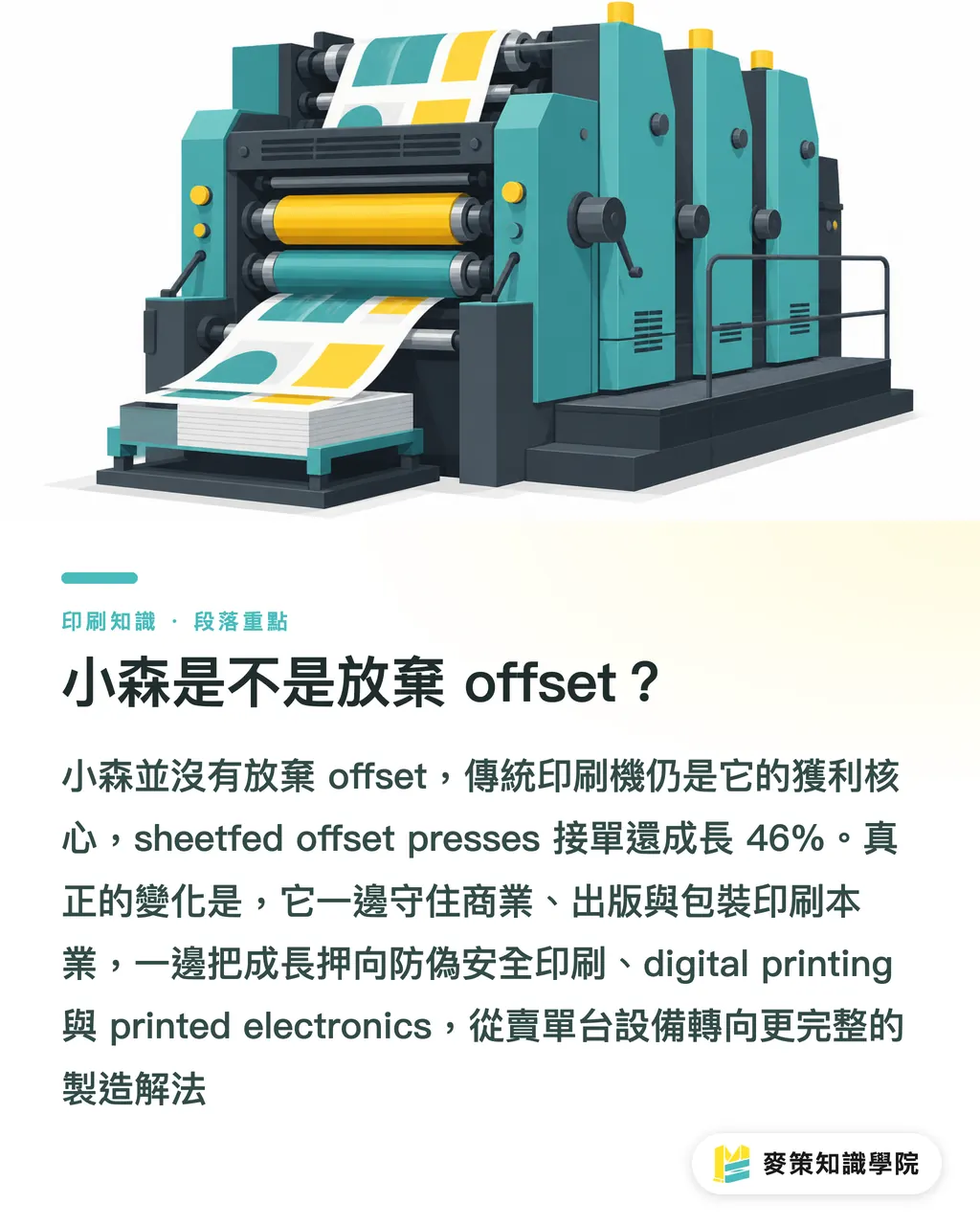
Komori is not giving up on offset. Conventional presses remain its primary profit driver, and orders for sheetfed offset presses even grew by 46%
Komori currently divides its business into four divisions. This setup reflects the pivot strategy I have seen at mature equipment makers in recent years: protect the core, and chase growth in materials, electronics, and high-security manufacturing
・Offset printing: Serving commercial, publication, and packaging print, this remains Komori's best-known core line
・Security printing: Using specialized processes, materials, and patterns to make documents harder to forge, typically for banknotes, passports, and secure documents. Komori serves over 30 countries
・Digital printing: Handling variable data, short runs, and high-mix custom jobs that are uneconomical for offset
・Printed electronics: Applying printing technology to electronic circuits, RFID, Micro LEDs, and semiconductor-related processes
When I looked at Komori's messaging for the J-throne 29 a while ago, I noticed their pitch had shifted from selling standalone presses to complete production line solutions. This four-division structure makes that direction crystal clear
What Are the Warnings for Small and Mid-Sized Print Shops in Taiwan?
The warning for Taiwanese print shops is that global commercial print market growth has slipped below 1% annually. Upgrading equipment simply out of habit based on old orders will no longer work
Komori saw slowdowns in Japan and North America, while sales grew 41% in Europe and 74% in Greater China. Demand for printing equipment is still there, but orders are migrating to shops that are more efficient and capable of handling hybrid processes. Bet on the wrong equipment, and the cost is not just a single bad quarter, but an entire depreciation cycle
ISO 12647 sets color targets for proofs and production runs, giving suppliers, designers, and clients a shared standard. Smaller shops need to lock down these fundamentals before talking about variable data, security printing, smart labels, or electronics manufacturing. Get the order of operations right
・Check existing offset lines for color consistency, delivery reliability, and post-press error sources
・If clients frequently ask for serial numbers, anti-counterfeiting, or supply chain tracking, put digital printing and security printing on your evaluation list first
・If a vendor only pitches speed and sheet counts but cannot clearly explain material compatibility, maintenance, and quality control support, do not rush into signing for that press
What Should Brand Clients Do Right Now?
What brand clients need to do now is nail down their basic print specifications before evaluating whether anti-counterfeiting, traceability, or smart packaging actually belong in their procurement plans
Do not rush
Komori's acquisition of Maruyama Chiller Corporation aims to secure cooling equipment for semiconductor processes and electronic component clients. That is still far from everyday brand print buyers, but the direction signals one clear reality: future printed products will increasingly touch materials, identification, and data flow, rather than stopping at pretty layouts
General clients should first use the Mai Strategy Three Print Checkpoints to manage what is within control
・Requirements Check: Define the purpose, quantity, deadline, and budget first. For complex substrates and brand color management, turn to MINDS; for standardized print products and online ordering, use MINDS Print
・Prepress Check: Verify bleed, resolution, color mode, and finishing placements before final output. Do not leave prepress issues to be discovered on press
・Acceptance Check: Check physical proofs for brand colors, paper texture, and finishing effects. Never replace hard proofs with verbal descriptions
That is enough

Key Takeaways
・Komori's pivot to printed electronics reminds print shops not to tie equipment investments strictly to paper volume
・Offset printing remains profitable, but the ceiling in mature markets leaves little margin for error
・Small and mid-sized shops should first stabilize color, turnaround times, and file delivery before exploring variable data, security printing, and smart packaging
・Brand clients do not need to chase electronic buzzwords. Turn every print job into verifiable specifications first
Further Thoughts
For print manufacturers, the next step is not rushing to buy printed electronics hardware, but organizing existing offset, digital printing, post-press, and quality control data to guide smart investment decisions. For designers, file handoff requires paying closer attention to materials, color reproduction, and finishing constraints. For AI and SaaS teams, the most practical entry points are quotation assistance, file preflighting, job scheduling, and customer spec management, addressing where print shops hurt most every day
Further Reading
FAQ
- Does Komori's pivot to printed electronics mean offset printing will disappear?
- No. Conventional presses remain Komori's main source of profit, with sheetfed offset orders growing 46% in Q1 FY2027. The shift simply means its growth curve is expanding into electronics manufacturing
- How does printed electronics differ from conventional printing?
- Printed electronics uses printing techniques to deposit conductive inks, thin films, or functional materials to produce circuits, sensors, RFID antennas, and semiconductor interconnects. Conventional printing primarily handles visual graphics and paper finishing
- Should small and mid-sized print shops in Taiwan invest in new equipment right now?
- Taiwanese print shops should not evaluate machinery based solely on running speeds and sheet counts. First check whether clients genuinely need short runs, variable data, anti-counterfeiting, or traceability before considering digital printing, security printing, or related processes
- Do brand clients need to adopt smart packaging right now?
- Brand clients do not need to force smart packaging just to follow trends. First clarify usage, volume, lead time, budget, color standards, and finishing acceptance criteria. If products require anti-counterfeiting, supply chain tracking, or loyalty interactions, evaluate RFID or serialized coding solutions
- Who should use the Mai Strategy Three Print Checkpoints?
- The Mai Strategy Three Print Checkpoints is designed for first-time print buyers, brands focused on color accuracy, and anyone dealing with frequent prepress rejections. It manages printing risks early through the Requirements Check, Prepress Check, and Acceptance Check
Related articles





The Print × AI weekly
The print and AI know-how designers, brands and enterprises can use before they commit — one email, every week
MINDS Free Tools
Spine width and imposition calculators — skip the manual math, free in your browser.
MINDS Group
Need actual printing or gifting services?
From premium printing to online ordering and festive gifts — the MINDS Group sister brands take it from here.