
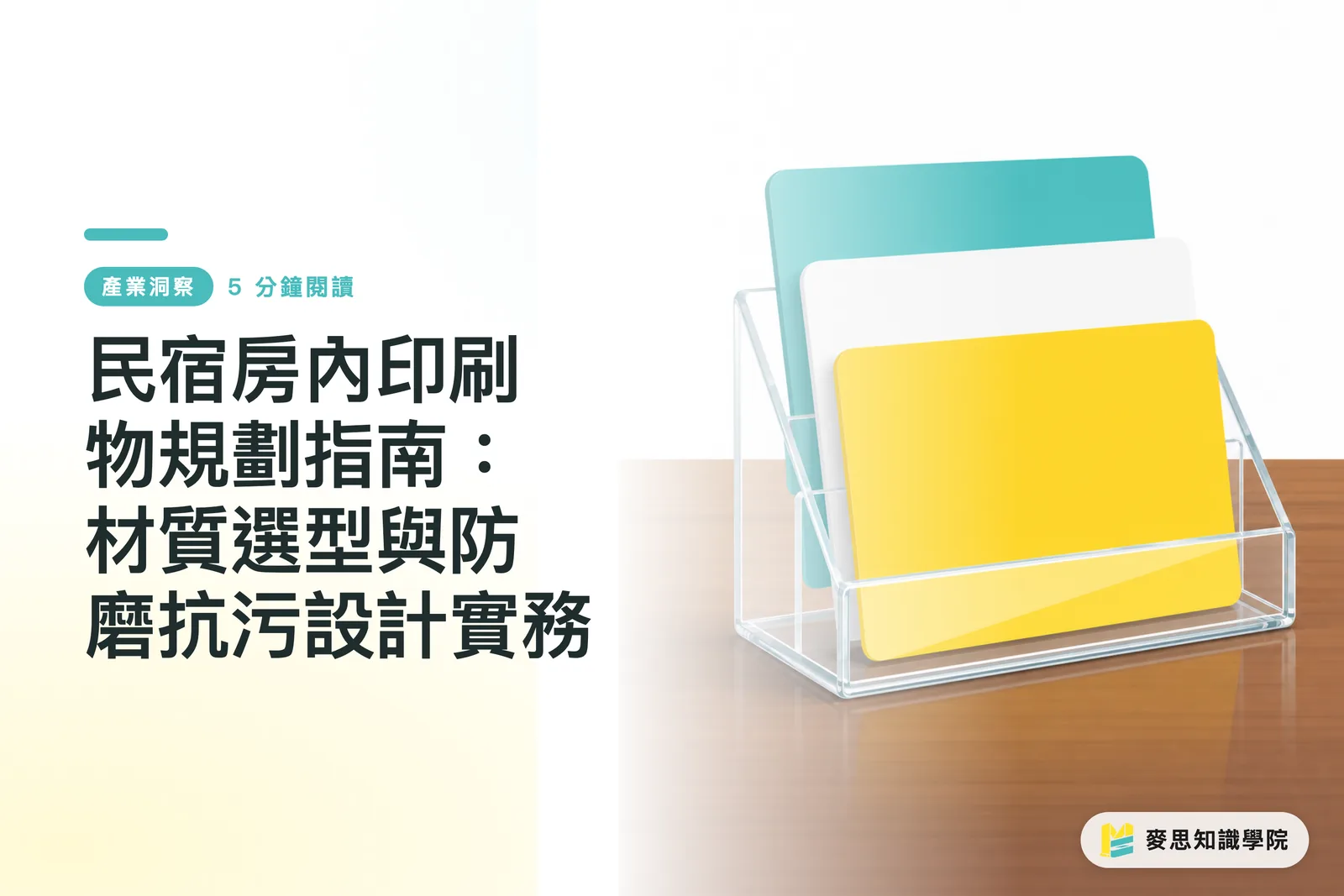
Why do housekeeping staff always complain that in-room prints are a pain to maintain?
Most maintenance headaches come from cramming information with different replacement cycles onto the same printed piece, change one detail and the whole sheet has to be reprinted
From years of hands-on work with lodging clients, the thing housekeeping staff dread most is a dense check-in notice where updating the Wi-Fi password or checkout time forces the entire full-color print to be tossed out
The real fix is building a clear structure
Borrowing the classification logic the Mai Strategy Knowledge Academy consulting team uses for commercial print planning, we can break in-room prints cleanly into three systems:
・Long-life identifiers: room numbers, emergency evacuation maps, fixed regulations. Go with 3mm acrylic or metal panels, paired with DIN A4 inserts sized to ISO 216. Service life can stretch past three years
・Modular update cards: Wi-Fi password cards, seasonal activity standees, multilingual guides. These get tweaked every quarter or every year, so they should be designed as independent cards
・Single-use consumables: breakfast vouchers, disposable coasters, luggage tags. Print these in bulk on 150g woodfree paper and you're done
Lamination: a finishing process that bonds polyester (PET) or polypropylene (BOPP) film to the paper surface using heat or pressure, giving the print waterproof and scuff-resistant protection
Once you separate dynamic info from static info, housekeeping restocking time drops by more than half, and every room's prints stay color-consistent under ISO 12647
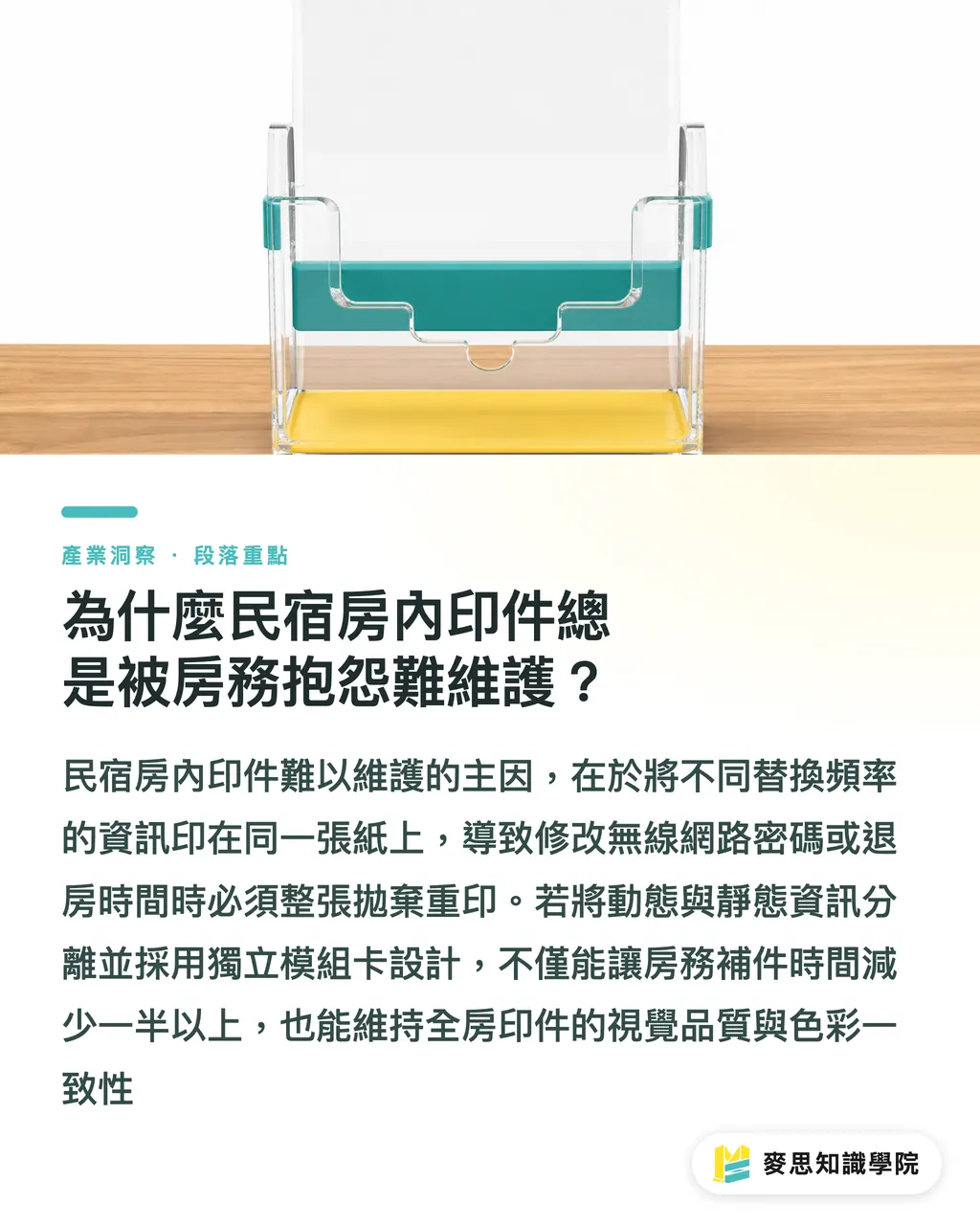
Which durable materials work best for in-room standees and info cards?
Material choice should put moisture resistance, stain resistance, and wipe-clean surfaces first. Skip fabrics and untreated papers that soak up oil and water and start warping
On the in-room tabletop, water, alcohol, and sunscreen are the three mortal enemies of any printed piece
Designers who spec out prints using only standard C2S art paper with single-sided gloss lamination will see the edges delaminate and peel within two months
On-site, three material options get weighed against each other:
・Synthetic paper (PP / PET): 100% waterproof, tear-resistant, edges won't wick moisture. A good fit for bathroom countertops and tea stations. Print colors stay saturated, but cost runs about 40% higher than traditional paper
・300g/m² C2S art paper with double-sided matte lamination: solid rigidity and basic water repellency, the coated layer keeps finger oils at bay. The best bang-for-buck option for most in-room standees and folded cards
・Acrylic standee with an embedded 150g C2S card: the outer shell is a one-time purchase, the inner card prints on FSC-certified stock. Ideal for B&Bs that change activities frequently
If you go with the C2S folded-standee option, the scoring line needs to sit at least 3mm from the trim edge, and the file must include a 0.2mm micro-perforation mark, that's what keeps the edge clean when guests tear off a breakfast voucher or breakaway card
How do you set type size and viewing distance so guests actually read it?
Type size and viewing distance should be set around how guests actually read, standing at a wall versus lying in bed calls for very different distances and sizes
A lot of designers eyeball their files at 100% on a 27-inch monitor and set the Wi-Fi password to 9pt body text, then wonder why guests can't read it in a dimly lit bedside area
It's simple
Get the distance-to-point mapping right and the rest follows:
・Tabletop standees and bedside cards: reading distance around 40cm to 60cm. Headlines should run 16pt to 20pt, body text no smaller than 10pt, line spacing at 1.5x
・Wall-mounted signs and emergency evacuation maps: standing viewing distance around 1.5 meters. Main headlines must go to 24pt or higher, and emergency contact numbers need to be bolded with enough contrast to read at distance
・Multilingual layout: Chinese and Latin typefaces carry different visual weight. English and Japanese body copy typically runs about 30% longer than Chinese, so leave at least 1.5mm of safety margin in the file
Another thing to watch: wipe-fade
If the print has an inkjet coating, add a UV-resistant varnish on top. Otherwise sunlit areas of the room will start shifting color within two weeks

How do you self-check press files before handoff to avoid misprints and layout shift?
Self-check before sending covers three lines of defense: bleed, color mode, and finishing die-line layers. Miss any of them and you're looking at white trim edges and registration drift later
That's all it takes
Designers hand files off to printers without standardized specs, and the only thing that comes back is rejected jobs and wasted revision time
We recommend running through the "MINDS (MS, mid-to-high-end fully custom commercial printing) Pre-Press Three Gates" self-check before submission: ① bleed and conversion check, set 3mm bleed, outline all text, keep images at 300dpi or higher in CMYK; ② finishing lines on separate layers, set foil stamping and scoring as 100% K spot color with Overprint enabled; ③ spec sheet cross-check, attach a guide file with paper weight and finishing dimensions to the job
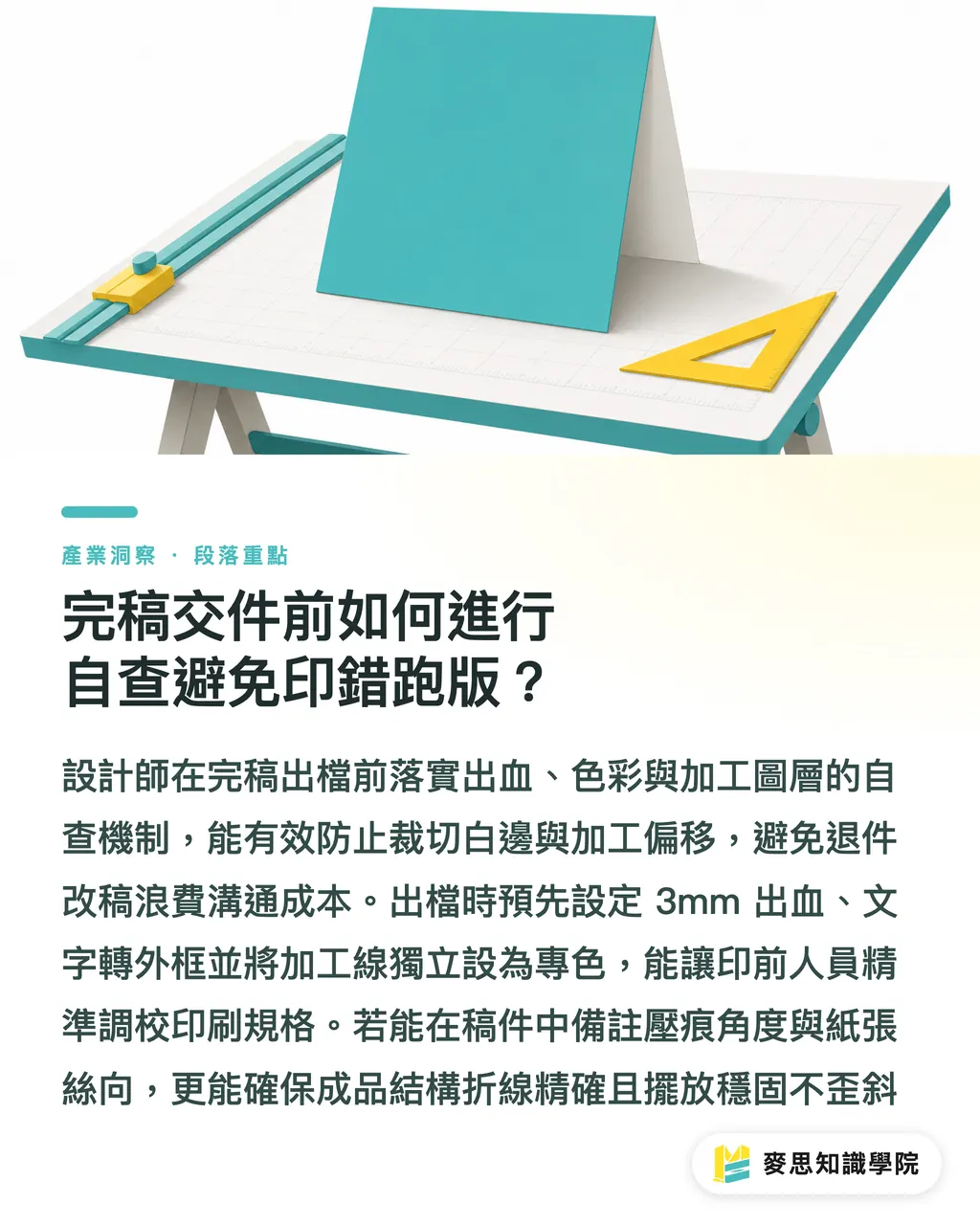
When pairing this with MINDS mid-to-high-end fully custom printing service, calling out the scoring angle and paper grain direction in the file helps prepress dial in the fold lines precisely, the finished piece sits flat and stable on the room's tabletop without leaning
Key Takeaways
・Split in-room prints into long-life, modular, and consumable tiers by replacement cycle, don't let one changed detail force a full reprint
・Bedside and tabletop body text no smaller than 10pt; wall notice headlines 24pt or higher to meet viewing distance
・300g/m² C2S art paper with double-sided matte film, or synthetic paper, both keep moisture and oils from seeping in
・Run the "MINDS (MS) Pre-Press Three Gates" self-check before handoff: confirm 3mm bleed and finishing die-lines on separate layers
・Scoring lines must sit 3mm or more from the trim edge to keep the surface film from cracking and bubbling during finishing
Further Thinking
From a print consultant's point of view, B&B in-room prints aren't just paper, they're the physical extension of the property's brand and service experience
As AI-assisted layout and on-demand printing spread, small and mid-sized lodging operators will be able to run short runs of multilingual and seasonal menus at low cost
For designers and print buyers, the real edge is folding material behavior, room humidity, housekeeping maintenance, and finishing die-lines into the design thinking at the pre-press stage. That's what actually decides how a print feels and how long it lasts
Further Reading
FAQ
- Wi-Fi cards in B&B rooms get stained easily, what's the most durable material?
- Go with 100% waterproof tear-resistant synthetic paper, or 300g/m² C2S art paper with double-sided matte lamination. Both hold up to a damp wipe and don't grab onto finger oils
- What type size should be used for in-room check-in notices and emergency contact info?
- Body text on tabletop standees and bedside cards no smaller than 10pt, headlines 16pt or above. For wall-mounted evacuation maps and notices viewed at 1.5 meters, headlines need to reach 24pt or higher
- If our B&B frequently changes breakfast times or in-room activities, how do we keep print costs down?
- Use an acrylic outer frame with an embedded paper card, or build a modular card slot. Keep long-life rules and dynamic activities on separate prints, when something changes, you only swap the small card
- What finishing details should I watch for when designing in-room folded standees?
- Scoring lines must sit at least 3mm from the trim edge. Finishing die-lines should be set as 100% K spot color on a separate layer with Overprint enabled, so the edge film doesn't crack during cutting and folding
Related articles



The Print × AI weekly
The print and AI know-how designers, brands and enterprises can use before they commit — one email, every week
MINDS Free Tools
Imposition calculator and preflight file check — free prepress tools, right in your browser.
MINDS Group
Need actual printing or gifting services?
From premium printing to online ordering and festive gifts — the MINDS Group sister brands take it from here.