
When Should Durable Printed Pieces Use Screen Printing?
If a durable printed piece needs to be printed on outdoor stickers, plastic signs, fabric, metal nameplates, acrylic, or dark-colored materials, and the priorities are opacity, adhesion, weather resistance, and abrasion resistance, screen printing usually enters MINDS Printing (MS)'s evaluation list early
Definition of screen printing: screen printing is a printing method in which ink passes through the open areas of a prepared mesh screen and is deposited directly onto the surface of the substrate. It is commonly used for plastics, metals, fabrics, stickers, and thick-ink special effects beyond ordinary paper printing
When I look at this type of job on the production floor, the first thing I ask is not about resolution. I ask how many times the piece will be touched, how long it will be exposed to sunlight, where it will be applied, and whether it will be wiped with cleaning agents. Durable printed pieces fail in very practical ways: ink loss, scratches, fading, lifting edges. Customers notice those immediately
Using MINDS Printing (MS)'s three-gate print-order evaluation makes the decision faster
・1. Usage environment: indoor display, outdoor sun exposure, vehicle exterior decals, machine panels, or washable apparel all require very different levels of durability
・2. Material surface: paper, PVC, PP, PET, acrylic, aluminum sheet, stainless steel, cotton fabric, or nylon fabric all have very different ink adhesion conditions
・3. Graphic type: large solid color blocks, white ink underlayers, single-color warning text, Logos, gradient photos, small text, and fine lines do not suit the same production process
A simple rule of thumb is this: if a design has two or more durability conditions at the same time, such as outdoor use plus a dark substrate, or a metal nameplate plus a high-friction operating surface, screen printing is worth evaluating seriously
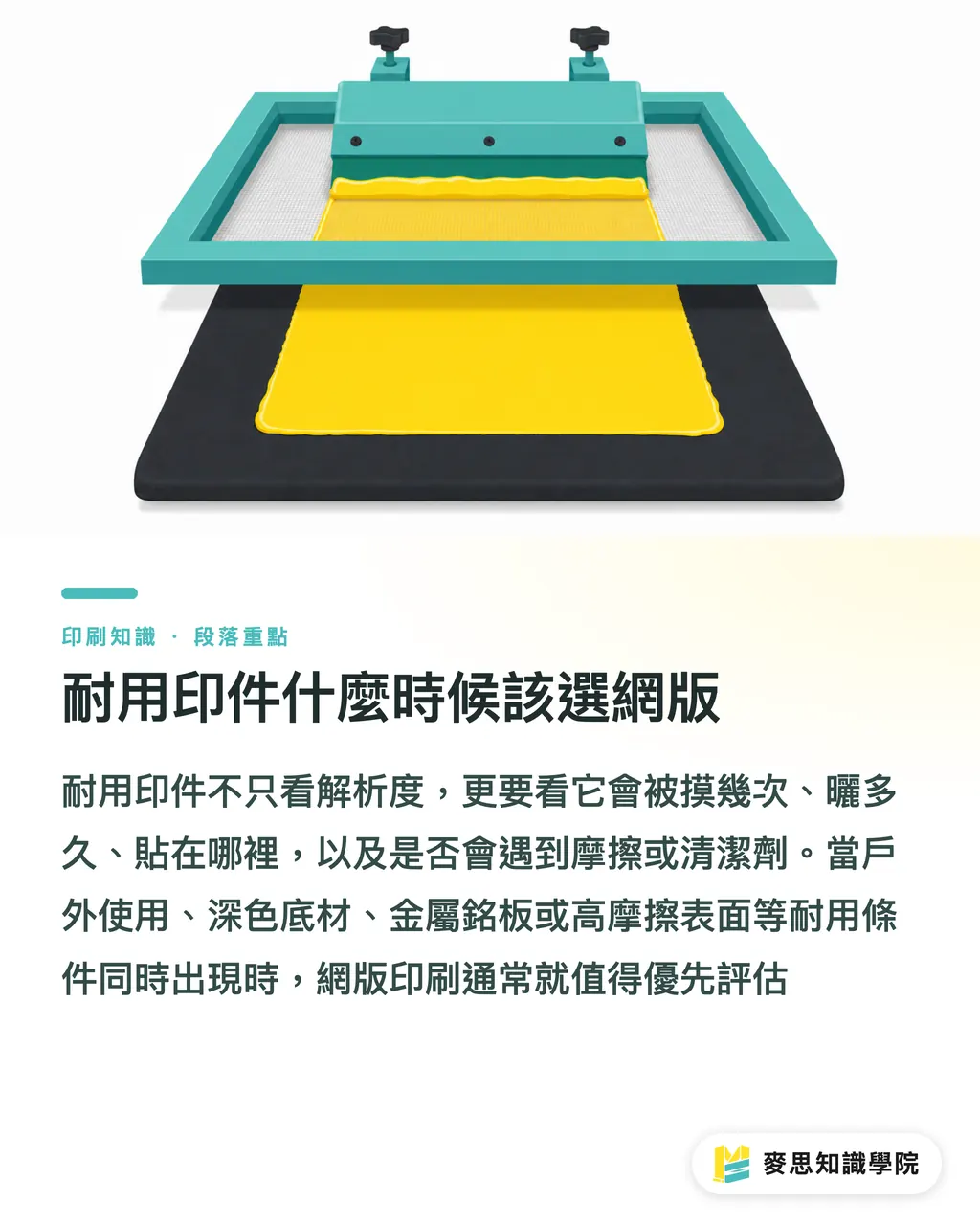
Why Outdoor Stickers, Plastic Signs, and Metal Nameplates Often Use Screen Printing
The strength of screen printing is its thick ink layer. Thick ink is not decorative language; it is the working layer of a durable printed piece. Large areas of white ink, warning colors, and light-colored text on dark substrates depend on ink with enough opacity, not on making colors brighter in the file
For five common categories of durable screen-printed pieces, this is how I evaluate them
・Outdoor stickers: the focus is waterproofing, UV resistance, and wipe resistance. Vehicle decals, equipment labels, and warning stickers all require material and lamination requirements to be confirmed first
・Plastic signs: PVC, acrylic, PP, and PET have different surface energies, so prepress treatment and ink systems must be matched. You cannot judge by thickness alone
・Fabric: T-shirts, canvas bags, and workwear often face washing and stretching. Screen printing can produce more substantial solid colors and specialty inks
・Metal nameplates: aluminum plates, stainless steel plates, and machine panels emphasize adhesion and abrasion resistance. Surface treatment often determines success or failure earlier than visual layout quality
・Special materials: transparent sheets, dark cards, wood pieces, and leather-like materials often use screen printing for white ink, gloss varnish, glow-in-the-dark ink, or thick-film effects
There is a very common scenario with metal nameplates: the customer needs one control panel that will be pressed by fingers every day, wiped with cloth, and exposed to machine oil. If a job like this uses only ordinary color output, it may look bright at delivery, but after a few months the text starts to blur, and the real problem surfaces
When MINDS Printing handles mid- to high-end fully customized commercial printing, it evaluates material, ink, surface treatment, and post-processing together. Durable printed pieces rarely have printing as the only issue. Often, one missing pre-treatment step cannot be repaired later
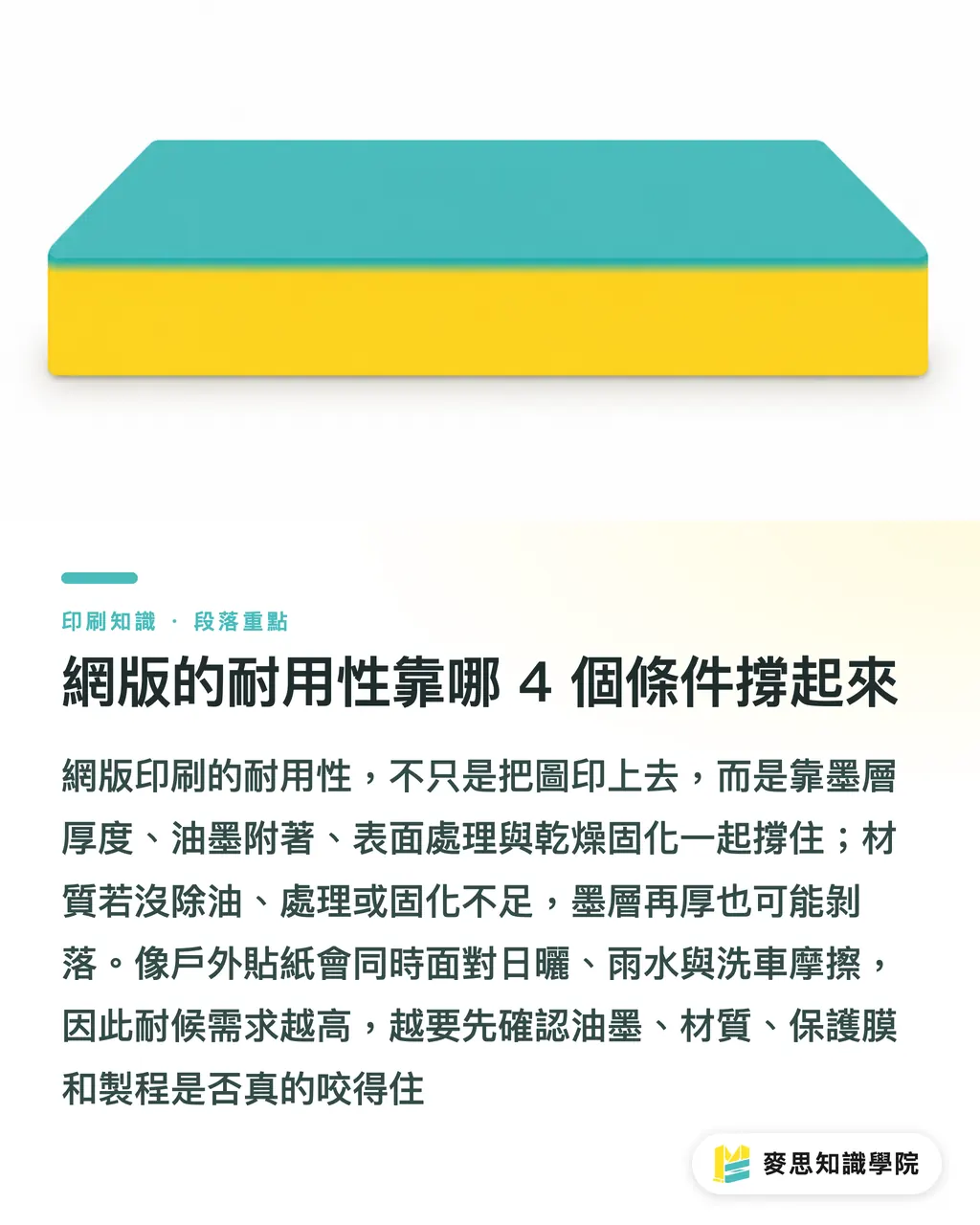
The 4 Conditions That Support Screen Printing Durability
Screen printing helps durable printed pieces last longer through four factors: ink layer thickness, ink adhesion, substrate surface treatment, and drying or curing conditions
・Ink layer thickness: thick ink gives white ink, light-colored text, and special effects better opacity, especially on dark substrates and transparent materials
・Ink adhesion: different materials need different inks. Metal, plastic, and fabric cannot be forced into the same approach
・Surface treatment: metal may need degreasing, while plastic may require corona or flame treatment. Dust and oil can directly cause the ink layer to peel
・Curing conditions: some inks dry by evaporation, while others rely on UV curing or heat treatment. Insufficient drying will reduce abrasion performance
The higher the abrasion requirement, the less you can treat screen printing as merely "printing the image onto the surface." The print shop needs to confirm whether the ink and material have bonded properly, while the designer needs to confirm whether the artwork can tolerate thick ink, registration, and edge variation
For outdoor stickers, moving an ordinary indoor sticker to vehicle exterior use introduces at least three additional variables: sunlight, rain, and car-wash friction. These three factors test the adhesive, material, ink, and protective film at the same time
For small-budget, small-run jobs, MINDS Printing is better suited to standard sizes, standard materials, and low-complexity retail printing needs. If the job involves metal nameplates, special stickers, or customized pieces with weather-resistance requirements, MINDS Printing is better suited to first evaluating the material and process
When Screen Printing Is Not the Best Choice
Screen printing has plate-making costs and registration limits. For jobs with many small-batch variants, photographic gradients, dense fine text and lines, variable data, or different content on every piece, forcing the job into screen printing may not be cost-effective
I usually ask clients to check six red flags first
・Too many variants: each color usually requires a separate screen, so 10 small-run sticker variants can make plate-making costs very noticeable
・Too many colors: multicolor registration increases both cost and error. If the artwork is close to a full-color image, inkjet or digital printing is often more intuitive
・Gradients are too fine: halftone dots and mesh limits restrict delicate gradients. Photo-like requirements should not be forced into screen printing
・Text is too small: small text, fine lines, and reversed-out text are easily affected by ink thickness and mesh count. Actual readability should be confirmed with a proof
・Lead time is too tight: plate making, test printing, drying, and inspection all take time. Rush jobs are not always suited to a full screen-printing workflow
・Short-term use only: if event stickers, temporary signage, or disposable packaging do not require abrasion or weather resistance, digital printing is usually simpler
I am especially careful with fine text, particularly white text on transparent stickers, small specification text on metal plates, and fine serif type on fabric. 6pt may look beautiful on screen, but once ink and material enter the production floor, edges do not always behave
If the requirement is 30 name labels with different names, 50 event labels, or 100 full-color gradient cards, inkjet or digital printing is usually more reasonable than screen printing. If the requirement is 500 warning stickers with the same artwork, plastic signs with a fixed Logo, or long-term machine nameplates, screen printing has a real chance to deliver the required durability
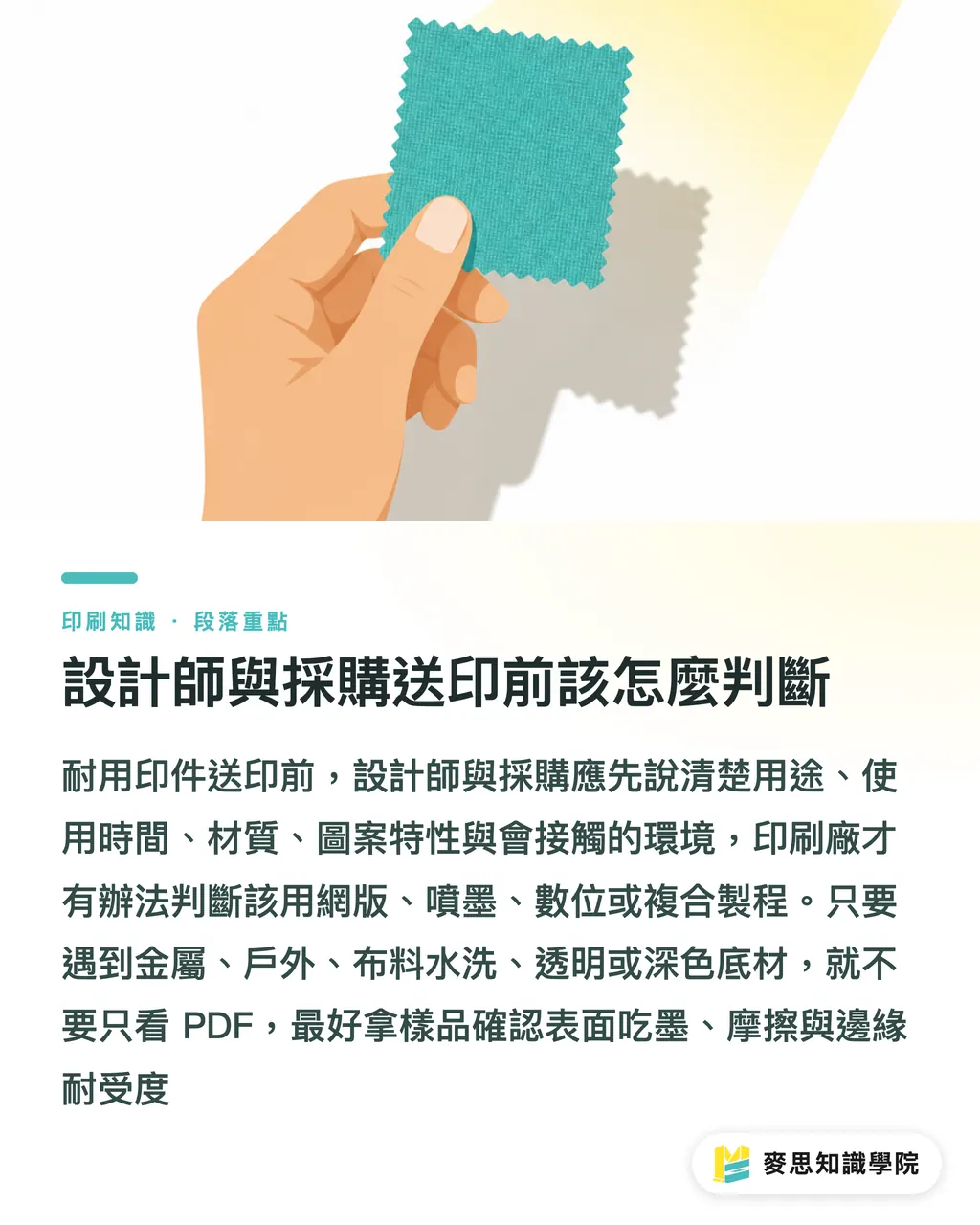
How Designers and Buyers Should Evaluate Before Sending a Job to Print
Before sending a durable printed piece to print, designers and buyers can first describe the requirement in five lines. That gives the print shop enough information to judge whether screen printing, inkjet, digital printing, or a hybrid process is reasonable
・Where it will be used: indoors, outdoors, on a vehicle exterior, on machinery, on clothing, or in a humid environment
・How long it will be used: one event, a 3-month display, signage lasting more than 1 year, or a long-term equipment nameplate
・What material it will be printed on: PVC, PET, acrylic, metal, fabric, dark paper, or transparent sheet
・What the artwork looks like: single color, large solid blocks, Logo, white ink, fine text, gradients, or photos
・What it will come into contact with: sunlight, rain, hand sweat, cleaning agents, friction, washing, or oil
For file preparation, durable screen-printed pieces should treat color as an "ink layer," not merely as screen-based color management. White ink, spot colors, partial gloss varnish, and glow-in-the-dark ink should all be marked separately. Line width and minimum type size should also be confirmed by the print shop according to the material
On the purchasing side, the question should not be simply "Will it fade?" but four more precise questions
・Does this material require surface treatment?
・Is this ink suitable for outdoor or high-friction environments?
・Is there proofing risk with small text and fine lines?
・Will the small-run plate-making cost exceed the price difference of switching to inkjet or digital printing?
My own habit is this: whenever a durable printed piece involves metal, outdoor use, washable fabric, transparent material, or a dark substrate, I hold the sample in my hand and look at the surface, not just the PDF. A PDF will not tell you how slippery that material is, whether it accepts ink, or whether the edges will fail first when wiped
Key Takeaways
・When choosing screen printing for durable printed pieces, look at the usage environment first, then the material and artwork. Do not start with unit price
・The value of screen printing lies in thick ink, adhesion, and abrasion resistance. It is best suited to large solid color blocks, white ink, special materials, and long-term-use signage
・Fine text, gradients, many small-batch variants, and variable data are the four most common limitations in screen-printing evaluation
・If substrate surface treatment is poor, even expensive ink cannot prevent the risk of ink loss
・Inkjet, digital printing, and screen printing are not ranked by prestige. Choosing the right process for the use case is what saves money
Further Thinking
For print manufacturers, inquiries for durable printed pieces should become "usage scenario forms" that first clarify environment, material, weather resistance, abrasion resistance, quantity, and artwork type. For designers, AI can help organize specifications, check file naming, and generate print notes, but it cannot replace material testing and proofing judgment. For SaaS teams, if they want to serve print procurement, the most valuable thing to build is a traceable structure for material, process, risk alerts, and proofing records, so the next similar job does not have to start from zero
FAQ
- Do outdoor stickers always need screen printing?
- Outdoor stickers do not always need screen printing. If the job involves full-color photos, many small-batch variants, or short-term events, inkjet or digital printing is often more reasonable. If it is for long-term use, fixed artwork, large solid color blocks, white ink, or a high-friction environment, screen printing is more worth evaluating
- Why is screen printing more suitable for metal nameplates?
- Metal nameplates often need abrasion resistance, wipe resistance, and long-term legibility. Screen printing can produce a thicker ink layer and can also be paired with inks and surface treatments suitable for metal. If the metal surface has oil contamination or insufficient treatment, ink loss may still occur
- Is screen printing suitable for small runs of durable printed pieces?
- Small runs of durable printed pieces depend on the artwork and material because screen printing usually involves plate-making costs. If there are only a few dozen pieces, many variants, or full-color gradient artwork, inkjet or digital printing is usually more economical. Screen printing is more suitable when the artwork is fixed and the durability requirement is high
- Can screen printing handle very small text and fine lines?
- Screen printing can print text, but small text, fine lines, and reversed-out text are affected by mesh, ink layer thickness, and material surface. Small type such as 6pt should not be judged only by its on-screen appearance. It is best to have the print shop confirm or proof it on the actual material
- What should be prepared before sending durable printed pieces to print?
- Before sending the job to print, prepare at least the usage environment, service life, substrate material, artwork type, and the friction or liquids it will contact. Also mark white ink, spot colors, gloss varnish, glow-in-the-dark ink, and similar elements separately, so the print shop can more easily judge whether screen printing, inkjet, or digital printing is appropriate
Related articles
The Print × AI weekly
The print and AI know-how designers, brands and enterprises can use before they commit — one email, every week
MINDS Free Tools
Spine width and imposition calculators — skip the manual math, free in your browser.
MINDS Group
Need actual printing or gifting services?
From premium printing to online ordering and festive gifts — the MINDS Group sister brands take it from here.