

What happened at Graphic Packaging?
Packaging Dive reported that Graphic Packaging International published its annual sustainability report on July 3, 2026, and announced the same day that its chief sustainability officer was stepping down. The timing stings: a report is the company telling the outside world where it stands, while a personnel move means the internal lines of responsibility are being redrawn
A CSO is the executive who owns ESG targets, decarbonization roadmaps, supply chain audits, and external disclosures. In practice, this role shapes material specs, procurement thresholds, supplier questionnaires, and yearly improvement KPIs
I'm not reading this as just one executive leaving. What the print and packaging supply chain should actually watch is where the audit authority moves next. Topics that used to be negotiated with the sustainability team, recyclable paperboard, FSC, inks, plastic reduction, may soon be decided jointly by procurement, legal, and finance
For small and mid-sized printers in Taiwan, this means the conversation changes. "We're committed to sustainability" used to be a decent opener; now you walk in with "why this material is compliant, what it costs, how it affects lead time, and which documents the client's audit requires."
Why does a CSO change shake up the print supply chain?
Packaging Dive's coverage notes that over the past 18 months, sustainability leaders at brands like Mondelez and Kellogg's have also seen notable turnover. The common backdrop: ESG budgets being trimmed, org restructures, and sustainability goals pivoting from outward storytelling toward compliance baselines
That shift changes the tempo on the procurement floor. A new CSO or a new governance team tends to slice multi-year decarbonization programs into KPIs visible within six months, and suppliers who've already locked in material swaps, testing, sampling, and production milestones often get asked to re-submit versions
What printers fear most isn't the bar getting higher; it's "the exam changed and nobody told you." One quarter they want a polished sustainability story; the next they want traceability proof, substantiation for recyclability claims, and a carbon boundary explanation. Those two sets of data are built completely differently
MINDS (MS) breaks sustainability options into four layers, material, process, finishing, and packing/shipping, when handling mid-to-high-end fully custom commercial print jobs. The reason is simple: once the brand-side contact changes, what survives is not a verbal promise but a spec sheet that lines up with the audit form
What three pieces of homework should small and mid printers file now?
My suggestion: start by organizing your files using the "MINDS (MS) three-gate print submission." The method is unglamorous, but it works, because it drags sustainability back from slogans to the actual print floor
・Gate 1, Materials: list sources and alternatives for paperboard, ink, coatings, lamination, adhesives, and plastic components. For each option, note the supplier name, available certifications, minimum order quantity, and any lead-time shifts
・Gate 2, Process: break prepress, sampling, printing, finishing, and packing/shipment into separate stages, so when a client asks about carbon reduction you know which stage can actually change and which is just cost-shifting
・Gate 3, Documentation: put FSC certificates, recycled paper percentages, material declarations, test reports, packaging structure diagrams, and quote variants in a single client folder, so a new CSO or new procurement contact can get a first-round response within one day
These three sets of files don't need to look like a multinational brand report from day one. If a Taiwanese small-to-mid shop can reach "ask it, find it, explain it clearly," it's already ahead of plenty of suppliers whose sustainability only lives on their website
Design studios need to do this homework too, because sustainable packaging isn't a last-minute paper swap, choices made at the design stage determine whether die-cut windows, foil stamping, film lamination, composite structures, or specialty box formats will pass audit. When client co-creation is needed, the Mai Strategy Knowledge Academy consulting team can help translate design language into spec language that procurement and compliance actually understand

Brand clients shift the goalposts, how should designers respond?
The most common situation designers run into: the client says "make it more sustainable" without clarifying whether they mean less plastic, lower carbon, recyclability, separable components, fewer finishing steps, or passing internal ESG audit. Those five things push design in completely different directions
My practice is to nail down four questions in the first round of a project. It's cheaper than revising the die-cut eight times later
・Is this sustainability ask about brand image, regulatory compliance, retail-channel listing, or supplier audit?
・Is the client's internal review contact sustainability, procurement, legal, or marketing?
・What cost increase is acceptable — 0%, 5%, 10%, or tiered quotes?
・What is the final deliverable, physical sample, material certificate, LCA-type data, or a procurement audit form?
AI and SaaS tools can help organize versions, compare questionnaires, and build material libraries, but don't outsource the judgment. Sustainable packaging ultimately lands on hand feel, structure, equipment capability, lead time, and client budget, and that still needs people on the print and design floor to call it
What is this wave of sustainability turbulence really telling us?
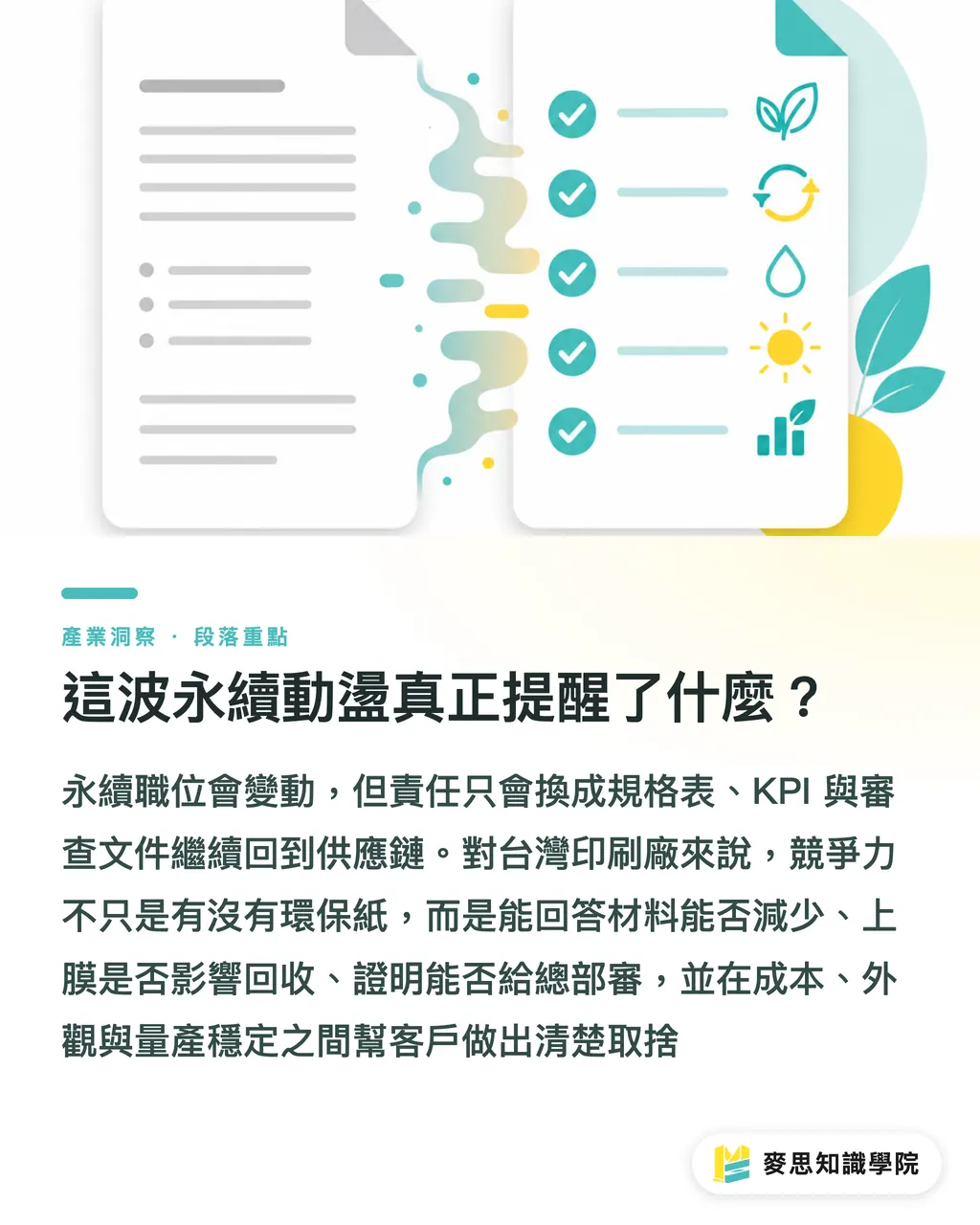
Graphic Packaging's dual signal on July 3, 2026 reminds the supply chain of one thing: the sustainability role can change hands, but sustainability responsibility doesn't go away, it just comes back under a different department, a different form, and a different KPI
Taiwanese printers shouldn't treat sustainability as a distant agenda for big multinationals. From recent brand projects, the questions are getting more specific, moving from "do you have eco-friendly paper" to "can this structure use one fewer material," "will this lamination affect recyclability," "can this certificate be sent to headquarters for review."
A truly competitive supplier isn't the one pushing the most expensive eco material every time; it's the one that can weigh cost, appearance, production stability, and audit documentation, and show the client the trade-off behind each choice
A CSO departure looks like a brand-side personnel story, but on the print floor it turns into the spec sheet for the next order, the material choice for the next sample run, and the next email asking you to resubmit documents
Key takeaways
・Sustainability is sliding back from brand story to compliance baseline. Print suppliers need to prepare documents, not just talking points
・A CSO change resets the audit criteria. A 6-month KPI can overturn the timeline of a multi-year program
・Small and mid printers should shore up the materials, process, and documentation gates first, that catches brand procurement better than empty sustainability slogans
・Designers need to clarify the sustainability goal before a project kicks off, or they'll pay the tuition in revisions and resamples
・AI and SaaS are good for organizing data. The final call on sustainable packaging still belongs to equipment, materials, and production reality
Further thinking
On the print manufacturing side, the next step is building an updatable folder of sustainable materials and processes, start with the top 20 paperboards you actually use, 5 finishing types, and 3 packing/shipping methods. On the design side, the next step is folding sustainability review questions into proposals before kickoff, so you don't discover the structure can't be recycled after the artwork is done. For AI and SaaS teams, the product that's actually useful isn't a pretty dashboard, it's one that links material certificates, quote versions, client questionnaires, and audit logs. For brand clients, the supplier worth finding right now isn't the loudest ESG talker; it's the print partner who can lay out options, costs, and risks clearly
Further reading
FAQ
- What does the Graphic Packaging news actually signal?
- Graphic Packaging released its annual sustainability report and announced its CSO's departure on the same day, July 3, 2026. It signals that brand-side sustainability governance is shifting its criteria, and suppliers need to get their materials, processes, and compliance documents audit-ready
- Why does a CSO departure affect printers?
- A CSO shapes ESG targets, supplier audits, material specs, and disclosure requirements. Once a new person takes the seat, they may reset KPIs within six months, forcing printers to re-submit versions of sustainability projects they thought were already locked in
- What should small and mid-sized printers in Taiwan do first?
- Organize three categories of files: material certificates, process records, and client audit documents. Aim to deliver a first-round response within one day when a client asks, that's far more reliable than scrambling to dig things up on the spot
- What should designers ask first when working on sustainable packaging?
- Clarify whether the sustainability goal is brand image, regulatory compliance, retail-channel listing, or supplier audit. Confirm the review contact, acceptable cost increase, and final deliverable, so you don't have to rebuild the structure after the artwork is finished
- How can AI or SaaS help with sustainable printing?
- AI and SaaS are well-suited to managing material libraries, version differences, client questionnaires, and certificate files. But whether sustainable packaging is actually producible still comes down to the printer's judgment on equipment, materials, lead time, and cost
Related articles





The Print × AI weekly
The print and AI know-how designers, brands and enterprises can use before they commit — one email, every week
MINDS Free Tools
AI background removal, a LINE sticker maker, spine & imposition calculators — all free, right in your browser, no upload.
MINDS Group
Need actual printing or gifting services?
From premium printing to online ordering and festive gifts — the MINDS Group sister brands take it from here.