
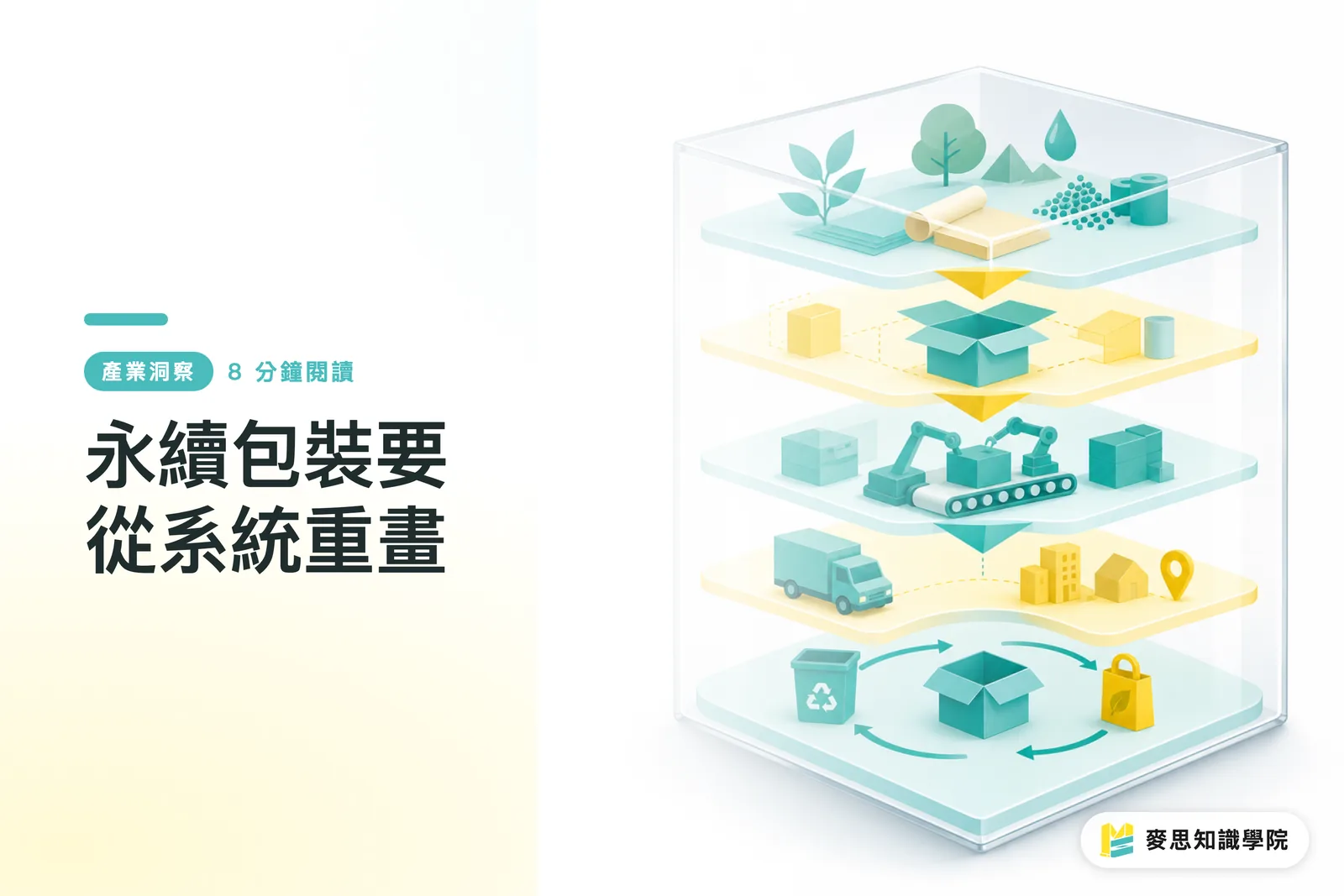
Why Does Sustainable Packaging Need to Start With the System?
The next step for sustainable packaging is to use packaging system design to lower material use, recycling risk, and logistics waste at the same time. When MINDS Printing evaluates a packaging project, I first look at size, structure, material, finishing, and shipping context before discussing which material is greener
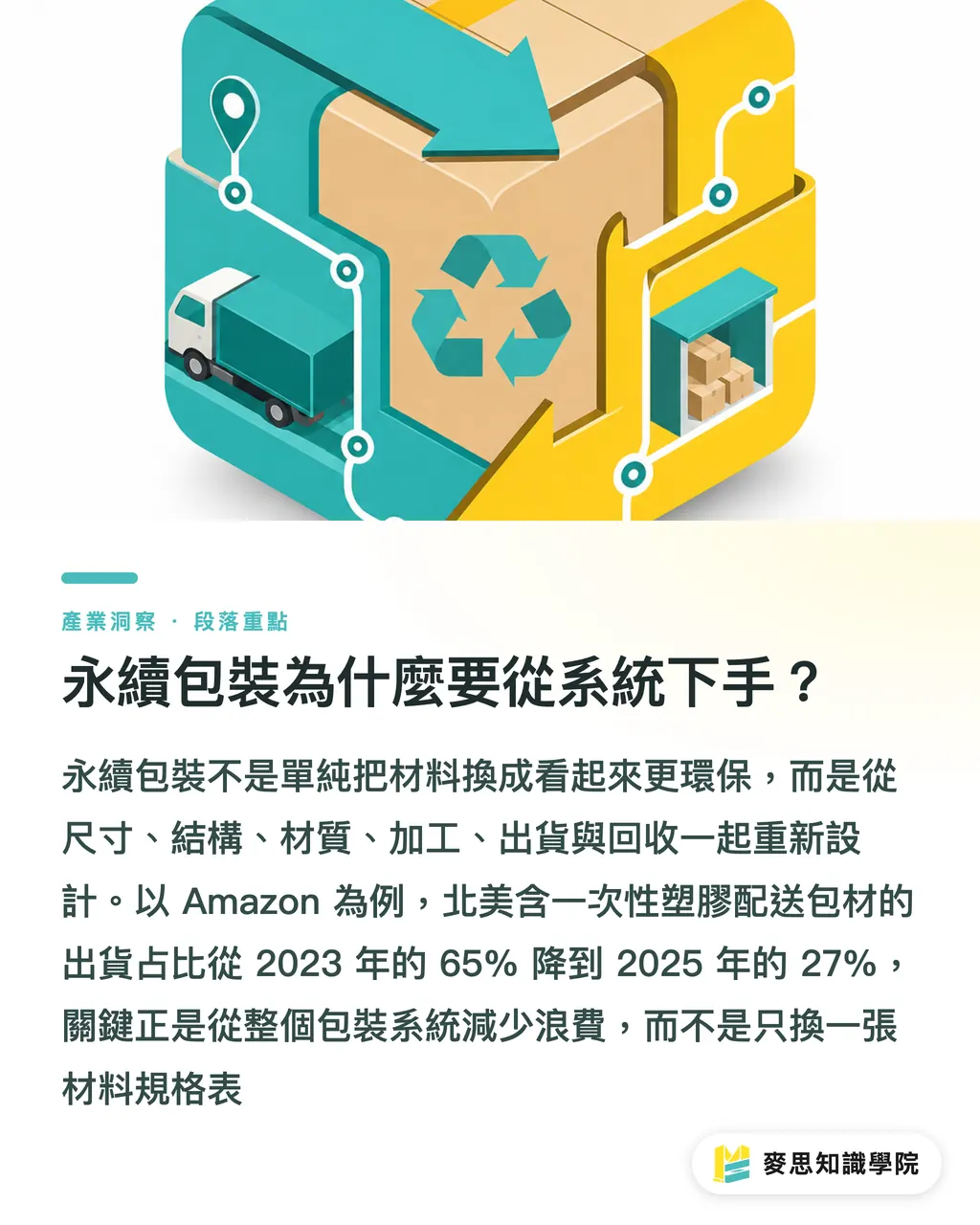
The Amazon 2025 packaging update summarized by Packaging Dive on July 17, 2026, is a useful reference point: in North America, the share of shipments containing single-use plastic delivery packaging was 65% in 2023, fell to 37% in 2024, and reached 27% in 2025. By 2025, 52% of North American fulfillment centers were shipping without plastic delivery packaging
When I work with Taiwanese brands on print projects, the mistake I see most often is treating sustainability as a material swap: PE becomes paper, composite film becomes mono-material, ink becomes water-based. The quote looks greener, but carton size, order consolidation rules, label size, and inventory turnover stay untouched. The carbon and cost saved on materials are quickly eaten up again by packaged air
It is simple. Packaging is not a single material spec sheet. It is the result of products, warehousing, logistics, consumer unboxing, and recycling systems all running together
What Does Right-Sizing Actually Change?
right-sizing: adjusting outer cartons, paper bags, or cushioning to match the product's actual size and compression needs, so less air is shipped, less tape and padding are used, and delivery volume drops
Starting in 2025, Amazon began introducing automated packaging machines in European fulfillment centers to make custom-sized boxes and paper bags, with the goal of avoiding excess material. In Japan, it reduced shipping label size by roughly half to cut adhesive and paper use. None of these moves is a material swap. They change the packaging action itself
The biggest risk in e-commerce packaging is when a "standard box" becomes the lazy box. Small products go into large cartons, cushioning fills the empty space, and the carton, tape, filler, and storage volume all grow together. In 2026, Amazon is also preparing to test a new approach to prevent items that can ship in their own product packaging from being overboxed when they are combined with items that cannot ship bare
I recommend that brand teams put the "three MINDS Printing gates before print production" into their packaging check before a new product launch, especially for products where the same SKU runs through retail stores, e-commerce, and channel warehouses
・① First, lock the SKU size band and shipping context. Single-item orders, consolidated orders, and returns need to be reviewed separately
・② Then validate structure and finishing. Die lines, fold lines, label zones, and inkjet areas need to enter sampling together
・③ Only then choose the material. Paper, mono-PP, and PCR film all need to be tested against the actual fulfillment route once
When an item expands from a retail box to an e-commerce box, asking the Mai Strategy Knowledge Academy advisory team to run a structural review before print production is usually cleaner than changing dies, adjusting labels, and adding cushioning after mass production has started
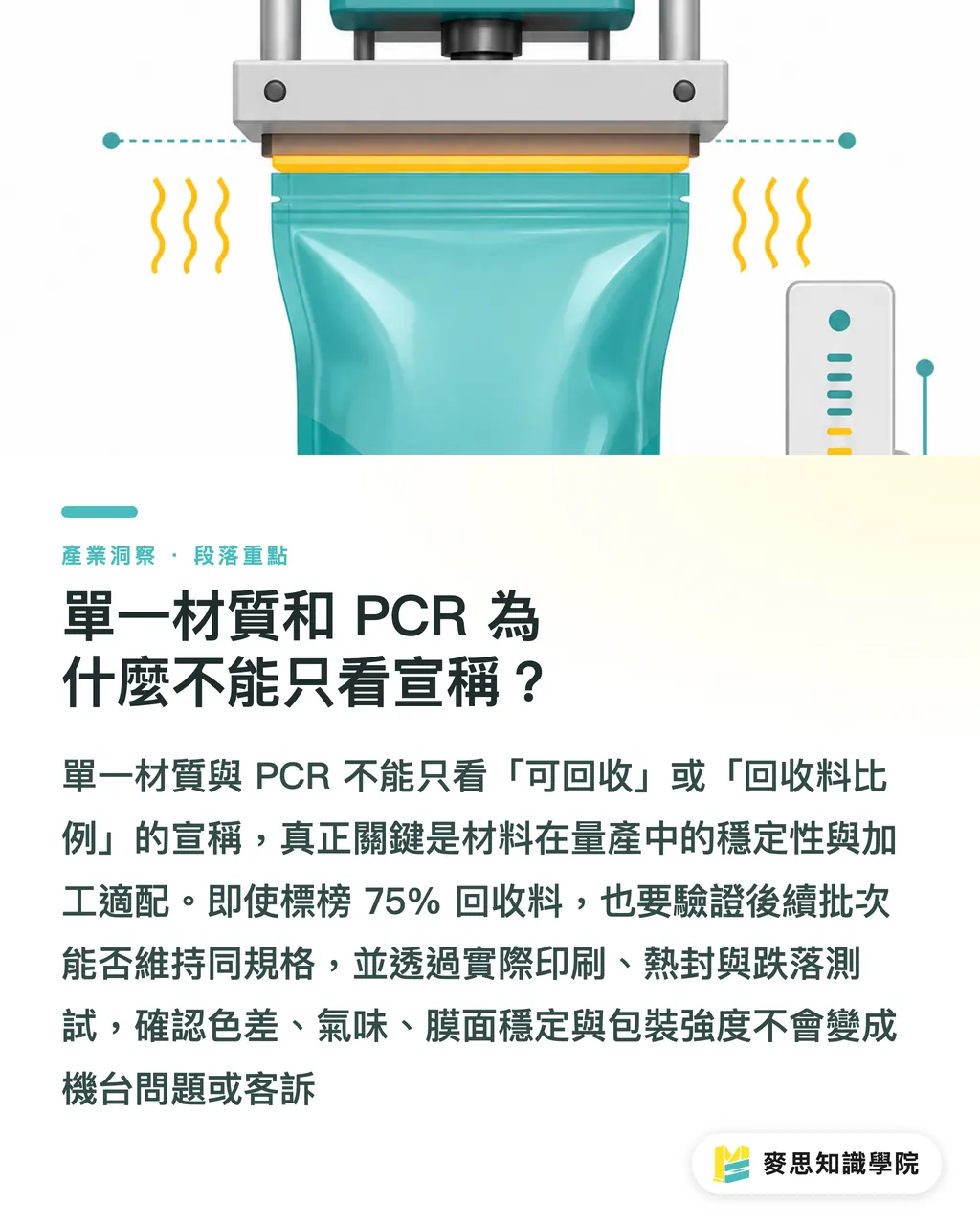
Why Can't Mono-Materials and PCR Be Judged by Claims Alone?
PCR: Post-consumer recycled content, meaning material recycled and remade after consumer use. In packaging, you need to check the source, batch stability, food-contact suitability, and processing performance
The material cases Packaging Dive covered that same day are interesting: Mondelēz, Amcor, and LyondellBasell created Marabou chocolate flexible packaging containing 75% recycled content. IPG launched cushion film with at least 50% recycled content. Duni Group changed its Duniform foodservice packaging to pure PP mono-material. These cases all look like material stories, but each one affects the processing window
The upside of mono-PP is a clearer recycling path. The trouble shows up in heat-seal temperature, stiffness, clarity, barrier performance, ink adhesion, and bag-making speed. The upside of PCR is lower dependence on virgin material. The trouble shows up in batch-to-batch color variation, odor, film surface stability, and brand color control. These issues do not appear in slide decks. They appear on printing presses, laminators, bag-making machines, and customer complaint forms
I ask brand clients to change material claims into material validation, instead of only asking, "Can this be recycled?" At minimum, do three things
・Run actual print colors on the sample sheets. White ink, full-coverage dark colors, and metallic colors expose film surface differences most easily
・Run heat-seal and drop tests on the packaging. Food, refill packs, liquids, and powders cannot be judged by appearance alone
・Procurement needs to confirm whether the recycled content ratio can be supplied consistently. 75% recycled content looks great, but whether the second and third batches can arrive to the same spec is the real production question
Which Brands Are Reusable Glass Bottles Right For?
Waiākea launched a thick-walled reusable glass bottle containing 40% recycled glass, with a goal of reaching 100% recycled glass within 5 years. This case reminds me of one thing: with reusable packaging, the calculation is about collection, washing, breakage, turnover, and secondary delivery, not how premium the bottle looks on its own
Glass bottles fit brands with fixed return scenarios, such as high-priced beverages, foodservice channels, membership delivery, and corporate reusable cup or bottle programs. Glass bottles do not fit every brand. For items with a large shipping radius, low return rates, and high breakage costs, thick-walled glass can easily increase transport weight
Printing and design teams need to get involved early in circular glass bottle design. Label adhesive has to account for washing. Printing inks need water and abrasion resistance. Bottle visuals need to account for scratches and shelf presence after repeated use. I have seen too many beautiful samples that reveal, as soon as they enter the washing line, that reverse logistics was never designed in
Do not rush
If a brand wants to build reusable packaging, the first version should not chase maximum production volume. Start with 1 channel, 1 city, and 1 bottle type to test return rate and loss. After 3 months of real turnover data, then decide whether the bottle shape, label, and printing method should scale
How Should Small and Midsize Taiwanese Printers Respond?
Amazon's global packaging mix in 2025 is still led by flexible packaging at 51%, corrugated boxes at 38%, and ships in product packaging at 11%. This ratio is worth studying for small and midsize Taiwanese printers: flexible packaging has not exited, and cartons have not disappeared. What is really being phased out is the supplier model that can only answer, "We have this material."
For Taiwanese printers to win sustainable packaging work, quotes need to move from material unit price toward system cost. At minimum, outer cartons, liners, labels, tape, fillers, damage rate, return packaging, and MOQ should all be part of the discussion. Brand clients also need to accept one thing: the savings in sustainable packaging are not always in the unit material. They are often hidden in one less outer carton, one less revision, and one less batch of unusable inventory
I suggest small and midsize printers start with 4 actions. There is no need to buy a full set of new equipment all at once
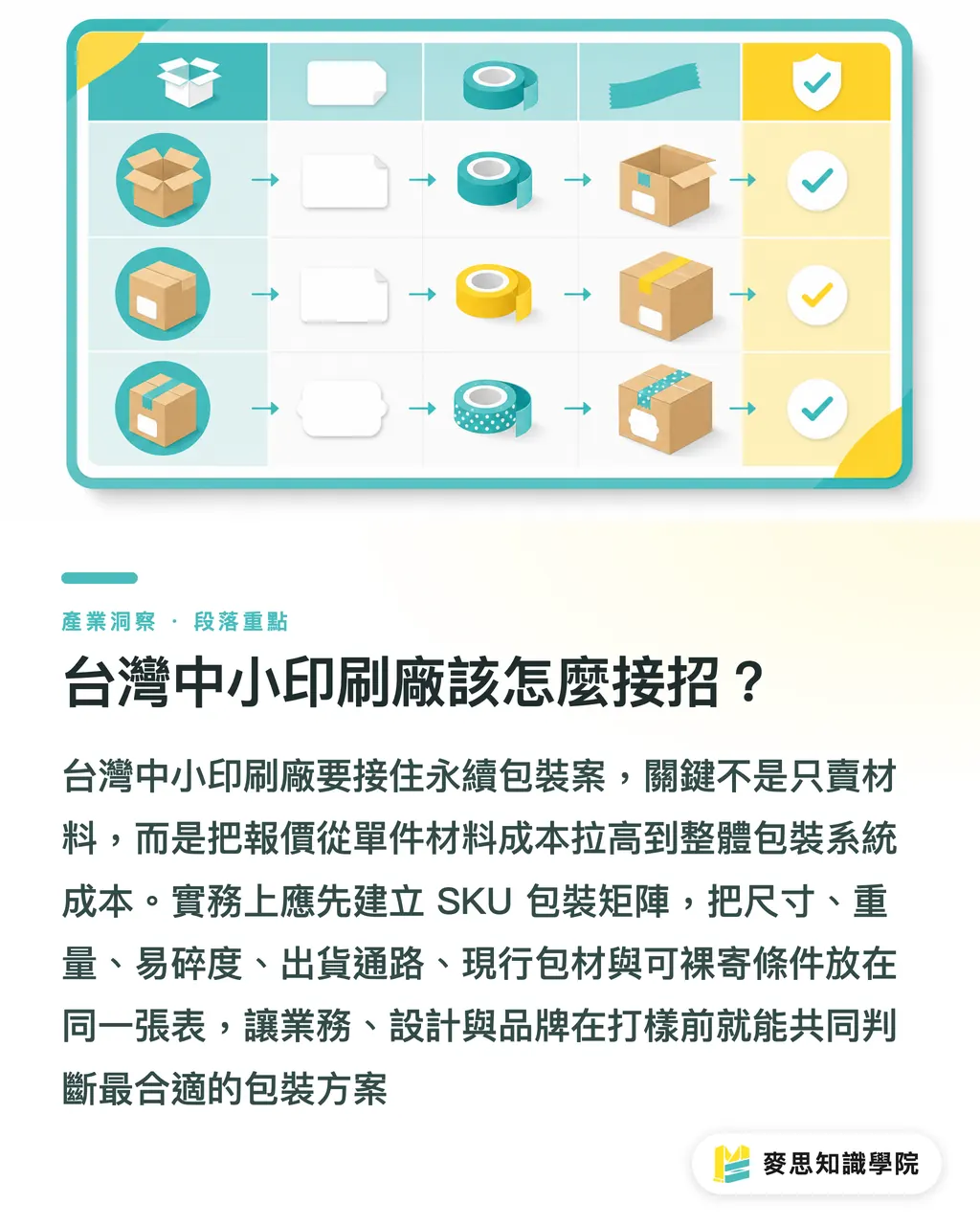
・Build a SKU packaging matrix that puts size, weight, fragility, shipping channel, bare-shipping eligibility, and current packaging materials in one table
・Change "recyclable" into "locally processable." For mono-materials, PCR, paperization, and reusable glass, ask whether the recycling side and washing side will actually accept them
・For sample development, do not stop at visual proofs. Run heat-seal, abrasion, drop, labeling, inkjet, packing, and unpacking tests
・AI and SaaS can start with rule organization: turn SKU sizes, material limits, complaint records, and shipping contexts into box-selection and pre-print checklists, so sales teams are no longer quoting from memory every time
For teams like MINDS Printing that handle mid- to high-end customized commercial printing, the next stage of value will sit closer to packaging co-development. Designers provide the visuals, brands provide the channels, and printers provide the processing boundaries. Having all three sides sit down before sampling is far more practical than trading rejections after mass production
Key Takeaways
・Sustainable packaging starts with the system. The material name is only one cell in the table
・right-sizing removes air, fillers, tape, and storage volume
・Mono-materials make recycling easier to explain. The production challenges are heat sealing, barrier performance, stiffness, and print stability
・The higher the PCR ratio, the more you need to verify batch stability, color variation, odor, and supply capacity
・The opportunity for small and midsize Taiwanese printers is to upgrade the quote into a packaging decision table
Further Thinking
For print manufacturing, sustainable packaging needs to move from "material supply" to "packaging engineering." For designers, layout aesthetics need to meet die lines, label zones, and logistics labels earlier. For AI and SaaS practitioners, the most practical entry point is not writing one eco-friendly line of copy for someone. It is turning SKUs, dimensions, material limits, fulfillment rules, and complaint records into a traceable decision process. For brand clients, before the next packaging change, take 10 main SKUs and run a right-sizing and material compatibility review. In most cases, the first batch of savings in outer cartons, fillers, and rework costs will already be visible
Further Reading
FAQ
- What is the next step for sustainable packaging?
- The next step for sustainable packaging is to redesign the packaging system, reviewing outer carton size, flexible packaging, labels, recycled content, shipping rules, and recycling-side capacity together. The problem cannot be solved by swapping in one different material
- How does right-sizing affect packaging printing?
- right-sizing changes carton die lines, paper bag sizes, label zones, inkjet areas, and cushioning needs. Printers need to confirm SKU dimensions, shipping context, and processing limits before sampling
- Is mono-material packaging always better?
- Mono-material packaging usually makes the recycling path clearer, but before mass production, heat sealing, barrier performance, stiffness, print adhesion, and bag-making speed all need to be tested. Mono-PP foodservice packaging is a typical example of this tradeoff
- What should buyers watch for when procuring PCR recycled-content packaging?
- PCR packaging needs to be checked for recycled content ratio, source stability, batch-to-batch color variation, odor, film surface performance, and regulatory suitability. Flexible packaging with 75% recycled content is a useful reference case, but mass production still depends on whether the second and third batches can be delivered consistently
- What is the first step small and midsize Taiwanese printers can take now?
- Small and midsize Taiwanese printers can start by building a SKU packaging matrix that organizes size, weight, fragility, shipping channel, current packaging materials, and bare-shipping eligibility, then use that table to discuss the feasibility of right-sizing, mono-materials, and PCR with brand clients
Related articles

The Print × AI weekly
The print and AI know-how designers, brands and enterprises can use before they commit — one email, every week
MINDS Free Tools
AI background removal, a LINE sticker maker, spine & imposition calculators — all free, right in your browser, no upload.
MINDS Group
Need actual printing or gifting services?
From premium printing to online ordering and festive gifts — the MINDS Group sister brands take it from here.