
Why Buying Carbon Offsets Is Suddenly Losing Its Appeal
The clearest shift over the past year is that brand clients are moving their ESG reporting from 'how much we offset' to 'how much we actually removed.' The key difference lies here: carbon offsets (carbon avoidance) fund projects that prevent emissions that would have otherwise occurred, such as afforestation or renewable power plants. Carbon removal directly extracts CO₂ from the atmosphere or sequesters it long-term, through methods like biochar, carbon capture and storage (CCS), or ocean alkalinization
Integrity standards in the international voluntary carbon market, such as IC-VCM's Core Carbon Principles, have explicitly categorized avoidance credits and removal credits since 2023. The latter demands far stricter audit rigor, permanence, and quantification methods. For brands, this means relying on offsets in ESG disclosures carries shrinking credibility. Coverage from WhatTheyThink highlights this shift, showing how corporate buyers are rewriting their carbon credit playbooks
The direct impact on print procurement is immediate. In the past, receiving a certificate stating 'this print run is carbon neutral' often meant it was backed by afforestation offsets underneath. Over the coming years, corporate accounting departments and Chief Sustainability Officers will start asking tough questions about the exact type of offset backing those certificates
In Print Carbon Claims, What Is the Real Difference Between Avoidance and Removal?
Most carbon neutrality claims in the printing industry today rely on paper mills or printers purchasing avoidance credits to offset their Scope 1 + 2 + 3 emissions across their books (defined by the GHG Protocol as three organizational boundary categories:
・Category 1,
・Category 2, and Category 3). This is fine in practice and fully compliant under the ISO 14068-1 carbon neutrality framework
The issue lies in the interpretation of permanence and additionality. Avoidance certificates operate on the logic of 'without my money, this project would not have happened.' Removal credits emphasize that 'this ton of CO₂ was actually extracted from the atmosphere and will not return.' Once a brand checks the box on whether they use removal credits in their Sustainability Report or CDP questionnaire, that answer decides whether your print carbon certificate counts
Based on my experience helping clients audit supplier credentials over recent months, carbon neutrality declarations from Taiwanese print vendors are almost entirely avoidance-based. Verified removal projects simply do not exist in the print market yet. This is not about right or wrong, but market economics: typical print jobs in Taiwan generate between tens to several hundred kilograms of CO₂e (kilograms of carbon dioxide equivalent, converting all greenhouse gas impacts into a single metric). Buying a removal credit scaled for thousands of tonnes to offset a small job makes zero financial sense
What Actions Should Procurement Teams Take Now?
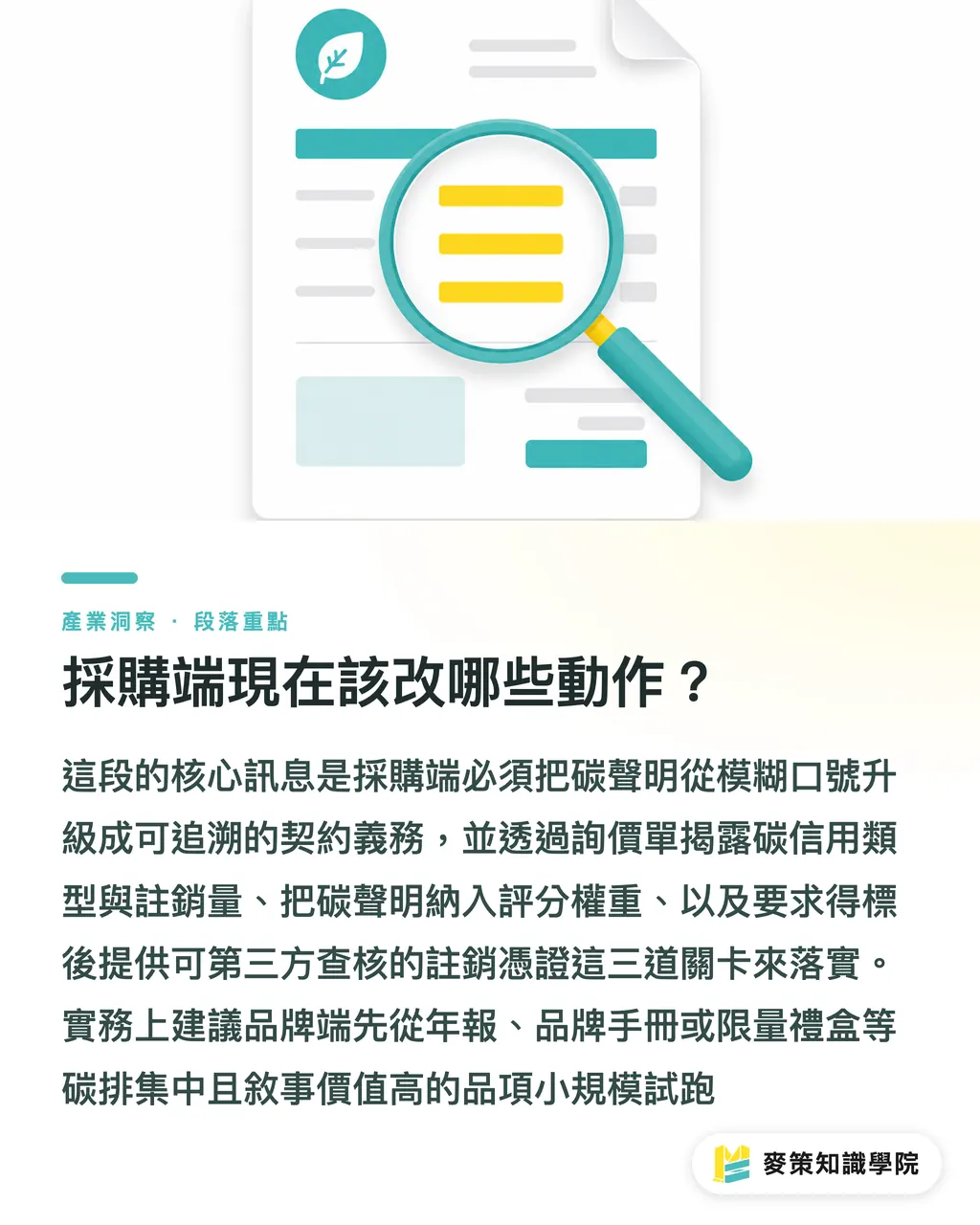
RFQ forms need a rewrite. This is the biggest obstacle I run into while visiting suppliers with clients. I recommend that ESG and print procurement leads at brand companies use a three-tier checkpoint to incorporate carbon claims into vendor evaluation:
1. Require suppliers to disclose offset types: Add a dedicated field to RFQ (Request for Quotation) templates specifying 'carbon credit type used in quote (avoidance / removal / hybrid)', 'verifying body', and 'estimated retirement volume (tonnes CO₂e)' 2. Factor carbon claims into scoring: Place carbon declarations alongside price, ISO 9001/14001 certifications, and FSC (Forest Stewardship Council) or PEFC (Programme for the Endorsement of Forest Certification) paper credentials, assigning a weight of 10-20% 3. Contractually require disclosure and retirement certificates: Mandate that winning vendors submit credit serial numbers and retirement certificates that third-party auditors can verify for ESG reporting
This workflow is not meant to force printers into a sudden transformation. It upgrades carbon claims from a marketing slogan into a traceable contractual obligation. If you want to pilot this on a small scale, start with high-impact items like annual reports, brand manuals, and limited-edition gift boxes where carbon footprint is concentrated and brand story value is high
Will Small and Mid-Sized Printers Be Hit by the New Rules?
Yes, and it is happening right now. Based on projects I've worked on over the past two months, compliance demands from brand clients are rising. However, throwing money at removal credits is not the right move for small and mid-sized printers, as that path makes no financial sense for orders generating only a few hundred kilograms of carbon. A far more practical strategy operates across three tiers:
・Material level: Prioritize FSC-certified paper, local recycled paper, and soy-based inks. This tier delivers the highest carbon reduction per dollar spent
・Process level: Conduct carbon accounting (ISO 14064-1 is the international standard for organizational greenhouse gas inventories) and lay out the numbers. Clients trust transparent data far more than a purchased offset certificate
・Communication level: Explain how you reduce emissions, how much was cut, and what was offset in clear, plain language inside delivery documentation. This builds brand trust far better than buying credentials
MINDS has already integrated this three-tier carbon reduction path into its quoting workflow for mid-to-high-end bespoke commercial printing. Brand clients interested in this breakdown can request to see this documentation during RFQ
What Concrete Changes Will Procurement Teams See Over the Next Two Years?
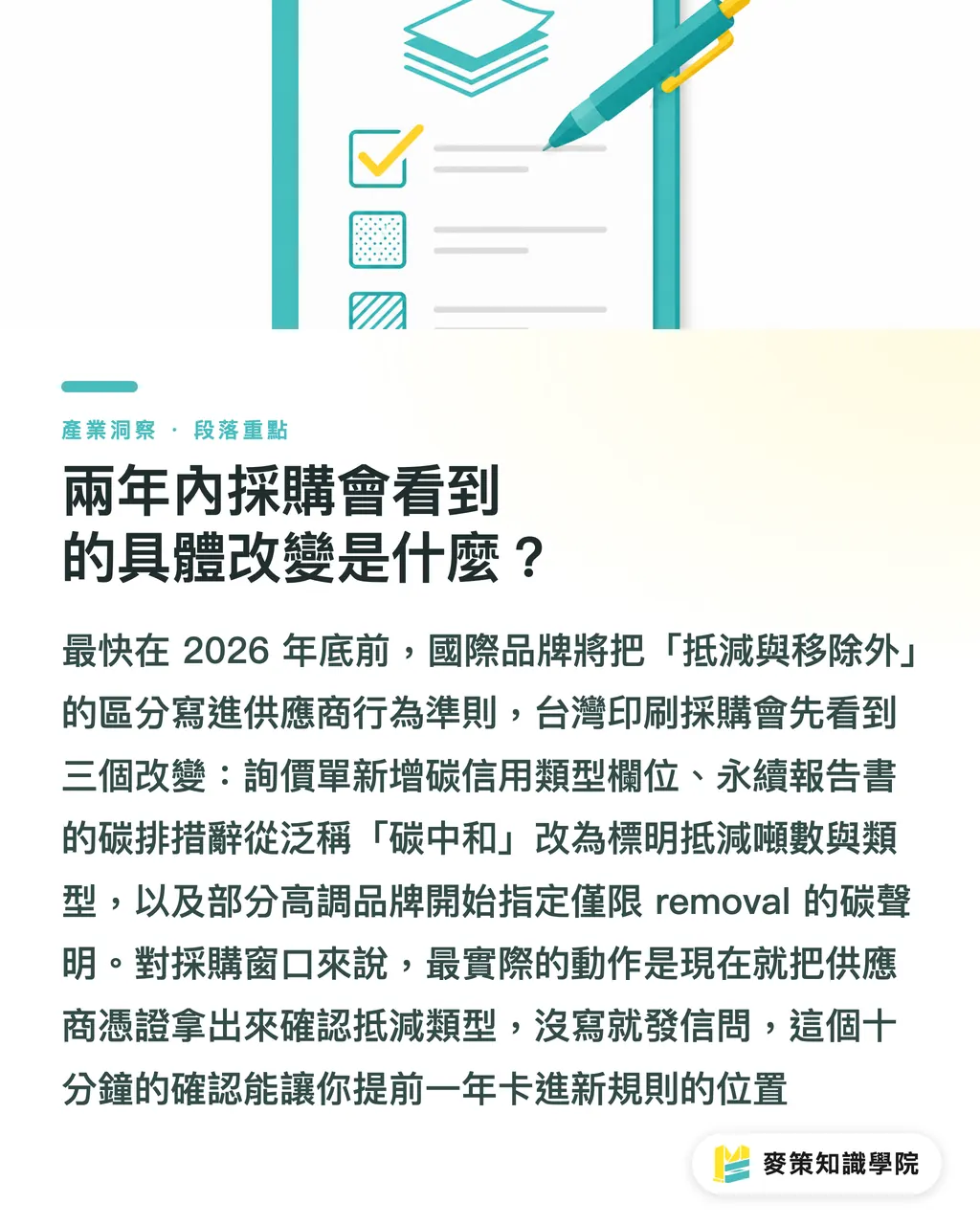
The next clear inflection point will arrive when brands incorporate 'avoidance vs. removal' into annual supplier audits. Based on my meetings with several global brand clients, this requirement will appear in updated Supplier Code of Conduct clauses by late 2026 at the earliest
For print procurement in Taiwan, I expect concrete shifts in three key areas:
・Adding a 'Carbon Credit Type' field to RFQs, piloting first on annual reports and limited-edition packaging
・Rewriting print carbon emission sections in sustainability reports from 'carbon neutral' to 'offset XX tonnes CO₂e (avoidance category)' for more precise phrasing
・High-profile brands specifying 'removal-only' carbon claims for gift sets and event materials, driving a small volume of high-unit-cost removal credit purchases
Procurement managers only need to do one thing right now: pull out current supplier certificates, check the offset type, and email the vendor if it is unspecified. This takes ten minutes, but puts you a year ahead of the curve
Key Takeaways
・The shift from carbon offsets to carbon removal stems from tightening standards across voluntary carbon markets and corporate ESG reporting
・Avoidance emissions and actual removal must be evaluated separately on print certificates, with permanence and additionality marking the dividing line
・Rewriting RFQs with a three-step checkpoint (disclose credit type + score carbon claims + mandate retirement certificates) is the most practical move for procurement today
・Small and mid-sized printers should adapt across three tiers (materials, process, communication), which is far more cost-effective than buying removal credits
・Updated Supplier Codes of Conduct will add 'avoidance vs. removal' to audit checklists within two years, making early preparation standard practice
Deeper Takeaways
The deeper signal for the printing industry is that carbon claims are evolving from marketing copy into accounting line items. Once treated as line items, every offset must be auditable, retirable, and verifiable by third parties, driving carbon data transparency across the supply chain. For the MINDS team and prospective clients, the key takeaway is clear: the real value of AI and SaaS tools at this turning point is no longer just calculating footprint numbers, but translating diverse carbon claims across the supply chain into a unified accounting language that connects brand ESG reports directly with printer production data. Competition in next-generation procurement systems will center on certificate verification and retirement tracking
Further Reading
FAQ
- What is the fastest way for print procurement to distinguish carbon avoidance from carbon removal?
- Ask suppliers to state the certificate type directly on quotes. Avoidance projects primarily involve afforestation or renewable energy. Removal projects extract CO₂ from the atmosphere using CCS, biochar, or ocean alkalinization. The latter carries far higher verification intensity and permanence requirements
- Are print carbon neutrality certificates still useful?
- Yes, but brand ESG reports will start pressing for details on which category they fall under. Procurement should contractually require credit serial numbers and retirement certificates so auditable proof is ready when audits happen
- Do small and mid-sized Taiwanese printers have to buy carbon removal credits?
- No. For orders emitting only a few hundred kilograms of CO₂e, purchasing removal credits with minimum thresholds of thousands of tonnes is cost-prohibitive per unit. The practical approach is to cut carbon across materials, process, and communication first, and consider avoidance offsets only if clients explicitly request them
- Which new fields should be added to RFQs to align with the new rules?
- Add at least three fields: carbon credit type used (avoidance / removal / hybrid), verifying body name, and estimated retirement volume (tonnes CO₂e). After awarding the contract, require a retirement certificate as a mandatory delivery attachment
- Which verifying bodies for carbon removal can be trusted?
- Established organizations include Verra (VCS standard), Puro.earth (specializing in carbon removal), and Gold Standard. When requesting certificates, procurement teams simply need to check for retirement certificates issued by these bodies without building in-house verification capabilities
Related articles



The Print × AI weekly
The print and AI know-how designers, brands and enterprises can use before they commit — one email, every week
MINDS Free Tools
AI background removal, a LINE sticker maker, spine & imposition calculators — all free, right in your browser, no upload.
MINDS Group
Need actual printing or gifting services?
From premium printing to online ordering and festive gifts — the MINDS Group sister brands take it from here.