
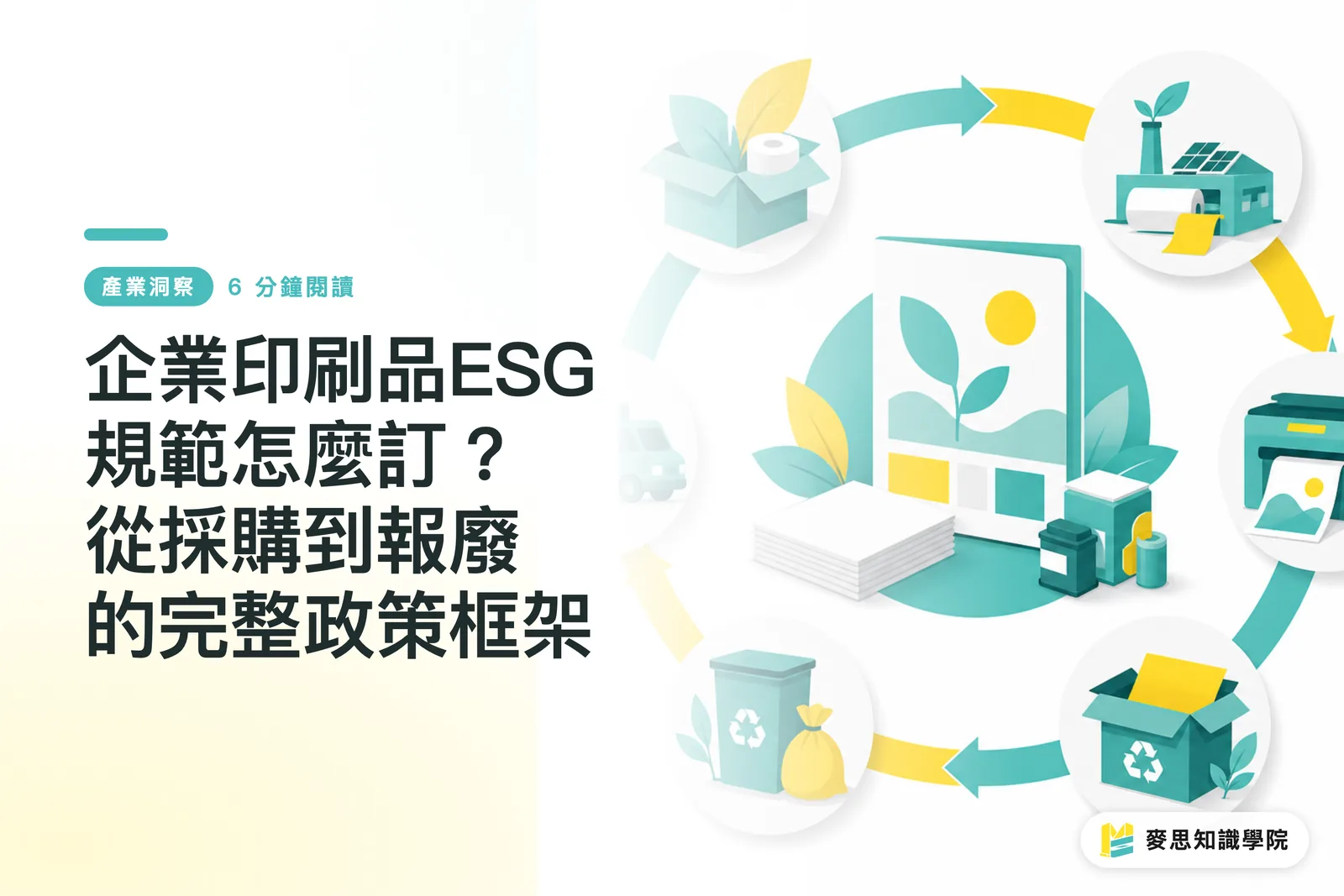
Why Do Companies Need Unified ESG Guidelines for Print Procurement?
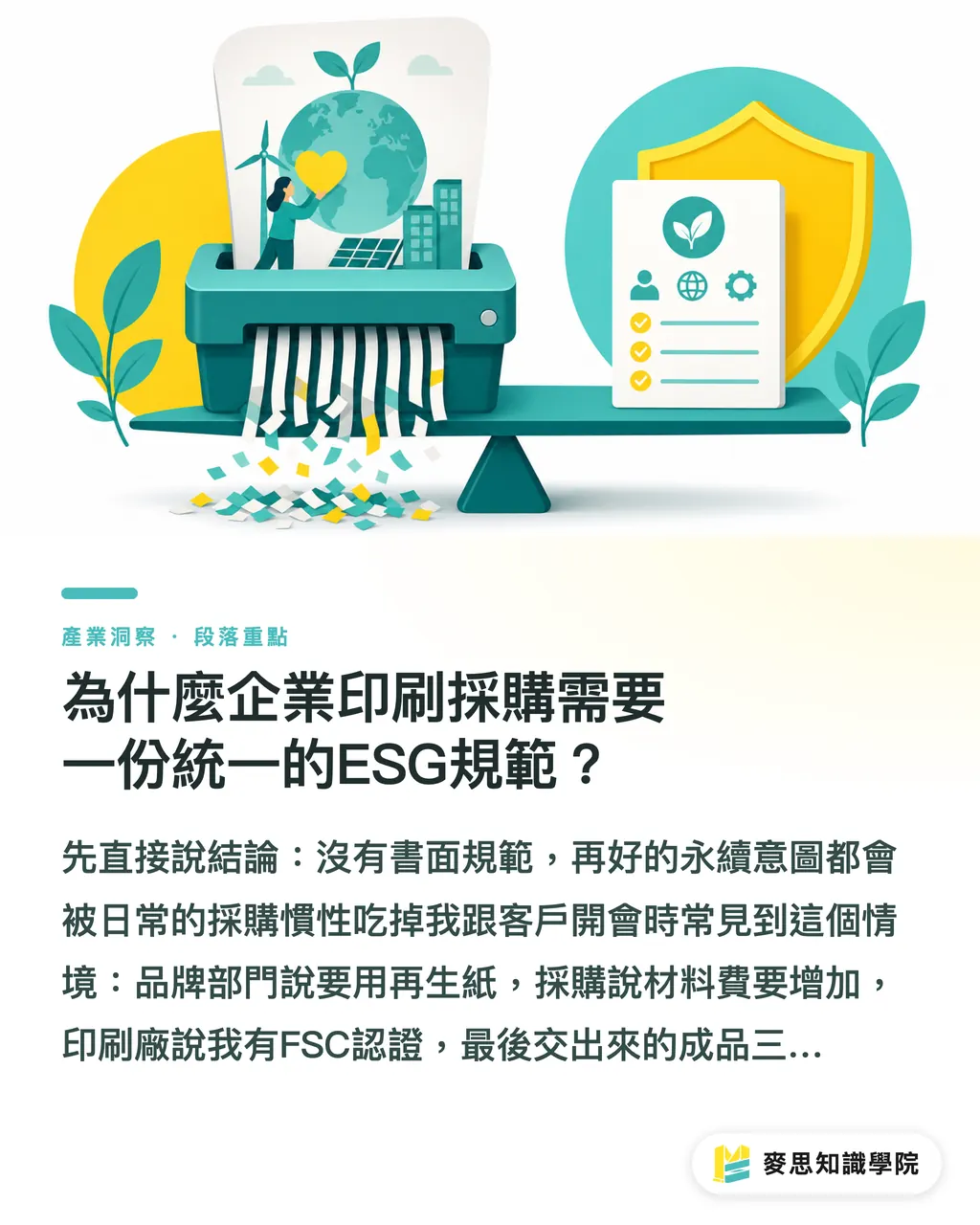
Let's bottom-line it: without written guidelines, even the best sustainability intentions get eaten alive by daily procurement habits
I see this all the time when meeting clients: brand wants recycled paper, procurement says material costs will go up, and the print shop says they have FSC certification. In the end, nobody is happy with the finished product, and next time everyone starts negotiating from scratch again. The problem isn't lack of effort from any party. The issue is having no written policy for everyone to follow
A mid-sized company spending over 500,000 NTD annually on print, business cards, flyers, catalogs, packaging, event collateral, makes two or three dozen print decisions a year. Asking 'should we use eco-friendly materials this time?' every single time means renegotiating your ESG position every single time. Sustainability never becomes a habit that way
The core focus of Mai Strategy Knowledge Academy when organizing client guidelines is pulling these scattered requirements into a single 'Print ESG Policy Document,' replacing case-by-case calls with fixed rules. Your guidelines don't need to hit the highest standard overnight, but they must cover all items so your team knows which rule to check when problems arise
How to Draft Paper Priorities and Certification Rules That Aren't Just for Show
Paper usually accounts for 40% to 60% of a print job's overall carbon footprint. Starting here gives you the most direct impact
Here is a practical priority ranking:
・Top priority: FSC or PEFC certified virgin wood pulp paper with traceable forest sources
・Second priority: Recycled paper, with recycled pulp content explicitly set at a 50% minimum threshold
・Exceptions: Waterproof labels, food contact packaging, and other special uses require different certifications. Build a separate exception list so exceptions don't become the norm
Certification rules must be specific. Vague language like 'prioritize eco-friendly materials' is useless. Try these instead:
・Vendors must hold valid FSC-CoC (Chain of Custody) certification; expired documents will not be accepted
・Procurement must verify active certification status when updating vendor lists each year
・Certifications must be attached to contract annexes, not left as verbal promises
A common misconception is treating a switch from coated paper to woodfree paper as an ESG move. That is just a texture change, not sustainability. Paper sustainability depends on forest management certification and material origin, not surface shine
How to Structure Rules for Minimum Print Runs, Revisions, and Sample Archiving
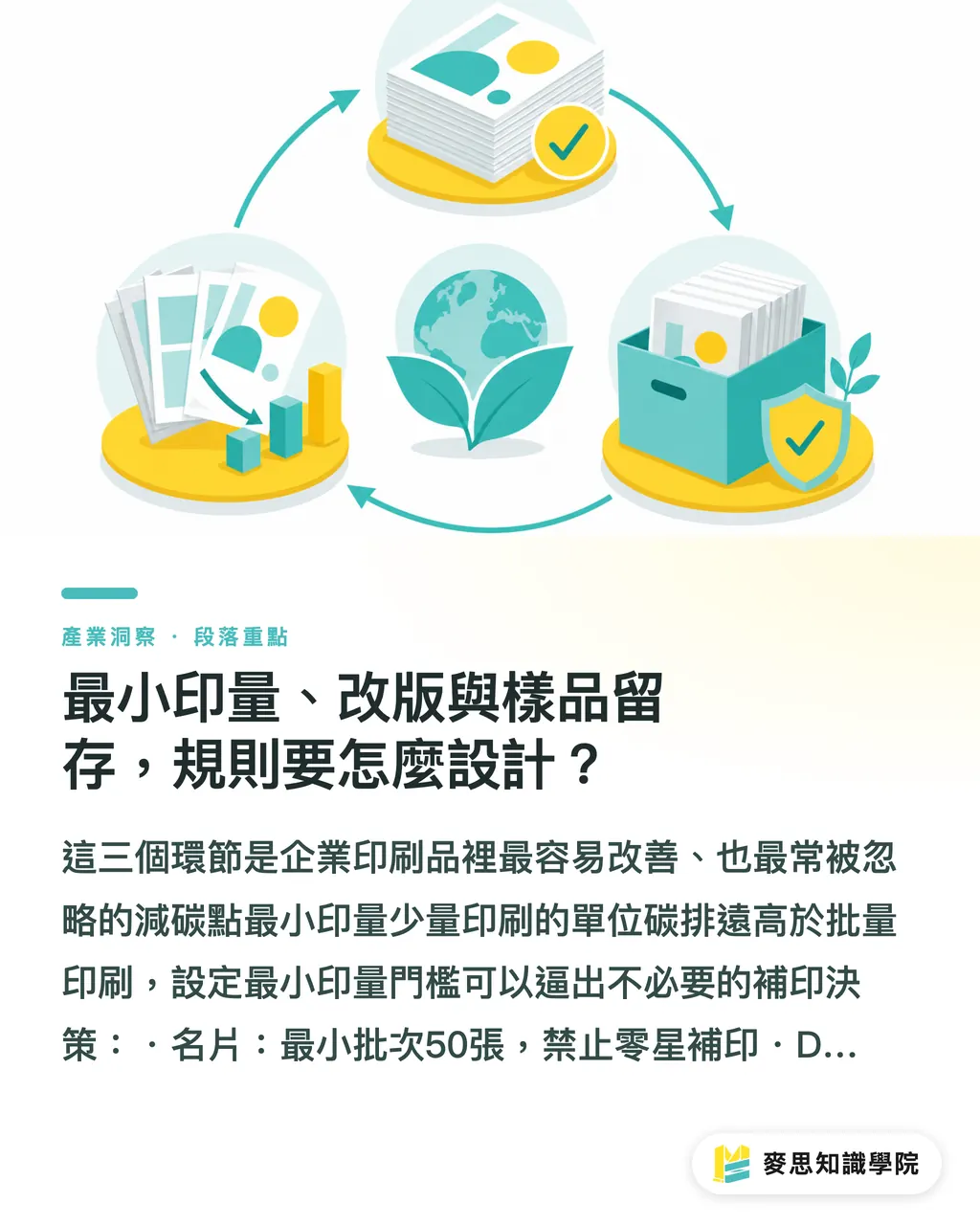
These three areas are the easiest carbon reduction quick wins in corporate printing, yet they get overlooked most often
Minimum Print Runs
Per-unit carbon emissions for small print runs are far higher than bulk runs. Setting minimum run thresholds forces teams out of unnecessary re-print habits:
・Business cards: Minimum 50 cards per batch; no piecemeal re-orders
・Flyers and catalogs: Consolidate printing quarterly; no additional small-batch top-ups allowed
・Event materials: Confirm quantities and freeze layouts 30 days before the event; late layout updates require managerial sign-off
On the surface, this looks like administrative control. At its core, it prevents print waste. Re-printing 3,000 catalogs just because two lines of text changed is something I've seen at client sites countless times, and every time it hurts to see all that paper go straight into recycling bins
Revisions and Re-prints
Revisions need justification, and re-prints need proof of need:
・If layout changes are under 20%, do not initiate a re-print. Use inserts or digital addendums instead
・Check warehouse inventory before re-printing. If remaining stock exceeds 30% of the original batch, re-printing is not allowed
・Record reasons and approvers for re-prints to serve as audit evidence for annual print ESG reviews
Sample Archiving
Many companies skip this practice, but it forms the foundation of vendor audits and quality tracing:
・Retain 2 to 3 sample copies per batch, logging paper specs, color output, and finishing methods
・Label samples with vendor name, production date, and version number
・Keep archived samples for at least one year to match re-print cycles
Vendor Data Needs and Over-Packaging: How Should Procurement Handle Them?
Vendor management is where policies turn into paperwork most easily. Writing certification requirements into contracts without ever checking them is no different from having no rules at all
We suggest listing four specific document types vendors must supply:
・FSC/PEFC Chain of Custody certification, updated yearly; expired certs will not count
・Ink specifications showing compliance with low-VOC (volatile organic compound) standards
・Wastewater and solvent disposal compliance documents
・Energy usage or carbon footprint overview, allowing staged compliance but requiring annual updates
When asking for these for the first time, around 30% to 40% of small and mid-sized print shops in Taiwan can provide a full set, while most can provide one or two. Give remaining vendors a grace period, but set firm submission deadlines rather than waiting indefinitely
Limits on Over-Packaging
Delivery packaging for printed goods is the most common hidden waste source on the buyer's side. For standard catalog deliveries, printers often wrap items in layers of bubble wrap and plastic bags for protection, creating more waste than actual printed goods upon unboxing. Add these guidelines:
・Ban single-use plastic foam or PVC packaging; switch to recyclable corrugated boxes
・Ban individual wrapping for single-color print jobs; use batch paper wraps instead
・Require vendors to label packaging materials so receiving staff can sort them properly
This places very little extra burden on vendors, but it cuts buyer-side packaging waste by 30% to 50%
If you are currently setting up your company's print procurement policy, MINDS can help align actual vendor audit documentation checklists to clarify policy execution
Scrapping and Recycling: How to Give Your ESG Guidelines a Real End-to-End Cycle
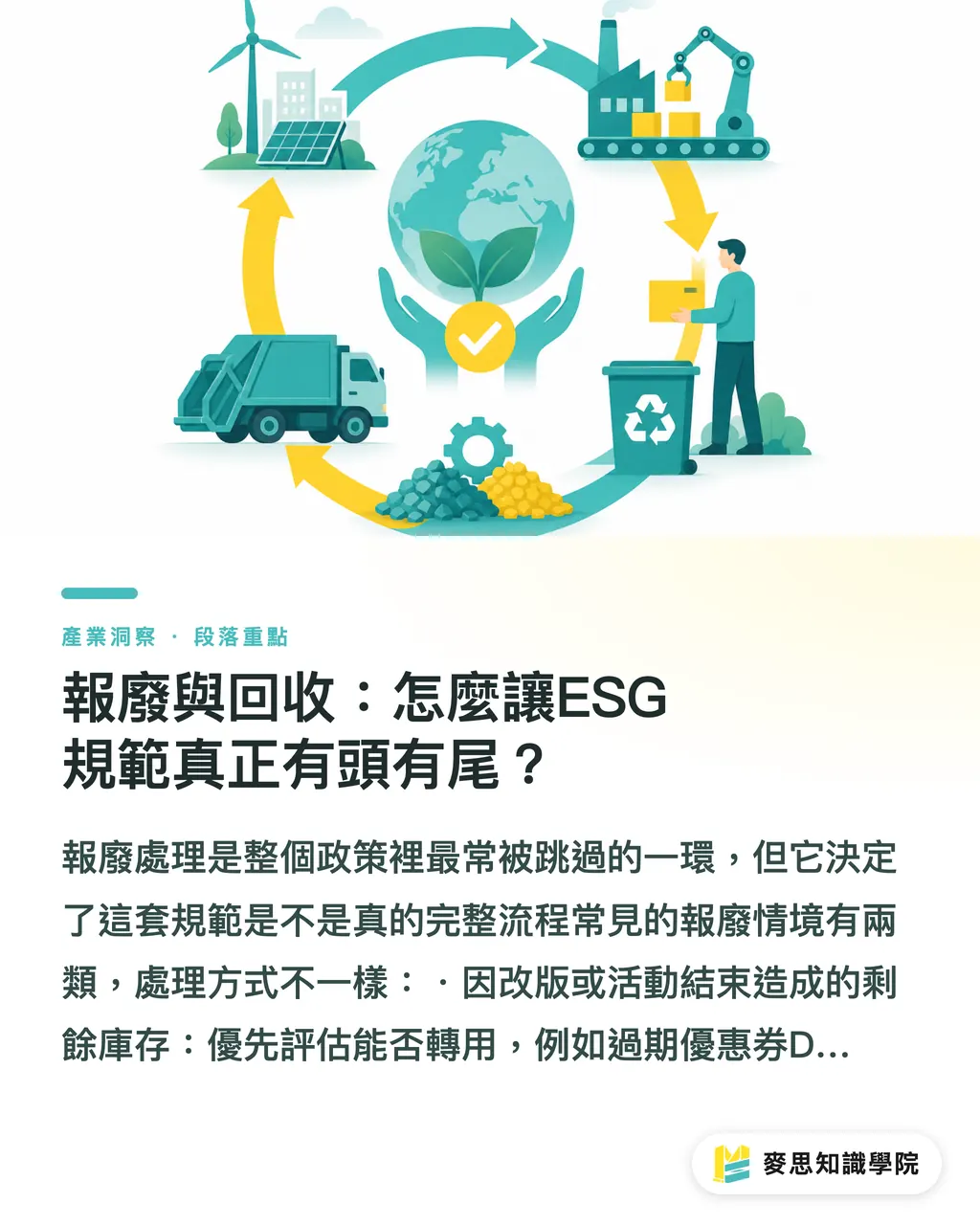
Disposal handling is the step most frequently skipped in corporate policies, yet it decides whether your framework is a complete process
Scrapping typically falls into two categories, each requiring different handling:
・Leftover inventory from layout revisions or ended events: Evaluate reuse options first. For example, tear off the discount section from expired coupon flyers to use as packing filler or office scratch paper. Send to paper recycling only after confirming it cannot be reused
・Defective items from quality issues or spec errors: Verify responsibility with the vendor. Defective goods caused by poor quality should be handled by the vendor
Recycling methods vary by material:
・Standard paper items (coated paper, woodfree paper): Send to paper recycling; never mix into general waste
・Items with glossy lamination, foil stamping, or heavy UV coating: Composite materials cannot be recycled standardly. Inform vendors how to handle them or hire qualified waste management contractors
Another detail often overlooked: test prints and proofing scrap at the printer's shop fall under vendor responsibility. However, buyers can require vendors in contracts to report scrap handling procedures, making supply chain waste transparent and easier to report in external ESG filings
Drafting policy isn't a one-and-done task. Conduct a print ESG audit at the end of every year to check whether rules were followed and what exceptions occurred. That is how you keep this framework alive
Key Takeaways
・The core issue in corporate print ESG isn't a lack of eco-friendly materials, but the absence of unified guidelines to ground every procurement call
・Paper certifications must require valid FSC-CoC documents. Empty phrases like 'prioritize eco-friendly materials' won't work in practice
・Setting minimum print run limits and a 20% layout change threshold for re-prints is the most direct, low-cost way to curb print waste
・Over-packaging restrictions are easy for buyers to enforce and face minimal vendor pushback, making them simple to add to contracts
・Disposal handling is the final step in a complete ESG cycle. Many companies still don't realize that print items with special finishing cannot be recycled
Further Considerations
The actual bar for launching this policy is lower than most people think: start with your two or three most frequently used print items, write down paper requirements and minimum print runs, and run it for six months to catch execution gaps before adding other items. Wait until the framework runs a full year before tracking vendor carbon data and scrap disposal records. This rhythm works far better than demanding everything at once
For designers, understanding a corporate client's ESG guidelines means you can build material choices and run recommendations right into your proposals. Clients will see you not just as a visual designer, but as someone helping manage their spec decisions. This is a point of differentiation many designers miss
For SaaS or print management platforms, providing digital archiving, version control, and audit logs for these corporate guidelines creates far stronger customer stickiness than offering simple ordering features
FAQ
- Where should an SME start when drafting print ESG guidelines?
- Start with your two or three most frequently printed items. Write down paper certification requirements (FSC-CoC) and minimum print run thresholds into a one-page rule. Run it for six months to verify feasibility before expanding to other items and vendor audits. Demanding total compliance from day one usually ends in zero execution
- What is the difference between FSC and PEFC certification? Which one should be in corporate guidelines?
- FSC (Forest Stewardship Council) and PEFC (Programme for the Endorsement of Forest Certification) are both internationally recognized sustainable forest management certification systems requiring vendor paper origin traceability. FSC is more common in the Taiwan market. We recommend listing FSC-CoC as the baseline requirement in your guidelines while accepting PEFC as an equivalent alternative. Accepting either one is sufficient; you don't need to demand both
- Why can't printed items with foil stamping or glossy lamination be recycled? How should companies handle them?
- Foil stamping uses metallic film, and glossy lamination uses plastic composite materials. Neither can be separated from paper fibers during standard recycling, contaminating the entire batch of recycled pulp. Classify these items as 'non-recyclable waste' in your policy and hire certified waste disposal vendors for collection, rather than throwing them into standard recycling bins
- What is the practical purpose of 'sample archiving' in print ESG guidelines?
- Archived samples serve as the sole proof of print quality and baseline references during vendor audits. If disputes arise over color variation, material mismatch, or finishing errors, saved samples prove where responsibility lies. We suggest keeping 2 to 3 samples per batch, tagged with vendor name, date, and version number, and saved for at least one year
- What if vendors fail to cooperate when asked to provide ESG compliance documents?
- When requesting a full set of documents (certifications, ink specs, waste liquid treatment) for the first time, roughly 30% to 40% of Taiwan's small and mid-sized print shops can provide everything at once. Give other vendors a grace period with firm submission deadlines, such as 60 days post-contract signing. Move uncompliant vendors to an observation list and prioritize vendors offering complete documentation in future procurement. Let market mechanisms encourage proactive vendor compliance
Related articles





The Print × AI weekly
The print and AI know-how designers, brands and enterprises can use before they commit — one email, every week
MINDS Free Tools
AI background removal, a LINE sticker maker, spine & imposition calculators — all free, right in your browser, no upload.
MINDS Group
Need actual printing or gifting services?
From premium printing to online ordering and festive gifts — the MINDS Group sister brands take it from here.