
What Is the Real Difference Between Standalone Upgrades and Line-Wide Handling?
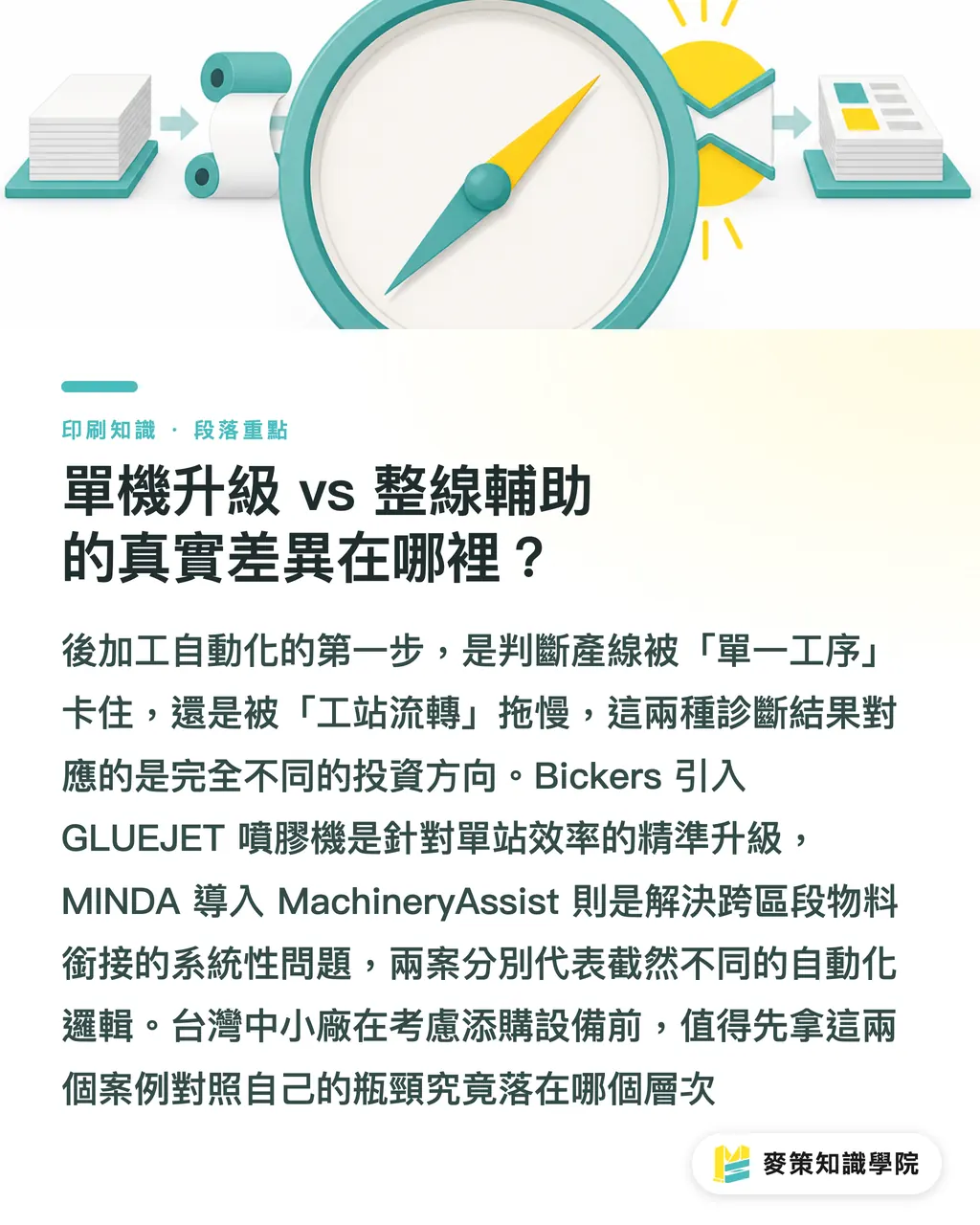
The first move in post-press automation is figuring out whether your line is stuck at a single station or slowed down by transfers between workstations
Two international case studies reported by ThePackagingPortal recently set these two investment paths in clear contrast
One is Bickers installing a GLUEJET gluing machine in Poland, pushing maximum flexibility at a single workstation
The other is MINDA rolling out MachineryAssist across the Baltic states to fix material handling issues between plant sections
The biggest risk in buying new machinery is misidentifying your bottleneck, and these two cases offer a practical benchmark for small and medium plants to assess their own setups
Who Needs a Standalone Upgrade? Clues from the Bickers Installation in Poland
When your turnaround time constantly stalls at a labor-intensive step, that is your signal for a standalone upgrade
Take the Bickers 20.30 PAi2 GLUEJET launched in Poland in July as an example. It is an XY gluing plotter equipped with CAD cameras and triple smart glue heads, an automated unit that moves along XY axes to apply hot melt or cold glue precisely to pattern drawings
The Polish plant uses it for gluing POS display stands
These displays have complex structures where manual gluing is slow and prone to squeeze-out, so bringing in a dedicated machine untangles that bottleneck immediately
Standalone upgrades deliver fast results, and you know right away which time-consuming jobs the machine is bought to handle
What Problems Does Line-Wide Handling Solve? The MINDA Baltic Case
When jobs repeatedly stall waiting to move between stations, investing in line-wide handling is what actually unlocks total plant capacity
Often individual machines run fast enough, yet printed sheets sit around waiting for cutting, creasing, or manual transport
The MINDA MachineryAssist solution takes this exact approach
These systems handle material infeed, outfeed, conveying, and changeover handoffs, keeping the operating rhythm in sync across workstations
This matters most for short-run, high-mix jobs that require multiple line changeovers a day
Buying Decisions for Taiwanese Plants: What Is the Payback Timeline?
Payback for a standalone upgrade typically runs two to three years, whereas line-wide handling depends on the extra order capacity created by shorter lead times and usually calls for a longer evaluation horizon
If you are weighing which path to take, or want the Mai Strategy Knowledge Academy consulting team to help assess your current plant operations, you can start by benchmarking these dimensions:
・Investment threshold: Standalone upgrades usually involve one-time capital expenditures in the millions of NTD, while line-wide handling involves reconfiguring workflows across the entire facility and requires a higher commitment
・Payback estimate: Standalone upgrades are calculated on labor and overtime savings, while line-wide handling factors in new job volume from shorter lead times, with payback horizons stretching up to five years
・Facility fit: Standalone machines only need floor space and basic utilities to go live, whereas line-wide handling demands redesigning traffic flow and overall floor layout
・Staff requirements: Standalone units need dedicated technicians who understand specific processes and parameter setups, while line-wide handling calls for central controllers who grasp whole-plant scheduling logic

Key Takeaways
Confirm whether your bottleneck sits in a single process or in wait times between workstations before buying machinery
Standalone upgrades solve specific process pain points quickly, making them ideal for complex work that relies heavily on skilled labor
Line-wide handling targets changeover and scheduling delays, fitting short-run, high-mix shops with frequent job switchovers
Equipment evaluations must look beyond top rated machine speed and calculate the actual turnaround time for completing entire print batches
Further Thoughts
After touring equipment with many clients over the years, my biggest takeaway is that hardware only solves half the problem
Whether you choose standalone machines or line-wide systems, if your scheduling logic and order mix do not adapt once the equipment arrives, old workflows will eventually swallow up that new capacity
What you need to track next is whether plant information flow keeps pace with your new machinery, because that is where the real profit gap widens
Further Reading
FAQ
- What is a GLUEJET gluing plotter?
- An automated system that moves along XY axes to apply hot melt or cold glue accurately according to CAD drawings, commonly used for complex packaging boxes and display stands
- On a tight budget, should a plant buy a standalone machine first or invest in handling equipment?
- Look at where your pile of work-in-progress is stacking up on the floor. If it piles up in front of a specific process, buy a standalone machine to clear it. If it sits scattered between machines waiting to be moved, consider handling equipment
- When evaluating a standalone upgrade, what should you ask the manufacturer besides machine price?
- Always check changeover setup times, tooling versatility, and compatibility with specialty substrates, as these are often hidden capacity killers
Related articles
The Print × AI weekly
The print and AI know-how designers, brands and enterprises can use before they commit — one email, every week
MINDS Free Tools
Spine width and imposition calculators — skip the manual math, free in your browser.
MINDS Group
Need actual printing or gifting services?
From premium printing to online ordering and festive gifts — the MINDS Group sister brands take it from here.