

When Does a Finishing Bottleneck Justify In-House Production?
Finishing bottlenecks are worth bringing in-house once pre-press can still take orders but finished stock piles up at cutting, creasing, hole-drilling, folding, gluing, or die-cutting, and lead times start running on the post-press schedule
A finishing bottleneck means post-press steps like cutting, creasing, folding, hole-drilling, and gluing run at lower capacity than pre-press, so already-printed work sits in queue waiting to ship
IPIA (Independent Print Industries Association) ran a piece on 30 July 2026 titled Record month for Northend as Duplo finishing investment pays immediate dividends, covering Northend's February install of the Duplo DC-646 and Duplo PFI Blade B2+. The goal was plain: add automation, kill the finishing bottleneck, and pull high-value work back inside the plant
When I look at cases like this, the first question I throw at procurement is pretty blunt: when your jobs run late, do they stall at the press, or after it
Which Orders Stall Finishing the Most?
Short runs, multi-version, custom die work, rush jobs, and premium commercial print are the ones that turn finishing into the whole job's lead-time risk. These jobs eat changeovers, setup, and stability, not raw speed
Northend is a UK full service print house founded in 1889, running 45 people. Pre-press gear includes a Ryobi RMGT five colour LED UV press, a Canon imagePRESS C10010VP, a Canon Colorado 1650, and an Epson SC-S80600, so litho, digital, and wide format are already covered. The bottleneck naturally migrates to finishing
Procurement can use MINDS's three finishing questions (MS) to filter risk:
・① Order structure: do batches often mix multiple sizes, SKUs, and tight deadlines?
・② Lead-time risk: does the outsourced return time squeeze packaging, delivery, or client sign-off?
・③ Sign-off responsibility: when cuts drift, creases crack, or custom dies miss the mark, does fault keep bouncing between vendors?
Hold on
If two out of three land on yes, finishing deserves an in-house evaluation, not more quote-shops on the same outsourced unit price
What Else Should Procurement Ask When Comparing Quotes?
Procurement should also ask about changeover time, what steps can run in-house, rework responsibility, and delivery guarantees. The value of in-house finishing usually hides in less waiting, less back-and-forth, and fewer mistakes
The Duplo DC-646 is a slitter cutter creaser that handles slitting, cutting, creasing, and hole-drilling in a single pass. Northend reports shorter setup, faster job switching, and steadier output
The Duplo PFI Blade B2+ is a programmable digital cutter built for high-speed blade paths and complex shapes. Northend uses it to keep premium pieces and custom shapes inside the plant
Procurement evaluation can break down like this:
・Keep outsourcing: fits occasional finishing needs. No depreciation on your books, but rush jobs and custom dies get pushed around by someone else's schedule
・Partial in-house: fits commercial print where cutting, creasing, and hole-drilling are routine. Lead times are more controllable, but a few special steps still need outsourced management
・High-value in-house: fits custom shapes, brand packaging, display work, and short-run high-ticket jobs. Margin and sign-off responsibility are cleaner, but operator training can't be skipped
For mid-to-high-end fully custom commercial print, MINDS usually looks at print specs, finishing path, and sign-off points together, rather than tossing procurement a single unit price to bid on
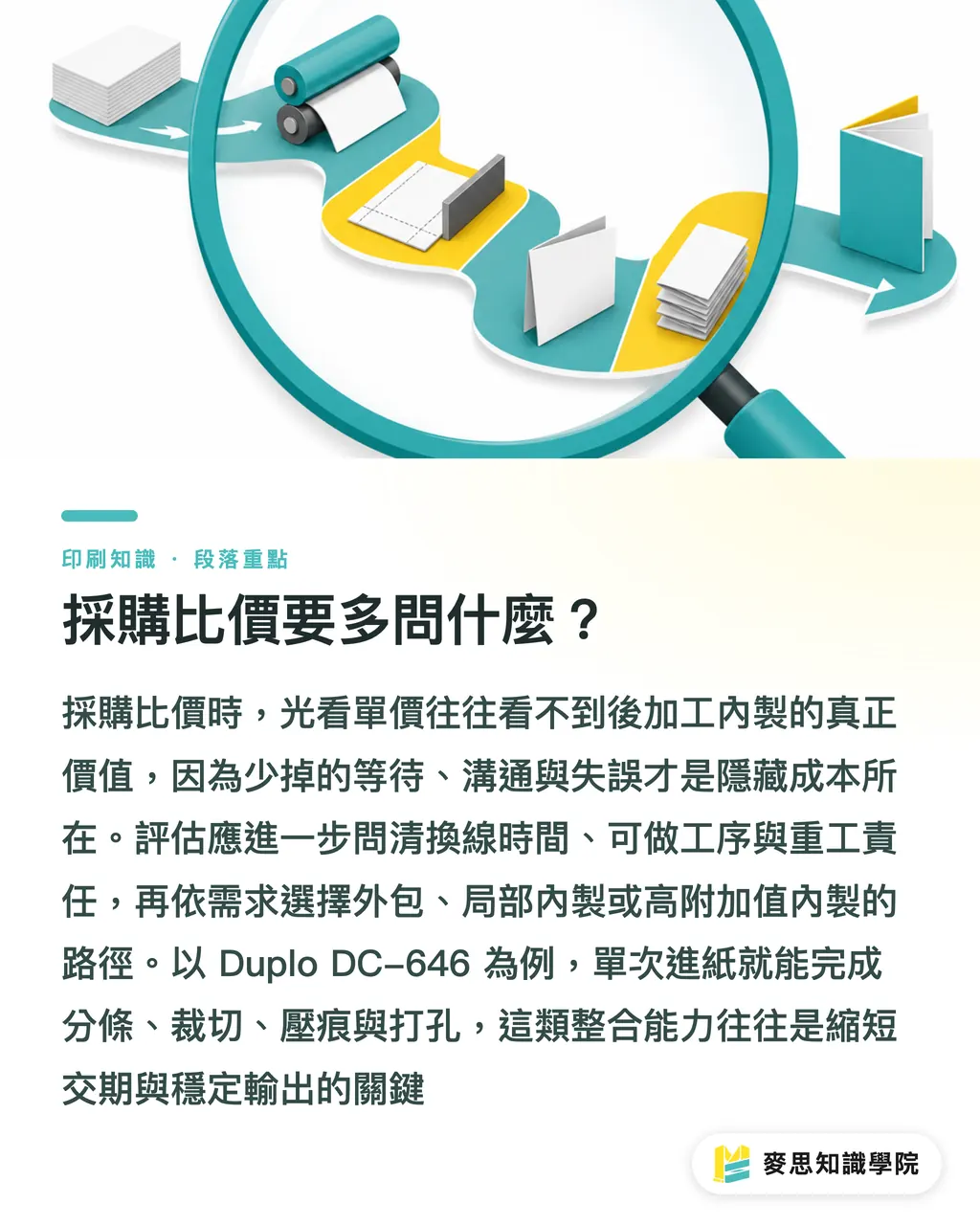
How Do You Sign Off After the Install?
After install, sign-off comes from real jobs running smoothly, not from the speeds printed on a brochure. What gets tested is changeover, registration drift, crease quality, and on-floor scheduling once the equipment is actually earning its keep
After installing the DC-646 and PFI Blade B2+ in February, Northend posted its strongest February in 137 years of trading. The part worth borrowing from the case isn't the monthly number, it's that the investment target was tied to bottleneck relief, in-house ratio, and high-value work retention
I suggest procurement sign off on these points:
・Sample sign-off: pull pieces from the same batch to check cut edges, crease lines, hole positions, and die-cut outlines
・Changeover sign-off: queue different sizes or die shapes back to back and see if setup time really shrinks
・Lead-time sign-off: compare rush-job scheduling before and after the install, confirm finishing isn't the last-day black hole anymore
・Responsibility sign-off: write print, finishing, packaging, and delivery responsibilities into the procurement terms so nobody traces the chain from scratch when something breaks
Don't skip this step
A shiny machine with the same old workflow just pushes the rush-job pile back onto the same workbench
How Should Small and Mid-Sized Print Shops Respond?
Small and mid-sized shops should bring the most frequent, highest-margin finishing steps in-house first, not every step at once. Cash and headcount both cap how fast equipment investment can go
Northend's setup is worth dissecting. The DC-646 handles the everyday cutting, creasing, slitting, and hole-drilling. The PFI Blade B2+ covers complex shapes and custom cuts. Older machines stay on for cover creasing and backup. That's not a simple old-for-new swap, it's a clear split of finishing tasks across tiers
When procurement looks at a vendor, the questions can flip the other way:
・Which finishing steps does this print shop run in-house?
・Which steps go outside, and who owns the outsourced schedule?
・When rush jobs cut in, is there backup equipment or an alternate path?
・How are acceptance criteria written for custom dies, crease cracking, and cut drift?
If enterprise procurement needs to turn recurring print specs into a quotable, sign-off-ready version, the Mai Strategy Knowledge Academy consulting team can help pin down the spec language first, so the quote looks cheap but a finishing delay doesn't blow an entire campaign window
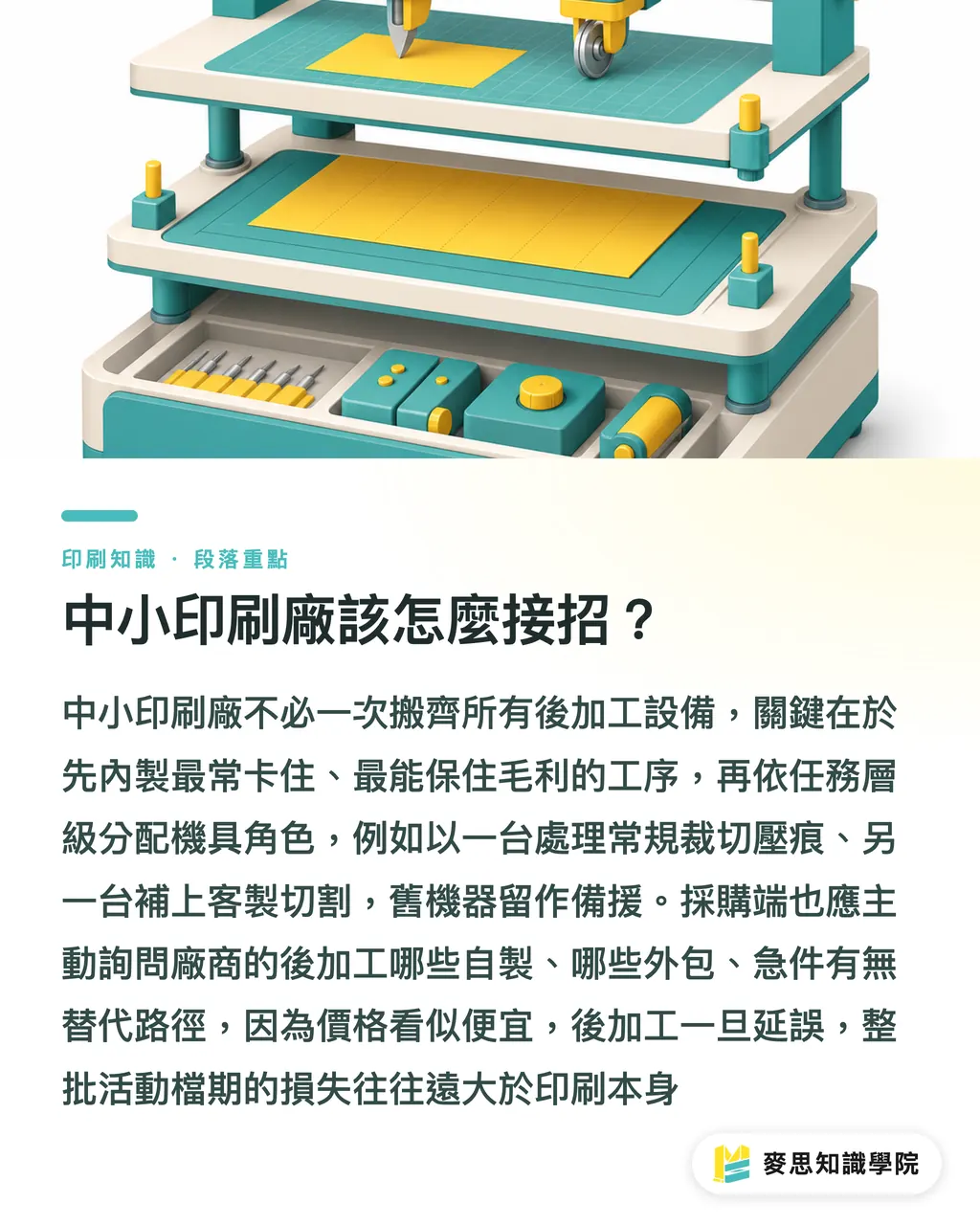
Key Takeaways
・Decide on in-house finishing from lead-time responsibility first, equipment price second
・When short runs, multi-version, and custom dies pile up, outsourced unit price hides the scheduling cost
・Procurement quotes should ask about changeover, rework, backup, and sign-off, not just per-piece cost
・Good finishing investment keeps high-value work in-house, so lead times and margins both stay more controllable
Further Thinking
Print manufacturers should treat finishing as a production-line math problem. Design teams should lock down cut, crease, and die paths before artwork is final. AI and SaaS teams can turn spec checks, step breakdowns, and sign-off logs into traceable workflows. The next step is concrete: spread the last 20 delayed job tickets on a table and see which finishing step they stalled on. The answer is usually more honest than any equipment catalog
Further Reading
FAQ
- When is a finishing bottleneck worth bringing in-house?
- A finishing bottleneck earns in-house production once short-run multi-version jobs, rush orders, and custom die work become routine, and outsourced lead times start squeezing quote flexibility, sign-off responsibility, and client delivery
- When procurement compares print quotes, what should they ask about finishing?
- Procurement should ask which finishing steps run in-house, which are outsourced, how long changeovers take, who carries rework responsibility, and whether backup equipment exists for rush jobs. These flag lead-time risk better than per-piece price
- What finishing problem is the Duplo DC-646 built for?
- The Duplo DC-646 fits situations where slitting, cutting, creasing, and hole-drilling stack up in the same short-run batch. Northend's draw after install was shorter setup and multiple steps in a single pass
- Is a digital cutter right for every print shop to bring in-house?
- A digital cutter fits shops with steady demand for custom shapes, short-run high-value work, and premium pieces. If custom dies are only occasional, staying outsourced or going partially in-house is the more practical call
- How do you sign off after bringing finishing in-house?
- After the install, sign off with real job tickets: check cut drift, crease quality, die-cut outlines, changeover time, and rush-job scheduling. Brochure speeds don't replace on-floor sign-off
Related articles




The Print × AI weekly
The print and AI know-how designers, brands and enterprises can use before they commit — one email, every week
MINDS Free Tools
Spine width and imposition calculators — skip the manual math, free in your browser.
MINDS Group
Need actual printing or gifting services?
From premium printing to online ordering and festive gifts — the MINDS Group sister brands take it from here.