

Overview
Let's start with a scene you probably know well
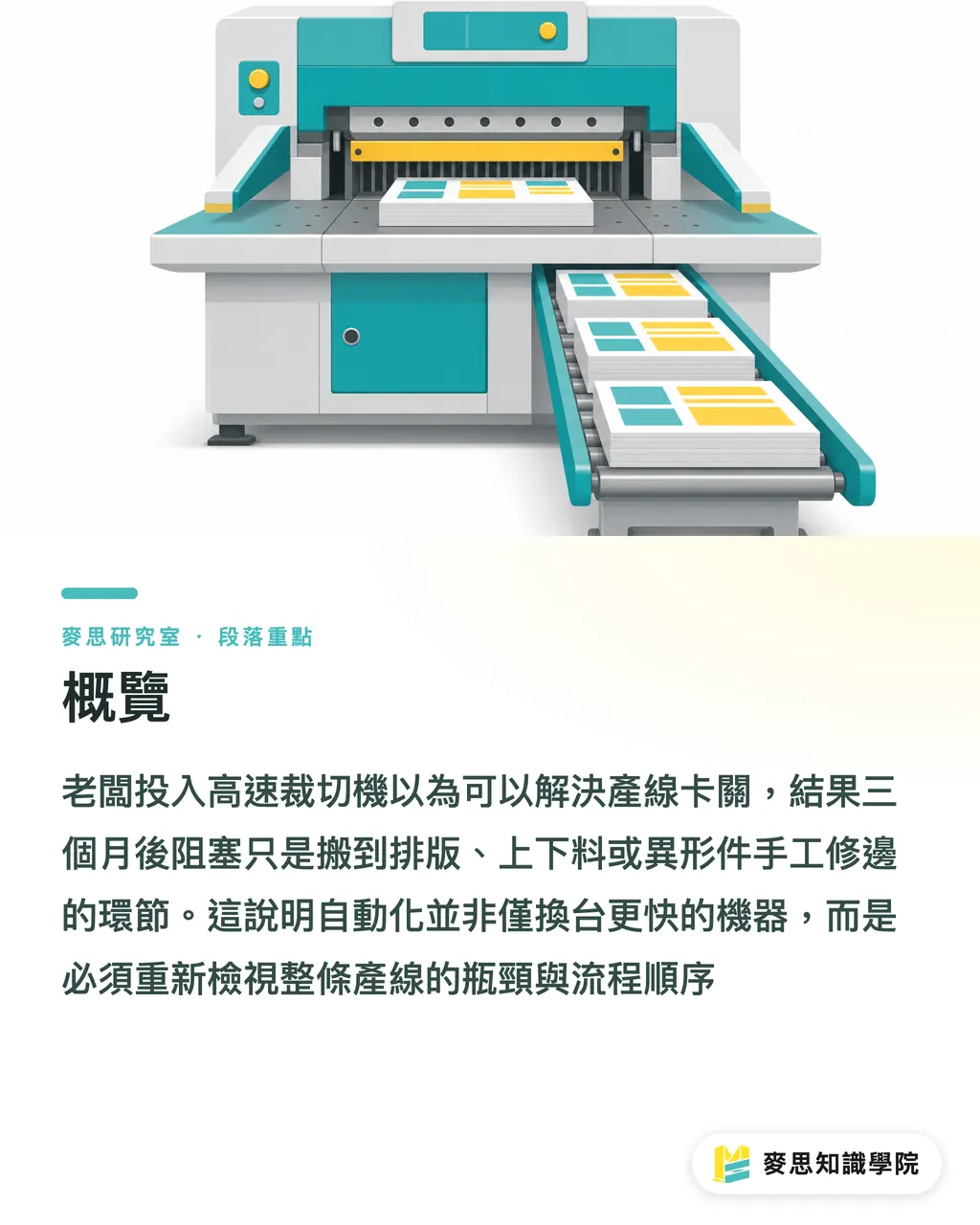
A shop owner bites the bullet and buys high-speed cutting gear, thinking it will finally end the nightmare of print jobs getting stuck downstream. Three months later, the floor is still backed up. The jam just moved one step down. Instead of stalling at cutting, jobs now stall at layout registration, at loading and unloading, or at custom contour jobs that still require an experienced tech to trim by hand
This isn't about picking the wrong machine. It's about thinking in reverse. Finishing automation is never as simple as buying a faster machine. It forces you to recalculate every bottleneck across your entire production line [1]
Why Is Finishing the Real Bottleneck?
In the past, whenever people talked about print capacity, all eyes were on the press. But in reality, almost every printed sheet needs some form of cutting after coming off the press. Once that cut goes wrong and forces a reprint, you don't just waste material. You waste all the press time already spent on that job [1]
In other words, finishing is the final gatekeeper on the floor. No matter how fast upstream runs, if finishing misses a beat, your delivery timeline falls apart
FESPA's guide on modern finishing and CNC tables puts it plainly: a clean cut is the baseline for all finishing tools, which makes the cost of service and support just as critical as the purchase price of the machine itself [1]. This matters even more for small and mid-sized shops. You aren't buying a metal box that cuts. You are buying uptime that cannot go down. The cost of a single day of downtime often exceeds whatever price discount you negotiated
So your first step isn't browsing catalogs. It's looking closely at your floor and asking: where does work actually back up the most?
Are CNC Cutting Tables Really Better, or Just More Expensive?
Bottom line first: no tool is universally good or bad. It only comes down to whether it matches your order profile
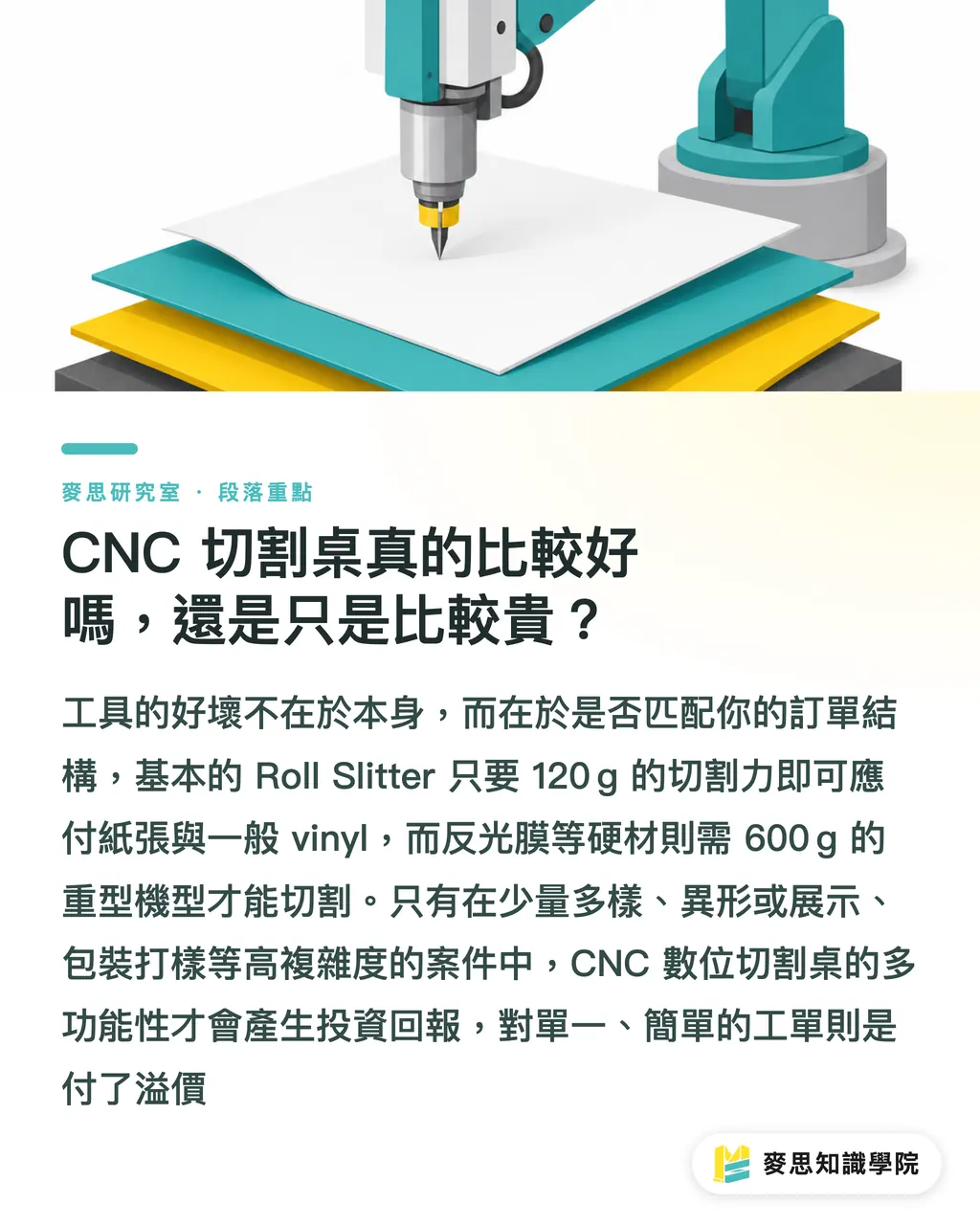
The simplest roll slitter remains essential for many print service providers today. It cuts master rolls down to required widths or into sheets, handling vinyl, banner material, and textiles with ease [1]. Stepping up, cutting plotters (commonly known as vinyl cutters) handle intricate shapes. But whether a plotter works for you depends on downforce. Around 120g of cutting force handles paper and standard vinyl for stickers and lettering with ease, but when handling tough substrates like reflective film, you need heavy-duty hardware that hits 600g to get the job done [1]
That comparison between 120g and 600g is your best self-check. If 80% of your work falls into the lighter range, splurging on a heavy CNC table is paying for capacity you will never use
The true value of a digital CNC cutting table lies in versatility. Using Computer Numerical Control to position the tool head with precision, it repeatedly produces identical, complex contours across vinyl, textiles, and foamcore [1]. It delivers real return on investment when handling short runs, custom contour cutting, display graphics, and packaging prototypes. But if your mix is simple and repetitive, that versatility is just an unnecessary markup
It is also worth noting that Chinese manufacturers like JWEI and iEcho have turned the cutting table market into a cutthroat space in recent years, forcing established Western brands like Kongsberg to respond [1]. That is good news for buyers, offering more options and lower pricing. But it also serves as a warning: as hardware becomes commoditized, the real differences come down to unseen factors like service, software integration, and handling downtime [1]
When Should You Buy Integrated vs. Standalone Equipment?
This is where buyers get burned most often, because intuition can be deceiving
Take sticker production. Your gut says an integrated print-and-cut machine is the cleanest choice with the sharpest registration. FESPA agrees that integrated units hold an advantage in registration precision [1]. But they quickly add a counterpoint: if you need high throughput, standalone machines are more cost-effective. Printing and cutting naturally run at different speeds. Tying them together forces the faster process to wait on the slower one [1]
This is the clearest example of recalculating bottlenecks. Integration trades throughput for tighter registration and a smaller footprint. Standalone units trade a bit of registration convenience so each machine can run at full speed. There is no generic right answer. The answer is buried in your job mix
Here is how I see it. If your volume leans toward precision-sensitive, short runs (like proofing and custom short jobs), the simplicity and registration precision of an integrated machine win. If your volume leans toward large runs of identical items with tight deadlines, running standalone machines at full speed is the right call. Figure out which camp you belong to before shopping for equipment. Get the order wrong, and you will regret whatever you buy
How Can Small Shops Take the First Step Without Overextending?
Don't rush to automate everything at once. The most practical approach to finishing automation is finding the single step that jams most often, and fixing only that step
Specifically, I recommend three steps before spending a single dollar:
・ Audit your traffic jams: Look at the past three months and list every job delayed by inconsistent manual finishing. You will notice the bottlenecks usually cluster around one or two specific job types
・ Measure material and size variance: The steps with the widest variety of substrates and dimensions should be automated first. That is where manual labor makes the most mistakes and struggles with consistency, and it is where CNC's repeatable precision pays off most [1]
・ Factor in service costs: Don't just compare equipment quotes. Calculate the cost of a single day of downtime, along with maintenance and support. FESPA makes it clear that this part is just as significant as the purchase price [1]
Once you finish these three steps, you have a solid basis for making an investment decision. It won't be based on what a sales rep recommends, but on what your own production data says about which bottleneck to tackle first
One final reminder: the success of automation is never determined by your most expensive machine. It is determined by the slowest manual step left on your line. Before buying equipment, recalculating your bottlenecks matters more than anything else

Wrapping Up: Calculate First, Buy Later
Think back to the shop owner from the beginning who simply pushed the bottleneck one step down. The mistake wasn't buying machinery. It was failing to ask where the next bottleneck would appear once the new machine arrived
At its core, finishing automation is a recalculation of your entire line. Pinpoint your slowest step first, then decide whether and with what tool to solve it. Reverse that order, and even the priciest equipment just relocates your headaches

Key Takeaways
・ Finishing is the final gatekeeper on the floor. No matter how fast upstream runs, missing a beat here breaks delivery schedules, making it the true bottleneck [1]
・ Use the 120g versus 600g cutting force threshold to check whether your job mix actually needs a heavy-duty CNC table [1]
・ Integrated machines win on registration precision, while standalone units win on full-speed throughput. Your choice should come from your job mix, not your gut [1]
・ Hardware is nearing commodity status with aggressive pricing from JWEI and iEcho. The real differentiators are service, software integration, and downtime response [1]
・ Automation outcomes depend on your slowest remaining step. Recalculate bottlenecks first and fix that single step instead of rushing to automate everything at once
Further Considerations
For print manufacturers, the takeaway is clear: capital expenditures must be driven by production data rather than equipment brochures. Quantify bottlenecks and material variance before purchasing, and immediately locate the next bottleneck afterward, treating automation as continuous iteration rather than a one-off purchase. For designers, understanding cutting force, registration, and the trade-offs between integrated and standalone hardware means understanding the manufacturing costs behind design freedom. Bringing custom contour and specialty material ideas to life requires verifying that downstream equipment can cut them cleanly and consistently. For AI and SaaS, the opportunity is straightforward: identifying floor bottlenecks currently relies heavily on the owner's intuition. That opens the door for scheduling optimization, job mix analytics, and finishing yield prediction software, turning vague mental impressions of where work gets stuck into metrics monitored by data. The remaining hurdle is that small and mid-sized shops often lack structured production data. Capturing that data at the lowest possible onboarding cost is the prerequisite for truly data-driven automation decisions
References
FAQ
- Can only large print facilities afford finishing automation?
- No. The most practical approach is solving the single step that jams most frequently on your floor, adopting equipment in phases rather than buying everything at once. Small and mid-sized shops see the highest returns by evaluating job mix and substrate variance to pinpoint which step to automate first
- What is the difference between a cutting plotter and a CNC cutting table, and which one should I choose?
- A cutting plotter's capability depends on cutting force. Around 120g handles paper and standard vinyl, while rigid substrates like reflective film require up to 600g [1]. A CNC cutting table excels at repeating complex shapes with precision across many materials, making it ideal for short runs and custom contour cutting [1]
- Should I buy an integrated print-and-cut machine or standalone units?
- Integrated units offer tighter registration precision and a simpler workflow. But when chasing high throughput, standalone machines are more cost-effective because printing and cutting run at different speeds, and integration forces the faster machine to wait on the slower one [1]. Your choice comes down to whether your jobs are precision-sensitive or high-volume with tight deadlines
- What is the most commonly overlooked cost when choosing finishing equipment?
- Service and support costs. If a clean cut fails, the job must be reprinted, wasting material and all the press time already invested. That makes downtime response, maintenance, and support just as critical as the purchase price of the machine [1]
- Why must automation start with recalculating bottlenecks?
- Because buying a faster machine often just moves the traffic jam one step down the line. Pinpointing the slowest step across your entire floor before choosing equipment prevents expensive hardware from simply relocating the problem while delivery deadlines still fall apart
References
- 後加工自動化不是買機器,而是重算整條產線的瓶頸 · fespa.com
- Downdraft tables · doi.org
- Downdraft grinding tables · doi.org
- Data Tables and Conversion Factors · doi.org
- Automation USA · doi.org
Related articles


The Print × AI weekly
The print and AI know-how designers, brands and enterprises can use before they commit — one email, every week
MINDS Free Tools
Spine width and imposition calculators — skip the manual math, free in your browser.
MINDS Group
Need actual printing or gifting services?
From premium printing to online ordering and festive gifts — the MINDS Group sister brands take it from here.