

Introduction: Why 'Binding Choice' Deserves to Be Treated as a Decision-Making Problem
Binding is the final structural process in the book printing workflow, yet it is often hurriedly decided at the end of a project. This article argues that binding should not be viewed as a post-print accessory but as a multi-objective decision-making problem that impacts costs, user experience, and brand tonality
The problem statement is as follows: When designers are faced with four advanced techniques, exposed spine (otabind-style), section sewn, ring/spiral binding, and hardcover (case binding)—they lack a repeatable, explicable logic for selection, resulting in decisions that are highly dependent on individual vendor verbal advice or the designer's subjective preference
The core question this article aims to answer is: In what usage scenarios should a specific special binding technique be prioritized? Contributions include Three:
・First, organizing scattered technical knowledge into a five-dimensional analytical framework: 'Lay-flat Ability, Durability, Flipping Frequency, Budget, and Tonality'
・Second, deconstructing the physical mechanisms of each technique to explain the root causes of their advantages and limitations
・Third, linking decision-making with page count and gutter margin planning at the final artwork stage, proposing actionable process recommendations for the Taiwan industry
This issue has practical significance for Taiwan's design and printing industry. This article analyzes that with the rise in demand for 'high-quality small-batch printing' such as notebooks, portfolios, brand books, and limited editions, special binding is shifting from a niche to the norm. However, the quotations and advice from small and medium-sized printing plants still tend to be based on rules of thumb, lacking structured communication tools, leading to back-and-forth between design and production ends, rejections, and cost misjudgments
Literature and Current Status Review: From Basic Binding to Advanced Binding Issue Grouping
Existing discussions on binding can generally be divided into three levels, with gaps between them. This section first defines these three levels and then positions the entry point of this article
The first level is the comparison of basic binding techniques, namely the choice between saddle stitch and general perfect binding. This type of discussion is mature and widespread, usually focusing on page count, cost, and production speed, which are standard solutions for mass-produced publications. This article will not repeat this, viewing it as established background knowledge
The second level is how materials and surface finishing cooperate with binding. Existing industry practical perspectives point out that the ink absorption and thickness characteristics of paper materials affect the flipping feel and binding compatibility, while surface processes such as lamination affect three dimensions: texture, cost, and environmental protection (this article analyzes this, integrated from the author's existing practical views on paper and lamination). This level illustrates that binding is not an isolated decision but is mutually constrained by paper and finishing, yet it rarely treats 'advanced binding' itself as an independent choice problem for in-depth handling
The third level is structural limitations at the final artwork stage. In practice, the most common sources of rejection include output errors on spreads, text cut off at the binding edge, and insufficient spine allowance (this article analyzes this, integrated from the author's existing practical views on final artwork). This level reveals a key but often overlooked fact: the binding method must be decided at the layout stage because different techniques have different requirements for gutter margins and lay-flat behavior
Synthesizing the three levels reveals a research gap: basic technique comparison is mature, material collaboration has been discussed, and final artwork pitfalls have warnings, but there is a lack of a decision framework that directly maps 'advanced binding technique selection' to 'usage scenarios.' In other words, existing discussions answer 'how to do it so it won't go wrong,' but rarely systematically answer 'in what scenario should which one be chosen.' This article takes this gap as an entry point
Core Analysis I: Mechanisms and Trade-offs of Four Advanced Binding Techniques
This section argues that the advantages and limitations of every advanced binding technique can be derived from its physical mechanism—'how the spine structure is handled.' Only by understanding the mechanism can one explain why a technique lays flat or why another is more durable
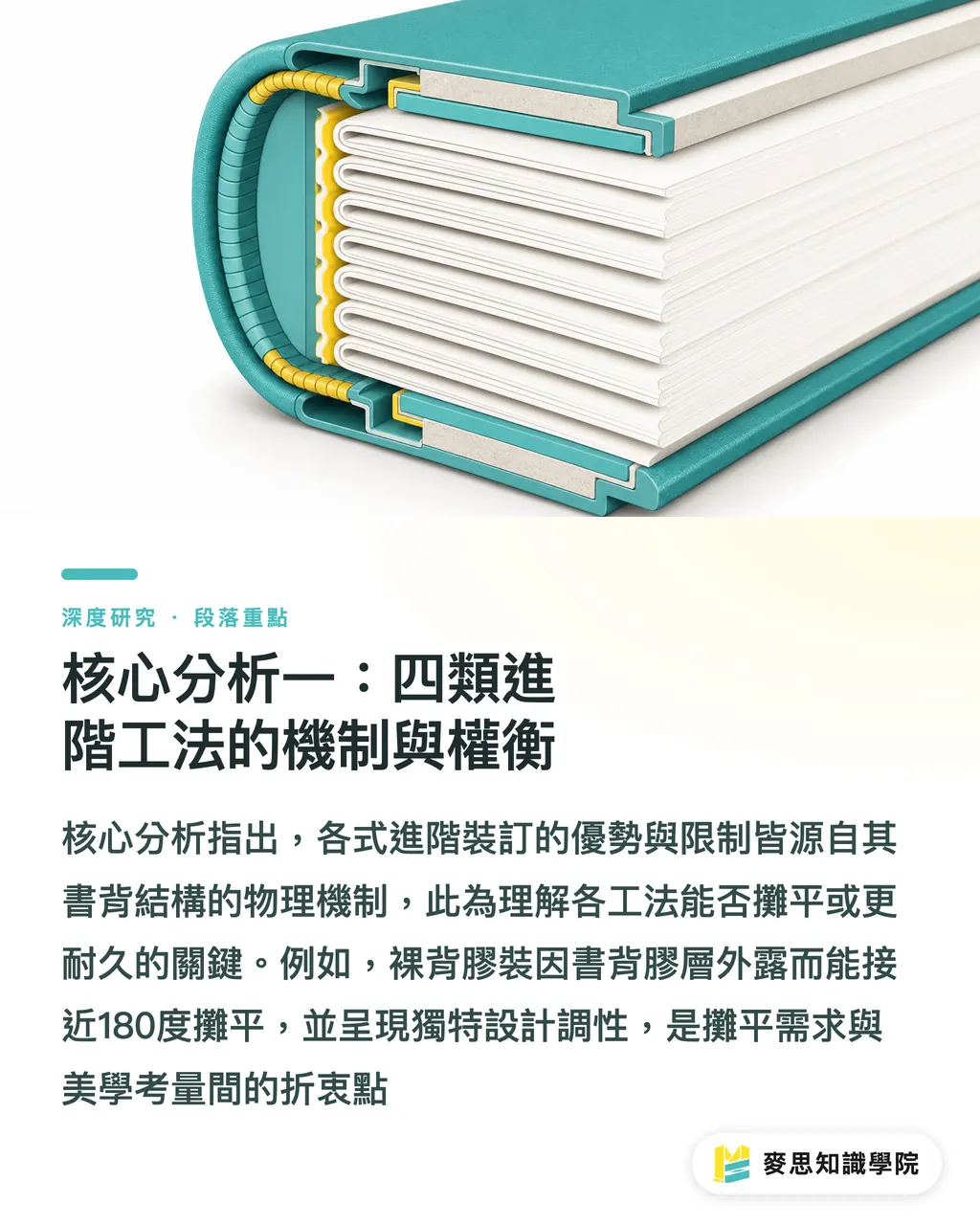
The core characteristic of exposed spine binding is that the spine adhesive layer is exposed and not covered by spine paper. Its mechanism allows the inner pages to lie flat near 180 degrees, while bearing an industrial/hipster aesthetic tonality of exposed structure. This article analyzes that exposed spine binding is the trade-off sweet spot between 'lay-flat demand' and 'design tonality': it is easier to lay flat than general perfect binding and cheaper than section sewing; however, exposed adhesive spines also mean that durability and protection are lower than techniques with spine covers, and it is more sensitive to adhesive quality
Section sewn binding uses threads to fix inner page signatures, supplemented by gluing. Its mechanism balances structural strength and lay-flat ability; therefore, among the four techniques, it is usually regarded as the option that is most durable while still able to lay flat. This article analyzes that section sewn binding is suitable for books expected to be flipped through repeatedly and needing long-term preservation, such as collectible portfolios or high-priced notebooks; the trade-off is more processing steps, and higher unit costs and production timelines than exposed spines
The mechanism of ring and spiral binding involves using metal or plastic rings to penetrate punched inner pages, allowing the pages to rotate around the axis. Its biggest advantage is the ability to fully fold and lay flat, even 360-degree folding, and it supports replacing inner pages. This article analyzes that this makes it irreplaceable in scenarios such as cookbooks, operating manuals, and supplementable workbooks that 'require laying flat for writing or frequent updates'; the limitation is that the tonality of exposed rings leans towards functional, making it difficult to present high-end quality, and the rings occupy gutter space
Hardcover uses hard cardboard to create the book case, and inner pages are mostly assembled with the case after section sewing or gluing. Its mechanism provides the strongest protection and highest visual specifications, making it a common choice for gift books, brand books, and commemorative publications. This article analyzes that the advantage of hardcover is that it peaks in both 'tonality and durability' dimensions, but the cost and production timeline are also the highest, and the hard case structure usually sacrifices the ability to lay completely flat (unless the inner pages are section sewn and designed for lay-flat)
In addition, Oriental stab binding/sewing is a traditional Eastern binding method, binding books at the side with threads, presenting an elegant, handmade cultural tonality. This article analyzes that it has a unique positioning in the 'tonality' dimension, suitable for projects emphasizing humanistic and craftsmanship senses, but lay-flat and durability are secondary appeals
Core Analysis II: A Five-Dimensional Decision Framework Driven by Usage Scenarios
This section proposes the core tool of this article: instead of asking 'which binding is best,' it is better to first define the usage scenario and then prioritize based on five dimensions. This article analyzes that binding selection is a multi-objective trade-off; there is no single best solution, only the optimal solution under specific weights
The five-dimensional framework is defined as follows:
・Lay-flat ability (whether it needs to lay flat for writing or complete presentation across spreads): For high demand, the priority order is Ring/Spiral > Section Sewn ≈ Exposed Spine > Hardcover
・Durability (whether it needs repeated flipping and long-term preservation): For high demand, the priority order is Section Sewn ≈ Hardcover > Exposed Spine > Ring/Spiral
・Flipping frequency (daily high-frequency vs. occasional flipping): High-frequency use leans towards the structural stability of section sewing or ring binding
・Budget (unit cost and quantity level): From low to high is roughly Exposed Spine < Ring/Spiral < Section Sewn < Hardcover (this article analyzes, actual ordering varies by quantity, size, and vendor)
・Tonality (functional orientation vs. quality/collection orientation): Functional orientation leans towards ring binding; hipster orientation leans towards exposed spine; collection orientation leans towards hardcover; humanistic craftsmanship orientation leans towards Oriental stab binding
Verifying this framework with scenarios shows its explanatory power. This article analyzes that: the primary weights for cookbooks and manuals are 'lay-flat + updateable,' so ring/spiral binding wins; the primary weights for collectible portfolios are 'durability + quality,' so section sewing or hardcover wins; for independent publications emphasizing design sense but with limited budgets, exposed spine perfect binding is often the trade-off sweet spot between lay-flat and cost; while gift and brand books pursue specifications and protection, making hardcover a reasonable choice
The value of this framework lies in transforming 'subjective preferences' into 'communicable weight rankings.' When the design and production sides use the same set of dimensions to talk, quotations and advice have a common benchmark, which can significantly reduce back-and-forth communication costs (this article analyzes)
Core Analysis III: Linking Binding and Final Artwork Planning
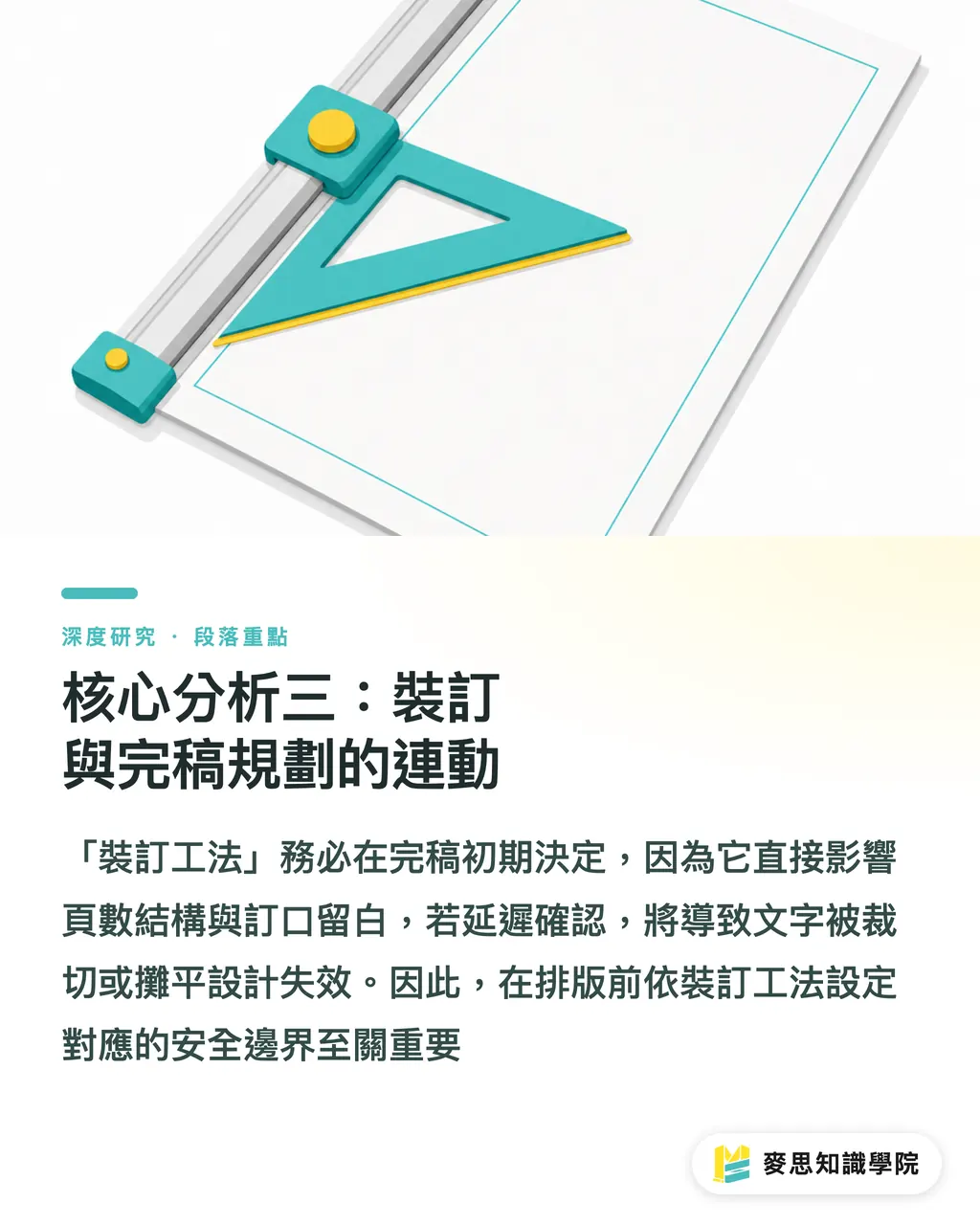
This section argues for an often underestimated principle: binding techniques must be decided at the beginning of final artwork, because they directly constrain page structure and gutter margins. Leaving binding to be chosen last often leads to text being cut off, failure to lay flat, or inability to execute
Regarding page structure, different techniques have different requirements for 'signatures.' Section sewing and hardcover are based on signature sewing, so page counts often need to match signature counts (e.g., multiples of 8 or 16 pages); saddle stitching needs multiples of 4; ring binding is relatively free. This article analyzes that if the technique is not locked in during the design phase, page count adjustments can trigger chain costs later
Regarding gutter margins, technique differences are even more critical. Adhesive bindings (including exposed spine and section sewn) will eat into the visible area near the spine due to gluing, so text and important elements near the gutter need to be indented; ring/spiral binding needs to reserve a safe distance for punching and rings, otherwise content will be destroyed by punch positions; hardcover also has grooves (hinge) near the spine that affect the visible area. This article analyzes that this is the root cause of rejections for 'binding edge text cut off' in final artwork, and the solution is to set corresponding gutter safety margins based on the technique before layout
Regarding lay-flat design, even if a lay-flat technique is chosen, if spread images span the spine, they may still be misaligned due to incomplete lay-flat. This article analyzes that although exposed spine is close to 180 degrees, it is still not completely flat; for images that truly need smooth spreads, ring binding or special lay-flat binding are safer choices
Implications for Taiwan's Design and Printing Industry
This section implements the aforementioned framework and discusses the actionable significance for small and medium-sized printing plants, designers, and brand owners. This article argues that the greatest benefit of the framework is establishing a common language for the three parties to shorten project cycles
For small and medium-sized printing plants, they can transform the 'five-dimensional decision framework' into a demand clarification checklist before quoting: first ask the customer for their priority in lay-flat, durability, frequency, budget, and tonality, then recommend corresponding techniques and compatible page and gutter specifications. This article analyzes that this can turn verbal experience into a standardized consultation process, reduce estimation errors and rework, and establish a differentiated positioning for high-value-added techniques such as exposed spine and section sewing
For designers, the implication is 'define binding first, then open the document.' At the beginning of layout, set gutter safety margins and page count multiples according to the technique, and evaluate lay-flat risks for spread images. This article analyzes that this can significantly reduce print rejections and also allow designers to proactively use binding as a design element for narrative and flipping rhythm rather than being passively limited
For brand owners, binding is a lever for budget and tonality. This article analyzes that brand books do not necessarily have to use hardcover; when the appeal is 'lay-flat display + design sense,' exposed spine or section sewing may better fit the usage scenario and have more controllable costs. Aligning binding choice with brand positioning and actual usage scenarios is more beneficial than simply pursuing the 'highest specification.'
Regarding process and timeline, this article analyzes that a front-end decision point should be established: lock in the technique, page count multiples, and gutter specifications at the project kickoff meeting, and require the vendor to provide the production timeline corresponding to the technique (hardcover and section sewing are usually significantly longer than exposed spine and perfect binding) to avoid listing schedules being blocked by binding processes
Conclusion and Limitations
This article responds to the research question in the introduction: advanced binding choices can be derived from the 'Lay-flat Ability, Durability, Flipping Frequency, Budget, Tonality' five-dimensional framework, sorted by the weights of usage scenarios, rather than seeking a single best technique. Exposed spine is a cost trade-off for lay-flat and design sense; section sewing provides a high-quality balance of durability and lay-flat; ring/spiral binding serves functional needs for lay-flat and updateability; hardcover peaks in protection and tonality; Oriental stab binding fills the tonality positioning of humanistic craftsmanship. The framework also requires binding decisions to be linked with page count and gutter margin planning at the beginning of final artwork
This article must honestly disclose limitations:
・First, the cost, schedule, and durability ordering of each technique in the article are generalized inductions and do not cite quantifiable empirical data; actual values are highly dependent on quantity, size, paper material, and individual vendors, and should be subject to on-site quotations
・Second, this article uses usage scenarios as the main axis and does not go deep into engineering aspects such as material chemistry (adhesive weather resistance, wire strength) and machine differences
・Third, the weight ordering of the framework still contains subjective judgment and lacks support from user experience measurement
Subsequent research directions include: establishing durability and lay-flat angle measurements for each technique under standard conditions, verifying the 'flipping frequency, binding life' relationship with user tests, and digitizing the five-dimensional framework into a quotation and selection tool that can be imported into printing SaaS, making the dialogue between the design side and production side more standardized
Key Takeaways
Binding is not a post-print accessory but a multi-objective decision that impacts costs, experience, and tonality; there is no single best solution
Sorting by the five dimensions—'Lay-flat Ability, Durability, Flipping Frequency, Budget, Tonality'—to select a technique based on the usage scenario is most reliable
Exposed spine compromises between lay-flat and design sense, section sewing is most durable and can lay flat, ring/spiral binding specializes in lay-flat and updateability, and hardcover peaks in specification and protection
The technique must be decided at the beginning of final artwork because it constrains page count multiples and gutter safety boundaries, which are the root causes of rejections due to text being cut off
Brand books do not necessarily have to be hardcover; aligning with usage scenarios is often more cost-effective than pursuing the highest specifications
Extended Thinking
For printing production, the five-dimensional framework can become a standardized consultation script before quoting, turning the verbal experience of senior masters into a replicable selection process and establishing differentiation in high-value-added techniques like exposed spine and section sewing. For the design side, the implication is 'define binding before opening the document,' moving gutter and page count multiples to the start of layout. For AI and SaaS adoption, the most valuable unsolved problem is structurally mapping 'usage scenario weights' to 'technique, page count, gutter, timeline, and quotation' to create a selection and estimation engine, giving the three parties a common benchmark for dialogue. The key gap for the next step is the lack of quantifiable measurement data for durability and lay-flat angles, which is both a research opportunity and a prerequisite for making decision tools more credible
FAQ
- What is the difference between exposed spine and section sewn binding, and how should I choose?
- Exposed spine has an exposed spine layer, can lay flat near 180 degrees, and has a hipster design sense, with lower cost but average durability. Section sewing uses threads to fix signatures before gluing, which is the most durable and can also lay flat, but the process and cost are higher. Choose section sewing for books that need to be flipped through repeatedly for a long time, and choose exposed spine for design sense and budget control
- Which binding allows for writing while laying completely flat?
- Ring and spiral binding can be fully folded to lay flat or even folded back, making them suitable for cookbooks and operating manuals. Exposed spine and section sewing can lay close to flat but are not completely level surfaces. Hardcover cases are usually more difficult to lay completely flat
- Must I use hardcover for brand books?
- Not necessarily. Hardcover has the highest specifications and protection but also the highest cost and timeline. If the goal is lay-flat display plus design sense, exposed spine or section sewing often better fit the usage scenario and save costs. Decisions should be made based on brand positioning and actual usage scenarios
- Why must the binding method be decided before layout?
- Because different techniques have different requirements for page count multiples and gutter margins. Adhesive binding will eat into the visible area near the spine, while ring binding needs to reserve distance for punching. If the technique is changed after layout, it easily leads to text being cut off, failure to lay flat, or inability to execute
- What kind of binding is suitable for books with many pages?
- Books with many pages tend to use perfect binding or section sewing because they can accommodate more signatures and maintain spine structure. Ring binding is limited by ring capacity, and saddle stitching is only suitable for thin books. The actual upper limit needs to be confirmed based on paper thickness and the vendor's machinery
References
- 活頁出版品的編製建議(Recommendations for Loose-leaf Publications) · BSI British Standards活頁形式的內頁抽換與編製規範
Related articles
The Print × AI weekly
The print and AI know-how designers, brands and enterprises can use before they commit — one email, every week
MINDS Free Tools
Spine width and imposition calculators — skip the manual math, free in your browser.
MINDS Group
Need actual printing or gifting services?
From premium printing to online ordering and festive gifts — the MINDS Group sister brands take it from here.