
What's the Actual Difference Between Saddle Stitch, Perfect Binding, and Smyth Sewn?
After years of taking on print projects, I've noticed that most people treat binding as a throwaway final step, when in reality it should be decided the moment you open a new file
Let me break down the three most common methods clearly
・Saddle stitch: Pages are folded and stapled through the centerfold, like straddling a saddle, which is exactly where the name comes from
・Perfect binding (also called adhesive binding): Page signatures are gathered together, glue is applied to the spine, and a cover wraps around them. This is the most common method for general trade books
・Smyth sewn: Each signature of pages is first sewn together with thread, then the whole book is glued and covered. The extra sewing step makes it the most durable of the three
The difference isn't just about which machine is used, it's about what holds the pages in place
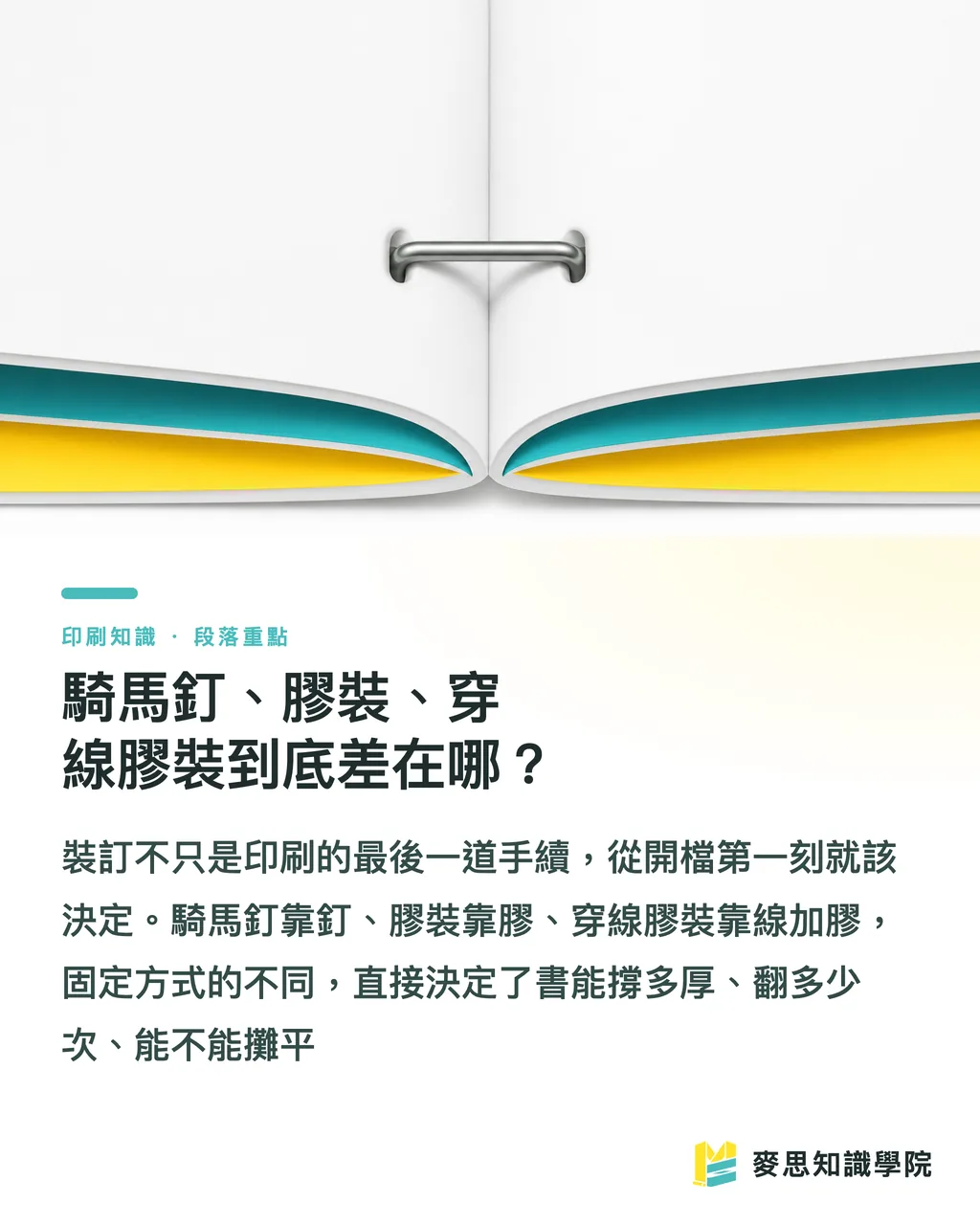
Saddle stitch relies on staples. Perfect binding relies on adhesive. Smyth sewn relies on thread plus adhesive
That distinction directly determines how thick a book it can handle, how many times it can be opened, and whether it can lie flat
Why Is Saddle Stitch the Smart, Economical Choice for Thin Books?
Saddle stitch is the go-to for thin books, and the reasons are purely practical
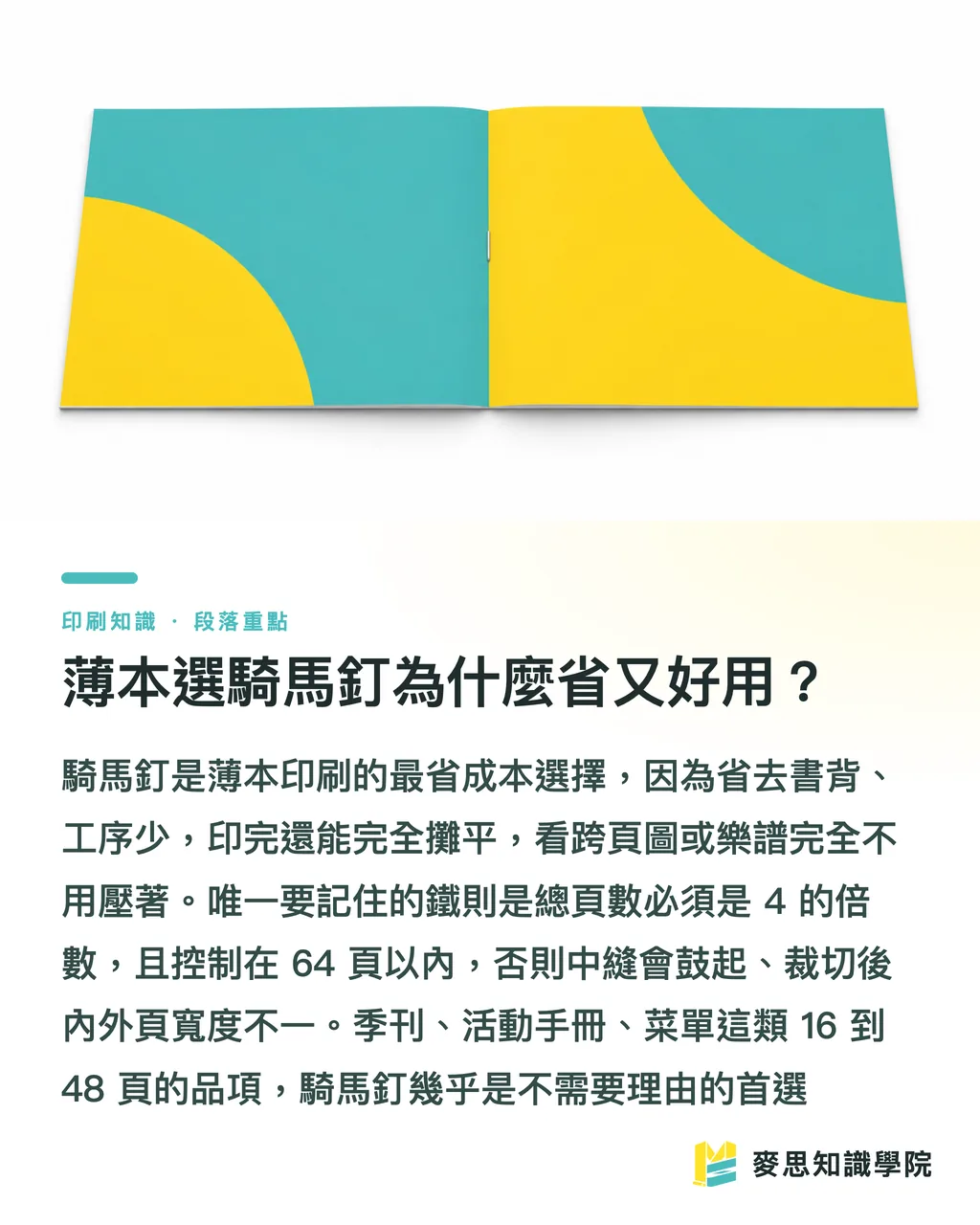
There's no spine, the whole thing is just a few sheets folded and stapled with two or three staples. It's fast to produce, uses minimal materials, and therefore has the lowest unit cost
When opened flat from the centerfold, the book lies completely flat on a table. That makes it ideal for spreads, sheet music, and recipes, no need to press it down
That said, there are two hard rules you need to know before going this route
・Total page count must be a multiple of 4: One sheet folded gives you four surfaces, two on each side. That's a physical constraint, not just a guideline
・There's a maximum page count: Generally around 64 pages. Beyond that, the centerfold starts to bulge outward, causing the outermost pages to protrude. After trimming, inner and outer pages end up at different widths
What works best with saddle stitch?
Seasonal magazines, event booklets, product brochures, menus, and small portfolios, typically 16 to 48 pages, opened occasionally. Saddle stitch is affordable and lies flat. It's more than enough
I often tell clients: if you're under 64 pages, want to save money, and need it to lie flat, saddle stitch should be your first instinct. Only rule it out if you have a specific reason not to use it
Do Thick Books Need a Spine, Is Perfect Binding the Only Way?
Once the page count pushes past the saddle stitch limit, perfect binding steps in
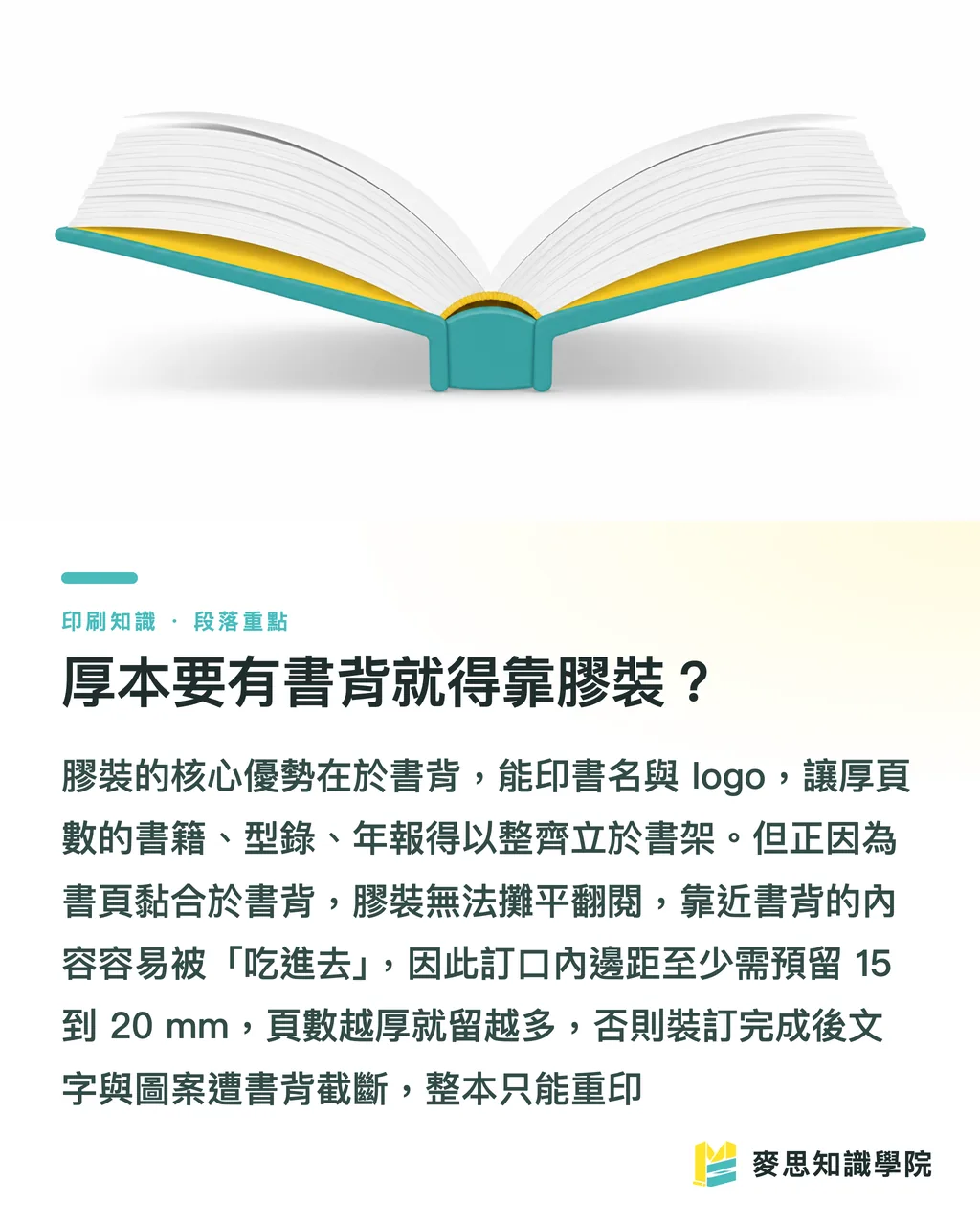
The biggest value of perfect binding is the spine
A spine lets you print the title and logo, so books can be found at a glance when shelved, something saddle stitch simply can't offer
Standard books, catalogs, annual reports, textbooks, and dissertations routinely run into the hundreds of pages. Only perfect binding (or Smyth sewn) can handle that kind of thickness
The trade-off with perfect binding is that it won't lie flat
Because pages are glued to the spine, content near the binding is harder to see. You have to hold the book open with your hand, let go and it closes
This leads to the most commonly overlooked detail, and the one most likely to cause expensive reprints: gutter margin
The gutter is the inner margin, on the side closest to the spine
・With saddle stitch, the book lies flat, so the gutter can be smaller
・With perfect binding, content near the spine gets 'swallowed,' so the inner margin must be noticeably larger than the outer margin
I've seen far too many jobs where text or key visuals were placed too close to the spine, and after binding, a chunk of content was eaten up. The entire run had to be reprinted
As a general rule, leave at least 15 to 20 mm for the gutter in a perfect-bound book. The thicker the book and the smaller the opening angle, the more margin you need
There's one more thing worth flagging: full-bleed spreads
Because perfect binding doesn't open fully flat, images across a spread won't align cleanly at the spine seam. If you need large double-page spreads, Smyth sewn will give you a noticeably better result than standard perfect binding
Thick, Lay-Flat, and Built to Last: Is Smyth Sewn Worth It?
If your requirements are 'thick, frequently opened, needs to lie flat, and should last for years,' the answer is almost always Smyth sewn
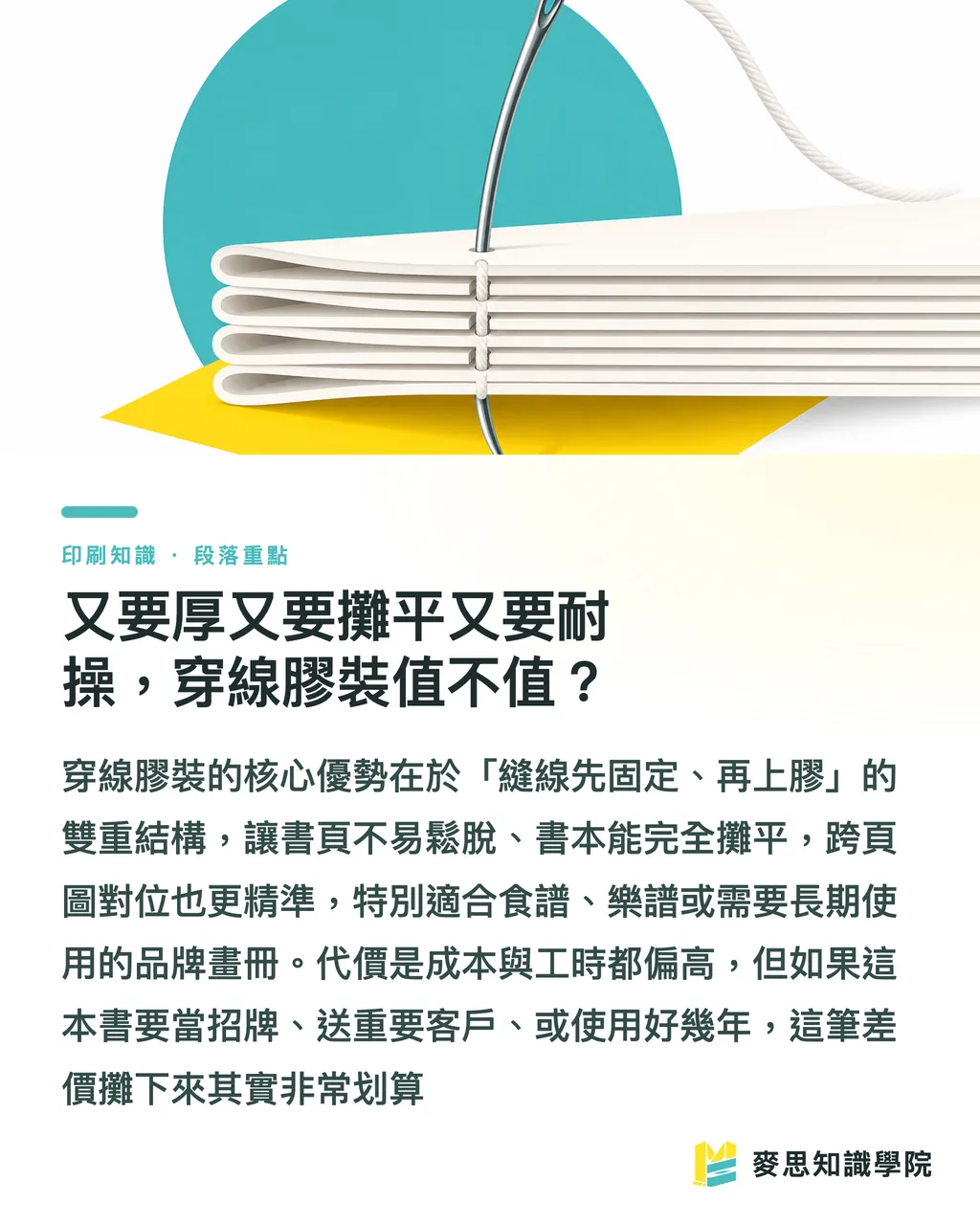
The key design feature is the thread
Each signature of pages is sewn securely before the entire book is glued and covered, giving you two layers of reinforcement
This delivers three advantages that standard perfect binding can't match
・Maximum durability: No matter how often or how forcefully it's opened, pages are far less likely to detach from the spine. The loose-page and falling-page problems common with worn-out perfect-bound books are much rarer with Smyth sewn
・Lies flat: The sewn structure allows pages to open flatter than standard perfect binding, ideal for cookbooks, sheet music, technical manuals, and premium photo books
・Cleaner spreads: Because it opens wider, double-page images align much more precisely at the seam compared to perfect binding
The cost, naturally, is higher, and turnaround times are longer
The extra sewing step drives the price up, and rush jobs are harder to accommodate
Here's how I typically frame it for clients
・One-off, read-once-and-discard? Don't spend the extra money, perfect binding is fine
・If it's meant to make an impression, go to an important client, be used for years, or be preserved (think commemorative books, brand books, premium catalogs) — spread the cost difference across the lifespan of the piece and Smyth sewn is absolutely worth it
As for hardcover binding, it typically wraps a hard shell around a Smyth sewn (or perfect-bound) text block
Hardcover is about prestige and protection, graduation albums, collector's editions, and high-end brand books. I won't go deep on it here; just remember it's a combination of 'a binding method for the text block' plus 'a hard cover.'
One Table and One Decision Tree, Make the Call on the Spot
Here's the decision logic distilled into a sequence you can apply immediately
Step one: look at the page count
・4 to 64 pages, and a multiple of 4: saddle stitch enters the shortlist
・Over 64 pages: skip saddle stitch entirely and choose between perfect binding and Smyth sewn
Step two: consider 'how often will it be opened, and does it need to lie flat?'
・Opened infrequently, flat opening doesn't matter: perfect binding
・Opened frequently, needs to lie flat for spreads (cookbooks, sheet music, manuals): Smyth sewn
・Thin book that still needs to lie flat: saddle stitch is the most cost-effective choice
Step three: consider spine requirements and budget
・Needs a printable spine for shelving display: perfect binding at minimum
・Needs to last for years and budget allows: Smyth sewn
・Lowest possible cost: use saddle stitch if you can
Quick comparison across all three
・Page count, Saddle stitch: thin books, roughly 64 pages or fewer; Perfect binding: works for thick books; Smyth sewn: works for thick books
・Spine, Saddle stitch: none; Perfect binding: yes, printable; Smyth sewn: yes, printable
・Lies flat, Saddle stitch: fully flat; Perfect binding: does not lie flat; Smyth sewn: lies flat
・Durability, Saddle stitch: moderate; Perfect binding: moderate; Smyth sewn: highest
・Cost, Saddle stitch: lowest; Perfect binding: mid-range; Smyth sewn: highest
・Page count restriction, Saddle stitch: must be a multiple of 4; Perfect binding: more flexible; Smyth sewn: more flexible
One final reminder that's almost always forgotten
The binding method needs to be decided when you open the file and start laying out pages, not after printing
It directly affects your gutter margin, whether the page count needs to be rounded up to a multiple of 4, and how you position any double-page spreads
These days, the first thing I confirm when reviewing a client's file isn't the color, it's 'how is this being bound?'
Once binding is decided, gutter, page count, and bleed can all be set correctly the first time. One less reason to reprint
Key Takeaways
・Binding isn't the last step, it's the first decision, made before you open the file. It drives your gutter margin, page count, and spread layout
・For thin books (roughly 64 pages or fewer, in multiples of 4) where budget matters and flat opening is needed, saddle stitch is almost always the default answer
・The value of perfect binding is a printable spine; the trade-off is that it doesn't lie flat and content near the spine gets swallowed up
・For a book that's thick, opened often, needs to lie flat, and has to last, only Smyth sewn checks all the boxes. What you're paying for is that extra sewing step
・For perfect-bound books, leave at least 15 to 20 mm for the gutter margin, more for thicker books, or critical content will be swallowed by the spine
Food for Thought
The most transferable lesson from thinking about binding is the mindset it forces: working backward from the finished product to the file. The same logic applies to design and process planning in general, start by asking how long this piece needs to last and how it will actually be used, then determine the specs, rather than trying to patch things up after the fact. The practical next step is simple: next time you receive a multi-page print job, resist the urge to jump straight into color and layout. Run the page count, open frequency, flat-opening requirement, and budget through the decision tree above first. Five minutes to lock in the binding method can save the cost of reprinting an entire run. For print buyers, turning this kind of judgment into a standard checklist item, something confirmed before a quote is even issued, saves more money and signals more professionalism than any flashy finishing technique
FAQ
- Why does saddle stitch require a page count that's a multiple of 4?
- Because saddle stitch works by folding a full sheet and stapling through the centerfold, one sheet folded gives you four surfaces, two on each side. That's a physical constraint, not a preference. So the total page count must be rounded up to a multiple of 4; if you're a page or two short, you'll need to add blank pages or adjust your content
- What's the difference between perfect binding and Smyth sewn, and is the extra cost worth it?
- Perfect binding holds pages together with adhesive along the spine. Smyth sewn adds an extra step, sewing each signature before gluing, which means better durability and a flatter open. Smyth sewn pages are far less likely to fall out with heavy use, and the book can lie flat for clean spreads. If the piece needs to hold up for years or is going to an important client, the price difference is well worth it
- How much gutter margin should I leave so content doesn't get swallowed by the spine?
- With saddle stitch the book lies flat, so the gutter can be smaller. With perfect binding, content near the spine gets pulled into the binding and becomes hard to see, a minimum of 15 to 20 mm for the gutter is generally recommended, with more needed as the book gets thicker and the opening angle decreases
- Can I still use saddle stitch for books over 64 pages?
- Not recommended. As the page count climbs, the centerfold starts to bulge outward, causing the outermost pages to protrude. After trimming, inner and outer pages end up at different widths. Once you're pushing past roughly 64 pages, switch to perfect binding or Smyth sewn
- Which binding is best for full-bleed double-page spreads?
- Perfect binding doesn't open flat, so images across a spread won't align cleanly at the spine seam, they can appear broken or mismatched. If you want spreads that look sharp and continuous, Smyth sewn is the better choice: the wider opening angle means the seam alignment is noticeably cleaner than with standard perfect binding
Related articles

The Print × AI weekly
The print and AI know-how designers, brands and enterprises can use before they commit — one email, every week
MINDS Free Tools
Spine width and imposition calculators — skip the manual math, free in your browser.
MINDS Group
Need actual printing or gifting services?
From premium printing to online ordering and festive gifts — the MINDS Group sister brands take it from here.