
How to Calculate Pages and Sheets to Avoid Rejection
Many novice buyers make the mistake of confusing 'sheets' with 'pages (P)' when placing print orders
A single sheet of paper has a front and a back side, so in print industry jargon, one physical sheet of paper equals two pages
Every binding method has its own page-count limits. It is best to master these general rules of thumb before placing an order:
・Saddle Stitching: The page count must be a multiple of 4, and it is generally recommended to keep it under 64 pages
・Perfect Binding: A minimum of 32 pages is recommended so the book is thick enough for glue application and spine text printing
・Spiral Binding: Featuring a 360-degree rotation, it is perfect for work manuals and practical notebooks
・Smyth Sewn Binding: Offers excellent lay-flat capability, making it ideal for photo books and catalogs that need to display full two-page spreads
・Hardcover Binding: Requires fabricating rigid board cases, resulting in relatively higher minimum order quantities and longer turnaround times
Why Do Your Carefully Formatted Spreads Get Ruined in Print?
Designing two-page spreads in InDesign feels intuitive, but what looks perfect on screen is often a disaster on the production line
When choosing saddle stitching, the most fatal mistake is overlooking 'creep' compensation
As the page count approaches the 64-page limit, inner pages are pushed outward by the outer sheets. Once trimmed, the inner margins of the layout will be cut off
If you choose perfect binding, the biggest pitfall is text being swallowed by the gutter
Perfect-bound books cannot lie completely flat; about 5 to 10 mm of text and images near the spine will be buried deep inside the gutter
I often see clients place important faces or headlines right in the middle of a two-page spread, which is bound to be a tragedy when printed
How to Make a Smart Choice Between Budget and Lay-Flat Usability
Selecting a binding method is essentially a multi-objective trade-off; there is never a single best solution
If you are responsible for a brand yearbook or a premium catalog that requires seamless visual presentation,
I strongly recommend opting for Smyth sewn binding, a method that allows the book to lay perfectly flat at 180 degrees
Although it costs more than standard perfect binding, the reading experience and durability are on a completely different level
When choosing paper stocks, thickness must also be considered. Thicker paper is harder to turn, making the choice of binding method even more critical
What Production Realities Should You Assess for Hardcover Books?
Clients often feel that hardcover books naturally carry a premium vibe, without realizing the hidden hurdles behind them
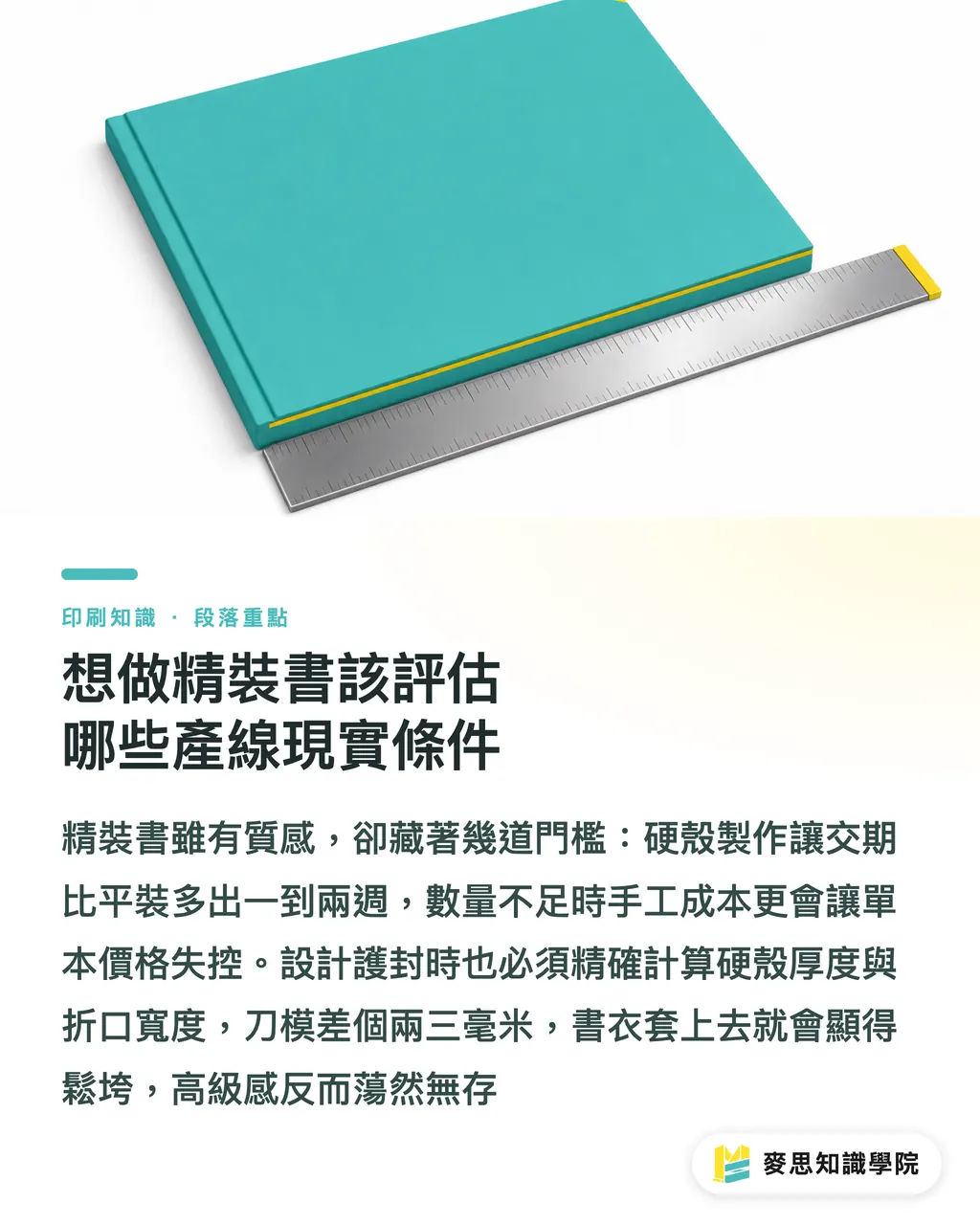
Hardcover books require extra work to manufacture the rigid cardboard cases, meaning bulk production times are typically one to two weeks longer than paperback books
From my hands-on experience with clients, if the order volume is too small, the manual labor cost allocated per book will be staggeringly high
Additionally, when designing dust jackets, you must precisely calculate the thickness of the case and the width of the flaps
If the die-cut dimensions are off by even two or three millimeters, the jacket will look loose and sloppy rather than snug
Key Takeaways
・Confirm that the page count is a multiple of 4 before placing an order to avoid the most common reason for saddle stitching rejection
・Be sure to leave a 5 to 10 mm safety margin at the binding edge of perfect-bound books to prevent images and text from being swallowed
・Select Smyth sewn binding for catalogs that require seamless two-page spreads, and choose spiral binding for practical manuals that need to fold 360 degrees
・The premium feel of a hardcover book is built on a higher budget and longer production timelines; the precision of the dust jacket dimensions determines the final success
Further Reflections
For the printing manufacturing and SaaS industries, if front-end layout software could integrate with print shop die-cut and binding parameter APIs, designers could receive automatic warnings about text being swallowed by the gutter or suggestions for creep compensation the moment they finish a layout. Such a preventive proofing mechanism would drastically reduce rejection rates on the production line, serving as the perfect entry point for MINDS MINDS Printing to showcase its strength in one-stop integrated services
Further Reading
・How to Choose Between Saddle Stitching, Side Stitching, Perfect Binding, and Hardcover? A Complete Comparison of Binding Methods for Print Procurement
FAQ
- Is there a page limit for saddle stitching?
- It is generally recommended to keep it under 64 pages. Anything thicker will cause the spine to bulge, preventing it from folding flat, and will lead to severe creep in the inner pages
- Can text be printed on the spine of a perfect-bound book?
- Yes, but only if the book meets a minimum thickness requirement. It is generally recommended to have at least 32 pages to provide enough space on the spine for printing
- Why are photo books rarely bound using perfect binding?
- Because perfect binding cannot lay flat at 180 degrees, which disrupts the continuity of photos spanning across two pages. For such requirements, Smyth sewn binding is typically used instead
- Is there a big difference in production times between hardcover and paperback books?
- Yes. Hardcover books involve complex processes like making the rigid cases and pasting the covers, so production timelines are usually one to two weeks longer than those for paperbacks
Related articles
The Print × AI weekly
The print and AI know-how designers, brands and enterprises can use before they commit — one email, every week
MINDS Free Tools
Spine width and imposition calculators — skip the manual math, free in your browser.
MINDS Group
Need actual printing or gifting services?
From premium printing to online ordering and festive gifts — the MINDS Group sister brands take it from here.