

Overview
Should your file be saddle stitched, perfect bound, sewn, or spiral bound? In all my years directing designers and print buyers, this is the question I hear most. People usually ask it way too late, long after layouts are finished. Switching binding methods at that point often forces you to rework the entire layout
Binding is never just a finishing detail. From day one, it dictates three things: reading experience, shelf life, and production cost. Skip memorizing spec sheets today. I will walk you through real-world scenarios to make the decision logic completely clear
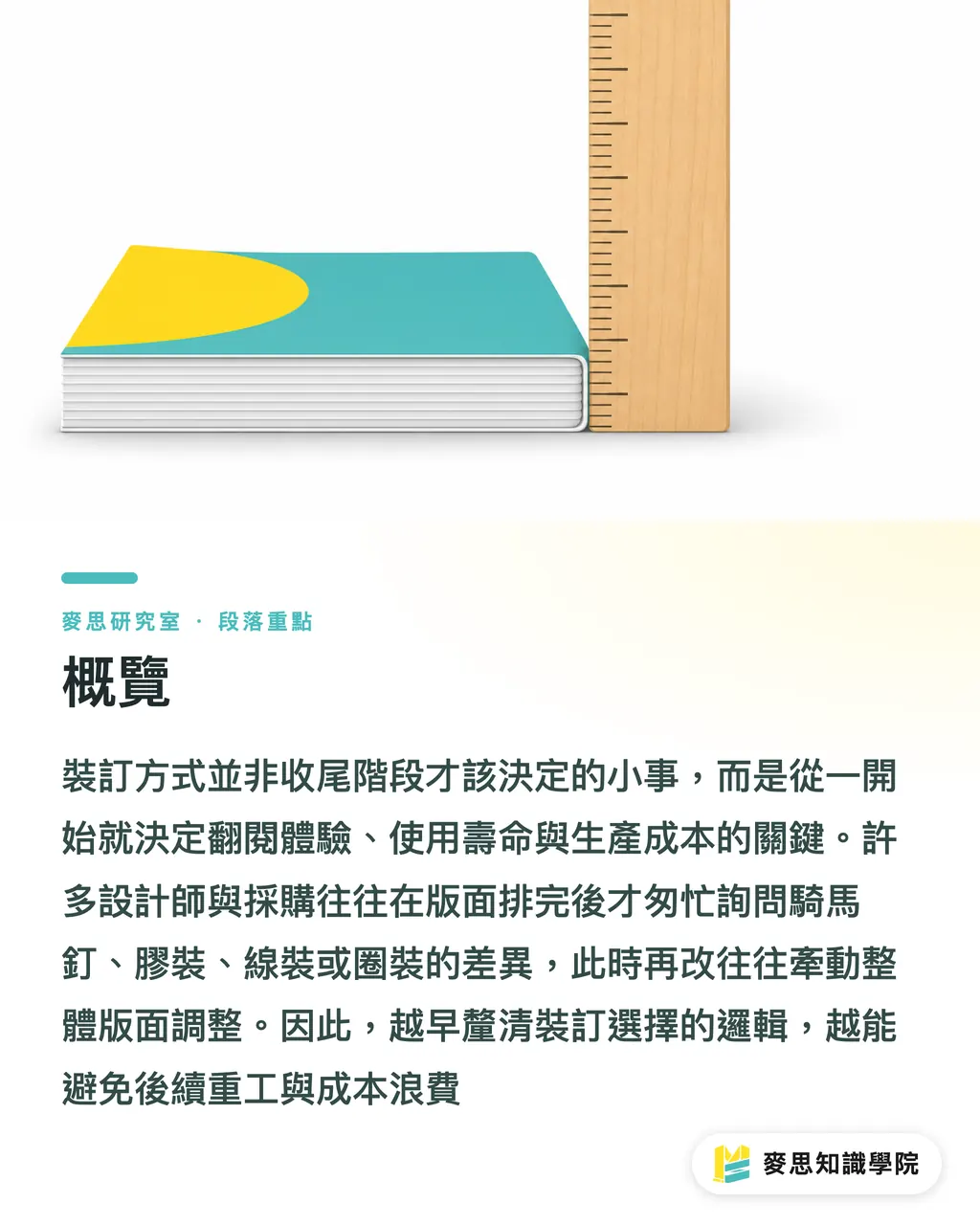
Why Page Count Is the First Big Filter in Choosing Your Binding
The fastest way to narrow your options is always looking at where your page count lands
At its core, saddle stitching nests folded sheets inside each other and staples them through the spine fold with wire. The English verb 'saddle-stitch' refers to binding folded sheets through the center fold with wire or thread. The Oxford English Dictionary defines it as securing folded sheets along the crease with wire. This creates an inescapable physical rule: because sheets are folded and nested, total page count must be a multiple of 4. For a slim booklet between 16 and 64 pages, saddle stitching is almost always your cheapest and fastest solution
Cross a certain threshold, though, and saddle stitching turns against you. In my experience, that limit sits right around 64 pages. Any thicker, and the gap between the outermost and innermost sheets becomes too wide. The inner pages start creeping outward, bulging out, and the trimmed edges end up uneven. That is when you need to switch to perfect binding
Perfect binding stacks trimmed pages, mills the spine, and wraps them in hot-melt glue. You need at least 64 pages to hold the block tight and give the spine enough bulk for printed text. If you climb higher into keepsake books or luxury gifts, that is where hard-case binding comes in. Lock down your broad direction with page count first, and you will save yourself endless trial and error
Laying Flat vs. Durability: Why You Rarely Get Both
The second dimension comes down to how this piece will actually be used
If it sits on a desk for hands-on reference, like cookbooks, sheet music, training manuals, or workbooks people write in, lay-flat performance beats everything else. Spiral or coil binding is practically unbeatable here. It flips 360 degrees, lays completely flat, folds back on itself, and never snaps shut on a table
The coil structure makes flipping pages effortless. The trade-off is clear: you get no flat spine, making it hard to identify on a bookshelf, and the finished piece feels like a working tool rather than a prestige publication
Standard perfect binding gives you the exact opposite. You get a neat spine that sits well on shelves and takes title printing easily, but traditional glue-only binding lays flat poorly, and forcing it open cracks the spine. If you want the best of both worlds, go with sewn perfect binding (Smyth sewn with a soft cover). Signatures are thread-sewn before glue wraps the spine, delivering far better lay-flat flexibility and durability than standard glue. The catch is an extra step in production, higher unit cost, and longer turnaround times
Here is the plain truth: laying flat, long durability, low cost, and a shelf-ready spine rarely go together. You must rank which single factor this print project cannot sacrifice, and treat everything else as a compromise
Prepress Pitfalls: Which Binding Allowances Trigger File Rejections?
Picking the right binding is only half the battle. If your prepress layout ignores the physical realities of that binding, the printer will still bounce your files
The first trap is spine width in perfect binding. Spine bulk is never a fixed number. It shifts with your page count and paper basis weight. For 120 pages, 100 lb and 150 lb uncoated paper yield very different spine widths. Before finalizing prepress files, ask your printer for the exact calculated spine width so spine text and bleeds align properly. If your spine estimate falls short by even 1 to 2 mm, your cover title will shift right into the gutter
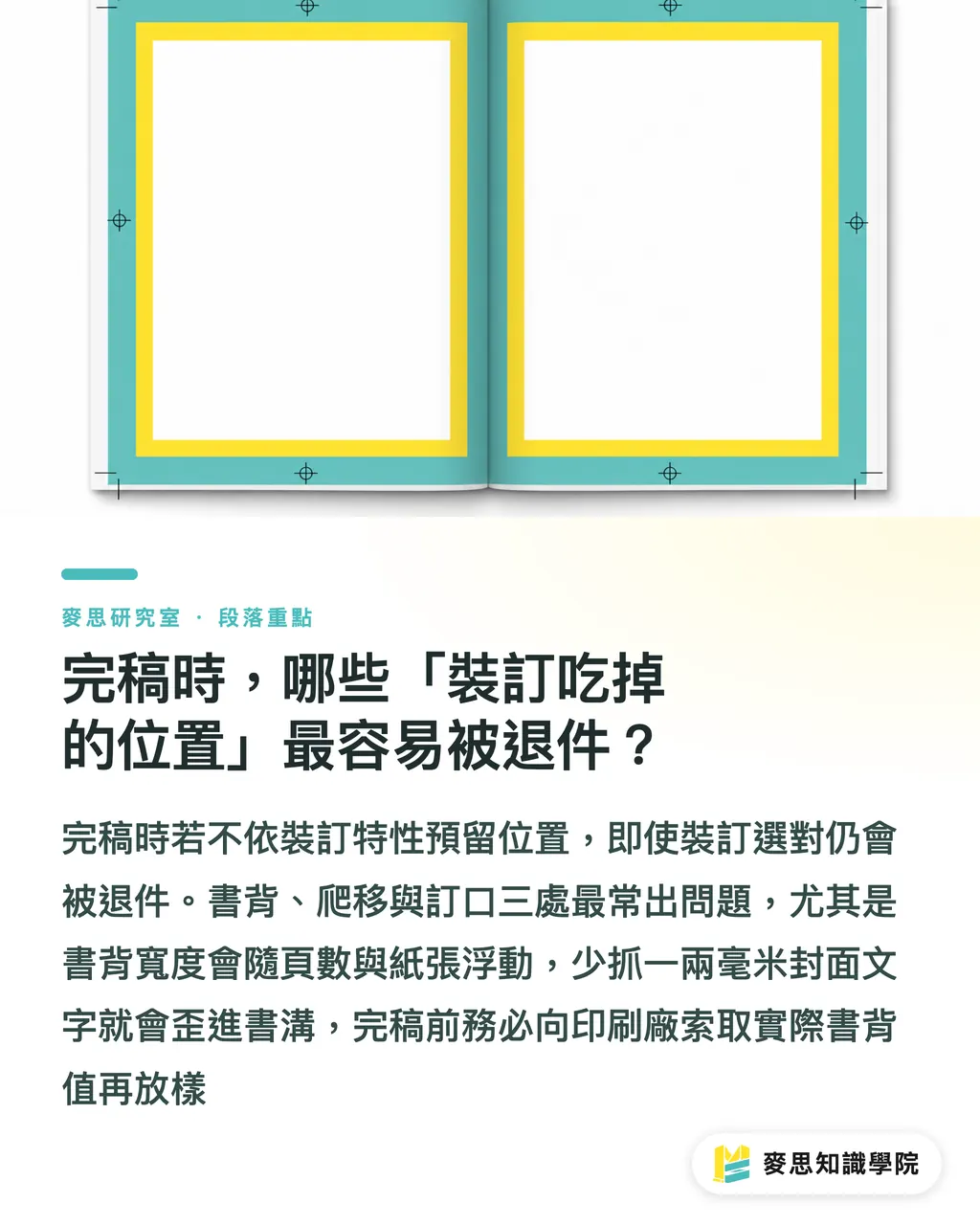
The second issue is saddle-stitch creep, also known as push-out. Because nested sheets wrap around each other, inner pages get pushed outward and end up trimmed narrower. If your spreads place important elements too close to the outer trim edge, those center signatures will lose artwork under the knife. Professional prepress workflows apply creep compensation during imposition, shifting inner page layouts slightly toward the spine gutter
The third trap affects every binding style: gutter margins. Perfect binding, case binding, and sewn binding all swallow visual space along the spine. Placing text too close to the gutter leaves words buried in the fold when opened. My recommendation is to add 3 to 5 mm of extra safety margin along the spine edge compared to the outer edge, while spiral binding requires clearing the punch hole area entirely. Decide these margins at the very start of design layout, not as an afterthought right before export
Matching Common Print Projects to the Right Binding
Bringing these principles together, common corporate print pieces fall into fairly clear categories
Event programs, exhibition flyers, and slim quarterly bulletins have low page counts, short lifespans, and call for high volumes at low cost. Saddle stitching is the textbook answer here, fitting its role for slim, budget-friendly booklets built in multiples of 4 [1]. Corporate catalogs and complete product directories run thicker, need to stand on display shelves, and require a printed spine for branding. Perfect binding works best there. If that catalog needs to last a year or two through frequent flipping, upgrading to sewn perfect binding will dramatically improve durability
Employee handbooks, training materials, and SOP manuals prioritize laying flat for note-taking or easy page swaps. Spiral binding or ring binders are the top picks here. When content requires updates, loose-leaf systems let you swap individual sheets instead of reprinting the entire book. Annual reports, brand books, and luxury showpieces published once a year are about making a statement, justifying the hardcover expense and longer production lead times of case binding
Here is a shortcut I share often: ask how long this piece needs to survive and how people will physically handle it. Disposable print goes to saddle stitch. Reference pieces you keep nearby go to perfect binding or spiral. Keepsakes and luxury gifts get case binding or sewn binding. Clarify lifespan and handling frequency, and the right binding picks itself
How to Move Forward Without Tripping Up
If you are getting ready to send a project to print, my advice is simple: nail down your page count before requesting quotes, keeping it at a multiple of 4 to leave room for saddle stitch flexibility. Clarify how long the piece must last and whether it must lay flat. Then bring your paper weight to the printer to get an accurate spine calculation. Locking down these three details turns your supplier conversation from 'I have no idea what to pick' into 'This is what I need, send me the prepress specs.' You save far more than budget. You save days of revision rounds
Key Takeaways
Start with page count: 16 to 64 pages points to saddle stitch (must be a multiple of 4), anything over 64 calls for perfect binding, and reserve case binding for thicker, premium pieces
Laying flat, durability, low cost, and a shelf-ready spine rarely coexist. Rank the one quality you cannot sacrifice before picking your method
For perfect binding, always confirm the calculated spine width with your printer before final art. It changes with page count and paper weight, never sitting at a fixed number
Apply creep compensation for saddle stitch, add 3 to 5 mm of extra margin along the spine for all bindings, and never place key content tight to the gutter
Match by use case: event programs go to saddle stitch, catalogs go to perfect binding, updateable manuals go to spiral or loose-leaf, and annual brand books go to case or sewn binding
Broader Implications
The deeper takeaway for the industry is that binding choices are multi-variable trade-offs, exactly where rules engines and AI can step in. On the print manufacturing side, spine width, creep compensation, and gutter margins follow clear formulas. Building automated tools that take page count, paper weight, and binding method to output prepress specs and imposition offsets would cut manual errors and file rejections. On the design side, software plugins and prepress SaaS could flag binding limitations directly inside layout tools, catching problems early instead of at prepress handoff. For AI adoption, the challenge is never the math, which is simple. The real hurdle is turning shop-floor tolerances, paper inventories, and press limitations into dependable knowledge bases. Most of that know-how still lives in veteran pressmen's heads without structured data. Whoever turns that tacit craft into searchable, verifiable digital assets will capture the most valuable piece of digital transformation in print
References
[1] Saddle Stitch. The Visual Dictionary of Pre-Press & Production. DOI: 10.5040/9781474293747.0199
FAQ
- What is the maximum page count for saddle stitching?
- In practice, 16 to 64 pages is ideal, and your total page count must be a multiple of 4. Beyond roughly 64 pages, the difference between inner and outer sheets causes creeping and uneven edge trimming. At that point, switch to perfect binding
- How do you calculate spine width for perfect binding?
- Spine width is not a static figure. It changes based on total page count and paper weight. The safest approach is giving your page count and paper specifications to your printer, having them calculate the exact spine bulk, and setting your spine typography and bleeds to that exact number
- Which binding should you choose for a manual that must lay completely flat?
- Go with spiral or coil binding first. It rotates 360 degrees and lays completely flat, making it ideal for hands-on workbooks, cookbooks, and training materials. If you also need shelf presence and greater durability, look into sewn perfect binding
- What is creep in saddle stitching, and how do you handle it in prepress?
- Creep refers to inner sheets being pushed outward in saddle-stitched booklets, which leaves their trimmed margins narrower. In prepress, apply creep compensation during imposition by shifting inner page content slightly toward the gutter, and keep key artwork away from outer trim edges
- Should a corporate catalog use perfect binding or case binding?
- Standard perfect binding works well for most corporate catalogs and master product directories, giving you shelf appeal and printable spine space. If budget allows, or if the book needs to last years or project prestige, upgrade to sewn perfect binding or hardcover case binding
References
- saddle stitch · doi.org
- Saddle Stitch · doi.org
- Spiral Energy · doi.org
Related articles


The Print × AI weekly
The print and AI know-how designers, brands and enterprises can use before they commit — one email, every week
MINDS Free Tools
Spine width and imposition calculators — skip the manual math, free in your browser.
MINDS Group
Need actual printing or gifting services?
From premium printing to online ordering and festive gifts — the MINDS Group sister brands take it from here.