

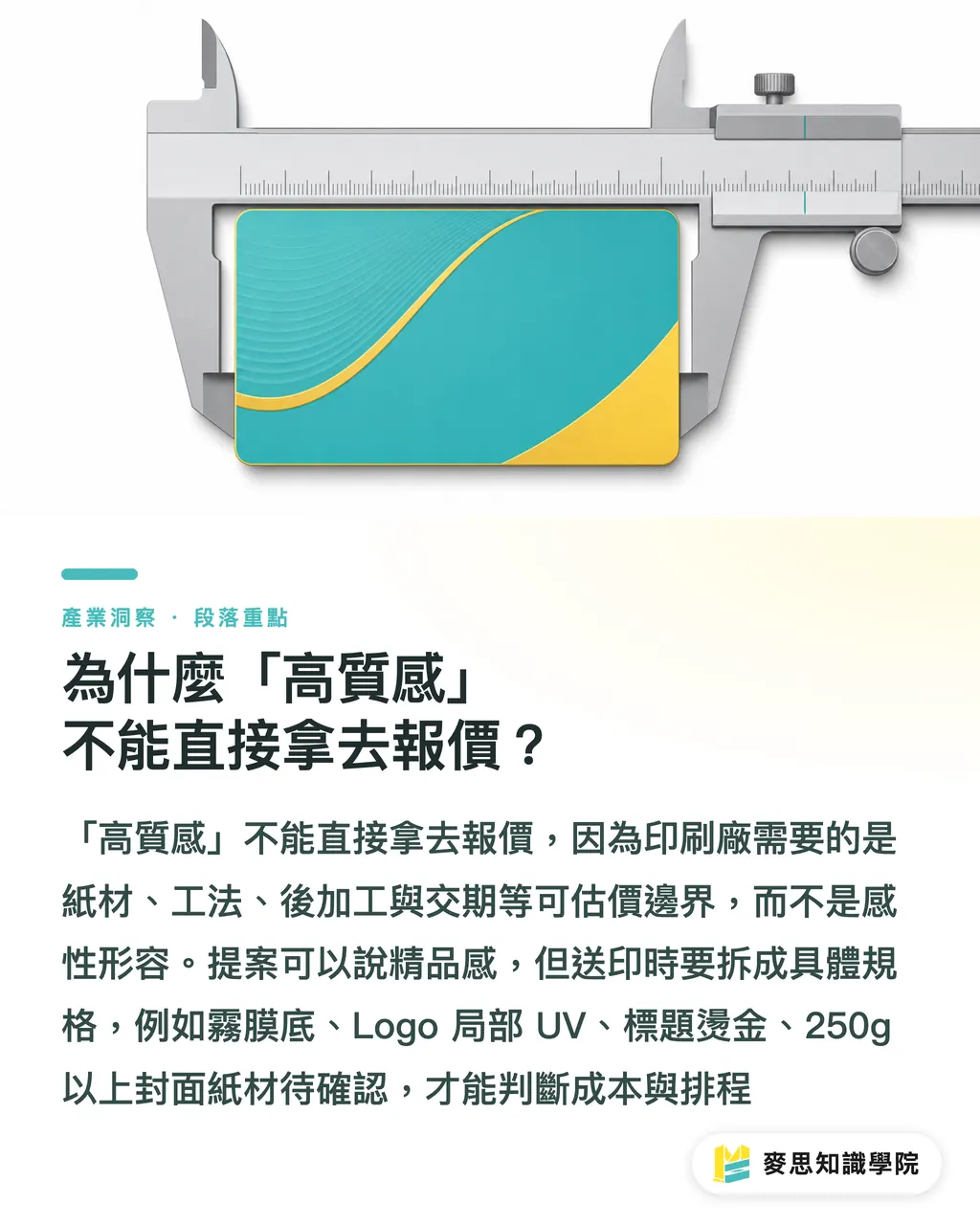
Why can't you quote from "premium feel" alone?
Because print quotes are based on paper stock, printing method, post-press finishing, and schedule. A single phrase like "premium feel" does not define the production boundaries needed for pricing
Post-press finishing: surface or structural treatments added after printing, such as lamination, Spot UV, foil stamping, debossing, embossing, and die-cutting. These affect touch, scuff resistance, and lead time
What worries me most on site is when designers decide the process for the client too quickly. The client says premium, the designer writes foil stamping, and later the job gets stuck because the paper is too thin or the schedule is too tight. Foil stamping usually needs paper stock of at least 150g as a starting point, and special finishing often adds 2 to 5 working days. None of this is about whether the layout looks good. It is about whether it can be produced
Do not rush it
Emotional descriptions can stay in the pitch deck, but print specs need to be written separately. For example, "we want a boutique feel" can first become "matte laminated base, Spot UV on the Logo, gold foil on the title, cover stock above 250g to be confirmed." That gives the print shop enough information to estimate the processes, plates, and production days
How can AI translate post-press finishing in 5 steps?
AI is good for turning design language into a first draft of specs, then the print shop should confirm machine capability and finishing limits. The MINDS (MS, mid- to high-end fully custom commercial printing) three-check print handoff breaks the translation into effect, spec, and feasibility checks
・①Write down the feeling: keep the client's original wording, such as "it needs gloss," "the Logo needs to pop," or "the card should feel thick."
・②Break it into effects: gloss maps to gloss lamination or Spot UV, a muted surface maps to matte lamination, a metallic feel maps to gold or silver foil stamping, and dimension maps to embossing, debossing, or sculpted embossing
・③Add the position: do not just write "partial." Write positions that can be drawn as a finishing plate, such as "cover Logo," "main headline," or "edge of product image."
・④Add material conditions: paper weight, surface coating, whether lamination is applied, and printing method all need to be checked together. For foil stamping, start by confirming paper stock of at least 150g
・⑤Add schedule conditions: Spot UV, foil stamping, embossing, debossing, and sculpted embossing usually add 2 to 5 working days. Let the client know during the proposal stage
I recommend treating AI output as a "pre-quote spec checklist," not as the final production order. This matters especially with digital printing plus Spot UV. Toner, ink layers, lamination material, and finishing sequence can all affect adhesion. This part must be checked with the vendor
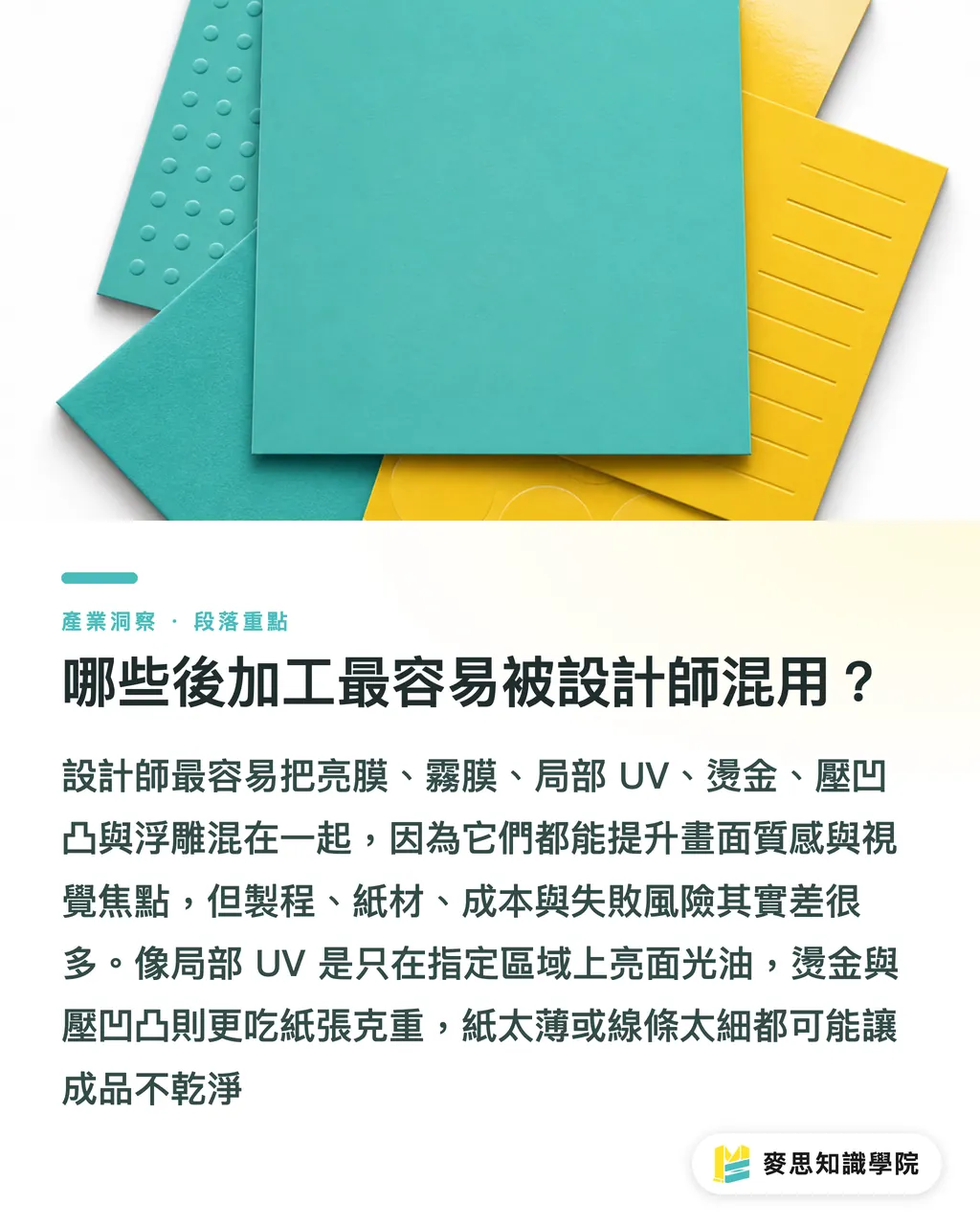
Which finishing processes do designers mix up most often?
The most common mix-ups are gloss lamination, Spot UV, foil stamping, embossing, debossing, and sculpted embossing. They can all make the design look more striking, but the process, paper requirements, and cost risks are completely different
・Matte lamination: soft in appearance and better at resisting smudges. Often used on covers, packaging, and business card bases, and it works well when you want Spot UV or foil stamping to stand out more
・Gloss lamination: gives the whole piece a clear shine. Photos and saturated colors look brighter, but fingerprints and reflections are also more visible. Best for event flyers or printed pieces that need strong visual impact
・Spot UV: applies glossy UV varnish only to selected areas. Often used on Logos, headlines, or pattern textures. For digital print jobs, compatibility needs to be confirmed first
・Gold foil / silver foil stamping: uses heat and pressure to transfer metallic foil onto the paper surface. Good for brand lettering, badges, and invitations. As a starting point, plan for paper stock of at least 150g
・Embossing, debossing, and sculpted embossing: use dies to create raised and recessed levels on the paper surface. Good for short words, marks, and seal patterns. Lines that are too fine or paper that is too thin can leave messy edges
Paper weight: the weight of paper per square meter. In Taiwan quotes, people often say 150g or 250g casually. A higher number usually means stiffer stock, which affects scoring, foil stamping, and binding stability
How should final artwork files be set up so the print shop does not have to guess?
Final artwork should separate the print layers from the finishing layers. UV plates, foil plates, and embossing plates should be clearly marked with spot colors or separate pages, so the print shop does not have to guess inside the PDF which area needs finishing
Adobe Illustrator, vector design and final artwork software, or Adobe InDesign, layout and final artwork software, can both create finishing plates. The point is to keep line art clean and positions aligned. Do not just write "make this shiny" in the notes. I have seen too many reworks that were not caused by bad design, but by finishing plates that were never separated
・Mark each finishing plate with a 100% single color, such as Spot UV, Foil Gold, or Emboss. Do not mix plate names
・Keep finishing objects as vector paths where possible. For small type, fine lines, gradients, and transparency effects, ask first whether they can be produced
・Attach a separate finishing guide with the final PDF, labeling matte lamination, Spot UV, foil stamping, and embossing positions in text
・If Spot UV and foil stamping appear on the same side, ask about registration tolerance and finishing sequence first. Do not wait until proofing to change it
・Reserve 2 to 5 working days for special finishing. Do not base the proposal schedule on printing days alone
If your project has already moved into material confirmation, you can send the effect description and final PDF to the Mai Strategy Knowledge Academy consulting team for a pre-print spec review, turning proposal language into post-press finishing specs a vendor can read
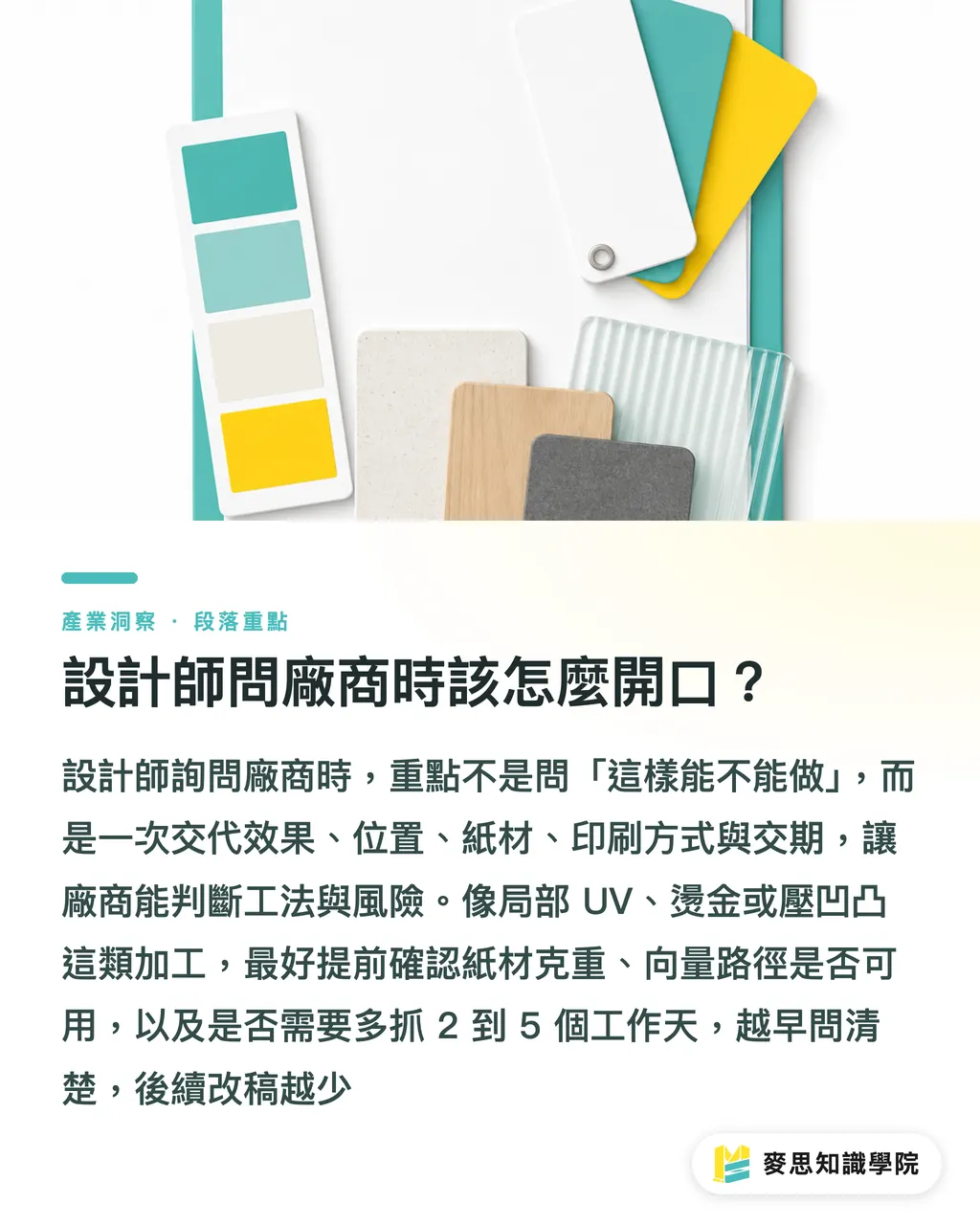
How should designers ask vendors about this?
When designers ask vendors, they should directly provide the effect, position, paper stock, printing method, and schedule. Do not only ask, "Can this be done?" Without the full conditions, the vendor can only answer conservatively
・"This design needs a matte base with Spot UV on the Logo. The planned paper is 250g C2S card. Please confirm whether Spot UV is possible with digital printing. If it is not suitable, please suggest an alternative process."
・"We would like gold foil on the cover title. Does the minimum paper weight need to be 150g or above? Can the foil plate use the vector path I provide?"
・"The main visual is intended for embossing or sculpted embossing. The thinnest lines are close to small text strokes. Please help judge whether they need to be enlarged or simplified."
・"If we add Spot UV, foil stamping, embossing, or debossing, does the lead time need to increase by 2 to 5 working days? I will update the client and adjust the schedule first."
That is enough
If the finished piece is positioned as a mid- to high-end brand catalog, invitation, or brand packaging, you can also check with MINDS before delivery to confirm whether Spot UV, foil stamping, embossing, and debossing can be arranged in the same production batch. The earlier this check happens, the fewer revisions you get
Key Takeaways
・Keep the feeling first, then break out the specs. Do not pack gloss, touch, dimension, and metallic effects into one sentence
・AI is best for early-stage translation. The vendor should confirm paper stock, process compatibility, and lead time
・Spot UV, foil stamping, and embossing look good, but every added finishing process adds another registration and waiting risk
・If designers ask one extra feasibility question before handoff, the print shop has one less thing to guess
・The more your finishing specs read like a production order, the less likely the client's emotional expectations are to fall flat in the finished piece
Further Thinking
Print manufacturers can turn common emotional words into a process comparison table. Designers can place AI after the proposal and before final artwork to generate the first post-press finishing spec checklist. If a SaaS product wants to enter the print workflow, the most valuable position is not making decisions for people. It is turning "the effect the client wants" into "questions the print shop can confirm." The next step is to start with 10 common client adjectives and build your own translation table
FAQ
- Can AI-selected post-press finishing be used directly to place an order?
- AI-selected post-press finishing works well as a first draft of specs, but the print shop still needs to confirm paper stock, machines, finishing sequence, and schedule, especially for processes such as Spot UV, foil stamping, embossing, and debossing
- When a designer says "glossy," should that usually mean gloss lamination or Spot UV?
- If "glossy" means the whole piece should shine, ask about gloss lamination first. If only the Logo, headline, or graphic should shine in selected areas, ask about Spot UV first
- Does foil stamping always require paper stock above 150g?
- For foil stamping jobs, it is best to ask the print shop using 150g or heavier paper as the starting point. Paper that is too thin can affect hot-stamping stability and finished flatness, though the actual answer still depends on paper type and artwork area
- Can digital printing use Spot UV?
- Spot UV on digital printing requires compatibility confirmation first. Toner, ink layers, lamination material, and finishing sequence can all affect UV adhesion, so you cannot judge from the design file alone
- How much longer does special post-press finishing add to the schedule?
- For special post-press finishing such as Spot UV, foil stamping, embossing, debossing, and sculpted embossing, it is best to reserve an extra 2 to 5 working days during the proposal stage, then have the print shop confirm based on the actual schedule
Related articles





The Print × AI weekly
The print and AI know-how designers, brands and enterprises can use before they commit — one email, every week
MINDS Free Tools
Spine width and imposition calculators — skip the manual math, free in your browser.
MINDS Group
Need actual printing or gifting services?
From premium printing to online ordering and festive gifts — the MINDS Group sister brands take it from here.