

What Crisis Does France's UNIIC See?
The crisis UNIIC is pointing to is that falling periodical print volumes are leaving a printing system built for high-volume, on-time production without enough work. This cannot be viewed only through the financial position of a single company, because idle equipment, fixed expenses, and a shrinking market are happening at the same time
UNIIC (the French printing industry association, an organization representing printing employers and industry interests) linked Maury Imprimeur's court-supervised restructuring to falling circulation for weeklies and other periodicals in its September 16, 2026 statement. PrintIndustry.news reported the policy call on September 20
The report says Maury Imprimeur and Roto France Impression print 36 national weekly titles every week, while Maury also handles books, catalogs, and other print jobs. These facts put the issue back on the production line: UNIIC Calls for a Rethink of France's Industrial Base
Why Doesn't Printing Less Cut a Printer's Costs Proportionally?
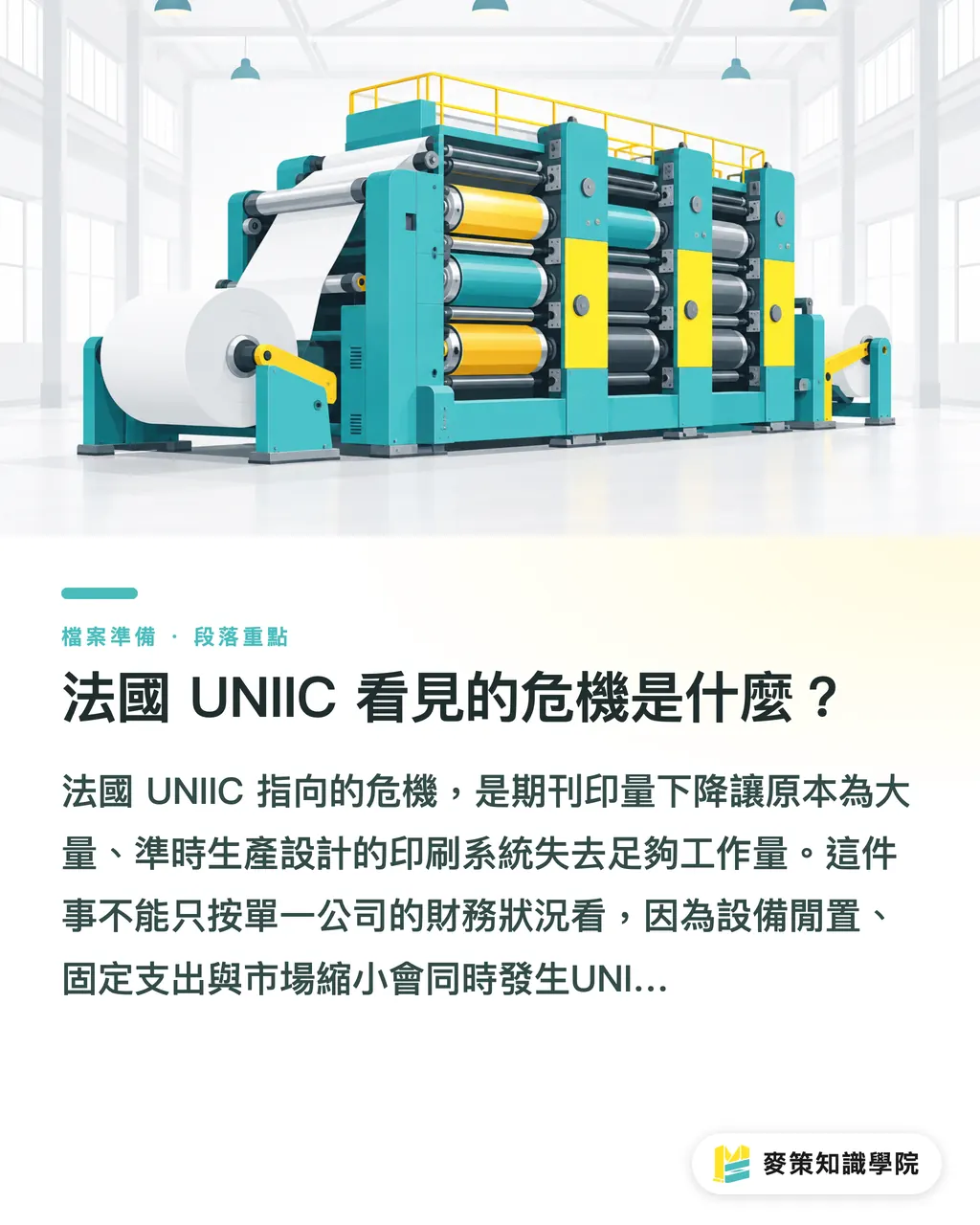
Printing a little less does not save an equivalent amount of money because a rotary printing plant is a high-fixed-cost industrial system. A rotary offset press (a press that uses continuous rolls of paper for high-volume printing), peripheral equipment, finishing equipment (post-press equipment for folding, binding, and similar work), and logistics infrastructure all have to be maintained together. Factory space, equipment, maintenance, staffing, and some utility costs continue to accrue
Capacity utilization is the share of the work that is actually booked and completed during the time the equipment is available. When that share falls, fixed expenses are spread across fewer print jobs. A printer running its machines a little less does not mean it is maintaining a smaller factory. Competition eventually comes down to who can keep the equipment busy
Publishers want print runs to track sales more closely, reducing inventory and unsold copies. That makes sense, but it also makes high-volume equipment harder to sustain. When small, scattered runs and more rush jobs appear, scheduling and changeover pressure becomes more pronounced
The machines do not shrink with the market
How Will Capacity Consolidation Change the Printing Market?
Capacity consolidation means reallocating printing work among different sites, machines, or companies. Through specialization, job transfers, shared resources, mergers, or equipment reductions, it is meant to keep the remaining production lines busy
UNIIC has publicly put this direction forward, showing that the industry is beginning to discuss idle equipment and market capacity at the same table. Maury Imprimeur handles weekly titles, books, catalogs, and other print jobs at the same time. When the weekly market shrinks, equipment originally set up for high-volume production still needs enough work
The measures listed in the report are concrete:
・Site specialization
・Production transfers
・Shared resources
・Company mergers
・Capacity reductions
Publishers get print volumes closer to sales, but printers have to rearrange equipment and staff. The interests of both sides meet around delivery times, quality, and inventory responsibility
In my experience, the real tests of whether consolidation can work are proofing after a job transfer, color consistency, binding handoffs, and exception reporting. Looking only at the price per sheet makes it easy to leave delivery risks with the brand and design teams

How Can Designers and Procurement Teams Avoid Supply Chain Disruptions?
Designers and procurement teams need to confirm print volume, equipment conditions, and delivery responsibility together. They cannot simply send out a PDF (Portable Document Format, a fixed-layout file format for submitting files) and then ask which vendor is cheapest. After revisions or format conversions, PDFs can omit bleed (the area extending beyond the trim line to prevent white edges on the finished piece), page numbers, binding direction, or paper stock, and those omissions become bigger problems during scheduling and job transfers. Before sending files, use Mai Strategy's three-gate print submission check
・①Requirements gate: Confirm print volume, the initial print run, responsibility for reprints, and the delivery date
・②File gate: Confirm finished size, bleed, page count, color, paper stock, binding, and finishing
・③Delivery gate: Confirm responsibility for backup equipment, proofing, color, binding, and exception reporting. Mid- to high-end fully customized jobs can go to MINDS, while small-volume standardized jobs can be ordered online through Mai Printing
What Should Taiwan's Small and Midsize Printers Change First?
Taiwan's small and midsize printers should first shift their order-taking logic from quoting each job to managing capacity and delivery responsibility, while spelling out which types of work are handled in-house, transferred out, or run on shared equipment. Maury Imprimeur entered restructuring proceedings in September 2026, reminding me that contingency plans have to be written before they are needed
Don't rush to cut prices
・Put job types, equipment, outsourcing points, proofing responsibility, and the exception contact in one table
・AI (Artificial Intelligence, a tool for comparing versions and spotting missing specifications) can help check documents. SaaS (Software as a Service, cloud software delivered by subscription) can retain quotation, job-transfer, and acceptance records
・When you need to put the process into practice, you can contact the Mai Strategy Knowledge Academy consulting team

Key Takeaways
・Falling periodical print volumes first reduce equipment utilization, then push up unit costs
・Capacity consolidation must spell out job transfers, proofing, color, binding, and responsibility for exceptions
・Before handing over files, designers should put print volume, bleed, version, and delivery date on one specification sheet
・AI compares information, SaaS keeps records, and people still decide who is responsible on the production line
Further Thoughts
I would suggest that Taiwanese printers start with a capacity and delivery-responsibility table. Each job type should be mapped to available equipment, outsourcing points, the proofing person, the person responsible for color approval, and the exception contact. Design teams can connect this table to their file-preflight checks. AI can help find version differences and missing fields, while SaaS stores quotation requests, files, job transfers, and acceptance records. These arrangements address information gaps first. Once equipment investment or market consolidation actually happens, the team will know which jobs it can take and which steps need to be changed in advance
Further Reading
FAQ
- Why did UNIIC discuss capacity consolidation after Maury Imprimeur's restructuring?
- Because falling periodical print volumes can leave high-fixed-cost equipment without enough work. UNIIC therefore wants to reopen the discussion about how France's printing industry should allocate and sustain its capacity
- Why don't a printer's costs fall in proportion when it takes fewer orders?
- Factory space, equipment, maintenance, staff, post-press work, and logistics costs keep accruing, so fewer print jobs must carry the same industrial system
- What should designers check before delivering files?
- First check print volume and the delivery date, then confirm finished size, bleed, page numbers, color, paper stock, binding, and finishing. Reconfirm the file version after revisions or format conversions
- Can AI or SaaS solve the printing capacity crisis?
- AI can help compare versions and catch missing specifications, and SaaS can retain quotation requests, job transfers, proofing, and acceptance records. But the printing team still has to decide capacity allocation, equipment responsibility, and delivery commitments
Related articles




The Print × AI weekly
The print and AI know-how designers, brands and enterprises can use before they commit — one email, every week
MINDS Free Tools
Imposition calculator and preflight file check — free prepress tools, right in your browser.
MINDS Group
Need actual printing or gifting services?
From premium printing to online ordering and festive gifts — the MINDS Group sister brands take it from here.