

Why Do Print Schedules Now Have to Follow the Weather?
Lately, when I talk production budgets with clients, eight out of ten say the same thing: it hurts
North American pulp and paperboard capacity has shrunk sharply, so tight base paper supply was already keeping material costs high
Add the swings in electricity prices over the past few years, and power bills have pushed straight into the top three expenses for many print shops
France's Riccobono printing group uses nearly 50 GWh of electricity a year across its 11 sites
Facing soaring energy prices, they decided to stop taking the hit and start treating power purchases like paper procurement, as a strategic buy
They brought in energy management company Mint Energie. The first step was breaking away from the old fixed-rate, all-you-can-use contract model
Instead, they monitor market prices and buy portions of their power budget only when conditions are favorable
It is exactly the same logic we use when buying futures or raw materials
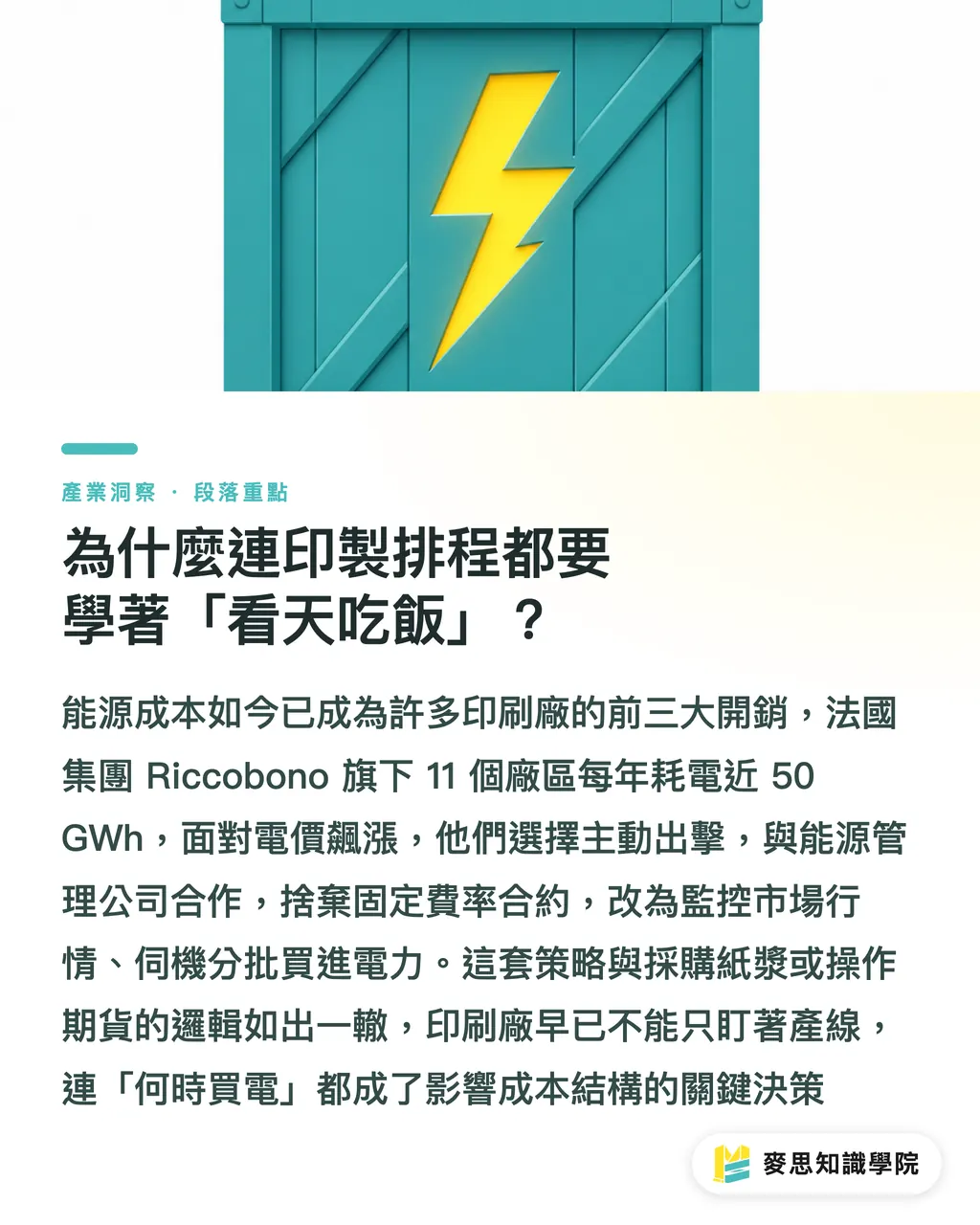
A Full Audit of Production Rhythms: How Do You Find the Power-Hungry Monsters on Day and Night Shifts?
To change how you buy electricity, you first have to know how you actually use it
Riccobono did not just look at the main meters. It ran a full checkup on electricity consumption data across 2,700 points in its operations
They found that every production line had a totally different breathing rhythm
Plants dedicated to daily newspapers were classic night owls, with power peaks packed into the late-night hours
Other sites, meanwhile, consumed large amounts of electricity during the day
From more than a decade of plant consulting, I have seen plenty of veteran plant managers schedule jobs by gut feel
But once you spread each machine's power peaks across a dashboard, you can dispatch work precisely and move high-consumption printing and pressroom stages into lower-rate hours
With this layer of visible data, Riccobono could finally get out of the trap of blind spending
How Can Adjusting One Power Contract Squeeze Out Millions in Profit?
Sometimes the most direct way to save money is hidden in the least noticeable contract clause
I often tell brand clients that reducing colors saves money. Taking packaging from 6 colors down to 4 colors cuts cost directly
The same idea applies to electricity management
Mint Energie's energy management director, Nicolas Vermogen, pointed to one blind spot: subscribed power capacity
Just by adjusting the "subscribed power" for two of Riccobono's sites, a concept similar to contracted capacity in Taiwan,
they saved EUR 50,000 a year, about NT$1.75 million, in money that had simply been wasted
No major equipment upgrade was needed. They just pulled out the contract, checked it against real data, and recovered that profit
Beyond contract fine-tuning, they are also assessing solar panel installation at the Gallargues site, which is expected to cut annual electricity use by another 25%
How Should Taiwan's Small and Midsize Printers Handle the Double Hit of ESG and Electricity Prices?
Everyone has been talking about the carbon footprint of printing lately. I always say it needs to be broken down across three points: materials, production, and transport
And in the production stage, electricity consumption is tied directly to both carbon emissions and manufacturing cost
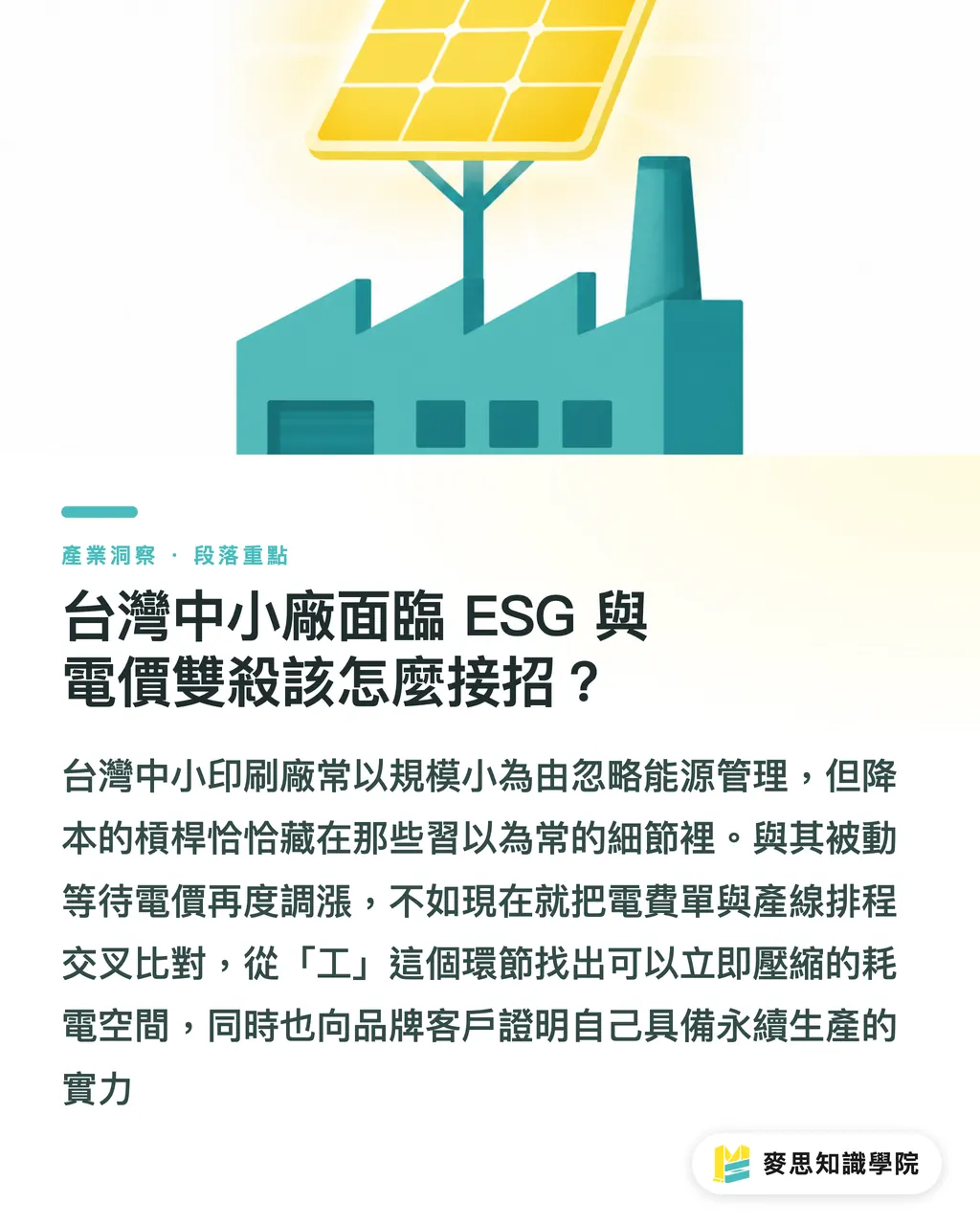
Many Taiwanese plants feel they are not big enough to need any complicated monitoring
But Riccobono's experience shows that the cost-cutting lever is often buried in details you have stopped noticing
This is not just about saving on electricity bills. It is also the best proof you can show brand clients that you have real sustainable production capability
Instead of passively waiting for the next electricity price hike, pull out your power bills and production schedule now and compare them side by side
You will definitely find places where excess cost can be squeezed out immediately
Key Takeaways
・Do not blindly sign fixed-rate, all-you-can-use contracts. Understand the day and night rhythm of your production lines before setting a favorable power procurement strategy
・Review the contracted capacity of your plant. Simply cutting excess subscribed power can turn cost straight into net profit
・Use a data dashboard to make electricity consumption visible. Scheduling high-consumption processes during off-peak hours is something you can put into practice right away
・Solar panels and energy storage are not just green decorations. They are investment options with real potential to cut costs by 25%
Further Thinking
In an era of thin margins, we cannot make money only by chasing more orders. We have to learn how to pull profit out of internal management
For plants serious about transformation, the key is bringing in a system that connects prepress, pressroom operations, and plant management
The one-stop integration the MINDS team works on is, in practice, about helping clients pull out production data that used to be scattered everywhere
When you can clearly see which press consumes the most electricity at what time, you have the basis to negotiate with Taipower, improve scheduling, and even present a solid carbon footprint report that convinces international brands to place long-term orders
Energy management is not a penalty item. It is a clear edge that puts distance between you and your competitors
Further Reading
FAQ
- We are only a small or midsize print shop, and we do not use nearly as much electricity as Riccobono. Is this still worth managing?
- Absolutely. Just rechecking whether Taipower's contracted capacity matches your actual peak demand can often save a meaningful amount in basic fees right away
- Besides changing the contract, what can the production floor do immediately?
- Start by scheduling high-consumption processes during off-peak hours as much as possible, and require machines to properly enter energy-saving mode when standing by
- Do brand clients really care whether a print shop saves energy?
- From the projects I have handled recently, more and more international brands are adding carbon footprint data to supplier evaluations. If you can show concrete power-saving data, it becomes much easier to win long-term orders
References
- How Riccobono cuts its electricity bill · printindustry.news
Related articles




The Print × AI weekly
The print and AI know-how designers, brands and enterprises can use before they commit — one email, every week
MINDS Free Tools
AI background removal, a LINE sticker maker, spine & imposition calculators — all free, right in your browser, no upload.
MINDS Group
Need actual printing or gifting services?
From premium printing to online ordering and festive gifts — the MINDS Group sister brands take it from here.