

Squeezed by labor shortages and rising wages, why should small and medium printers talk about automation now?
Over the past six months, I visited a dozen traditional print shops and design studios in central and southern Taiwan with around 15 employees. The most common complaint from owners was the struggle to find young people to take over, while the wages of veteran masters keep climbing
Many instinctively think automation is only for those who can drop millions on massive equipment. This is actually a myth
Judging by the atmosphere at the recent FESPA 2026 show in Barcelona, European equipment suppliers have already shifted their focus to lightweight, modular solutions
According to observations by Keypoint Intelligence analyst Johnny Shell at the exhibition, manufacturers that adopted automation were about 40% faster in quoting and delivery times than purely manual shops. This directly translates to a significant boost in customer retention
Faced with the industry pressures in Taiwan right now, we shouldn't chase an all-at-once arms race. Instead, we need to find the entry points with the highest return on investment and fund them in phases

Phase 1: Stopping the Bleeding with Workflow Automation
Most hidden costs are eaten up by manual intervention in prepress
Sales reps receiving files, designers checking bleeds, converting file formats, and imposing layouts. These highly repetitive tasks are bound to run into errors as long as they rely on manual labor
Implementing workflow automation software should be the first step
・Establish standardized online file intake and preflight systems so that low-resolution files or missing fonts are caught and flagged before they ever hit the RIP
・Use software to pre-configure paths for different substrates, cutting down the delay caused by human decision-making
This does more than just free up prepress staff to focus on fine-tuning designs. It also ensures the production line stays stable during night shifts or weekends
What Hidden Costs Can Standardized Color Management Solve?
Once the workflow is smooth, the next big hurdle is color disputes
Many traditional plants still rely on the press operator's eyes and experience to match colors. This means results change whenever shifts rotate or jobs move to another press
Johnny Shell emphasized that standardizing color management is the core backbone of the automation journey
・Set up a profile synchronization system that links monitors, proofers, and final output devices
・Adopt presses with closed-loop color control or use external spectrophotometers
When equipment automatically reads color bars and corrects ink keys in real time, reprint rates drop sharply. For small shops operating on thin margins, this goes straight back to your bottom line as cash
How Can Post-Press Operations Break Free from Labor Bottlenecks?
Printing fast doesn't mean delivering fast. Production bottlenecks often pile up at the final cutting, folding, or binding stages
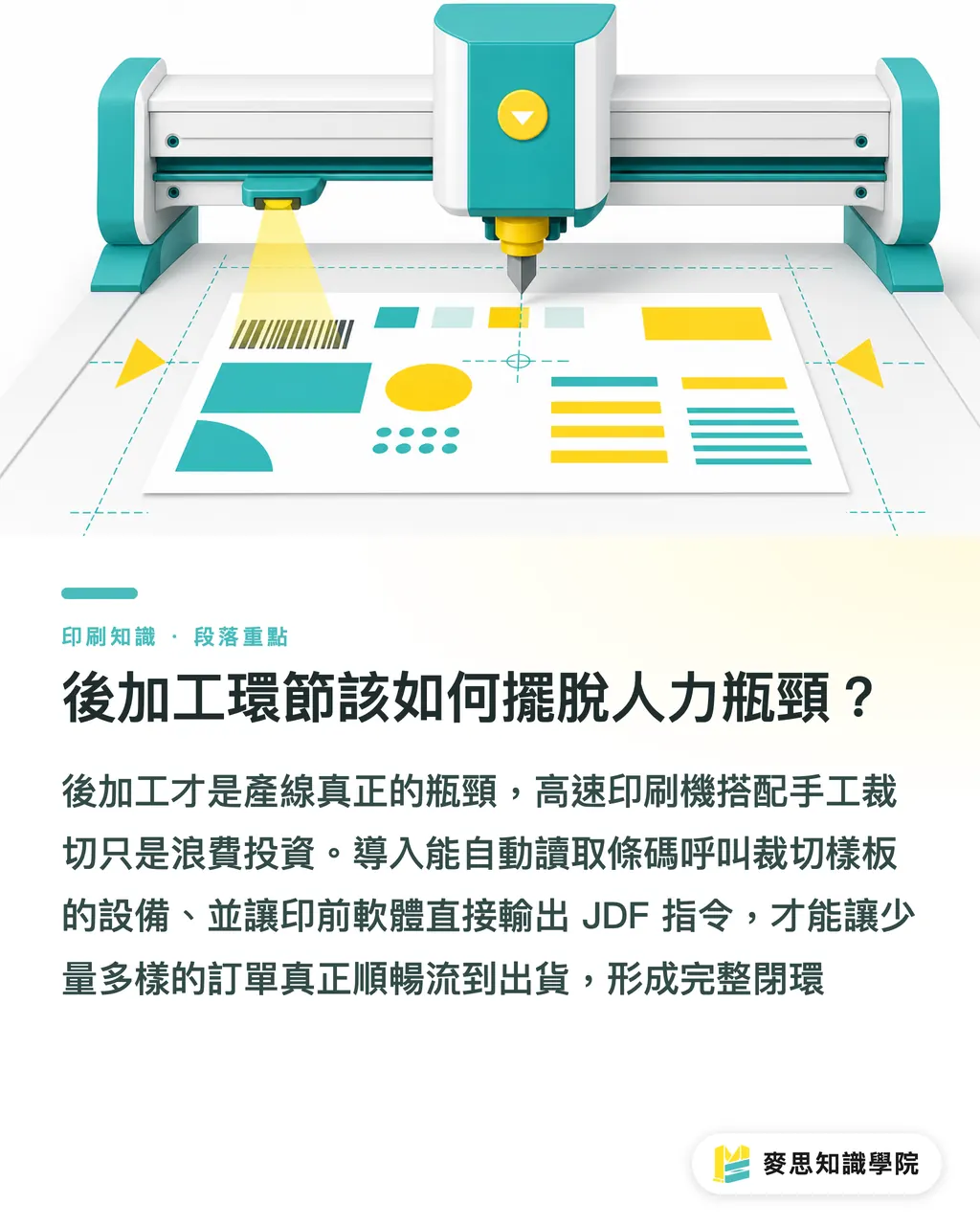
Buying a high-speed digital press only to manually align and cut sheets at the back end is a waste of investment
The final practical step is the digital integration of finishing equipment
・Choose finishing machines that can read printed barcodes or marks. The machine scans them and automatically loads the matching cutting template
・Have prepress software generate JDF files containing finishing instructions to connect front-end and back-end data
This makes short-run, high-mix jobs run smoothly, turning the entire workflow from order intake to shipping into a continuous process
Key Takeaways
・Automation is not an all-or-nothing zero-sum game. Investing in phases balances cash flow with the pace of upgrades
・Adopting workflow automation for preflight and file routing is the most cost-effective remedy for prepress labor drain
・Letting machines use data to match color instead of relying on an operator's naked eye is the key to lowering reprint costs
・When purchasing digital presses, you must evaluate their digital connection to finishing equipment at the same time to avoid bottlenecks
Further Thoughts
The essence of automation is shifting humans from being machine servants back to workflow directors
For small and medium printing shops in Taiwan working with tight budgets, I strongly recommend auditing your operations to see where customer complaints or overtime happen most. Start small with a lightweight software package targeting that specific pain point
For those in design or brand purchasing, when picking print partners in the future, check if they have standardized color management and automated preflight capabilities. This secures delivery timelines much better than simply comparing quotes
MINDS is actively integrating these standardized processes, with the goal of ensuring every great design is executed precisely
Further Reading
FAQ
- We have fewer than 10 people in our company. Is automation right for us?
- The smaller the scale, the more you need systems to prevent errors. We recommend starting with the most affordable cloud-based prepress preflight software. Saving the hours a designer spends fixing files every day will pay for it
- Standardizing color management sounds expensive. Do we have to buy high-end equipment?
- You don't need to replace your machines right away. You can start by hiring a consultant to perform a thorough color calibration on your current monitors and presses. This builds a baseline understanding of digital color matching
- The owner only wants to buy new presses to boost capacity. How can I convince him to invest in software or post-press equipment?
- Do the math for the owner by showing the cost of wasted materials from reprints and overtime pay. Show him how bottlenecks in finishing eat up all the profits gained from printing faster on the front end
References
Related articles




The Print × AI weekly
The print and AI know-how designers, brands and enterprises can use before they commit — one email, every week
MINDS Free Tools
AI background removal, brand stamping, and a LINE sticker maker — free design tools, right in your browser, no upload.
MINDS Group
Need actual printing or gifting services?
From premium printing to online ordering and festive gifts — the MINDS Group sister brands take it from here.