

Do SMEs really need to spend millions to implement AI?
In the last six months, I have visited over a dozen traditional printing houses and design studios in central and southern regions with around 15 employees. This is the question owners ask most often
This is definitely a myth
Enterprise-level complete automation and MES systems are certainly expensive, but the advantage of SMEs lies in their agility
We should not evaluate 'how powerful this system is,' but rather 'can this lightweight tool immediately solve the current pain points?'
For teams with tight budgets, the first step is to lock into subscription-based cloud services that show immediate results, buying substantial human resource liberation for a fraction of the cost

Where should small teams with limited budgets start?
Based on my experience in helping small factories transform, I strongly recommend cutting in from these three low-cost, high-return points
・Cloud AI Design Assistant: Handle front-end ideation and basic background removal/retouching. Treat AI as a tireless assistant to quickly generate sketches and color schemes, while designers take over to handle bleeding and high-resolution finalization according to printing standards
・Intelligent Customer Service System: This is the savior of the ordering window. By introducing an intelligent customer service system that recognizes basic file specifications, you can intercept highly repetitive inquiries like 'Can my file be printed?', allowing staff to focus on quoting and major client maintenance
・Simplified Automated Scheduling: There are now many monthly subscription-based lightweight scheduling tools. Through algorithms assisting in imposition and press positioning, I have personally seen a small factory of 5 people use this to reduce paper waste rates by a solid 15%
Why do AI artworks that look great on screen become a disaster on press?
Buying tools is just the beginning; what is more fatal is the gap in practical execution
Based on my experience handling thousands of printing cases, 99% of the beautiful AI-generated artworks clients bring to print in the last six months end up with issues
The eye-catching RGB gradients on screen immediately shift to dull gray once they enter a CMYK printing press, not to mention edge jaggedness and loss of detail due to insufficient resolution
The key here is color management at the source
When introducing AI design tools, it is essential to synchronize internal standards: require designers to define styles during the Prompt stage, and strictly lock brand colors in the post-production workflow to ensure creativity can truly be realized into high-quality printed matter
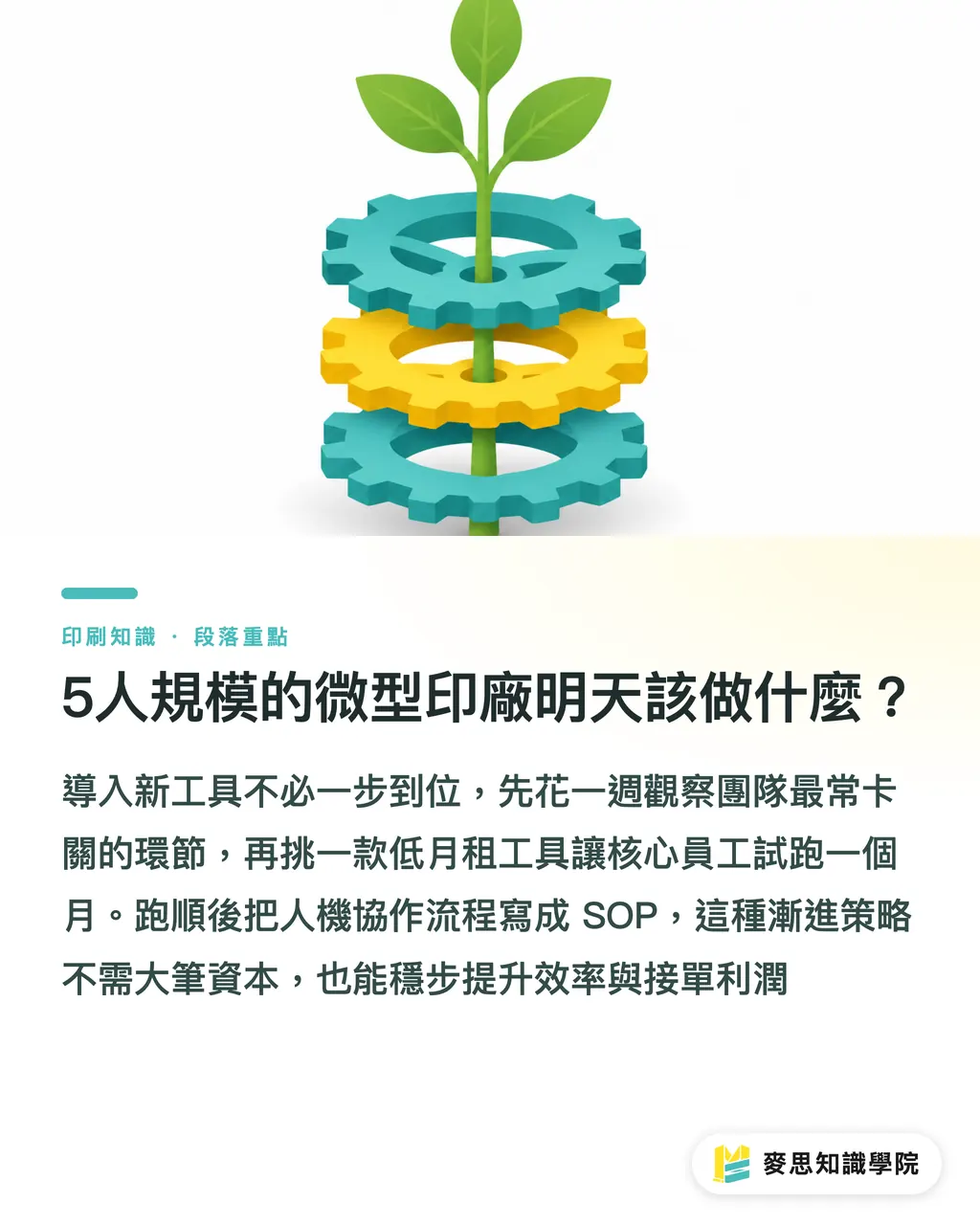
What should a 5-person micro-print shop do tomorrow?
Never dream of getting it right in one step. My advice for SMEs is to 'test locally, expand gradually'
・Identify Time-Consuming Hotspots: Spend a week observing where the team gets stuck the longest, whether it's confirming client files or internal imposition scheduling
・Launch Small-Scale Tests: For the most painful link, choose a lightweight tool with a monthly fee of a few hundred dollars and let one or two core employees run it for a month
・Establish Internal SOPs: Once human-AI collaboration is smooth, write down the process, for example, defining 'three steps to check AI files received from clients'
Through this progressive strategy, you can effectively improve operational efficiency and order profit without taking out loans to buy large equipment
Key Takeaways
The core of SMEs adopting technology is to solve pain points, not blindly chasing expensive enterprise-level systems
Cloud design assistants, intelligent customer service, and lightweight scheduling are the three best entry points for teams with limited budgets to get a high return on investment
AI artwork must undergo strict color management and resolution standards to avoid practical disasters in physical printing
Local trial-and-error and building human-AI collaboration SOPs is the best path for micro-printing houses to upgrade competitiveness at a low cost
Extended Thinking
For teams like MINDS Printing that provide one-stop integrated services, technology is not just a productivity tool within the factory, but an important bargaining chip for coaching clients. When we can proactively guide SME clients to use lightweight design assistance correctly, and strictly oversee print specifications on our end, we can significantly reduce communication and reprint costs for both sides, establishing a relationship of trust that others cannot easily take away
FAQ
- Our company has fewer than 10 people; is it too early to introduce these tools?
- Not at all. Micro-teams are actually in greater need of tools to bridge manpower gaps. Starting with monthly subscription-based lightweight scheduling or intelligent customer service is equivalent to buying the capacity of an extra person at the lowest cost
- Why does the color of posters generated by designers using these tools look so muddy when printed?
- Because generation tools usually default to the RGB mode for screen display. You must convert and manually correct CMYK values through professional software after image generation, or even intervene in color control from the source prompt
- There are so many auxiliary tools on the market, how should I choose?
- Start by auditing the trivial tasks that take up most of your time each day. If it's getting stuck on file checks, look for front-end intelligent customer service; if it's wasting paper on imposition, evaluate lightweight automated scheduling software
Related articles



The Print × AI weekly
The print and AI know-how designers, brands and enterprises can use before they commit — one email, every week
MINDS Free Tools
AI background removal, brand stamping, and a LINE sticker maker — free design tools, right in your browser, no upload.
MINDS Group
Need actual printing or gifting services?
From premium printing to online ordering and festive gifts — the MINDS Group sister brands take it from here.