

Why Is the European Paper Industry So Gloomy?
Recently, I've been chatting with counterparts in Europe, and the general feeling is that 'something is off.' The survey released by the French Cardboard Industries Association (CAP) in late May has essentially quantified this sentiment
This survey of industry managers presents some sobering figures:
・40% of operators explicitly state that business conditions in the first half of the year are deteriorating, and there's no light at the end of the tunnel for the second half, with orders, cash flow, and manpower all shrinking
・A staggering 97% of companies feel the impact of the Middle East crisis. This isn't some distant geopolitical issue, but tangible cost pressure. Seven out of ten report that raw material procurement costs have risen by 5% to 20%; even more concerning, half of the business owners report that fuel costs have surged by over 20%
・Half (50%) of the manufacturers are facing supply instability, with 3% of companies even in the dire situation of having to partially or fully shut down production lines
Overall, weak end-user demand, stagnant energy costs, and the major trend of lightweighting in e-commerce packaging are squeezing the profits of the cardboard industry from all sides. This is no longer an isolated problem, but a systemic stress test
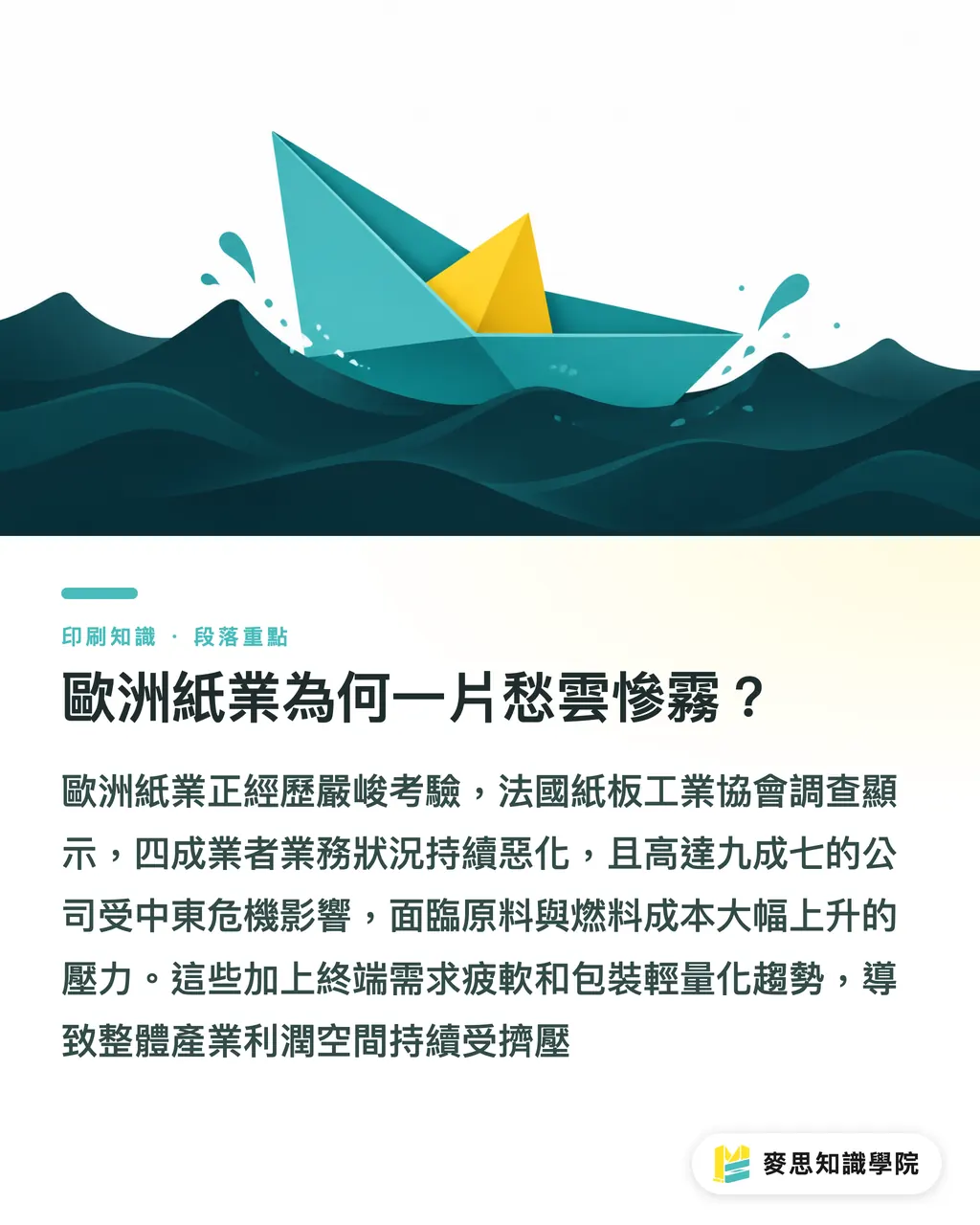
How Far Away Is This Fire from Taiwan's Doorstep?
Why should we be so nervous about the situation in Europe? Based on my long experience working between production lines and clients, the global pulp and cardboard raw material market is like a system of communicating vessels. Europe is a major consumer and producer; their economic climate and pricing directly affect global raw material flows and quotes
What's even more critical is the 'time lag.'
Historical data speaks for itself: European industry confidence indices typically lead imported paper prices in Taiwan by 3 to 6 months. In other words, the pessimism we are seeing from our French counterparts is highly likely to be reflected in the procurement orders we receive in the fourth quarter of this year
Don't forget, this wave of pressure didn't come from nowhere. Since last year, North American pulp and cardboard capacity has been shrinking. The effects of the plant closures announced for Containerboard just last year haven't even fully materialized yet, leaving the supply chain itself in a strained state. Now, the disruption in European demand signals is adding another variable to an already fragile supply-demand balance, naturally increasing the risk of price volatility
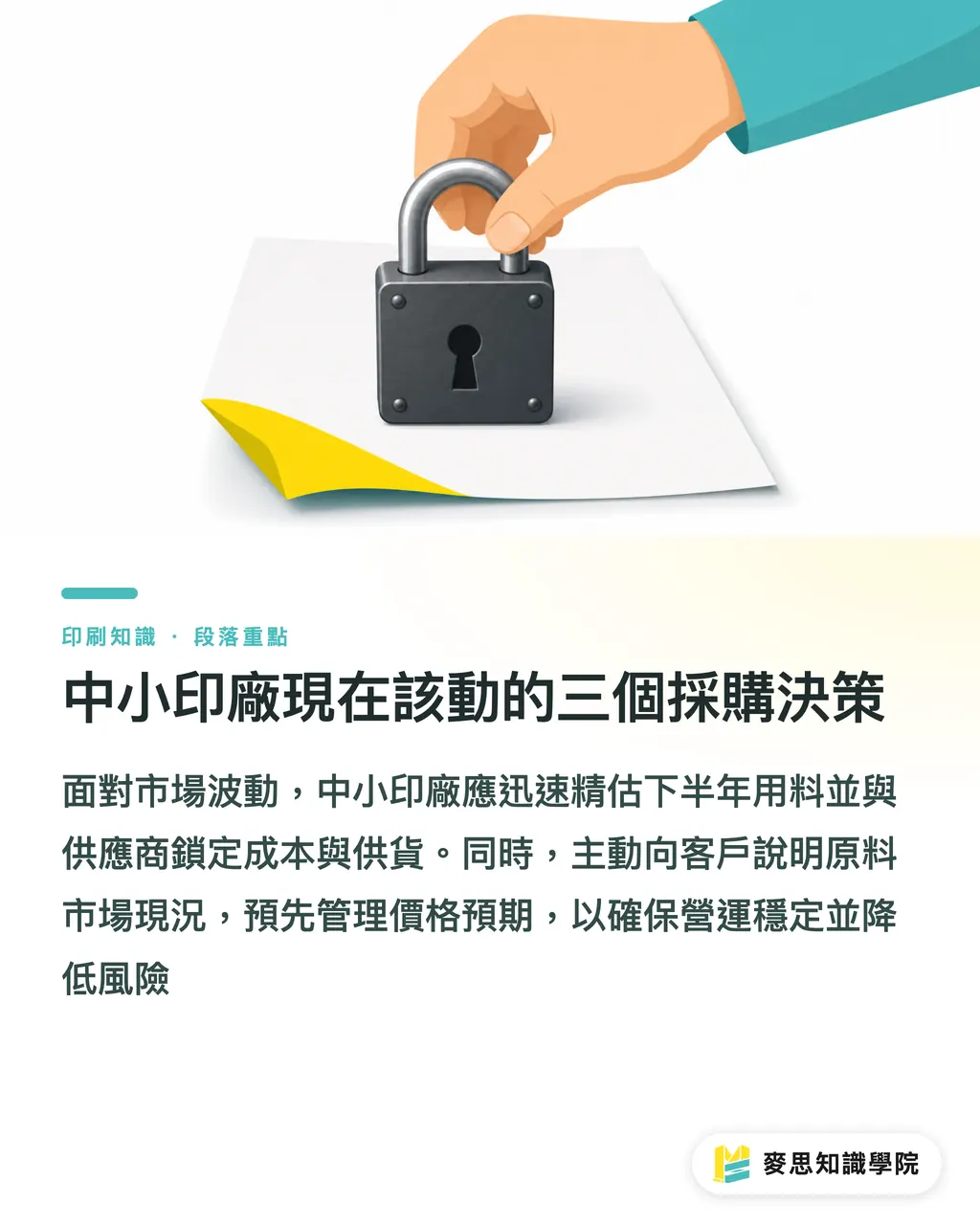
Three Procurement Decisions Small and Medium-Sized Printing Houses Should Make Now
"So, what should we do?" This is the question clients have been asking me most often lately. My advice is straightforward: don't wait, act now. Before Q3 ends, there are three things you should start doing today:
・First, fully reassess your usage plan for the second half of the year
Lay out all known orders and potential projects for Q3 and Q4, and calculate your total paper and cardboard requirements precisely. Don't rely on past rules of thumb to gauge inventory; what you need now is an accurate forecast to avoid unnecessary capital tie-up and ensure that orders for key clients don't fall through
・Second, immediately schedule time with your main suppliers
Take your calculated requirements and proactively approach your suppliers. You shouldn't just negotiate price, but rather "lock-in." Ask if you can sign framework agreements for quantity and price on specific paper types, or extend payment cycles in exchange for stable supply. Be flexible in your approach, but firm in your goals, the key is to secure a predictable cost structure
・Third, proactively manage your clients' price expectations
This is the most overlooked point, but also the most important. While negotiating with suppliers, you should also start "setting the stage" with your brand clients and designers. Help them understand that volatility in the global raw material market is not a unilateral move by you to raise prices. When cost fluctuation becomes an industry-wide consensus, clients will be more accepting if price adjustments are necessary in the future; they might even thank you for the early warning, allowing them to adjust their own product pricing and marketing budgets in advance
This isn't fear-mongering; it's risk management. When a storm is coming, closing the windows and reinforcing the foundations is always easier than cleaning up the mess after the fact
Key Takeaways
・The confidence of the French cardboard industry is a 3-6 month leading indicator for imported paper prices in Taiwan; current pessimistic signals forecast price volatility in Q4
・Weak end-user demand, energy costs, and geopolitics are hitting the global paper supply chain from three sides, making already tight capacity even more fragile
・The key procurement actions for printing plants now are: precisely calculate second-half usage, proactively negotiate and lock in prices with suppliers, and manage client cost expectations early
・Faced with supply chain uncertainty, passively waiting for quotes is the biggest risk; proactive action and expectation management are the only ways to minimize the impact
Further Reflections
This warning from Europe once again highlights the vulnerabilities and opportunities for the printing industry in today's globalized market. For my fellow colleagues in printing and manufacturing, this is a wake-up call, reminding us that we can no longer just focus on production. We must look up and watch the trends in the global supply chain, elevating "procurement strategy" to a level as important as "business development." The old model of waiting for orders to come in before sourcing paper carries too much risk
For designers and brand clients, this means the concept of "design as cost" needs to be deepened. When planning packaging and publications for the second half of the year, communicate early with your printing partners to understand the cost trends and supply status of different materials. Even incorporating alternative options early in the design phase can prevent the embarrassment of budget overruns or material shortages halfway through a project
This is also the value of integrated service platforms like MINDS Printing. We don't just do printing; our core value lies in managing these complex supply chain variables for our clients. Through the bargaining power of collective purchasing, a diversified supplier network, and real-time monitoring of the global market, we can act as a "risk buffer," helping clients obtain relatively stable and predictable quality and costs even during severe market fluctuations. This isn't just about saving money; it's the foundation for ensuring that businesses can operate steadily
Further Reading
FAQ
- Why does the European economic climate directly impact paper prices in Taiwan?
- Because the global pulp market is an integrated market, and as a major production and consumption region, Europe's demand and prices are transmitted to Asia through international trade. Historical data shows that the European industry confidence index typically leads imported paper prices in Taiwan by about 3 to 6 months, making it a very effective early warning indicator
- I'm a designer; how do rising material costs specifically affect my work?
- The impact is significant. First, the project budgets you set for clients will become tighter; second, some of the imported fine papers or special cardboards you are accustomed to using may experience supply instability or price surges. It is recommended that you discuss with the printing house at the beginning of the design phase, prepare several material alternatives, and incorporate material cost volatility into your design considerations
- If I purchase materials early now, won't I end up buying at a high point?
- This is not a game of betting on the lowest price, but a "hedging strategy." The goal of locking in prices or quantities early is to circumvent the dual risks of "higher prices" and "stockouts" that may occur in the coming months. What you are buying is a predictable cost structure and stable capacity, allowing you to confidently accept orders, the value of this certainty far outweighs betting on an unknown, potentially lower price point in the future
References
- CAP survey: confidence among cardboard industry leaders falls sharply in 2026 · printindustry.news
Related articles





The Print × AI weekly
The print and AI know-how designers, brands and enterprises can use before they commit — one email, every week
MINDS Free Tools
AI background removal, a LINE sticker maker, spine & imposition calculators — all free, right in your browser, no upload.
MINDS Group
Need actual printing or gifting services?
From premium printing to online ordering and festive gifts — the MINDS Group sister brands take it from here.