
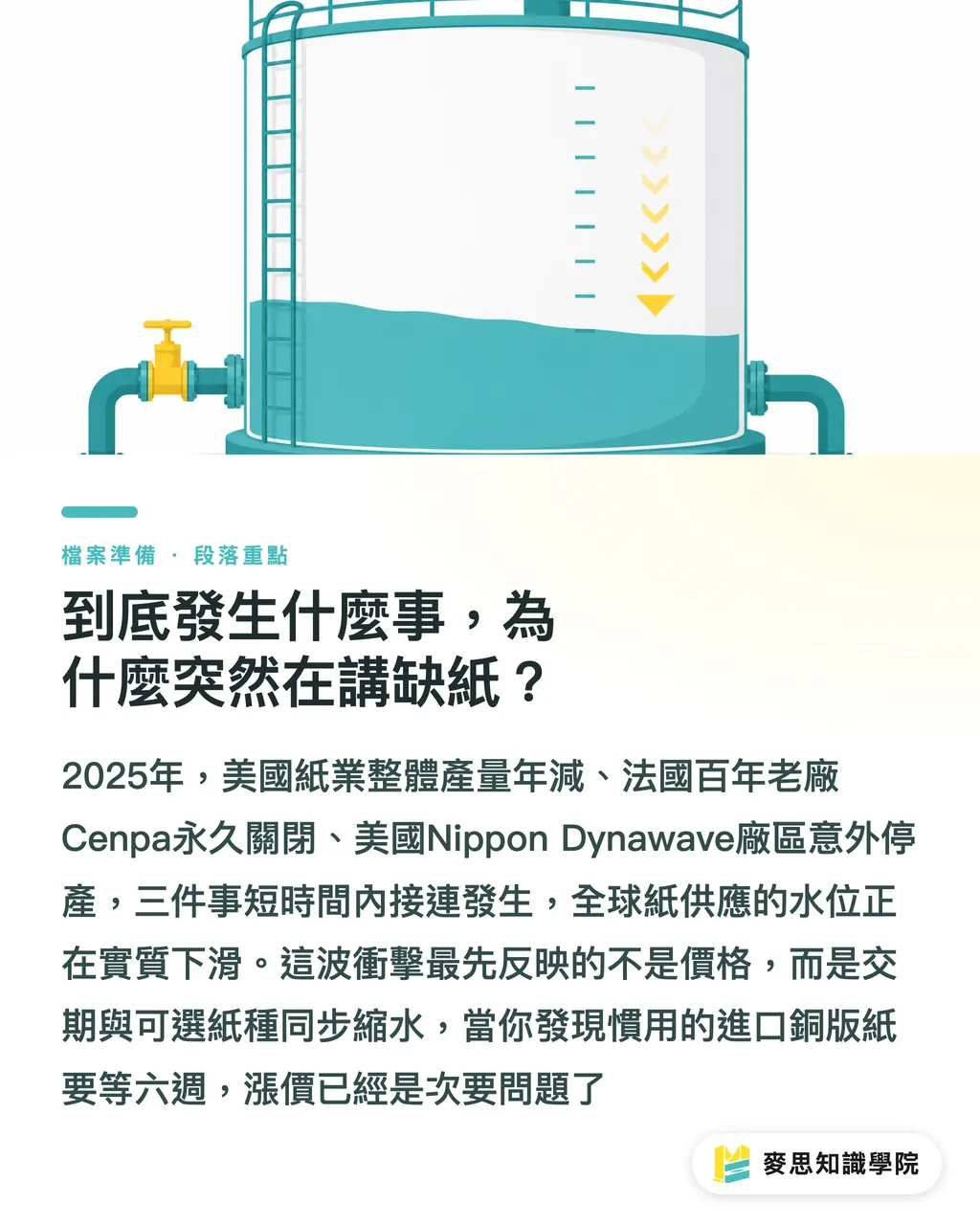
What's Actually Happening, and Why is Everyone Suddenly Talking About Paper Shortages?
To set the stage: this is not an isolated event, but three incidents stacked in a short period
・The capacity report from the American Forest & Paper Association (AF&PA) indicates a year-over-year decline in U.S. paper and paperboard production in 2025; this is a contraction of the overall foundation
・Cenpa, a century-old mill in Alsace, France, has announced a permanent closure, not for maintenance, but a complete exit from the market
・The Nippon Dynawave facility in Longview, USA, halted production due to an accident, resulting in a sudden evaporation of capacity
Viewed individually, these could be dismissed as isolated cases. However, occurring consecutively within a few months, the implications are different. This indicates that global paper supply levels are substantially declining, rather than experiencing seasonal fluctuations
Based on my extensive experience on production lines and with clients, what's most feared in the paper industry isn't high prices; it's when a quote comes back saying, 'We're out of stock.' With declining production and mill closures, the first impacts are usually on lead times and a reduction in available paper types. By the time you realize a staple imported coated paper suddenly requires a six-week wait, price becomes a secondary concern. For detailed data, refer to the AF&PA report on capacity data and declining containerboard production
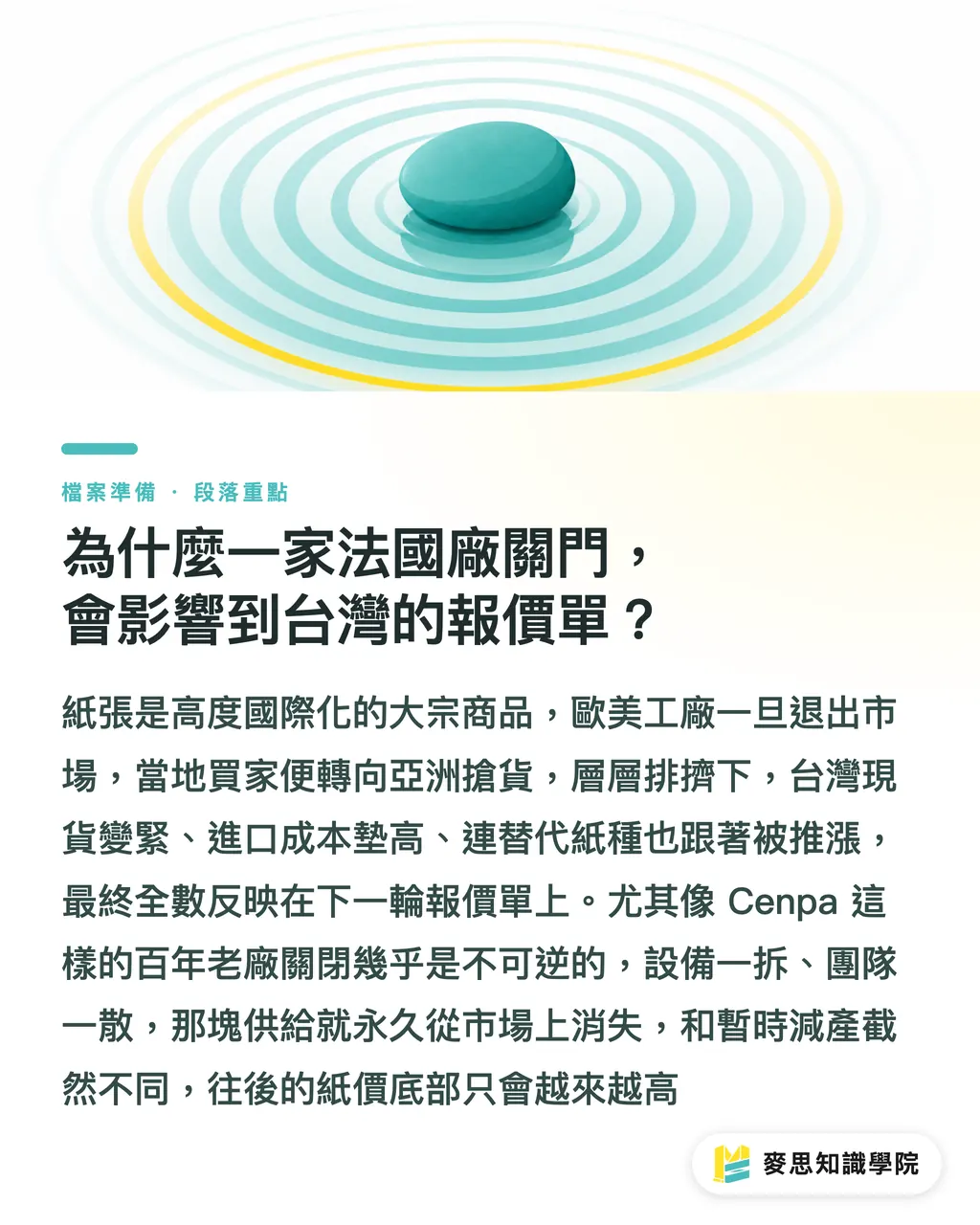
Why Does the Closure of a French Mill Affect Price Quotes in Taiwan?
Many business owners ask, 'That's a Western issue, what does it have to do with me?' This requires understanding the global flow of paper
Paper is a highly internationalized commodity. Taiwan relies on imports for a significant proportion of fine paper, specialty paper, and high-end packaging paper. When capacity exits the market in the West, buyers there scramble for stock from other regions, consequently siphoning off supplies that would otherwise be available to the Asian market, this is known as the crowding-out effect
Here is how this specifically trickles down, in three stages:
・The first stage is a tightening of spot stock; paper types that were previously readily available now require scheduling
・The second stage is price impact; once import costs rise, wholesalers and paper merchants reflect this in their next round of quotes, usually adjusting everything at once
・The third stage is that alternatives also increase in price because everyone is scrambling for the same pool of substitute paper, concentrating demand and pushing up prices for those solutions as well
Cases like the century-old Cenpa are particularly noteworthy. Old mill closures are almost irreversible; once equipment is dismantled and teams disperse, production won't resume even if the economy recovers. It is effectively permanently removing a piece of long-term supply from the table, this is entirely different from 'temporary production cuts'
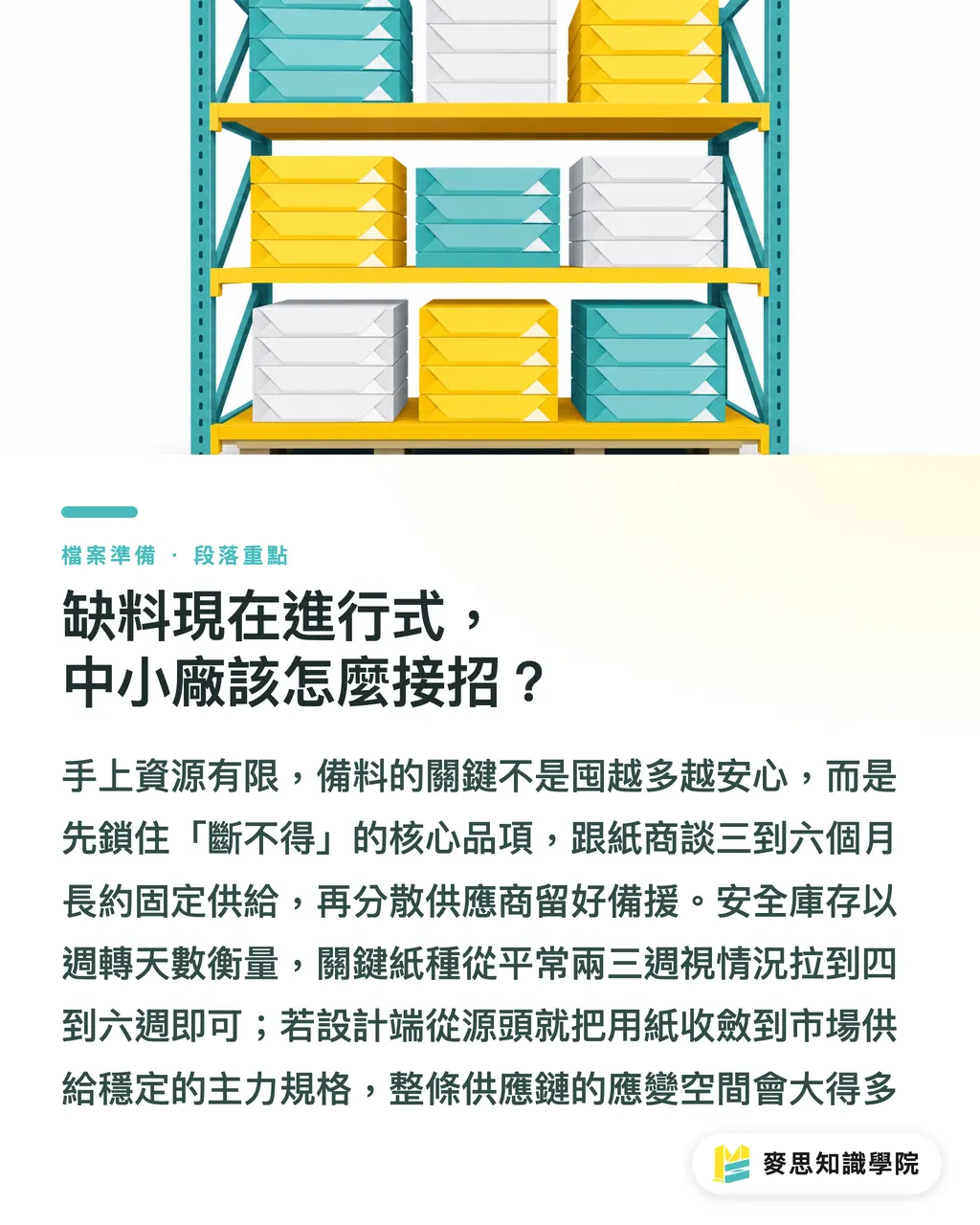
Shortages are Underway: How Should Small and Medium-Sized Plants Respond?
Everyone understands the logic, but the difficulty lies in limited cash flow and storage space; you cannot stockpile infinitely. I suggest a three-step approach based on urgency:
・Prioritize inventory of 'indispensable' items: Identify the orders from the past year that had the highest volume, were client-specified, and required specific paper types. These are the items to prioritize for inventory, not everything
・Negotiate long-term fixed-price contracts with paper merchants rather than just comparing spot prices: At this juncture, securing a stable supply and price for three to six months is far more important than saving a few percentage points on a spot purchase. You are locking in 'availability.'
・Diversify suppliers, keeping at least one backup: Do not rely on just one paper merchant or one region. The accident-related shutdown of the Longview plant is a reminder that if a single source fails, your production line stops with it
There is a simple criterion for judging inventory preparation: view it in terms of 'inventory turnover days,' not 'the more I stockpile, the safer I feel.' Increase safety stock for key paper types from the usual two to three weeks to four to six weeks, depending on the situation. Keep it within a range that won't result in spoilage or crush your cash flow. Excessive stockpiling can lead to materials becoming obsolete due to moisture damage or specification changes
The design side can also help. If paper types can be consolidated to 'major market-stable specifications' during the design phase, rather than specifying obscure specialty papers for every project, the flexibility of the entire supply chain will be much greater. This is why integrated services, from design and paper recommendations to printing, make a difference. Information on material availability can be sent forward to the design desk, rather than realizing it's unavailable only when it's time to print
How Long Will This Last, and Should We Act Now?
Honestly, no one can give you an accurate end date, but there are several signals to watch
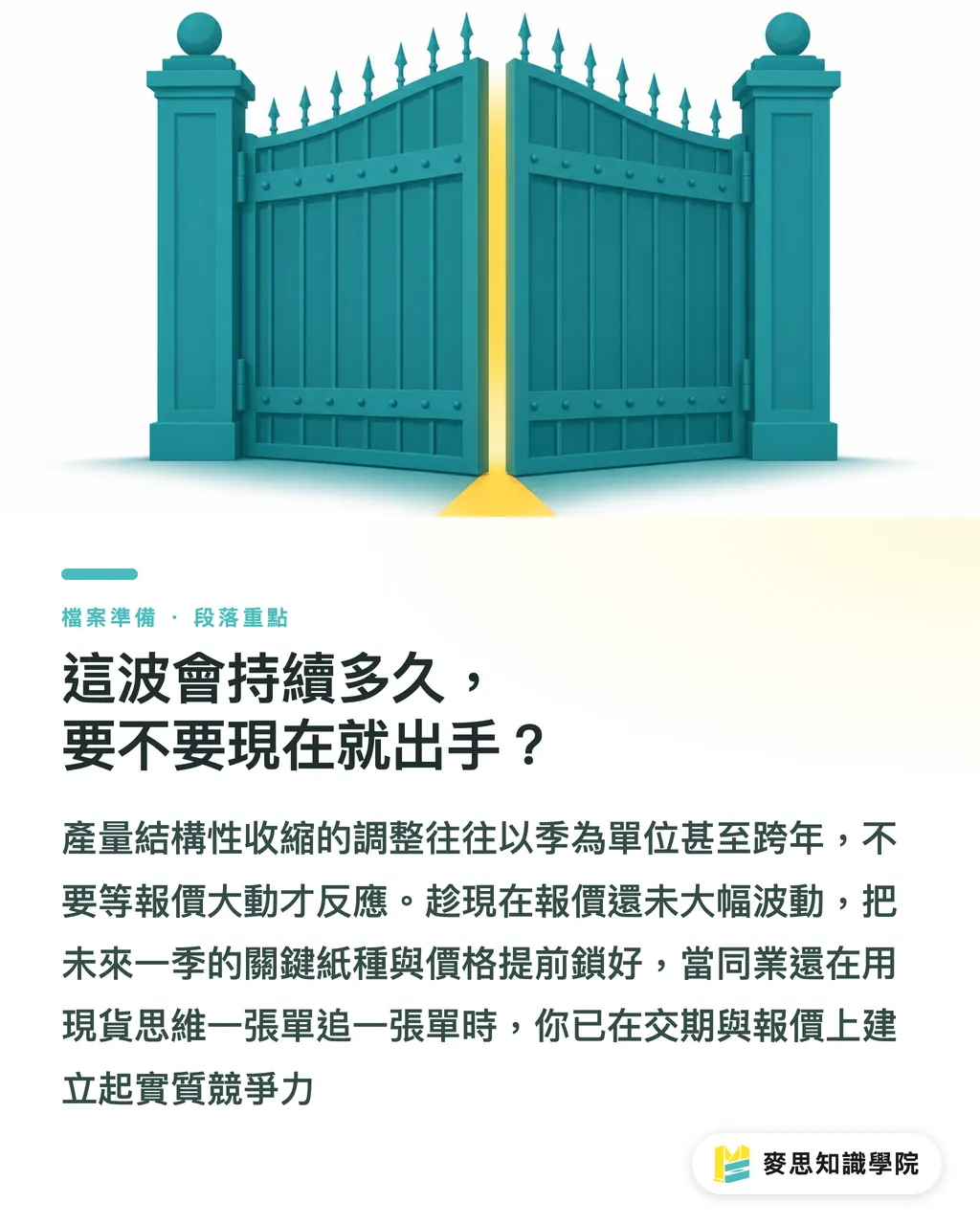
Declining production combined with permanent full-mill exits constitute structural contraction, not the kind that returns after restocking. This type of adjustment usually plays out over quarters or even spanning years. My assessment is: don't bet on a short-term stabilization. Lock in the materials you need and negotiate your contracts before the price lists shift significantly
Looking at it from another angle: while competitors are still operating with a 'spot-purchase' mindset, chasing materials order by order, you will have already secured the key paper types and prices for the next quarter. This is tangible competitiveness in terms of lead times and quotes. What clients want is never just 'cheap'—it's 'you can take the order, and you can deliver.'
Key Takeaways
・The stacking of three paper mill incidents within three months indicates that the global paper supply is undergoing structural contraction, not seasonal fluctuation
・Shortages are first reflected in lead times and a reduction in available paper types, not price. By the time prices move, it's often too late
・The permanent closure of century-old mills is irreversible, effectively permanently removing a piece of long-term supply from the market
・Do not stockpile everything; prioritize 'indispensable' key items, and increase safety stock from two to three weeks to four to six weeks, depending on the situation
・Negotiating long-term contracts at this time is about securing 'availability,' which is far more important than saving a few percentage points on spot prices
Further Reflections
The true revelation here is the necessity of pushing procurement intelligence forward. The traditional workflow only starts looking for paper after design is complete, client sign-off is obtained, and the order is placed, placing the entire risk of material fluctuation on the final stage. If you can understand which paper types have stable supplies and which are contracting during the project acquisition and design phases, you can reduce risk at the source. For designers, this avoids the pitfall of 'designing something that can't be produced due to lack of paper.' For printing plants, this connects procurement, production, and design intelligence into a single line. The client side benefits from reduced costs of revisions and re-prints. This is the practical value of integration: it's not just selling services bundled together, but allowing supply chain information to flow across links. The next step is simple: list your top three most relied-upon paper types, and go negotiate supply and price locking with paper merchants this week
Further Reading
FAQ
- Why is there a shortage and price hike for paper in 2025?
- Because global paper supply is undergoing structural contraction. The American Forest & Paper Association (AF&PA) report indicates a year-over-year decline in U.S. paper and paperboard production in 2025. Combined with the permanent closure of the century-old French Cenpa mill and the accident-related shutdown of the U.S. Longview mill, these three incidents have collectively caused spot stock to tighten and import costs to rise
- Should printing plants in Taiwan stock up on paper in advance?
- It is recommended to handle this by item category. Prioritize locking in 'indispensable' key paper types, increasing safety stock from the usual two to three weeks to four to six weeks depending on the situation, while keeping it within a range that doesn't overwhelm your cash flow. Do not stockpile everything infinitely to avoid materials becoming obsolete due to moisture or specification changes
- Is it worthwhile to negotiate long-term fixed-price contracts with paper suppliers?
- At a time of supply contraction, it is very worthwhile. The core of locking in a long-term contract is 'availability and fixed prices for the next three to six months,' which is far more important than pursuing a few percentage points of savings on spot prices. Ensuring stable lead times is true competitiveness
- Why does the closure of a French paper mill affect quotes in Taiwan?
- Paper is a highly internationalized commodity. Taiwan relies on imports for a significant proportion of fine paper and high-end packaging paper. When capacity exits the market in the West, buyers there scramble for stock from other regions, consequently siphoning off supplies that would otherwise be available to the Asian market, thereby pushing up import costs and prices for substitute paper in Taiwan
References
Related articles

The Print × AI weekly
The print and AI know-how designers, brands and enterprises can use before they commit — one email, every week
MINDS Free Tools
Spine width and imposition calculators — skip the manual math, free in your browser.
MINDS Group
Need actual printing or gifting services?
From premium printing to online ordering and festive gifts — the MINDS Group sister brands take it from here.