
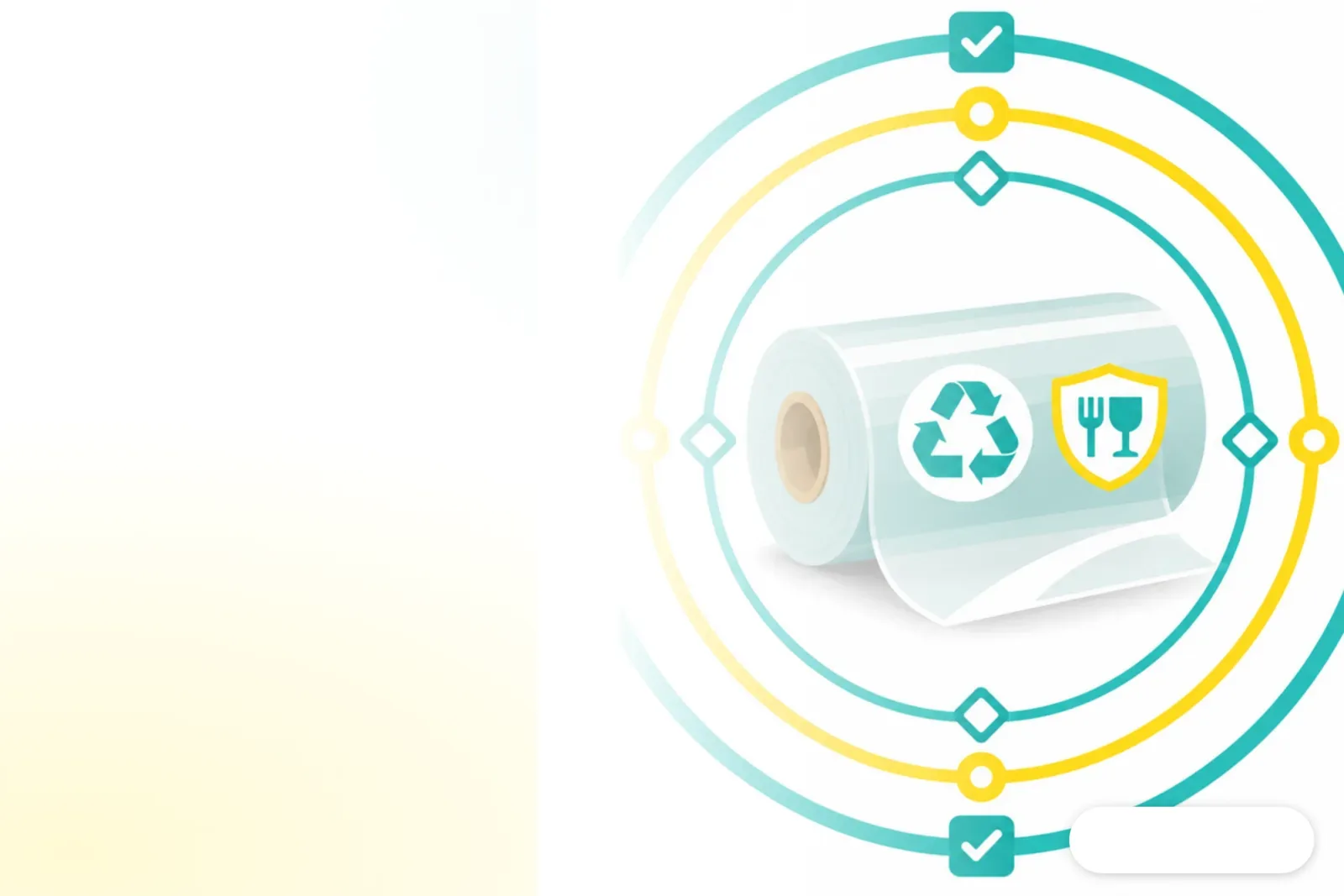
Why Is Food-Grade PCR Becoming a Brand Decision?
Food-grade PCR is becoming a brand decision because procurement teams need to confirm both food-contact safety and film performance. At Pack Expo 2026, CNG (Charter Next Generation, a materials supplier that makes a range of plastic films) shared a case that brought both requirements into the same materials discussion
PCR (post-consumer recycled) is new material made by recycling plastic after consumer use. Food-grade PCR also needs to be checked for food-contact safety and film performance
Food packaging cannot be judged by material name alone. The film also needs to perform as expected through printing, bag making, filling, and storage and transport. In my experience, if a brand starts by asking only, "What percentage is recycled content?", it often has to follow up with questions about suitable applications, test methods, and production consistency. Define the food use first, and suppliers will know what evidence to provide

What Do CNG's Figures Tell Us?
CNG's case shows that PCR is part of its materials circularity strategy and is now entering discussions about food films. A Packaging Dive report cites CNG's 2025 sustainability report, which says the company used more than 30% more PCR in 2025 than in 2024. John Garnett, senior vice president of technology, sustainability, and innovation, said that increasing PCR use is a key driver of materials circularity
The report also says CNG's Scope 1 and 2 greenhouse gas emissions fell 23% in 2025 from the previous year. The company has set targets to cut emissions by 42% by 2030 and 90% by 2050. These figures describe CNG's own progress. They do not directly show the emissions reduction of a particular film, and they are not proof of food safety
How Should Food-Grade PCR Safety Be Checked?
Safety needs to be assessed for the finished film and its intended use. The words "food-grade" alone are not enough. Packaging Dive reports that Garnett discussed research with CNG and industry partners at a Pack Expo session on October 19, 2026. The research aims to assess the safety and performance of PCR in food films. That research direction does not mean the same PCR material is suitable for every food and package
During procurement review, brands can ask material suppliers:
・Which foods, contact types, and conditions of use do the tests cover?
・Was the sample a raw material, a film, or a finished package, and does it match the production item number?
・Do the documents specify the PCR source, content percentage, test methods, and limits on use?
How Can Brands Plan a Small-Scale Trial?
For a food-grade PCR trial, it is best to start with one packaging item, confirm its specifications, make samples, and run filling tests before deciding whether to expand. In 2025, CNG diverted more than 23 million pounds of production scrap from landfill. That company figure is also a reminder that procurement reviews should look beyond material content to account for manufacturing waste and where it goes
・Define the use first: specify the food type, storage conditions, and areas of the package that will contact food
・Check the documents next: confirm that the test data applies to the actual material, content percentage, and conditions of use
・Then run a trial: sample using the planned printing, bag-making, and filling conditions. Record the results before discussing higher volumes
This sequence helps brands spot gaps between the material documentation and actual production conditions early, before the packaging artwork is finalized and safety documents need to be added or tests repeated
How Can Smaller Brands Avoid Overstating Sustainability Claims?
Small and midsize brands in Taiwan can start by choosing one package with a clearly defined food use and making a small batch of samples. Then they can align the records across procurement, quality assurance, and design. CNG's PCR use grew by more than 30% in 2025 compared with the previous year. That figure describes CNG's own adoption progress. It is not an industry-wide rate, nor does it prove that consumers have approved a particular material
Sustainability copy should match the confirmed material percentage, scope of use, and test basis. If all you have is a research direction or a supplier's verbal assurance, do not present it as general approval for the product. If you are also updating a carton, label, or other branded print piece, bring the material specifications and claim wording to MINDS, a mid-to-high-end commercial printer specializing in fully customized work, so the final printed copy matches the evidence on hand

Key Takeaways
・For food-grade PCR, check both safety data for the intended use and film performance
・CNG's increase in PCR use reflects the company's own progress, not an industry-wide benchmark
・Check food-contact testing and production performance separately
・Run a trial with one package first, then decide whether to expand adoption
Further Considerations
Printers can keep the PCR item number, batch, sample, and filling results together in one specification record. Designers should tie sustainability claims to the approved material version. AI and SaaS can help compare document versions and flag missing validation fields, while the brand's quality team and supplier still need to confirm food-contact suitability. The next step is to choose one package for a small-scale validation, then assess other items once the process works
Further Reading
FAQ
- Can food-grade PCR be used in all food packaging?
- Not necessarily. Food-contact safety, package structure, and film performance must all match the specific use. CNG's case does not mean every PCR material is suitable
- What does CNG's increase of more than 30% in PCR use mean?
- It describes CNG's own usage in 2025 compared with 2024. It is not an industry-wide growth rate or a required percentage for brands
- What is the first step for a brand adopting food-grade PCR?
- Define the food type, contact method, and storage conditions. Then ask the supplier for the relevant documents, followed by sampling and filling validation
- How can a brand describe its use of food-grade PCR?
- State only the material percentage, scope of use, and validation results supported by documentation. A research direction or a supplier's verbal assurance cannot be presented as general approval
Related articles
The Print × AI weekly
The print and AI know-how designers, brands and enterprises can use before they commit — one email, every week
MINDS Free Tools
AI background removal, a LINE sticker maker, spine & imposition calculators — all free, right in your browser, no upload.
MINDS Group
Need actual printing or gifting services?
From premium printing to online ordering and festive gifts — the MINDS Group sister brands take it from here.