
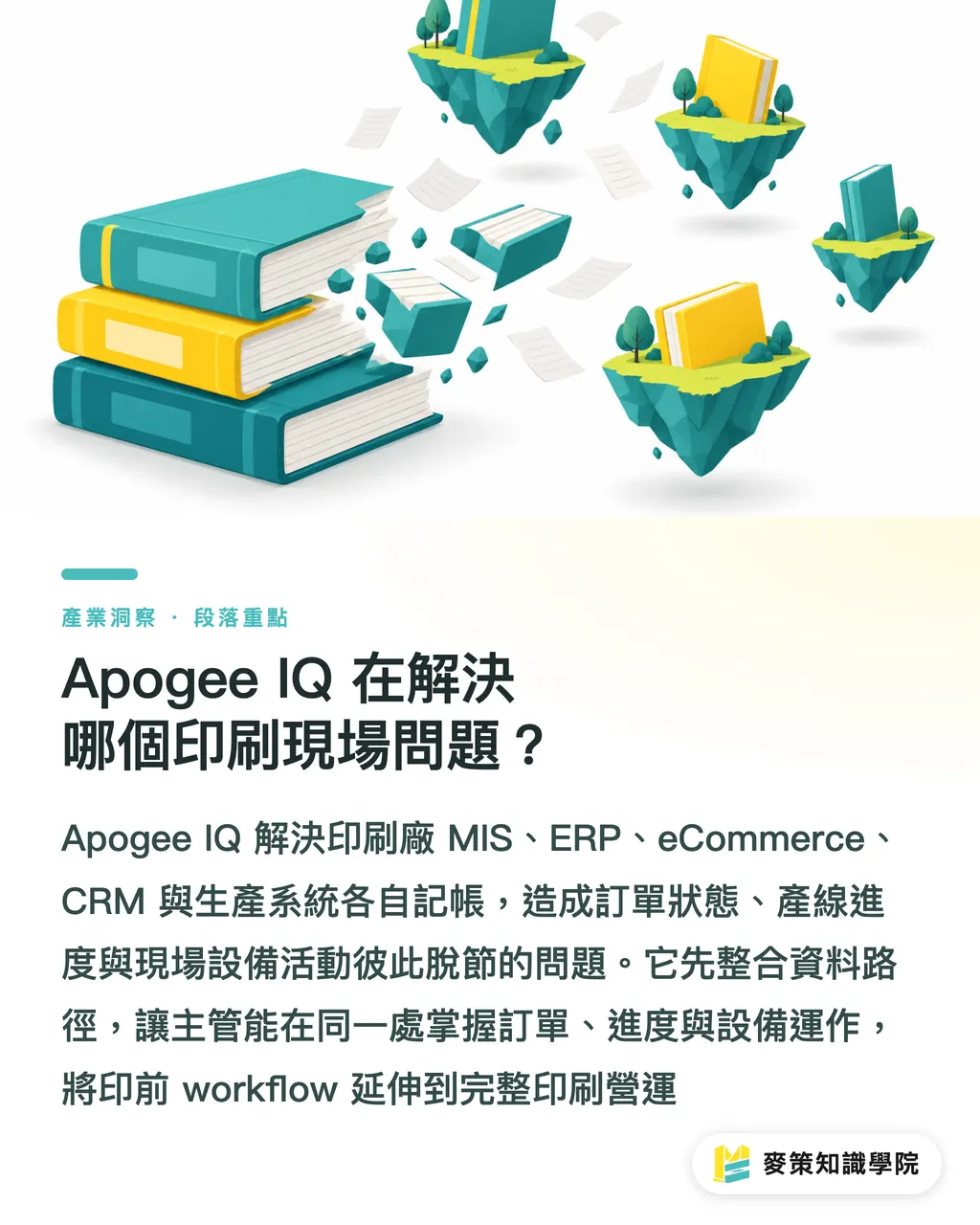
What print-floor problem is Apogee IQ solving?
Apogee IQ addresses a common print-shop problem: multiple systems keeping their own records while shop-floor information never makes it back
On September 25, 2026, ECO3 launched Apogee IQ, extending Apogee, ECO3's automated prepress workflow platform, into full print operations. ECO3 was spun out of Agfa Offset Solutions' plate and digital workflow business, then launched Apogee IQ roughly three years later, extending the product from prepress into end-to-end print operations. Print21: ECO3 launches Apogee IQ points out that manual transcription, point-to-point connections, and gaps in shop-floor information can split order status from production progress
・Business data: MIS (Management Information System, a system that organizes order and production data for shop-floor use) and ERP (Enterprise Resource Planning, a system that connects orders with company resources)
・Customer and order-intake data: eCommerce (an e-commerce system that handles online orders and customer data) and CRM (Customer Relationship Management, a system that organizes customer interactions and case data)
・Production data: logistics and prepress workflow
Apogee IQ takes a practical entry point: first put the data back on one shared path, then give managers visibility into orders, progress, and activity from the production equipment
How does the central integration layer get the data moving?
The central integration layer is a shared interface between multiple systems. It handles data transfer, synchronization, and validation. Apogee IQ uses it to put business data and equipment reports on the same path
Apogee IQ consists of two connected applications with clearly divided roles
・Apogee IQ Integrate: connects MIS, ERP, eCommerce, CRM, and logistics, reducing manual entry and keeping data in sync
・Apogee IQ Retrieve: pulls operational data directly from presses, CTP (Computer to Plate, plate-making equipment that outputs plate files directly to printing plates), digital presses, and finishing equipment
Once Integrate and Retrieve are connected, a print shop can use events and conditions to drive multi-step workflows, route and validate data, and feed the results into scheduling, planning, and resource allocation
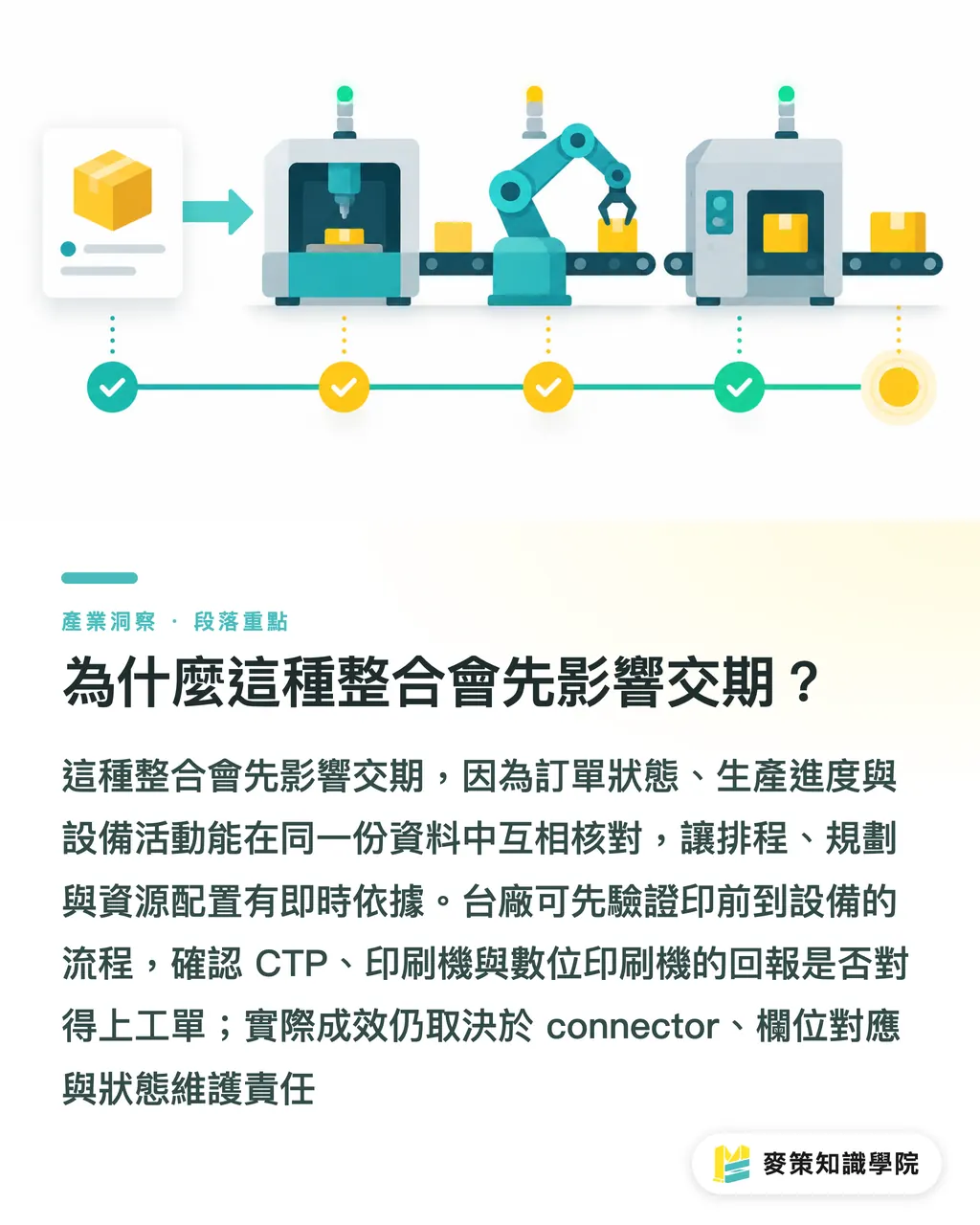
Why does this kind of integration affect delivery dates first?
It affects delivery dates first because order status, production progress, and equipment activity can be checked against one another using the same data
Print-shop managers keep asking about order status because process progress and equipment reports often live on different screens. Apogee IQ puts these data in the same environment. ECO3 says it can provide real-time visibility, giving scheduling, planning, and resource allocation data to work with
Taiwanese print shops can start by testing three scenarios
・From order intake to prepress: check that order conditions are complete, then send the information into the workflow
・From prepress to equipment: check whether reports from CTP, presses, and digital presses match the job order
・From production to customer service: return production progress to the CRM so delivery-date answers have something behind them
The announcement does not promise that every print shop can use these scenarios out of the box. The actual result will depend on the connector, field mapping, and who is responsible for changing statuses
When bringing AI into a print shop, should you first check whether the data is usable?
If you want to treat Apogee IQ as an entry point for AI adoption, first check whether the data has consistent fields, clear events, and traceable reporting. Do not judge it by the IQ in the product name alone
The capabilities explicitly described in the announcement are automatic routing and validation of information based on events and conditions, followed by support for scheduling, planning, and resource allocation. The announcement does not list generative AI, chatbots, or any feature that makes quoting decisions directly for print shops. That boundary needs to be clear. Otherwise, you may end up buying an integration platform that is just a fancy data-transfer box
I use Mai Strategy's Three-Gate Print Check before implementation
・Data gate: Are the field names and versions for orders, quotes, specifications, and delivery dates consistent?
・Process gate: When is each step reported, who is responsible for changing the status, and where does the equipment data come from?
・Decision gate: What conditions should guide scheduling, resource allocation, and exception handling, and who has the final say?
If the data, process, and decision gates do not pass, adding more systems will only make errors spread faster
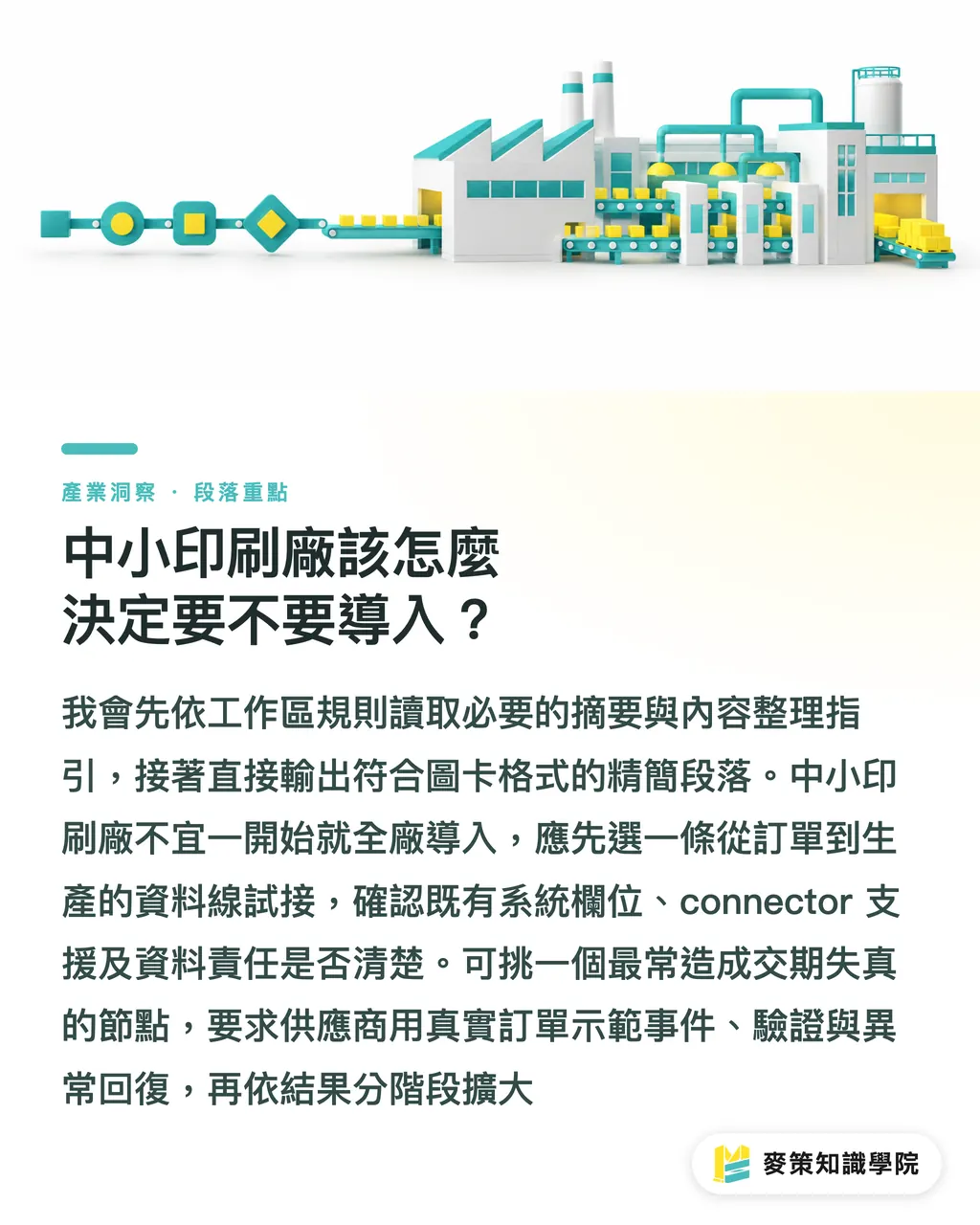
How should a small or midsize print shop decide whether to adopt it?
Small and midsize print shops should first test one order-to-production data line, then decide whether to expand it across the shop
ECO3 announced that Apogee IQ will be available in Q2 2027 for print businesses using ECO3 Apogee or other prepress workflows. ECO3 is developing it with Bodoni. More partners are expected to be announced in due course. The available connector coverage should be checked as part of procurement
・Map the data flow among MIS, ERP, eCommerce, CRM, logistics, the workflow, and equipment, marking the fields that people re-enter by hand
・Pick the point where delivery dates most often go wrong, and ask the vendor to demonstrate events, conditions, validation, and reporting using a real order
・Confirm the connectors, data ownership, permissions, and exception recovery before discussing a phased rollout
Advantages:
・Business applications and presses, CTP, digital presses, and finishing equipment can sit within the same integration architecture
・Scheduling and resource allocation can draw on more complete shop-floor data
Disadvantages:
・Results depend on the fields in existing systems, connectors, and partner support
・If data ownership is not defined first, a new platform will reproduce the existing mess
Key takeaways
・Apogee IQ's value lies in connecting MIS, ERP, and equipment reports through one data flow
・Before bringing AI into a print shop, organize the three data areas: orders, processes, and equipment reports
・Integrate handles business-system synchronization. Retrieve handles production-equipment data
・Before Q2 2027, use one real order to validate the connector, fields, and ownership
Further thoughts
What print shops need to draw next is a data-ownership map for one real order, from order intake and prepress through equipment reporting. The polished system architecture diagram can wait. Use this map to make the vendor demonstrate the flow, and confirm the fields, events, permissions, and exception recovery. If you need to turn the inventory into an implementation blueprint, contact the Mai Strategy Knowledge Academy consulting team. Highly customized commercial print scenarios can also be tested against MINDS's production-floor workflow
Further reading
FAQ
- Is Apogee IQ an ERP?
- Apogee IQ is an integrated platform that extends ECO3's prepress workflow, connecting MIS, ERP, eCommerce, CRM, logistics, and production equipment through a central integration layer
- Which print-production equipment can Apogee IQ connect to?
- Apogee IQ Retrieve can pull operational data from presses, CTP systems, digital presses, and finishing equipment
- What should small and midsize print shops in Taiwan do before adopting it?
- Start with Mai Strategy's Three-Gate Print Check to review order data, process reporting, equipment data, and the division of responsibilities, then use one real order to test the connector and field synchronization
- When will Apogee IQ be available?
- ECO3's September 25, 2026 announcement says it is expected to be available in Q2 2027 for print businesses using ECO3 Apogee or other prepress workflows
Related articles


The Print × AI weekly
The print and AI know-how designers, brands and enterprises can use before they commit — one email, every week
MINDS Free Tools
AI background removal, brand stamping, and a LINE sticker maker — free design tools, right in your browser, no upload.
MINDS Group
Need actual printing or gifting services?
From premium printing to online ordering and festive gifts — the MINDS Group sister brands take it from here.