

Where does AI land first in the print industry?
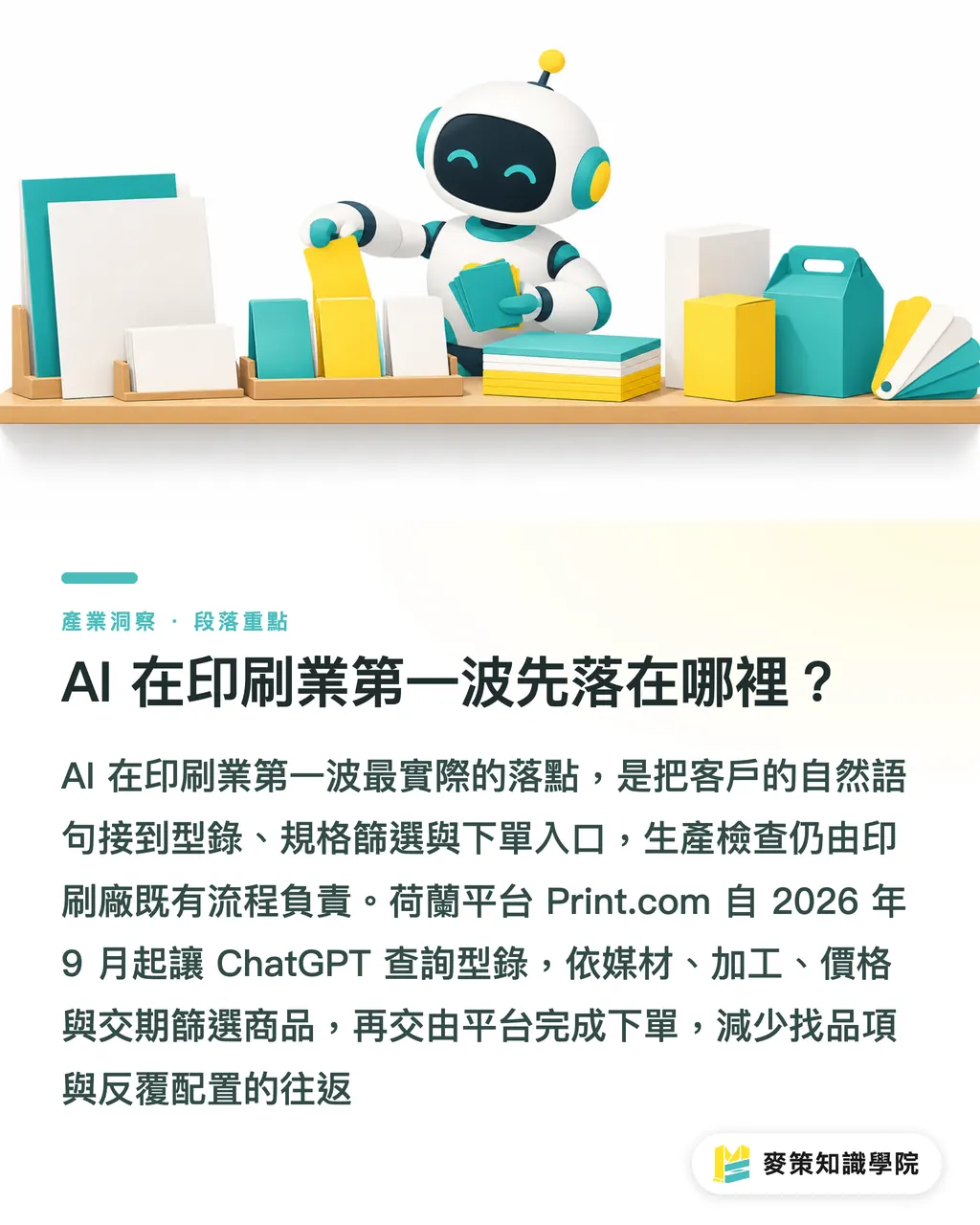
The first place AI works well in print is connecting a customer's plain-language request to the catalog, spec filtering and the ordering entry point. Production checks stay with the print shop's existing process. Shops are also trying auto-layout, image repair, color management and order forecasting, but the payoff depends on whether they cut manual corrections or wrong orders. For now, the concrete business cases sit in order intake and design services
Print.com, a Dutch online print platform, has let ChatGPT, the conversational AI assistant, search its catalog since September 2026. A customer can ask for the price of flyers delivered to Paris by Friday. ChatGPT filters by media type, finishing, price and lead time, then hands the customer back to the platform to place the order. The case in AI and Printing: The First Practical Applications in the Printing Industry has a clear boundary. ChatGPT doesn't handle payment, file download or preflight. What it saves is the back-and-forth of finding a product and configuring it again and again
MCP connects the catalog, UCP standardizes the fields. What's the difference?
MCP lets an AI assistant query outside systems. UCP is heading toward standardized commerce information. They solve different problems. MCP (Model Context Protocol) is an open standard for AI assistants to query external systems. It can plug into a catalog service, but it won't standardize print spec fields
UCP (Universal Commerce Protocol) is a protocol direction for standardizing commerce data, and a print extension is being discussed that would cover specs, proofing, preflight and lead-time fields. Initiative Online Print, Germany's print federation BVDM and the European print organization Intergraf are involved in pushing this extension. The goal is for different services to describe a print job in similar ways. Print.com already connected to ChatGPT through MCP, so there's no need to wait for UCP to be finalized before you start testing
For a small or mid-sized shop, write paper stock, finishing, proofing method and lead time as stable fields first. Whatever interface you connect later, there's one less layer of manual cross-checking. Get the specs aligned first
With AI in design and order intake, which part of the work can a print shop save?
On the design and intake side, AI mainly cuts operating steps and product setup. Technical prepress checks still have to be owned by the print shop. In August 2026, Adobe, the design software company, announced that more than 70 features from its apps would be integrated into ChatGPT, so users can do some graphic design and image editing through conversation commands
Cimpress, a print services provider, handles production handoff for orders from Canva Print Shop, Canva's online print ordering service, so customers never need to visit a print shop's website first. The first lets customers operate some design features by conversation. The second shortens the path from creating something to placing a print order. Both focus on simplifying product access or configuration. Neither replaces technical prepress checking
On the design side, AI can be used for proposals and small edits that are easy to undo. In the shop, you still check finished size, bleed, color and finishing conditions. A layout that looks finished doesn't mean the file is ready for press

How should a small or mid-sized print shop run a pilot so the return actually shows?
Start with products that have stable specs and get quoted repeatedly. That work is easier to measure in labor time and wrong-spec jobs. I suggest laying out the pilot as three gates in order intake
・Product data: organize specs, finishing, price and lead time, and offer only approved options
・Quote filtering: let AI find suitable combinations from the customer's needs, then hand back to the platform to place the order
・Prepress handoff: payment, file download, preflight and proofing follow your existing process
Print.com's approach is for ChatGPT to filter catalog options, then provide a path back to the platform to order. Before and after the pilot, record quote handling time, how many times sales has to ask follow-up questions, and the number of wrong-spec rejections, all measured the same way. Then decide whether to widen the range of products. Start with one product
What are the risks of AI order intake?
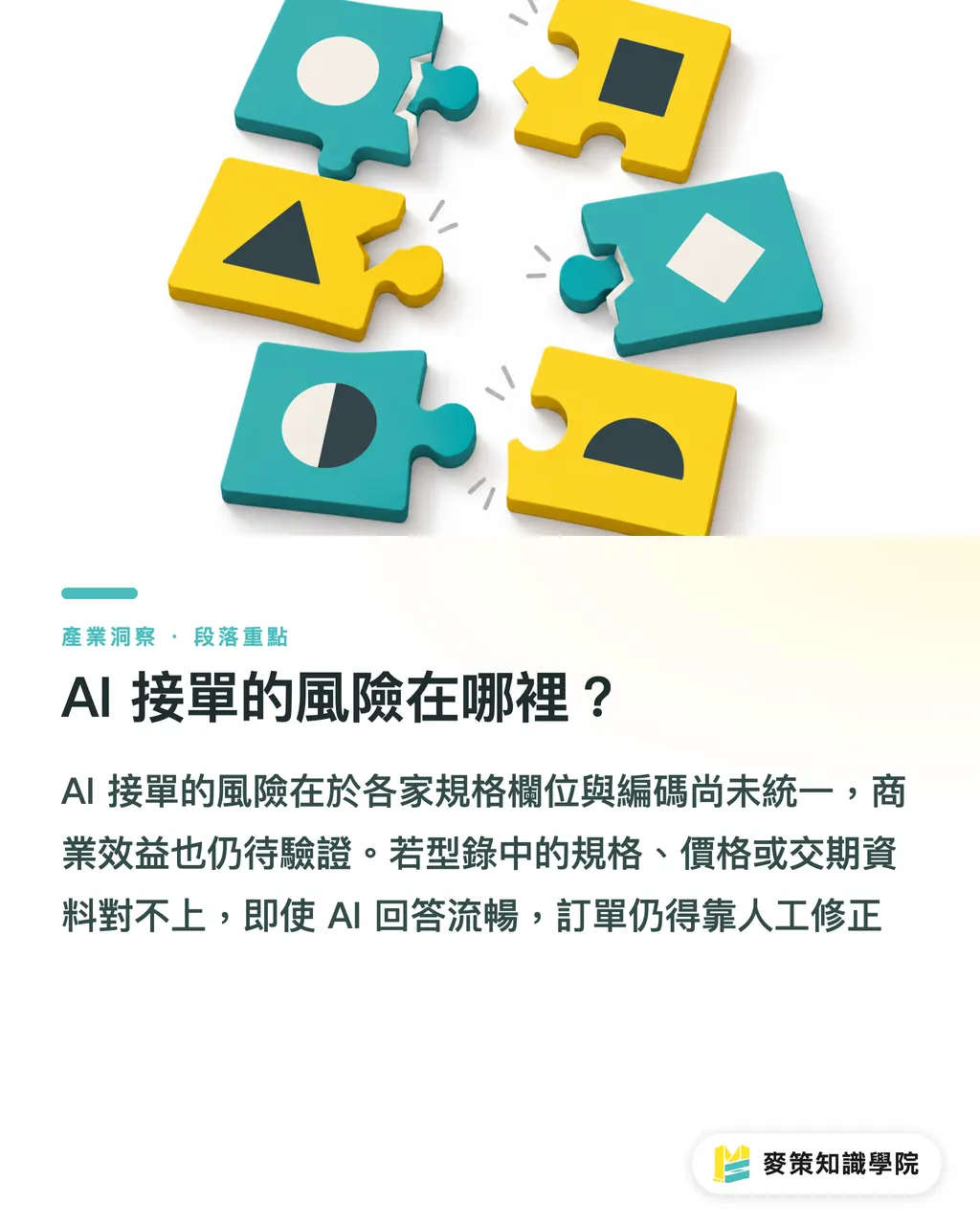
The risk right now is that each vendor still uses its own spec fields and codes, and the overall business payoff hasn't been proven yet. Before adding any interface, the print shop has to confirm that someone maintains the specs, price terms and lead times in the catalog. If the data doesn't match, the front-end answer can be as smooth as you like, and the back end still has to fix the order by hand
・Upside: customers can find products in plain language, with less field-by-field lookup and configuring
・Upside: your existing catalog gets one more AI entry point, and the order still ends up on the platform
・Downside: MCP won't standardize print spec vocabulary, so each vendor's interface still has to be mapped by hand
・Downside: in the Print.com case, payment, download and preflight don't happen inside ChatGPT, and the commercial return is still undecided
If you want to inventory your products, data fields and manual handoff points, the Mai Strategy Knowledge Academy advisory team can turn the pilot scope into a checklist you can verify
Key takeaways
・In this first wave, AI shortens the back-and-forth of finding products and configuring specs. It doesn't take over the whole print workflow
・MCP lets AI query the catalog, and the UCP print extension handles cross-platform spec descriptions
・Pilot on fixed-spec products that get quoted repeatedly, and judge the result by labor hours, follow-up questions and rejections
・Finishing a design step in conversation doesn't mean the file can go straight to print
Further thinking
A print shop can first organize the specs, price terms, lead time and handoff responsibilities for one high-frequency product, then let AI answer quote requests only from approved data. On the design side, limit AI to small edits that can be undone. SaaS teams should handle field mapping, order-status write-back and manual takeover first, and widen the product range only after follow-up questions and wrong-spec jobs have actually dropped
Further reading
FAQ
- Where in a print shop does AI fit best to start?
- Start with plain-language catalog search, filtering product specs, and sending customers back to your existing ordering platform. Preflight and proofing still follow the shop's own process
- What's the difference between MCP and UCP for a print shop?
- MCP lets an AI assistant query an outside catalog. The UCP print extension aims to standardize how print products and orders are described
- Can ChatGPT complete an order for a print shop on its own?
- In the Print.com case, ChatGPT finds product specs and gives a link to the platform's order page. Payment, file download and preflight stay outside the conversation
- How can a small or mid-sized Taiwanese print shop tell whether AI order intake is worth adopting?
- Pick a fixed-spec product that gets quoted repeatedly. Compare quote handling time, follow-up question counts and wrong-spec rejections before and after, then decide whether to expand
Related articles
The Print × AI weekly
The print and AI know-how designers, brands and enterprises can use before they commit — one email, every week
MINDS Free Tools
AI background removal, brand stamping, and a LINE sticker maker — free design tools, right in your browser, no upload.
MINDS Group
Need actual printing or gifting services?
From premium printing to online ordering and festive gifts — the MINDS Group sister brands take it from here.