
What Is the Difference Between the Two New Cyrel ReNew Plates?
Start with the platemaking workflow: Cyrel® EASY ESXR is a digital solvent-processing plate, while Cyrel® EASY FAST EFXR is designed for the Cyrel® FAST thermal system. Flexographic printing transfers ink through a flexible plate and is common in packaging and label production. Designers first need to know which workflow the final file will enter
The photopolymer in both ReNew plates contains more than 50% ISCC PLUS-certified bio-circular raw material. ISCC PLUS (International Sustainability and Carbon Certification, a certification system covering material sourcing and mass balance across the supply chain) uses mass balance to bring renewable feedstocks into existing manufacturing processes while preserving the material's properties and supply-chain traceability
I would not start by asking which one is newer. ESXR addresses resolution, ink transfer, and dot performance in solvent platemaking. EFXR addresses fast processing within an existing Cyrel FAST thermal workflow. They are really two entry points for two production lines

Which Printing and Prepress Scenarios Suit ESXR?
ESXR suits flexographic jobs that use solvent platemaking and require stable fine screens and tonal detail. It has built-in flat-top dot technology, which keeps the tops of halftone dots flat. The plate also emphasizes high ink transfer, resolution, durability, clean running, and a wide tonal range. Its smooth surface is suitable for micro-screening and special print effects
If a packaging file combines fine-screen tonal gradations, localized micro-screening, and special effects, do not send only a PDF. The designer should include a proof reference, color targets, spot colors, and a check of reversed-out small type. ESXR's platemaking latitude and consistency can help reduce press setup time, but it will not restore an incorrect file version from the design side
For example, if a brand changes its primary color while keeping the original fine-screen background, the designer needs to clearly mark the revised color proof in the filename and delivery notes, and state which effects must remain. Flexographic detail is not finished just because it appears on screen. Both the platemaking and printing teams need to know how it will be verified
Why Is EFXR a Good Fit for Small and Midsize Flexographic Printers with Rush Jobs?
EFXR suits flexographic printers that already use the Cyrel® FAST thermal system and need to respond quickly when schedules shift. The plate can be processed in under an hour, with no drying step, making it possible for just-in-time platemaking to support rush jobs and last-minute revisions
A common situation at small and midsize plants is that changing a date, SKU, or regulatory statement means remaking the entire plate. With no drying wait, EFXR can bring file approval, platemaking, and press scheduling closer together. But if the plant does not have a compatible Cyrel FAST thermal workflow, the sub-one-hour processing time alone is not a sufficient purchasing reason
When submitting files, designers should put the plate name, thermal workflow, file version, and final approval time on the same job sheet. This small step can eliminate the most troublesome rush-job problems: hunting down files and accidentally using an outdated version

How Can Small and Midsize Flexographic Printers Bring the New Plates into Their File-Delivery Workflow?
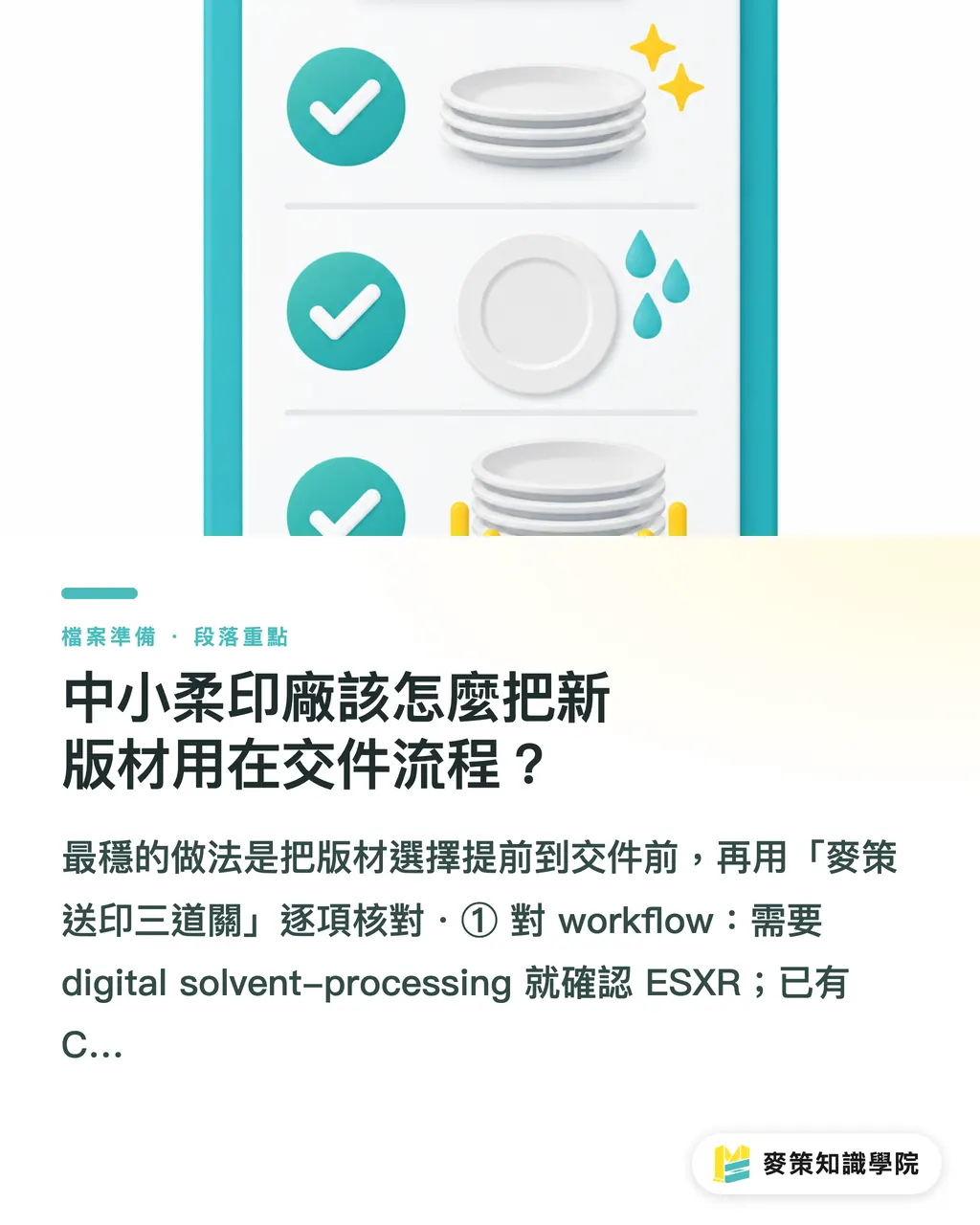
The most reliable approach is to choose the plate before file delivery, then run through the "Mai Strategy Three-Gate Print Submission Check" item by item
・① Workflow: confirm ESXR when digital solvent processing is required. If the plant already has a Cyrel FAST thermal system and needs just-in-time platemaking, evaluate EFXR
・② Artwork: put fine screen, wide tonal range, micro-screening, and special print effects in the delivery notes, and include the proof and file version
・③ Verification: on the first run, check high ink transfer, resolution, clean running, uniformity, and press setup time. If the brand plans to use sustainability claims, request supply-chain documentation for ISCC PLUS and mass balance
If the same brand produces both flexographic packaging and mid- to high-end commercial print, document the process conditions separately. MINDS is well suited to fully customized commercial printing, but flexographic plate specifications cannot be applied directly to a different printing process
Key Takeaways
・The first dividing line between ESXR and EFXR is the solvent or thermal workflow, not which model is newer
・More than 50% ISCC PLUS-certified bio-circular raw material gives sustainability claims a traceable basis
・EFXR's under-one-hour processing time and no drying step turn into production speed only when connected to a Cyrel FAST thermal system
・When submitting files, designers should put the plate name, file version, and proof target on the same job sheet
Further Considerations
Manufacturing teams should first establish equipment, proofing, and first-run records for ESXR and EFXR. Design teams should put the workflow, file version, dot settings, and effect notes into the file-delivery template. AI can help compare file versions, check specification fields, and flag missing items, but it cannot replace the platemaker's confirmation of processing and press results. If a SaaS product is to serve flexographic orders, its fields should at least record the plate, solvent/thermal route, supplier documents, and first-run verification
Further Reading
FAQ
- What is the biggest difference between ESXR and EFXR?
- ESXR is a digital solvent-processing plate, while EFXR is designed for the Cyrel FAST thermal system. The former focuses on resolution and dot control in solvent platemaking, while the latter focuses on thermal platemaking speed and a no-drying workflow
- Can every flexographic printer use EFXR right away?
- EFXR is designed for the Cyrel FAST thermal system. Before using it, confirm that the existing thermal equipment and workflow are compatible. Do not look only at the sub-one-hour processing time
- What should designers confirm before submitting files?
- First specify the plate and solvent/thermal workflow. Then check the file version, proof target, fine screens, and special print effects. Finally, confirm which first-run items the platemaking plant can verify
- How should brands describe Cyrel ReNew's sustainable materials?
- Cyrel ReNew photopolymer contains more than 50% ISCC PLUS-certified bio-circular raw material. DuPont integrates and tracks renewable inputs through mass balance. Brand copy should still follow the wording supported by supply-chain documents and must not extend it into an unverified claim about the share of carbon emissions
Related articles
The Print × AI weekly
The print and AI know-how designers, brands and enterprises can use before they commit — one email, every week
MINDS Free Tools
Imposition calculator and preflight file check — free prepress tools, right in your browser.
MINDS Group
Need actual printing or gifting services?
From premium printing to online ordering and festive gifts — the MINDS Group sister brands take it from here.