
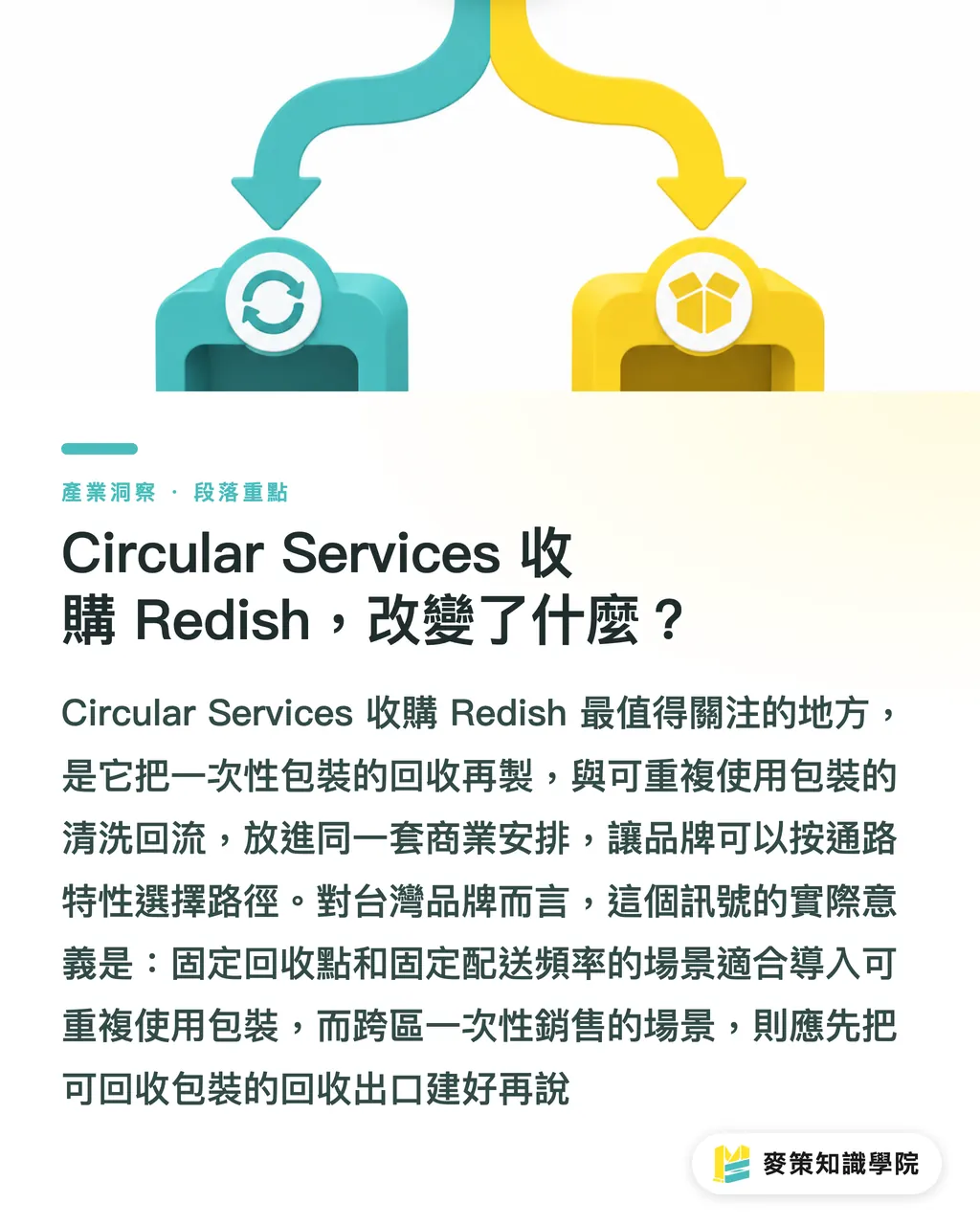
What Does Circular Services’ Acquisition of Redish Change?
It brings the recycling network for single-use packaging and the reusable-packaging system into one business arrangement, aiming to let brands assign different return pathways based on how the packaging is used. For details, see Circular Services’ Acquisition of Redish Reveals a New Closed-Loop Model
The signal I think brands should take from this acquisition is that two capabilities the industry often discusses separately are starting to appear on the same operating map. Single-use packaging needs collection, sorting, and reprocessing. Reusable packaging needs collection, cleaning, inspection, and a return to service for its next use
This is especially practical for brands in Taiwan. Services with fixed collection points and regular delivery schedules are in a better position to test reusable. Packaging sold across regions, used once, and hard to return is generally safer when the recyclable collection route is made clear first
How Can Reusable and Recyclable Work Together?
They share a return-loop mindset, but split into different post-use handling paths
A closed loop means keeping packaging within a controlled recycling or reuse system after use. It is sorted, processed, and put back into circulation, returning to the original product or a similar use instead of leaving the market after a single use
・Reusable: The packaging itself stays within the service system. After consumers return it, it is cleaned, inspected, and delivered again. This suits settings with clear return points and stable usage frequency
・Recyclable: After one use, it enters a recycling and reprocessing pathway. Design must consider material identification, ease of disassembly, labeling, and downstream processing conditions together
The point of this acquisition is not to turn every package into a reusable one. It is to send packaging that can reliably come back through a reusable route, while keeping a recyclable route open for packaging that cannot return. Each route needs its own processes
Why Can’t Brands Choose Only “Recyclable”?
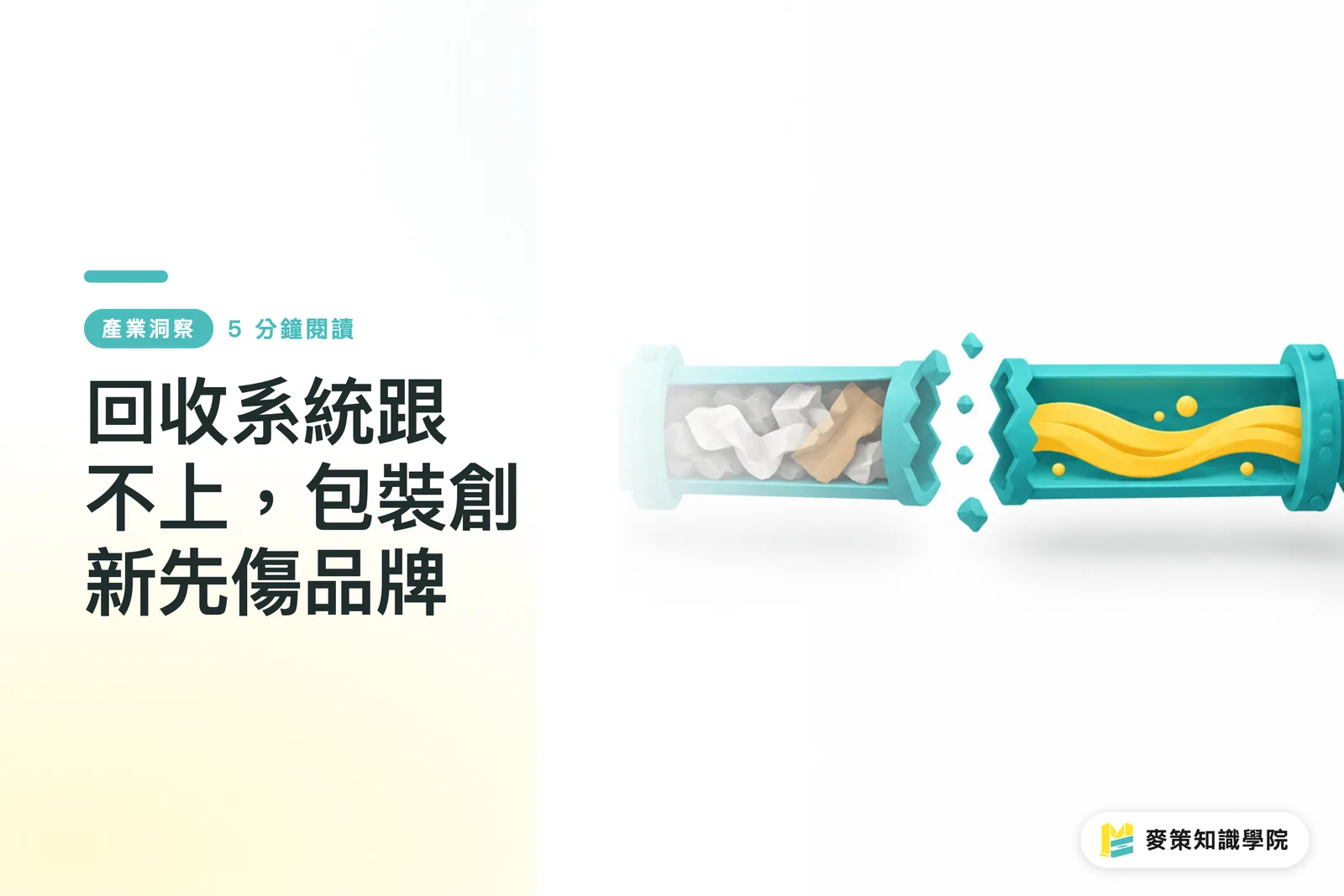
Because “recyclable” describes what a package could be, not whether it can actually be collected and processed after the consumer is done with it
In brand projects, I often see the material listed first on the spec sheet, with the recovery method added at the end. The result is that the package front carries a label, while retail channels, customer service teams, and consumers still do not know where to put it. The brand cannot clearly explain what happens to it next
The difference is even clearer with refillable personal-care products. The primary container, refill pouch, repurchase process, and post-use handling all have to be designed together. Leave out any one part, and consumers will simply treat it as another package to throw away
When I assess a package, I start with three questions:
・Who is responsible for collection or returns?
・At what point does the consumer hand it back?
・Where do the material or container go after processing?
If any one of those questions has no answer, tighten the sustainability claim first. Don’t rush to print “circular” in large type
How Should Brands and Printers in Taiwan Respond?
Map the package’s post-use route first, then decide on materials, finishing, and copy. This is the “Mai Strategy Three Print-Ready Gates” I recommend for brands and printers in Taiwan
・1. Return-flow gate: First confirm whether the package will be reusable or recyclable, then list the collection points, the return handler, and the transport method. If there is no return route, do not promise circularity yet
・2. Process gate: Put the paper stock or plastic, ink, coating, adhesive, label, and disassembly method into one specification. The printer should point out which finishing steps will make downstream sorting harder
・3. Communication gate: Use the same collection or return language on the package, e-commerce page, and in customer service. Reusable products also need to explain how refills work and when the package should be returned
When a brand turns these three gates into sampling and mass-production specifications, MINDS can bring the layout, printing conditions, and brand requirements into a single print-ready document, drawing on its focus on mid- to high-end, fully customized commercial printing. Test the return flow with one SKU first, then decide whether to scale up
What Should AI and SaaS Do in Circular Packaging?
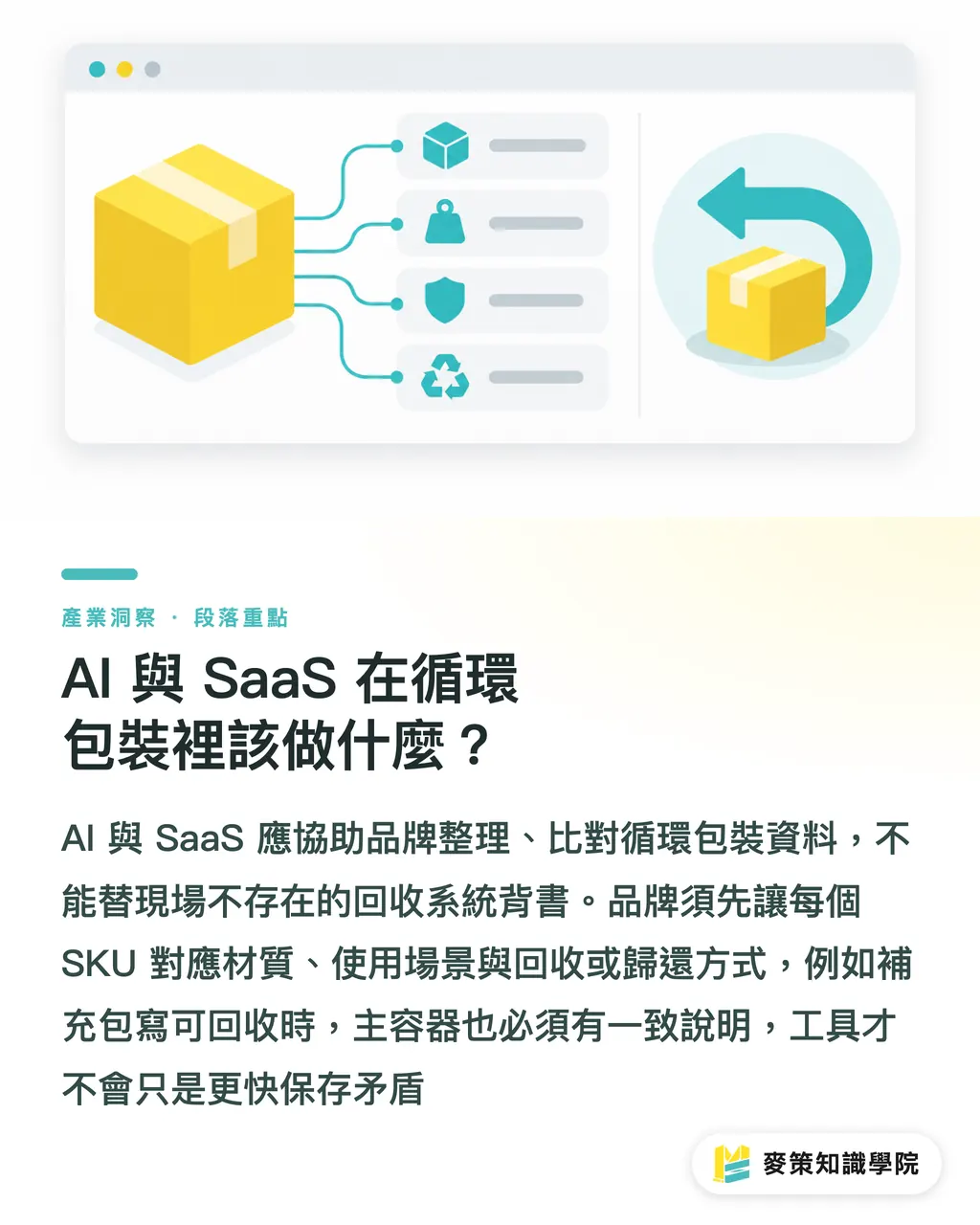
AI and SaaS are best used to organize circular-packaging data, not to assure a brand that a collection system exists on the ground when it does not
Every SKU should map, at a minimum, to its materials, finishing, use case, collection or return method, responsible party, and version. SaaS can manage specifications and supplier responses. AI can help compare packaging copy with print-ready files to see whether they contradict each other
If a refill pouch says it is recyclable but the primary container has no matching recycling instructions, even a complete system will only preserve the contradiction faster. Brands need to define the data fields first. That is when the tools become useful
Key Takeaways
・Circular Services’ acquisition of Redish puts reusable and recyclable in the same packaging strategy
・For reusable, ask first whether the package can reliably come back. For recyclable, ask first whether its collection and processing route is clear
・The first specification for sustainable packaging is not the material name, but who takes over after use
・Printers need to include finishing conditions, disassembly methods, and recycling instructions in the print-ready specification
・AI and SaaS can organize circularity data, but they cannot replace real collection points or processing capacity
Further Thoughts
Printers should add one question to the quote request: Where does this package go after use? Designers should treat recycling or return instructions as part of the layout. Brands should validate the return flow with one SKU before deciding whether to expand. AI and SaaS teams should establish data fields for materials, finishing, versions, and responsible parties before talking about automation. If you need to turn these decisions into print-ready specifications, the Mai Strategy Knowledge Academy consulting team can help sort them out
Further Reading
FAQ
- What is the main point of Circular Services’ acquisition of Redish?
- The main point is to put the recycling network for single-use packaging and the reusable-packaging system in the same strategy, so brands can arrange a recyclable or reusable route based on the use case
- Can reusable and recyclable be used at the same time?
- Yes. They can serve different use cases. Fixed collection points suit reusable, while single-use settings where returns are difficult need clear recycling and processing conditions for recyclable packaging
- What should brands ask first when assessing circular packaging?
- First ask who will take the package back after use, where the handoff will happen, and how it will be collected. Then decide on materials, finishing, and labeling instead of looking only at the recyclable claim on the package
- What can a printer do for reusable packaging?
- A printer can include the packaging structure, ink, coating, adhesive, label, and recycling or return instructions in the print-ready specification, connecting the design to the downstream handling route
- Can AI or SaaS guarantee that packaging is truly circular?
- No. AI and SaaS can manage SKU specifications, versions, responsible parties, and collection records, but actual circularity still depends on collection points, processing capacity, and consumer behavior
Related articles
The Print × AI weekly
The print and AI know-how designers, brands and enterprises can use before they commit — one email, every week
MINDS Free Tools
AI background removal, a LINE sticker maker, spine & imposition calculators — all free, right in your browser, no upload.
MINDS Group
Need actual printing or gifting services?
From premium printing to online ordering and festive gifts — the MINDS Group sister brands take it from here.