
Overview
Calendars are usually labeled as calendar in English. Corporate desk calendars and wall calendars can be named 2027 Calendar, Monthly Calendar, or Corporate Calendar. When MINDS (mid-to-high-end fully custom commercial printing) handles English calendars, we start by checking three things
・① Consistent month and day naming
・② Holiday names tailored to the target market
・③ Final text that is not trimmed off or scaled down until unreadable
A commercial English calendar arranges 12 months, 7 days of the week, holidays, and brand information according to the reading habits of the target market into a layout that is printable, easy to check dates on, and representative of the brand. The key points are consistent naming, clear information hierarchy, and error-free prepress
Should a Calendar in English Be Called Calendar or Planner?
Calendar is the most general English term, suitable for corporate wall calendars, desk calendars, annual calendars, and general promotional calendars. Planner leans toward schedule organization and appears on writable products meant for tracking to-dos, such as Weekly Planner or Monthly Planner
When I review corporate calendar artwork, I ask one question first: Is this for clients to check dates, or for clients to write down their schedules?
If it just shows 12 months plus holiday info, writing 2027 Calendar on the cover is perfectly clear. If each month leaves large blank grids, to-do columns, and notes areas, Monthly Planner fits the actual use case better than Calendar
Here is how to choose common commercial labels:
・2027 Calendar: Works for general corporate annual calendars, wall calendars, and desk calendars
・Monthly Calendar: Layouts with one page per month or a two-page spread per month
・Desk Calendar: Suitable for tent desk calendars and wire-bound desk calendars
・Wall Calendar: Suitable for A3, A2, or long strip wall calendars
・Corporate Calendar: Corporate image calendar, carrying a more formal tone
・Promotional Calendar: Promotional gift calendar, great for trade shows and channel marketing events
Keep English titles short. A cover headline with 2 to 4 English words works best. For example, 2027 Corporate Calendar is already enough. Cramming in Brand Annual Monthly Business Calendar only makes the layout noisy and feels unnatural to foreign clients
Should Month Names in English Be Full Words or Abbreviations?
There are 12 months in English. Full names suit main visuals, spread titles, and brand calendars. Abbreviations suit small date grids, side navigation, and mini calendars. For date boxes smaller than 20 mm, I usually prioritize abbreviations
Here are commercial formats for the 12 months:
・January, abbreviated Jan
・February, abbreviated Feb
・March, abbreviated Mar
・April, abbreviated Apr
・May, usually not abbreviated
・June, usually not abbreviated
・July, usually not abbreviated
・August, abbreviated Aug
・September, abbreviated Sep. or Sept
・October, abbreviated Oct
・November, abbreviated Nov
・December, abbreviated Dec
The biggest design flaw is mixing rules in the same calendar writing January for Jan, Feb. for Feb, and MAR for Mar. This mistake is not about English proficiency, but a lack of layout guidelines set beforehand
I suggest creating a text spec sheet to lock down month naming rules before opening your layout software to format the 12 months
English capitalization must also stay consistent
Covers can use Title Case, such as January 2027. Small date grids can use abbreviations, like Jan. If you use ALL CAPS like JANUARY, check your letter spacing and font weight, or small print runs the risk of ink filling in, especially with reverse white text on dark backgrounds
Should English Days of the Week Start on Sunday or Monday?
There are 7 days of the week in English. Corporate calendars in Taiwan mostly follow the Sunday to Saturday arrangement, but exports to Europe, B2B scheduling calendars, and weekly planners often start on Monday. Decide this before designing, never leave it until the end
Here are commercial formats for the 7 days of the week:
・Sunday, abbreviated Sun
・Monday, abbreviated Mon
・Tuesday, abbreviated Tue. or Tues
・Wednesday, abbreviated Wed
・Thursday, abbreviated Thu. or Thurs
・Friday, abbreviated Fri
・Saturday, abbreviated Sat
If a standard calendar starts on Sunday, the first column is usually Sun., with weekends highlighted in red or warmer tones
If it starts on Monday, the first column is Mon., and Sunday lands in the last column. This feels far more intuitive for European clients or work-scheduling layouts
I always remind designers to check two spots:
The day header row in the main date grid follows one rule, and the mini reference calendar in the lower right corner must follow the exact same rule
Many print mistakes happen when the main calendar starts on Monday while the mini calendar still starts on Sunday, shifting every single month off by a full column
How to Layout Holiday Names in English Without Sounding Machine-Translated
Holiday English requires looking at the target market first, then the tone. Calendars sold domestically in Taiwan can keep Chinese holidays with English subtitles, while export calendars must use holiday names that target audience understands, never translate word-for-word from Chinese
Common fixed holidays can be formatted as follows:
・New Year's Day: Fixed on January 1
・Valentine's Day: Fixed on February 14
・Christmas Day: Fixed on December 25
・Mother's Day: Second Sunday in May across many markets
・Father's Day: Varies by market, August 8 in Taiwan, third Sunday in June in the US
・Lunar New Year: Date varies each year
・Dragon Boat Festival: Date varies each year
・Mid-Autumn Festival: Date varies each year
In commercial typesetting, do not force every holiday name into the exact same font size
A single date box often holds the date number, lunar calendar date, holiday, solar term, and notes. Be careful when text exceeds two lines. For small desk calendars, keep English holiday names to essential labels and move detailed descriptions to the sidebar or monthly overview section
Projects in Taiwan need one extra check: national holidays, make-up workdays, and extended weekend schedules must be rechecked against official government announcements each year
You can build a standardized wording glossary for English translation, but never copy dates from old files. The saddest mistake I have seen was a gorgeous design where make-up workdays were copied from the previous year, forcing the entire batch of inner pages to be reprinted
How to Inspect English Calendar Files Before Sending to Print
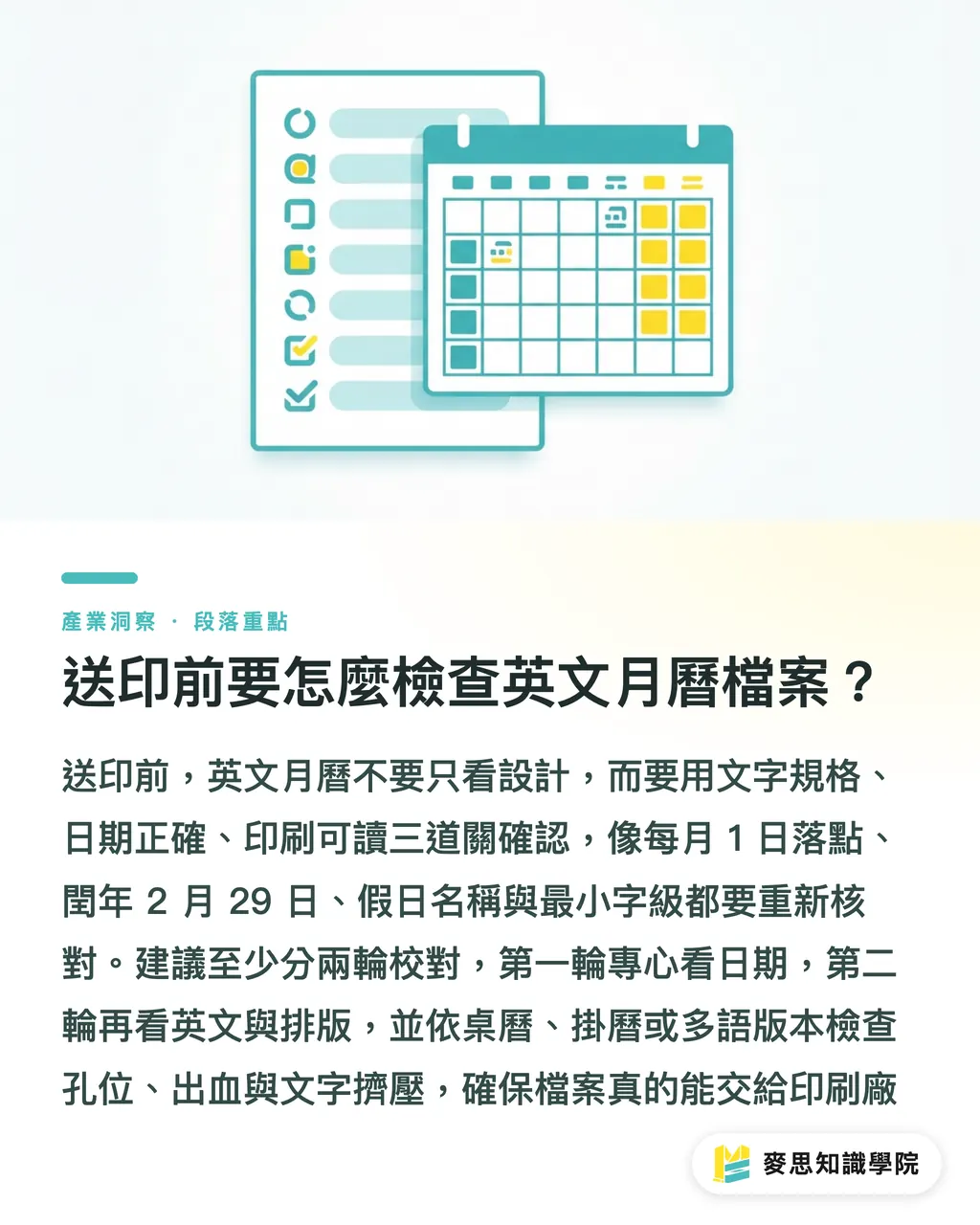
Before sending an English calendar to print, use MINDS three-stage prepress checklist: text specifications, date accuracy, and print legibility. Only after passing these three checks is the calendar truly ready for the print shop
・Text specifications: Ensure month names, day names, and holiday titles are consistent across the entire document
・Date accuracy: Double-check the starting day of each month, leap year February 29, make-up workdays, and lunar festivals
・Print legibility: Verify that minimum font size, reverse white text, bleed, safety margins, and wire-O hole positions do not impair readability
I usually recommend doing at least two proofreading rounds for English calendars
Round 1 checks only dates, ignoring design aesthetics. Round 2 checks only English wording and layout without distraction from images, colors, or paper stock
Separating the checks this way makes errors surface much faster
Final artwork files must also be handled according to print specifications
Desk calendars require attention to wire-O binding holes and tent stand clearance. Wall calendars require checking hanging punch holes, binding edges, and bleeds. Bilingual calendars must ensure Chinese and English text do not crowd each other. If the same calendar needs multilingual versions across Chinese, English, and Japanese, the Mai Strategy Knowledge Academy consulting team usually helps build the text specs first before expanding the layout
For mid-to-high-end corporate gift calendars, MINDS pays special attention to paper weight, writability, and post-press finishing
A calendar is not just for looking at, many clients actually write on it. If inner pages are too slick, grids are too small, or print is too faint, the poor user experience shows within the first week
Key Takeaways
・Calendar is the safest English term, reserve planner for layouts meant for writing and scheduling
・Decide on full names vs. abbreviations for months and days first, never mix rules within the same artwork
・Starting on Sunday vs. Monday has no single right answer, choose based on target market and use cases
・Do not translate holiday names word-for-word, handle fixed holidays, lunar festivals, and regional date variations separately
・Proofread dates first, proofread English next, and examine paper stock and finishing last before sending an English calendar to print
Further Considerations
English calendars are print products ideal for standardized workflows. The print manufacturing side can build standard wording libraries for 12 months, 7 days of the week, and common holidays. The design side can use stylesheets to control capitalization and abbreviations. AI integration can generate initial multilingual drafts, but human proofreading remains necessary for final dates and local market terms. SaaS systems can manage holiday, language, and year versions as traceable data fields. Your next step is not rushing into layout, but drafting a one-page text specification sheet for your English calendar
FAQ
- Should a calendar in English be called calendar or calendar planner?
- Use calendar for general calendars, such as 2027 Calendar. If the layout includes large writing areas, to-do lists, or weekly planning sections, use planner or Monthly Planner
- Does a period always have to follow a month abbreviation in English?
- Commercial layouts often add periods like Jan., Feb., Mar., but some use Jan, Feb, Mar without periods. The key is keeping it consistent across the same calendar, do not include periods on some months and omit them on others
- Should days of the week on an English calendar start on Sunday or Monday?
- General corporate calendars in Taiwan often start on Sunday, whereas European markets and work-scheduling calendars commonly start on Monday. Confirm your target market before designing, and use the exact same starting rule for both the main calendar and mini reference calendars
- Can Taiwanese holidays be directly translated into English for a calendar?
- Yes, but avoid literal word-for-word translation. Use Lunar New Year for Lunar New Year, Dragon Boat Festival for Dragon Boat Festival, and Mid-Autumn Festival for Mid-Autumn Festival. Dates must be rechecked every year
- What is most easily missed before sending an English calendar to print?
- The most easily missed items are date placements and small text legibility. Verify the 1st of each month, February 29 in leap years, and make-up workdays first, then inspect abbreviations, reverse white text, wire-O binding holes, and safety margins
Related articles


The Print × AI weekly
The print and AI know-how designers, brands and enterprises can use before they commit — one email, every week
MINDS Free Tools
Imposition calculator and preflight file check — free prepress tools, right in your browser.
MINDS Group
Need actual printing or gifting services?
From premium printing to online ordering and festive gifts — the MINDS Group sister brands take it from here.