
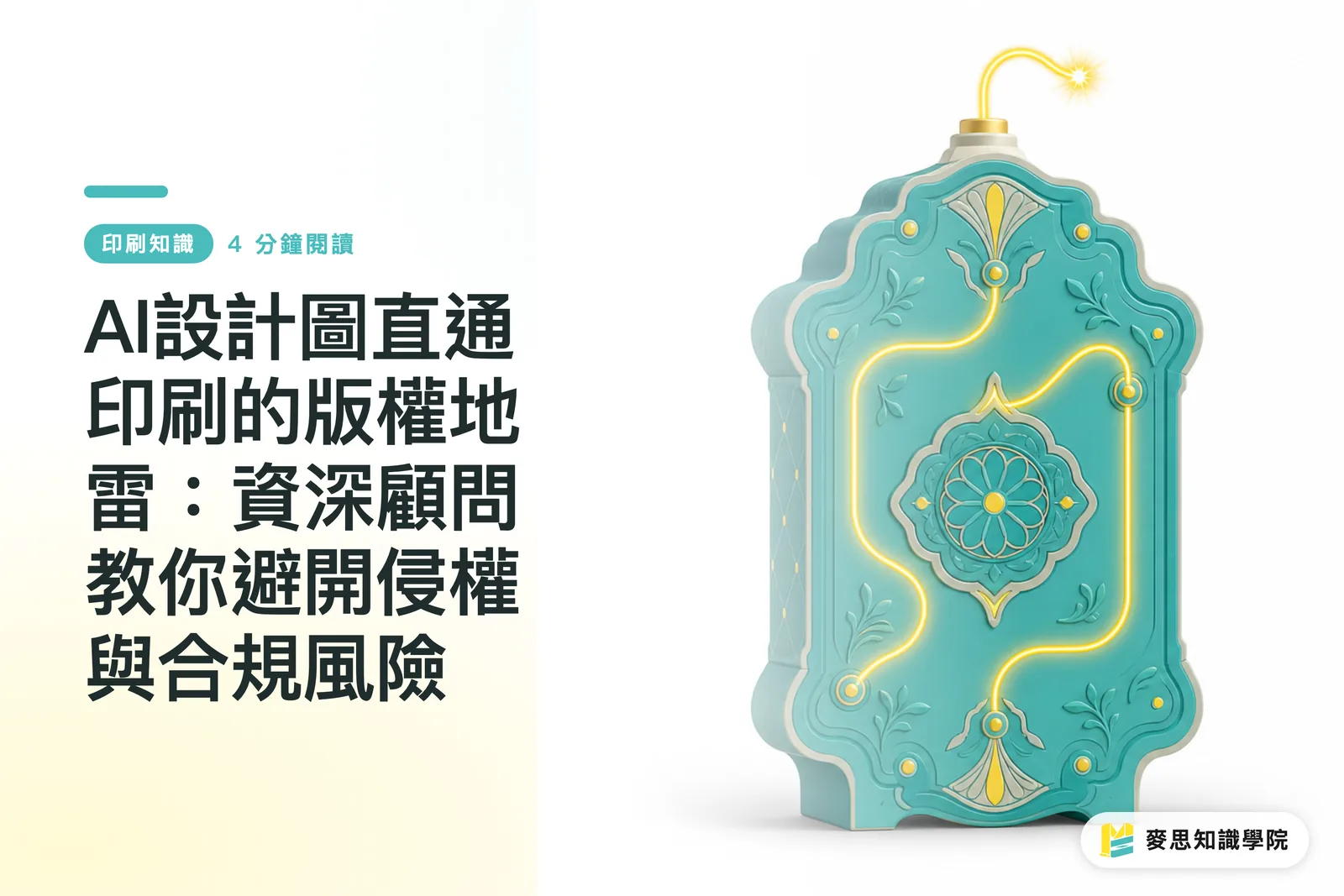
Why are 'perfect' AI-generated designs often a ticking time bomb for commercial printing?
Over the past six months, my desk has been piled high with AI artworks plagued by color discrepancies and resolution issues. More frequently, I hear clients ask: 'Can I use this image generated by Midjourney directly as the packaging for our new product?'
Most people assume that as long as they upscale the file and convert it to CMYK, it's ready for print. They ignore the most fatal legal risks associated with commercial applications
According to current mainstream international copyright interpretations, images generated purely by AI lack the essential element of 'human intellectual creation' and are therefore not protected by copyright law
This means that if you print 100,000 retail boxes for a client using a purely AI-generated image as the key visual, a competitor could legally print the same image on their own products tomorrow, and you would have no grounds to sue for infringement
In a commercial context, this poses immense risks for both the brand owner and the printing plant assisting with production

Using AI images for print, who actually owns the copyright?
Pre-press communication already consumes over half of our daily working time. Now, that communication cost must include 'clarifying the source of the image files.'
In practice, determining whether a printed piece containing AI elements possesses copyright hinges on the 'depth of human intervention.'
・Using raw AI-generated images directly: No copyright, no protection. Anyone can use them without compensation; it is highly discouraged as a brand logo or exclusive packaging key visual
・AI-generated assets with deep post-processing: If AI serves only as a background or partial asset, and the designer performs complex layout work, typography design, and color planning, the final complete design has the potential to obtain copyright
・Images trained on specific artists' works: These carry an extremely high risk of infringement and plagiarism. Once a dispute arises, both the printing house accepting the order and the brand owner commissioning it may face joint and several liability
Prevention at the source: Building an AI compliance check workflow for design and pre-press
At the start of the design phase, AI is like a tireless creative assistant. We don't need to reject it, but we must incorporate verification mechanisms into our workflow
I strongly recommend that print and design teams establish an 'AI-first, human-compliance' workflow
・Verify the commercial terms of generation tools: Strictly distinguish between the authorization differences of free and paid versions. Many free versions of AI tools explicitly prohibit commercial printing
・Retain creation history and prompts: When presenting designs and archiving files, simultaneously save the AI-generated raw files, prompt history, and subsequent manually edited layers to serve as evidence of the proportion of original content
・Implement manual pre-press review: Beyond checking bleeds and crop marks, the human eye must zoom in to inspect the artwork for common AI artifacts, such as deformed features or nonsensical 'fake' watermarks, to prevent post-print consumer concerns
・Sign compliance declarations: Explicitly stipulate in quotes or printing contracts that if the image files provided by the client contain AI-generated content, the client assumes sole responsibility for any derived copyright and trademark registration issues
How should SMEs and brand owners adopt AI responsibly?
Over the last month or two, I've clearly noticed that the larger the enterprise, the stricter the review process for AI-generated printed materials
A responsible AI application framework is not intended to limit creativity, but to protect your brand assets
・Internal education and training: Ensure marketing and design personnel understand that how well a prompt is written does not equal ownership of copyright. AI is meant to 'accelerate ideation,' not 'directly produce final trademarks.'
・Transparency in proposals: When design firms deliver print-ready files to clients, they should proactively label which local elements were generated with AI assistance to build mutual trust
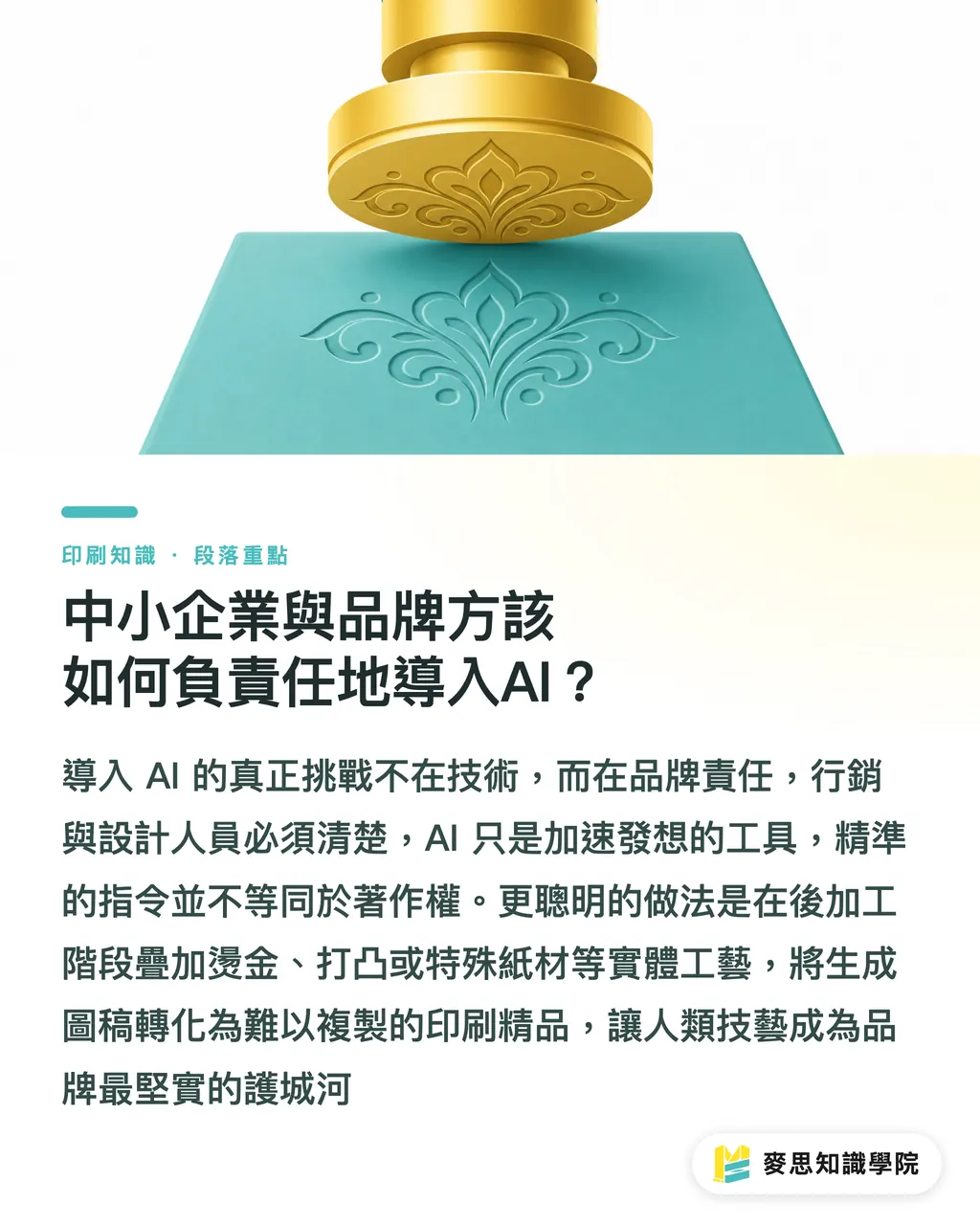
・Create value through physical craftsmanship: Since AI images are easily copied, we can incorporate post-processing techniques like foil stamping, embossing, or specific paper textures to transform cheap, generated images into tangible, high-quality products that cannot be easily imitated by humans
Key Takeaways
・Images generated purely by AI lack a human author and are not protected by copyright; using them directly for commercial printing risks them being legally misappropriated
・The sole standard for determining copyright ownership lies in the 'depth of human post-processing and layout design.' AI can only be an assistant, not the absolute protagonist
・Before printing, enterprises must confirm the commercial licensing terms of their AI tools and clarify legal responsibilities for image sources in their contracts
・Combining AI-generated imagery with special physical printing and post-processing techniques is the best line of defense against designs being easily replicated
Reflections
In the face of the widespread adoption of AI applications, the value of printing manufacturing and SaaS providers has long ceased to be just 'printing an image.'
When generating a beautiful image becomes so effortless, our professional value lies in 'ensuring that this image can safely, legally, and accurately land as a commodity.'
Instead of worrying about AI replacing designers, we should proactively integrate copyright reviews, AI material compliance guidelines, and color management processes directly into our work systems. This will be the key competitive advantage for winning the trust of corporate clients in the future
FAQ
- Can we accept an order if a client brings us an image generated by Midjourney for product packaging?
- You can accept it, but you must add a disclaimer to the quote or contract stating that 'the copyright and legality of the artwork are the sole responsibility of the party commissioning the print,' and kindly remind the client that the key visual may not be registrable as a trademark or protected against use by competitors
- We use AI to generate backgrounds for clients and add our own layout design; is this considered infringement?
- As long as you ensure the AI tool account you use has commercial authorization, and the overall layout, typography, and visual rhythm have been thoughtfully arranged by a human designer, the entire design draft possesses value worthy of original protection
- How can we tell if the pre-press file provided by a client was AI-generated?
- Aside from asking directly, you can zoom in to 300% to inspect if the edges contain illogical fusions, if background text has turned into unrecognizable 'alien' symbols, or watch for any residual, fragmented fake watermarks in the corners of the frame
Related articles


The Print × AI weekly
The print and AI know-how designers, brands and enterprises can use before they commit — one email, every week
MINDS Free Tools
AI background removal, brand stamping, and a LINE sticker maker — free design tools, right in your browser, no upload.
MINDS Group
Need actual printing or gifting services?
From premium printing to online ordering and festive gifts — the MINDS Group sister brands take it from here.