

Why Dropping AI-Generated Copy Straight into a Print Layout Is a Recipe for Disaster
Over the past six months, my desk has been piled high with DM drafts from clients ready to send to print, and nine out of ten of them share the exact same flaw
They use ChatGPT or Claude to produce persuasive marketing copy, then hand that five- or six-hundred-word wall of text straight to the designer without a second thought
Five hundred words flies by when you're scrolling through a webpage, but the moment you try to fit that onto a physical A5 flyer, you've got a disaster on your hands
Print has absolute physical constraints, a sheet of paper has a fixed area, white space cannot be sacrificed, and the image-to-text ratio must be carefully balanced
When copy runs too long, designers are forced to shrink the font to 8pt or smaller, and the finished DM ends up being something nobody wants to read
Making the mental shift from a screen-advertising mindset to the physical reality of a print layout is the very first hurdle in bringing AI into physical marketing

How Much Body Copy Can an A5 Flyer Actually Hold?
To solve this problem, we first need to develop a feel for spatial constraints
Take the most common A5 flyer (14.8 x 21 cm) as an example, once you subtract the bleed, margins, hero imagery, and a large-scale headline,
the space actually available for body copy is usually less than one-third of the entire sheet
If you set the font size in the comfortable reading range of 10pt to 12pt with reasonable line spacing,
・All-text layout limit: approximately 250 to 300 Chinese characters
・Image-heavy layout: body copy should ideally stay within 100 to 150 characters
・Bullet-point features: keep only 3 to 5 selling points, each no longer than 20 characters
If you fail to factor in these physical figures from the start of your copywriting process, even the most brilliant AI-generated content will go to waste
Writing Prompts That Teach AI to Respect Layout Constraints
Rather than agonizing over cuts after the fact, give AI explicit layout constraints right from the source
I typically advise clients to treat the physical layout framework as part of the instruction when writing their prompts
You can add hard word counts and paragraph limits directly into the prompt:
・Headline instruction: Write 3 headlines from different angles; each headline, including punctuation, must not exceed 12 characters
・Body paragraph instruction: Write an opening paragraph of no more than 50 characters, broken into two sentences
・Feature bullet instruction: Provide 4 product features in bullet-point format, with each point no more than 15 characters
When you set these clear boundaries, AI-generated text can slot directly into your text frames, saving a tremendous amount of time during final artwork preparation
Where to Place Your Call to Action for Maximum Impact on Printed Pieces
AI is excellent at writing promotional CTAs (calls to action), but on physical printed pieces, placement and size determine conversion rates
A digital ad CTA is typically a large button, whereas a physical DM relies on a phone number, address, or QR Code
Based on my experience handling thousands of print jobs, the lower-right corner or the natural visual landing point at a page turn is the prime real estate for CTA placement
When handling this information, there are several non-negotiable print standards to keep in mind:
・QR Code size: the side length must never be smaller than 1.5 cm, or dot gain from the printer will make it unscannable by a phone
・Contact information font size: phone numbers and addresses must be at least 9pt to remain legible for older readers
・Color contrast: QR Codes must always be set as single-color black (K100); avoid four-color overprinting, as misregistration can make them unscannable
Incorporate these standards into your design, and the promotional taglines AI writes will actually translate into real foot traffic
Avoiding Common Pitfalls in Chinese Typography and Multi-Version Testing
Once the copy is finalized, there are two critical steps before sending to print that are often overlooked
The first involves Chinese typographic punctuation rules, AI-generated text frequently contains half-width punctuation marks or odd spacing
In your layout software, always check the line-break punctuation settings; commas and periods must never be left stranded at the beginning of a line
Additionally, AI-generated marketing language can sometimes be overly hyperbolic, phrases like 'absolutely effective' can easily cross into false advertising territory, so a human review before going to print is essential
If you have several strong AI-generated copy variations and can't bear to discard any of them, modern digital printing technology has a perfect solution
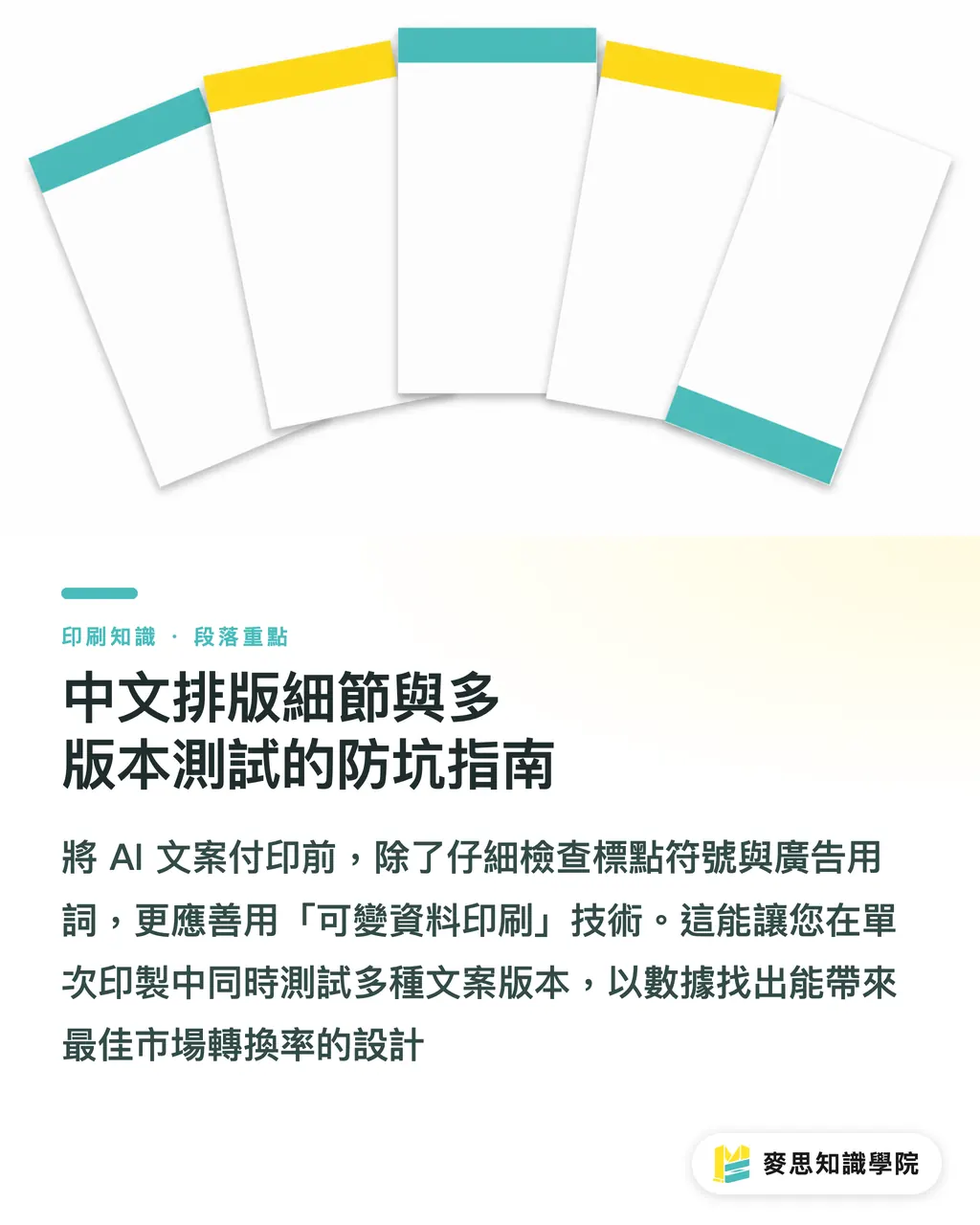
We can use Variable Data Printing (VDP) technology
A single run of five thousand DMs can be split into five different copy versions, with one thousand copies printed per version
Testing which AI-generated headline drives the best conversion rate within the same layout framework, this is the most sophisticated way to combine AI with physical print
Key Takeaways
Print has absolute physical constraints, before using AI to write DM copy, always confirm the maximum character count your layout can accommodate
Embedding strict character limits for headlines and body copy into your prompts is the key to ensuring AI-generated copy fits perfectly into your design
CTAs such as QR Codes and contact information must follow specific physical print standards to ensure readability and successful scan rates
By using Variable Data Printing in digital printing, physical DMs can run multi-version copy A/B tests just like digital ads
Further Reflections
AI tools have dramatically lowered the barrier to content creation, but making that creativity land successfully still hinges on a deep understanding of the physical medium
Designers and marketers should think of AI as a creative assistant working within a physical framework, one whose dimensions and word-count boundaries need to be defined from the very start
By further combining MINDS Printing's one-stop integrated service with Variable Data Printing technology, SMEs can pursue physical marketing that balances creative variety with precise market testing, ensuring every dollar of the print budget delivers maximum return
FAQ
- My AI-generated copy is great, but my designer says it won't fit, what should I do?
- Go back and revise your prompt, set a hard rule that AI headlines must not exceed 12 characters and body copy must stay within 100 characters. Solve the layout congestion problem at the source
- Why does the QR Code on my DM fail to scan after printing?
- This is usually because the QR Code is smaller than 1.5 cm, or because four-color black was used, causing misregistration during printing. Always set it to single-color black (K100) and ensure sufficient surrounding white space
- Can physical flyers test different copy versions the way Facebook ads do?
- Absolutely. Through Variable Data Printing (VDP) in digital printing, you can swap different AI copy versions within a single print file and run conversion rate tests
- What are the most common mistakes when pasting AI copy into layout software?
- The most commonly overlooked issues are mixed half-width and full-width punctuation and line-break punctuation rules. Always manually check to ensure punctuation marks do not fall at the start of a line, as this disrupts the reading experience
Related articles



The Print × AI weekly
The print and AI know-how designers, brands and enterprises can use before they commit — one email, every week
MINDS Free Tools
AI background removal, brand stamping, and a LINE sticker maker — free design tools, right in your browser, no upload.
MINDS Group
Need actual printing or gifting services?
From premium printing to online ordering and festive gifts — the MINDS Group sister brands take it from here.