

Can AI Really Draw Usable Packaging Die-lines from Scratch?
Recently, more and more clients have been coming to me with "stunning packaging boxes" generated by Midjourney or ChatGPT, asking if they can be directly converted into die-cut templates for printing
The answer is brutal: Absolutely not at the moment
A packaging die-line is like an architect's 2D expansion blueprint. If it is off by even a millimeter or two, the box will either jam or burst during the production process on the machine
The assistive tools we see today are mainly divided into two categories: "Parametric Die-cut Generation Software" and "AI Sketch Assistants."
Parametric software can indeed quickly generate basic die-lines, but the prerequisite is that you must first provide accurate physical variables
If you do not input material thickness parameters, such as 350g gray-back paperboard or 3mm corrugated board, the lines generated by AI will never be ready for direct die-cutting
Because there is no allowance for crease thickness, the box will inevitably misalign or deform when folded into its 3D form
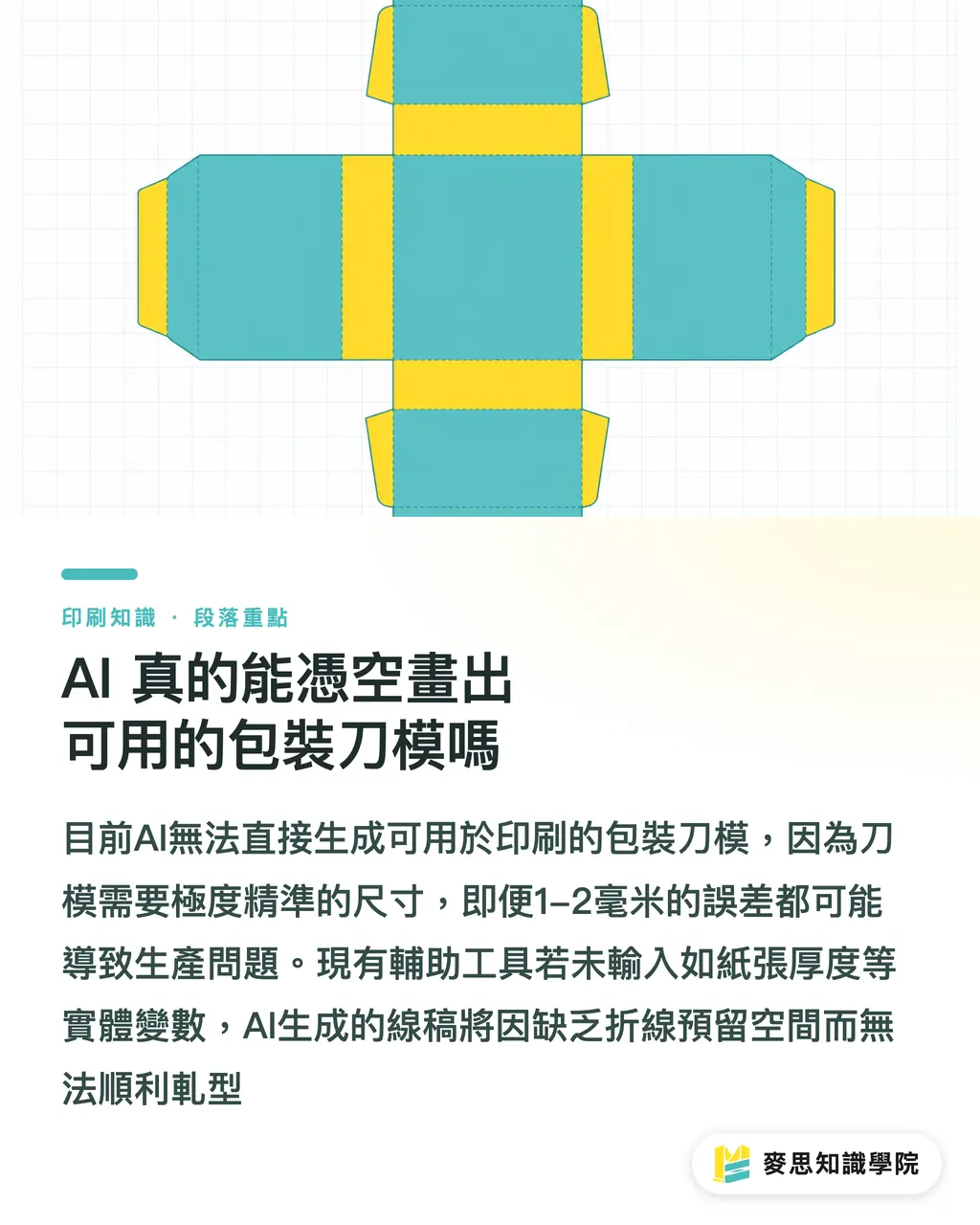
What is the Success Rate of Letting AI Handle Common Box Types?
To clarify the practical limits of these tools, we examined three structures most commonly used on the production line
In practice, the more a structure relies on physical locking mechanisms, the higher the failure rate when software generates the drawing directly
・Telescopic Box (Lid and Base): The lowest difficulty. Because the structure is simple, involving only length, width, height, and right-angle folds, about 80% of die-lines generated by parametric tools are directly usable as long as the paper thickness is input correctly
・Tuck-end Box: Moderate difficulty. The length and bevel angle of the bottom tuck flap need to be fine-tuned according to the actual toughness of the paper; standard angles calculated by computers often tear easily during assembly
・Auto-bottom Box: The highest difficulty. The 45-degree glue flap and crease placement at the bottom create a chain reaction; currently, this part relies entirely on professional die-cutters judging based on experience, and almost 90% of the generated lines require redrawing
Why Do Calculated Die-lines Still Require Manual Fine-tuning?
In the world of packaging design, a beautiful 3D render is one thing, and a physical product that can be successfully mass-produced is quite another
From a draft to a file that can truly be sent to a die-cutting plant for mold making, there are several irreplaceable manual tasks in between
The core value of a professional die-cutter lies in handling physical variables that algorithms cannot perceive
・Crease Testing and Grain Direction: Paper has a fiber direction (grain). Whether it is with or against the grain determines if the crease will rupture, which must be tested manually by a technician through touch and physical stress tests
・Glue Flap Position Confirmation: The paper gripping position of the folder-gluer and the width of the glue flap vary depending on the equipment of different processing plants
・Structural Strength Verification: When loading heavy objects (such as glass bottles), determining how to fold the inner lining to absorb shock and prevent drops requires physical white-box drop testing to verify
Consultant's Field Notes: A Three-Stage Workflow from Design to Successful Mass Production
Since we cannot get it right in one step, we should place these new technologies in the right positions
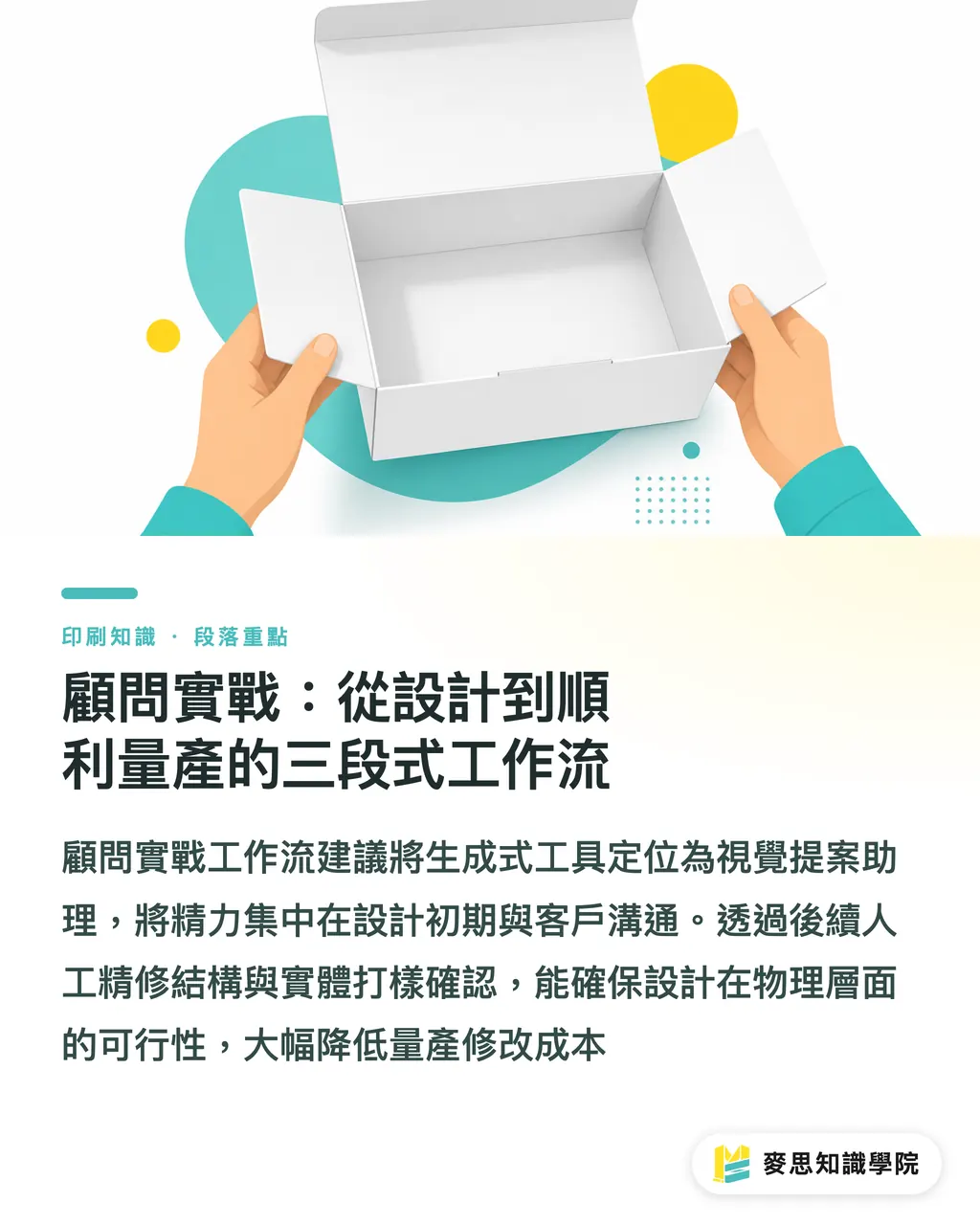
I suggest positioning them as "tireless proposal assistants," allowing you to focus energy on visual brainstorming and client communication, while leaving the backend physical structure to the professionals
This three-stage process can significantly reduce the costs of back-and-forth modifications on the production line
・Visual Concept Proposal: During initial client meetings, use generative tools to quickly produce 3D packaging context images to confirm the aesthetic style and opening method
・Manual Structural Fine-tuning: Once the concept is confirmed, a structural designer or printing plant draws accurate 2D die-lines based on the actual product and paper materials
・Physical Prototyping Confirmation: You must cut a white-box physical prototype (Dummy), fold it by hand, insert the product to test it, and confirm all locks and tolerances are correct before proceeding to mass production
Key Takeaways
Generative AI is an excellent accelerator for visual proposals, but human experience is still required to manage physical structural tolerances and locking mechanisms
The prerequisite for producing a usable die-line is providing precise material parameters; a line drawing lacking thickness and paper material settings is just beautiful waste paper
The more complex the box type, the more it requires professional manual fine-tuning by a die-cutter; basic box types like the telescopic box can be produced quickly with parametric tools
Strictly executing the three-stage workflow of "Concept Ideation, Manual Drafting, and Physical Prototyping" is the only solution to ensure printing yield
Extended Thinking
For printing plants and SaaS providers, the next breakthrough is to digitize paper physical characteristics and folder-gluer tolerance data, and integrate them into parametric tools
Designers today do not need to worry about their structural skills being replaced; instead, they should invest time in thoroughly understanding paper characteristics and post-processing limitations
Only those who understand materials and can perform white-box prototyping will be able to steadily secure large commercial packaging contracts in an era flooded with exquisite AI-generated drafts
FAQ
- How should I handle it when a client brings an AI-generated packaging die-line file for printing?
- I strongly recommend pausing the production run to re-evaluate the structure. You can directly inform the client that a line drawing lacking paper thickness settings and glue flap tolerances cannot be used for die-cutting. It must be redrawn by a structural designer and verified through prototyping to ensure the box can be formed successfully
- What tools are currently used in the industry to assist with die-line design?
- In practice, most rely on professional parametric packaging software, which generates basic line drawings by inputting length, width, height, and paper thickness. Such tools save time compared to drawing from scratch, but details like tuck-flap angles and glue-flap positions still require manual fine-tuning based on the specific production line equipment
- Can I use the die-lines calculated by software if it is just a standard cosmetic telescopic box?
- It is relatively safer but still carries risks. Although the telescopic box structure is simple, the tightness of the fit between the base and the lid is affected by the paper basis weight and surface lamination. I suggest confirming the feel with a physical white-box prototype before officially creating the mold
Related articles


The Print × AI weekly
The print and AI know-how designers, brands and enterprises can use before they commit — one email, every week
MINDS Free Tools
AI background removal, brand stamping, and a LINE sticker maker — free design tools, right in your browser, no upload.
MINDS Group
Need actual printing or gifting services?
From premium printing to online ordering and festive gifts — the MINDS Group sister brands take it from here.