

Does Anti-Counterfeit Printing Have to Cost a Fortune?
The biggest fear in branded packaging is seeing counterfeits pop up once a product takes off. But traditional anti-counterfeit methods have a painfully high entry barrier! While visiting small and midsize brands and print shops in central and southern Taiwan, I often heard owners back off as soon as they learned that laser anti-counterfeit stickers add 3 to 8 dollars per label, plus tens of thousands in plate fees and another two weeks of lead time. In the end, they had no choice but to go unprotected
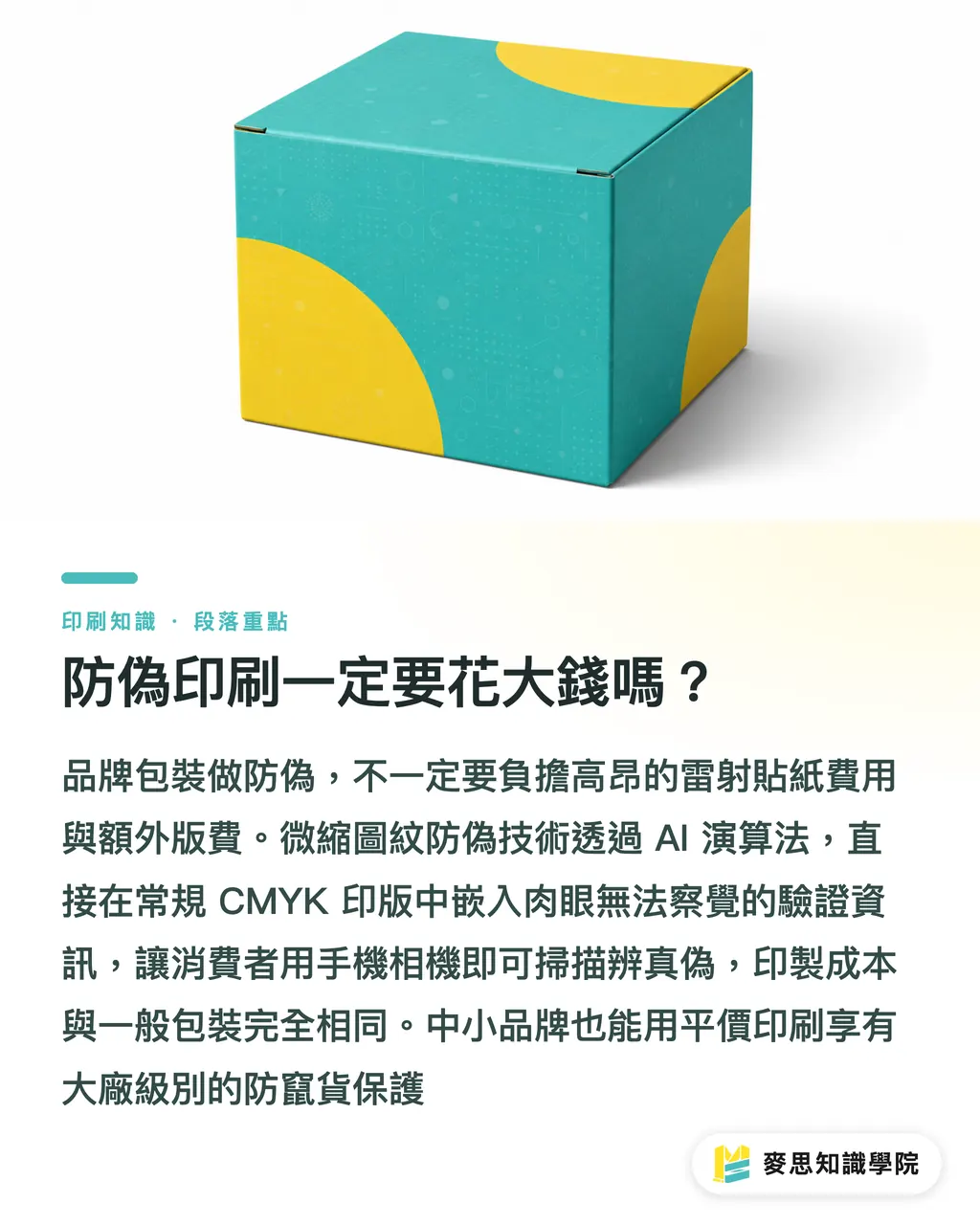
The truth is, anti-counterfeit packaging does not have to cost a fortune! Micro-pattern anti-counterfeit technology hides dense security graphics and text inside standard CMYK print dots, creating a lightweight protection method that lets consumers verify authenticity directly with a phone camera
With AI algorithms, we can add information-bearing micro-patterns that the naked eye cannot detect directly into standard CMYK plates. There is no need to buy expensive fluorescent ink or laser foil! That means packaging print costs stay almost the same as regular printing, while the brand gets anti-counterfeit and anti-diversion protection at a level usually seen from large companies
If you have doubts about anti-counterfeit patterns or print suitability while planning your packaging, it is best to consult the Mai Strategy Knowledge Academy consulting team for early file inspection and feasibility assessment
How Are AI Micro-Patterns Hidden Inside CMYK Dots?
Traditional anti-counterfeit stickers can be peeled off whole and copied. AI digital watermarks are different. They are built right into the genetics of the print file! The core workflow behind this technology includes the following steps:
・Algorithm-generated micro-patterns: AI mathematical models generate high-precision micro-text, random linework, or geometric shapes
・Dot phase modulation: The generated micro-patterns are embedded through frequency mixing into the screen angles and tiny position shifts of the CMYK printing dots
・High-resolution visual camouflage: At a normal viewing distance under 300 DPI, the printed piece looks like an ordinary color image, but under macro magnification or a phone lens, the feature code can be resolved
・Optical scan decoding: Consumers or inspectors photograph a specific area of the package with a phone camera, and the cloud system returns an authenticity result within seconds
For small and midsize businesses printing a few thousand to tens of thousands of boxes a year, this turns physical anti-counterfeiting, once an expensive technology, into pure digital file processing! The print shop does not need to change equipment. As long as the output resolution of the press meets the standard, it can be printed
How Can Small and Midsize Businesses Put AI Packaging Protection Into Practice?
To make AI-generated anti-counterfeit micro-patterns work perfectly on a physical printed piece, it is not enough to admire them on screen! In practice, the safest execution path is the "MINDS (MS, mid-to-high-end fully custom commercial printing) three-step anti-counterfeit upgrade":
・① Inspiration generation and image frequency mixing: During the design stage, AI tools create brand-specific micro-patterns, then the algorithm embeds them into high-contrast color areas of the packaging
・② Three-point prepress file check: Strictly check whether resolution meets the threshold, whether CMYK dot interference is happening, and whether ultra-fine lines fall below the press's minimum printable limit
・③ Digital proofing and phone decoding test: Before mass production, produce a one-to-one digital proof and test the phone camera's scan recognition rate under different lighting and angles
If these micro-patterns will be used on mid-to-high-end fully custom commercial packaging or specialty cardstock, professional MINDS services can handle accurate physical proofing and prepress dot calibration
Do not rush into mass production! Testing the waters with a few hundred boxes first is the safest move
What Technical Traps Must Be Avoided in AI Anti-Counterfeit Artwork?
Even the smartest algorithm can fail when it meets poor final artwork or unsuitable paper conditions! The failures I see most often on the production line usually come from designers ignoring the physical limits of printing
It is simple. To make sure a phone can scan and decode smoothly, pay close attention to these details during final artwork and printing:
・Output resolution threshold: The file resolution of the anti-counterfeit micro-pattern area must reach at least 1200 DPI. A normal 300 DPI image cannot carry enough micro-structure information
・Paper surface smoothness: Give priority to glossy art paper, coated cardstock, or gray-back duplex board. If embossed paper, rough woodfree paper, or specialty art paper is used, the paper fibers will scatter the dots directly
・Plate spread control: The print shop's dot gain must be controlled precisely within 15%. Otherwise, ink spread will make the anti-counterfeit barcode unreadable
・Color saturation settings: Avoid solid single-color black blocks or extremely pale backgrounds. Areas with rich color variation and a medium-chroma background work best for hiding micro-patterns

Key Takeaways
Anti-counterfeit printing does not require expensive laser molds. AI micro-patterns can be built directly into standard CMYK dots to achieve anti-counterfeit protection
AI algorithms hide security features inside dot phase shifts, allowing consumers to complete verification in seconds with a phone scan
Apply the MINDS (MS) three-step anti-counterfeit upgrade: inspiration frequency mixing, prepress file check, and proofing plus decoding test. This lets brands upgrade packaging protection with low risk
Final anti-counterfeit artwork must reach 1200 DPI or higher and be paired with smooth coated paper to prevent dot spread
Further Thoughts
For small and midsize businesses and brand owners, packaging protection is no longer reserved for high-end luxury brands! By turning anti-counterfeit logic into software through AI algorithms, brands can add protection inside a standard printing workflow with almost zero added marginal cost
For designers and print buyers, the next real edge will not be whether they can draw complex security patterns. It will be whether they understand how to combine AI digital files with the physical realities of printing! Master dot control, resolution thresholds, and proof-based verification, and you can create high-value anti-counterfeit packaging for clients
Further Reading
FAQ
- Does AI-generated micro-pattern anti-counterfeit packaging require special ink or paper?
- No! The biggest advantage of this technology is that it can be printed directly with standard CMYK process inks and ordinary printing presses, with no special ink needed at all. You only need to choose coated paper with a smoother surface to avoid dot spread
- Will anti-counterfeit micro-patterns affect the original look and visual design of the packaging?
- Not at all! The AI algorithm hides micro-patterns and information inside normal print-dot displacement. When viewed with the naked eye at a normal distance, you only see the original design. The information is read only under close magnification or when scanned by a phone camera
- Is this kind of AI print protection suitable for small and midsize businesses with very small print runs?
- Very much so! Traditional anti-counterfeiting requires expensive laser plate fees and high MOQ requirements. AI micro-patterns are fully integrated into the final digital artwork file, so even digital packaging runs of just a few hundred boxes can adopt it without pain
Related articles

The Print × AI weekly
The print and AI know-how designers, brands and enterprises can use before they commit — one email, every week
MINDS Free Tools
AI background removal, brand stamping, and a LINE sticker maker — free design tools, right in your browser, no upload.
MINDS Group
Need actual printing or gifting services?
From premium printing to online ordering and festive gifts — the MINDS Group sister brands take it from here.