

Overview
If small packaging and sticker imposition is to break free from manual nudging, the key is parametric dielines paired with an AI layout engine that automatically calculates the optimal trim and bleed. Using the three-method framework for small-pack imposition put together by the Mai Strategy Knowledge Academy consulting team for MINDS Printing (MS, mid-to-high-end fully custom commercial printing), it's possible to optimize hundreds of layout variants in seconds while squeezing corner waste down to a minimum, cutting prepress labor costs significantly for print shops
Imposition is the prepress technique of precisely arranging multiple individual print pages or packaging dielines onto a single printing plate according to press specifications, paper size, and post-processing bleed requirements. Good imposition maximizes paper utilization and reduces post-press cutting errors
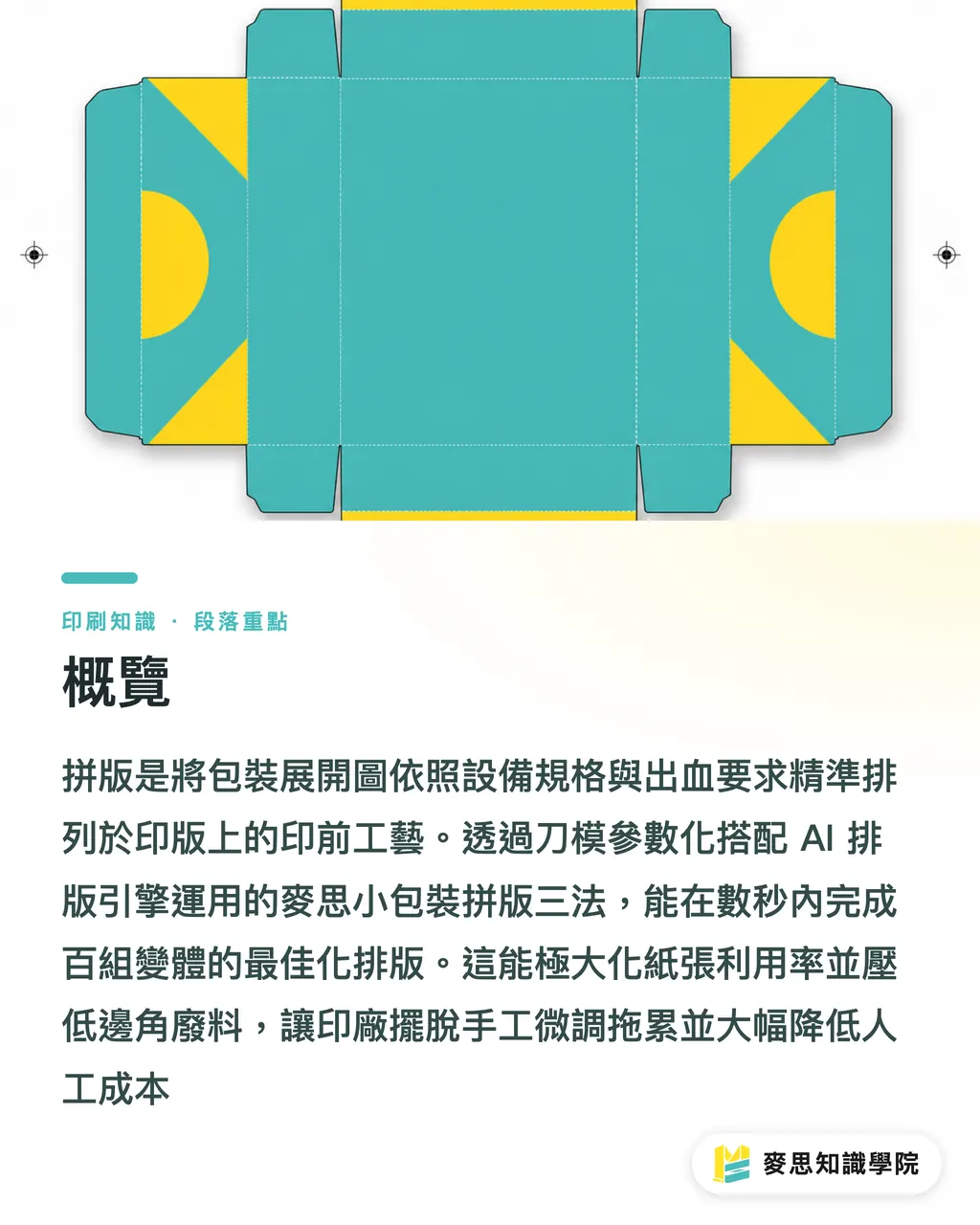
Why has small-package batch layout always relied on manual tweaking?
Walking into small print shops or design studios in central and southern Taiwan with around 15 staff, the most common pain point is prepress operators dragging vector files around one by one on screen. This hits especially hard with small-format jobs like cosmetic labels, food stickers, or gift-box inserts, where every change in spec means starting the manual arrangement over
Three blowups tend to hit during manual layout:
・Mixing different color or size variants, when someone forgets to set prepress bleed or drops text without noticing
・Stretching spacing blindly just to fill the sheet, burning more than 15% of each sheet as corner waste
・Back-and-forth file checks between shop and client, with two extra days lost just on adjusting die spacing
Hold on
The industry has long blamed designers for sloppy file handoff, but after years on the production line I'm convinced the real culprit is the absence of standardized parametric dieline design
How does an AI auto-layout engine eliminate manual adjustment time?
The core mechanism behind an AI layout engine is breaking vector dielines plus text and image assets down into a parametric database. Once the engine takes over, it calculates the dieline geometry, bleed lines, and the press's gripper allowance all at once, then spits out the optimal arrangement
To make AI auto-imposition actually work, I'd suggest three steps to get it on the floor:
・Step one, build a parametric dieline library: convert common box, pouch, and sticker shapes into formulas controllable by length, width, and height
・Step two, enforce data cleaning and field standardization: scrub product copy, color codes, and barcodes into clean CSV or JSON so images don't shift and fields don't jump
・Step three, hook it up to AI-driven layout calculation: the algorithm reads the press gripper and cutting path, then auto-optimizes the gang-run across multiple versions and sizes
That's it
What used to take two hours of manual arrangement drops to a 3-second auto-calculation, and multi-version variants generate in one click with zero human intervention
How do you push imposition paper waste down to the floor?
The most tangible payoff of small-package imposition shows up in waste control. Veteran operators eyeballing the layout typically land between 12% and 20% corner waste, while AI auto-imposition can test hundreds of rotation angles under raw compute and lock in the best paper utilization
Hands-on coaching with MINDS Printing has shown that the rules and exception handling around auto-layout are where cost really gets controlled:
・Auto-avoidance for dielines: set a minimum 2mm safety gap so post-press die-cutting tools don't collide
・Dynamic cost estimation linkage: the moment the layout engine finishes calculating, it outputs sheet count, plate cost, and material spend at the same time
・Scrap reuse algorithm: when leftover blank space shows up on the big sheet, it automatically slots in small-label jobs sitting in inventory
Pulling waste down under 5% on thin-margin small-batch orders turns the paper savings straight into net profit
How should print shops respond when auto-layout throws an error?
The worst thing you can do with an automated system is leave it alone. When source files are too low-res, type isn't outlined, or a dieline boundary blows past spec, the AI layout engine has to catch it in real time and flag it
Here's my breakdown of the most common failure modes and how to handle them in practice:
・Missing assets or mismatched fields: the system auto-flags them red and halts, so it doesn't burn cycles on garbage
・Special-structure dielines that won't gang cleanly: bounce back to manual review and log that dieline model so the formula can be improved
・Color variants outside the press gamut: prepress auto-generates an ICC Profile correction preview and sends it to the client for sign-off
Catching exceptions at prepress beats printing the whole batch only to scrap it for typos and misaligned layout

Key Takeaways
・Parametric dielines turn packaging dielines into geometric formulas, fixing the manual dieline-spacing headache at the source
・Data cleaning is the bedrock that keeps AI layout from scrambling fields, so smooth out text and files before running the auto-gang calculation
・Setting a 2mm safety gap with auto-avoidance in the layout engine drops paper waste from 20% to under 5%
・Pair auto-layout with dynamic cost estimation and you get sheet cost and material spend calculated the second the layout file is produced
Further Thinking
For print shops and design teams, AI auto-layout isn't about replacing prepress operators, it's about turning tedious file shuffling into an automated flow. If future SaaS developers can package parametric dielines, data cleaning, and dynamic cost estimation into lightweight modules, small and mid-sized print shops can take the leap into digital transformation without a huge upfront cost
FAQ
- Does bringing AI auto-layout into small packaging and stickers mean spending over a million on new equipment?
- No need to pour money into a new press. Just parameterize your existing dielines, clean up the field data, and pair it with a lightweight layout tool, and you can run auto-imposition inside your current prepress workflow
- How do you keep color and copy from getting swapped around during multi-variant layout?
- Data cleaning has to happen up front. Organize copy and color codes into standardized CSV or JSON so the AI layout engine pulls directly from the database and applies the template
- Can auto-imposition output a layout that causes die-cutting collisions downstream?
- Set a dieline safety gap of 2mm or more and turn on auto-avoidance rules in the AI engine, and you can trust that cutting and die-cutting won't collide or damage the finished piece
Related articles


The Print × AI weekly
The print and AI know-how designers, brands and enterprises can use before they commit — one email, every week
MINDS Free Tools
AI background removal, brand stamping, and a LINE sticker maker — free design tools, right in your browser, no upload.
MINDS Group
Need actual printing or gifting services?
From premium printing to online ordering and festive gifts — the MINDS Group sister brands take it from here.