
Overview
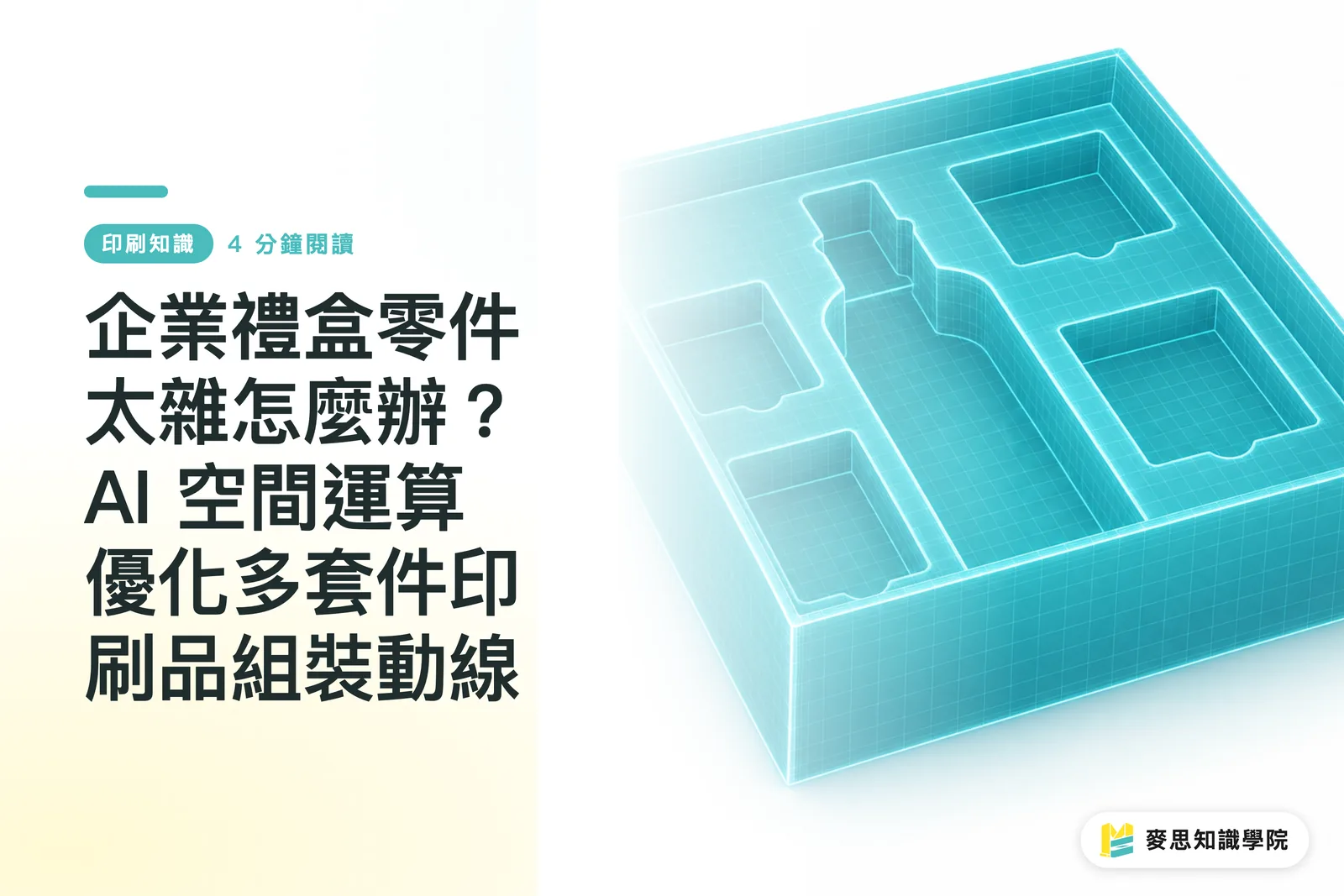
Faced with the missing-parts and bottleneck headaches of multi-component PR gift boxes, the Mai Strategy Knowledge Academy advisory team argues for bringing AI spatial computing and scheduling algorithms into prepress planning, running the optimal pack-in order and inner-tray die-cut as a digital rehearsal right at the structural design stage
Multi-component print assembly: the full production flow that combines an outer box, custom inner tray, manuals and assorted gifts into a finished pack through precision post-press work and motion-path planning
Why does the traditional packaging line keep jamming as gift boxes pile on more parts?
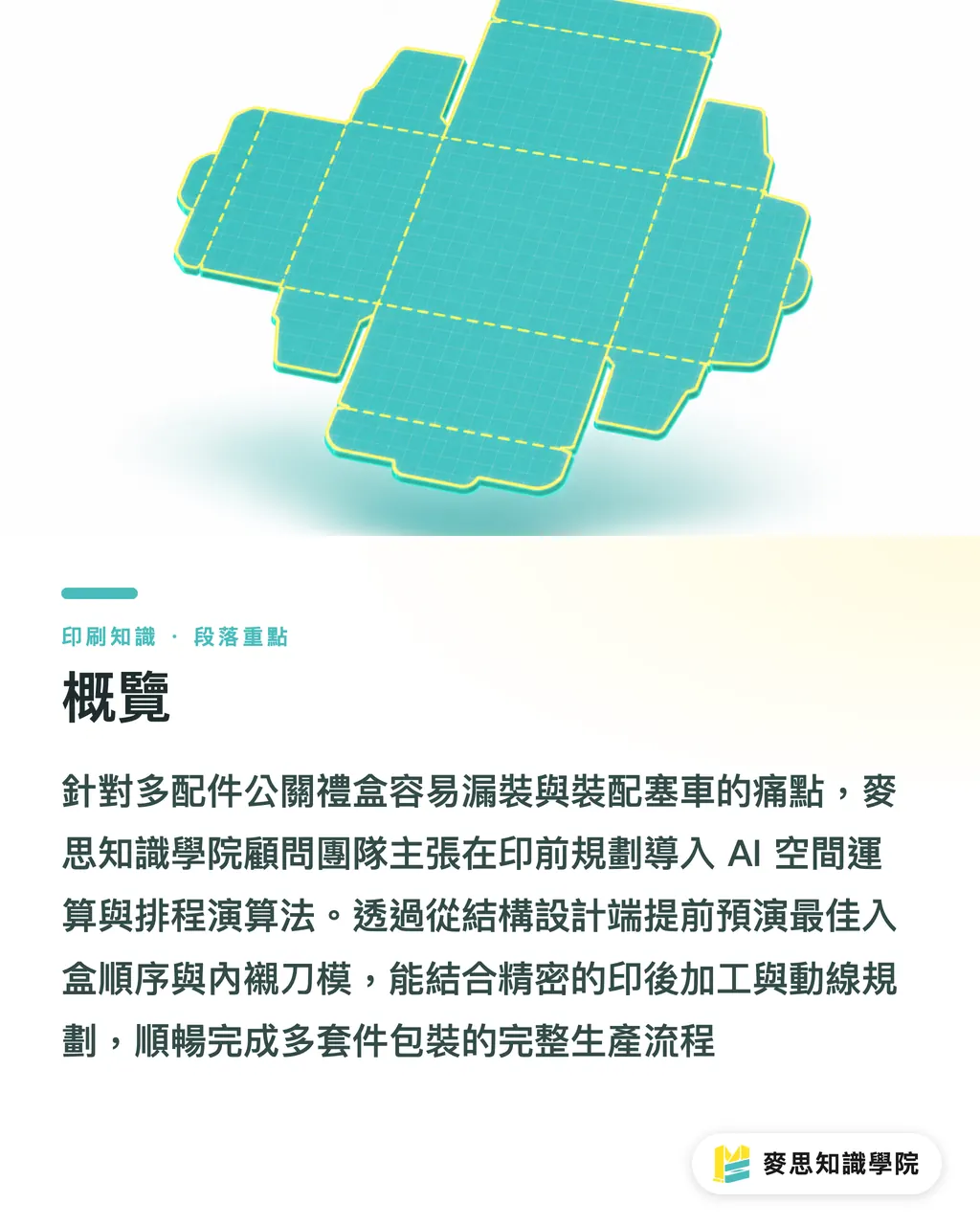
From the jobs I've watched closely over the past few years, brand clients keep doubling the variety of accessories inside gift boxes to amp up the unboxing moment. Take a tech-product gift box with an outer case, a two-layer cardstock insert, three folded brochures and five PR freebies, the manual packing error rate routinely runs above 15%
Hand-packing falls apart the moment the table is buried under cards, bottles and hardcover booklets. One slip of focus and a card goes missing or an insert tab gets crushed
It's simple
The old way is to print everything first, then scramble for a packing order on the floor. That's when you discover the manual is too thick for the lid to close, and the whole shop has to halt for a die-cut redo. Time burned, cost burned
How do you use AI spatial computing in prepress to rehearse the best pack-in order?
The fix is to pull motion-path optimization upstream into prepress design. AI spatial computing simulates each accessory's physical volume and gravity distribution, then automatically works out the pack-in sequence that wastes the least hand time
Drawing on the Physical AI trends released at Automate 2026, robotics and spatial computing are speeding into packaging lines and optimizing automation from the source. For Taiwan's small and mid-sized print shops, a software-side digital rehearsal is the most cost-effective play
For high-complexity gift boxes, I usually recommend the 'MINDS (MS, mid-to-high-end fully custom commercial printing) Three-Gate Submission' to keep production on track:
・① Structural spatial digital-twin simulation: build a 3D model of the outer box and accessories in software, precisely calculating the insert's wrap coverage and tab tension
・② Visualized poka-yoke SOP generation: AI breaks the multi-step assembly into a single-page visual manual marked with color-coded guides
・③ Minimized line-motion testing: simulate the geometric path of a worker's two hands picking parts, cutting wasted reach and re-grabs to the bone
Hold on
If you want to get a grip on prepress poka-yoke and stock selection, reach out to MINDS for professional commercial printing and structural development support
How does a visualized AI SOP manual actually cut manual packing errors?
Once you've nailed the best pack-in order, on-floor accuracy comes down to how the SOP is written. What print shops typically hand finishing houses is a plain-text dispatch sheet, and workers are left to figure it out from experience
AI tools can turn a 3D spatial simulation straight into a pictorial SOP. The system stamps assembly arrows and matching part numbers onto the step diagrams, and even flags the fragile corners of the insert most likely to tear
From my own experience helping companies develop over ten thousand custom gift-box sets, this kind of visual SOP bumps new-hire packing speed by 30% or more, while dropping missing-part complaints to near zero
That's the whole game
Floor staff don't need to memorize a wall of steps, just place parts against the visual cards, and the line keeps its rhythm
How should small and mid-sized print shops and designers actually land AI packaging optimization?
For this tech to pay off, designers, procurement and the print shop have to be on the same page early. I've watched big runs on the floor too many times, nothing worse than realizing, half an hour before kickoff, that the brochure's folded thickness is crushing the gift box lid. That full-shop stoppage for a die-cut redo is the kind of stress that turns hair white overnight
The standard rollout steps:
・Design stage: hand over the full physical dimensions and tolerances of every gift and accessory, including the exact thickness of the brochure when laid flat and when folded
・Prepress stage: run AI spatial computing to lay out the insert structure digitally, simulating compression forces and the finger-grip space for part removal
・Production stage: print the pictorial SOP and run a small-batch pilot pack before opening the main run. Only green-light the full print after that passes
Treat post-press packing as part of the design, not as cleanup after the press is done. That's the real key to shipping complex gift-box projects on time

Key Takeaways
The multi-component gift-box bottleneck starts in prepress, where there's no spatial rehearsal, and the floor pays for it with jams and missing parts
AI spatial computing can pre-rehearse the optimal pack-in order and insert tab structure before any plate is burned
Pictorial visual SOP manuals cut on-floor packing errors by 30% or more
Adopting the MINDS (MS) Three-Gate Submission wipes out the risk of dimensional mismatch and full-shop die-cut redoes at the source
Packing motion-path planning has to move upstream into design, combined with digital-twin simulation of the actual accessory tolerances
Further Thinking
Post-press packing and logistics have long been the print industry's black box, and the silent cost that quietly eats margin. As Physical AI and automation mature, printing competitiveness won't just be about how fast you run or how tight your color is. It'll be about who can deliver an integrated service from design, structural poka-yoke and line motion-path optimization in one shot. For designers and brand procurement, the smartest move is pulling a print consultant into structural development early, and using software tools to rehearse the assembly flow before the budget blows out and the timeline slips
FAQ
- What should I hand the print shop at the start of a multi-accessory gift-box project?
- Send the outer box dimensions plus the exact length, width, height, weight and folded thickness of every gift and booklet inside, so prepress can build an accurate 3D model
- How is a visualized AI SOP manual different from a traditional dispatch sheet?
- A traditional dispatch sheet is mostly text. A visual SOP is auto-generated by AI from the spatial simulation as a pictorial card with color-coded marks and step arrows, workers just follow the pictures and pack it right
- Why does the insert structure need a 3D spatial simulation in prepress?
- Paperboard has thickness and springback. Simulation lets you test tab grip and removal order in advance, so you don't print the whole run only to find the parts won't fit, or fall out because they're too loose
Related articles



The Print × AI weekly
The print and AI know-how designers, brands and enterprises can use before they commit — one email, every week
MINDS Free Tools
AI background removal, brand stamping, and a LINE sticker maker — free design tools, right in your browser, no upload.
MINDS Group
Need actual printing or gifting services?
From premium printing to online ordering and festive gifts — the MINDS Group sister brands take it from here.