

What Is Digital Embellishment? Why Print Shops No Longer Need Metal Plates
Digital embellishment uses digital inkjet heads to apply resin and foil, skipping the prep time and plate fees of traditional zinc or copper plates entirely
Core definition: Digital Embellishment is a finishing process that bypasses metal zinc or steel plates, using digital inkjet heads to deposit clear varnish or raised resin onto targeted paper areas, finished with heat pressing or UV curing for spot UV, 3D embossing, and metallic foil application
In the past on the shop floor, whenever a client asked for raised text on a cover or a layer of metallic foil, print estimators immediately calculated plate fees first. A single traditional foil die or embossing plate started at several thousand dollars. If a client only wanted fifty hardcover gift boxes or one hundred VIP invite cards, amortizing those plate fees alone made the unit cost painfully expensive
Digital embellishment turns that logic on its head. It operates like an ultra-precise 3D inkjet printer, controlling varnish nozzles directly from digital files. Wherever the file specifies gloss or built-up height, the heads drop resin onto those exact coordinates, instantly cured by UV light
Even more impressive is the technology inside high-end presses like the Scodix Ultra 2500 SHD, which feature Smart High Definition (SHD) and Multi-Layer Embellishment (MLE). Digital inkjet used to struggle on uncoated fine paper because the liquid varnish got sucked right into the paper fibers, leaving no shine or volume. With MLE, the press seals the surface first, then layers 3D foil stamping and spot UV on top, delivering sharp metallic relief even on tactile fine papers
Plain and simple, that is what technology changes

Shutterfly Bought 4 Presses at Once: What Signal Does This Send?
This purchase shows the customized gift and packaging market has firmly shifted into an era of micro-runs and premium finishing
In July 2026, US custom print leader Shutterfly announced the purchase of four Scodix Ultra 2500 SHD digital embellishment presses alongside a five-year consumables and service contract, gearing up for peak seasonal demand in late 2026. This is not their first time with digital foiling. Back in 2018, Shutterfly began adopting Scodix technology, bringing tactile effects to photo books and personalized gift lines
This move carries serious weight for print shops and brand buyers everywhere. Shutterfly is one of the world's largest web-to-print operations, running under relentless pressure on production cost and turnaround time. When a giant like this doubles down on digital embellishment, it means the tech is rock-solid on real production lines and consumers are happy to pay for touchable texture
Looking at recent market shifts, consumer brands launch products at a faster pace than ever. Where one packaging design used to run for three years, brands now push out seasonal or collaboration editions every holiday, shrinking single orders from tens of thousands down to a few hundred units. Brands want luxury box sophistication, but cannot swallow the cost and delays of re-making foil dies every time packaging changes
Digital embellishment breaks that exact deadlock. Without plate fees, you can print a single sheet, sending files in the morning and holding physical samples by afternoon. That flexibility lets small brands go toe-to-toe with major conglomerates on visual impact
Traditional Foil Stamping vs Digital Embellishment Prototyping: How Do They Compare?
Traditional metal die stamping fits high-volume runs of tens of thousands, while digital embellishment holds an absolute lead in speed and cost for short runs of 1 to 1,000 pieces and fast prototyping
When designers or buyers first encounter digital finishing, the question I hear most is: Can digital foiling really replace traditional hot foil stamping completely? My answer is that both have their own home turf. It all comes down to your run size and substrate requirements
Let's break down their practical differences point by point:
・Traditional metal stamping: Requires engraved metal plates, plate fees around NT$1,500 to NT$4,000 per color, setup and calibration take 2 to 3 hours, unit processing cost is extremely low for mass production, delivers deep physical impression, best for conventional coated papers and ultra-dense flat gold foiling
・Digital embellishment: Zero plate costs, starts printing within minutes of file approval, creates gradient 3D height layering and varied crystal-clear relief, ideal for short orders of 1 to 1,000 units and personalized variable data, works directly on uncoated fine paper via MLE technology
In the past, when a brand wanted high-end packaging samples, waiting for foil dies to be engraved and delivered ate up two or three days. If the sample showed a font size tweak was needed, another few thousand dollars and two days vanished. Now, with digital embellishment prototyping, a designer tweaks the file on screen and holds a physical box sample with 3D foiling within half an hour
The cost difference is massive

How Can Small Brands and Designers Put This Tech to Work for Packaging?
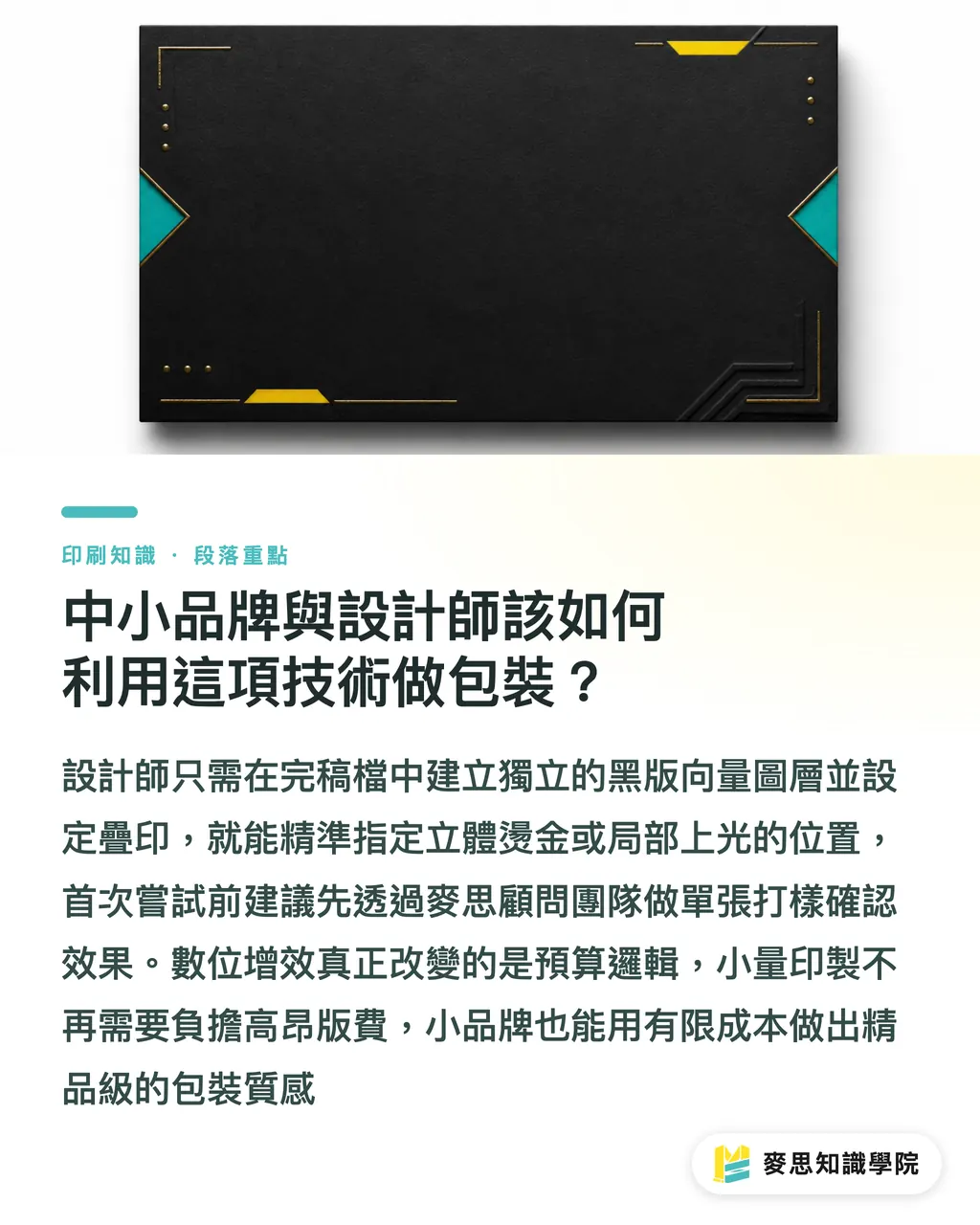
Designers only need to set up a dedicated black vector layer in artwork files to pinpoint exact spots for 3D foil stamping or spot varnish
To get the most out of digital embellishment, file preparation works much like traditional foiling. Follow standard artwork guidelines from MINDS Printing and keep these three straightforward steps in mind to nail your first digital 3D foil run:
1. Create a separate finishing layer: Build a dedicated vector layer in Illustrator or InDesign, fill areas meant for 3D varnish or foiling with 100% K spot black, and set them to Overprint
・2. Control lines and typography precisely: While SHD technology in digital embellishment can print ultra-fine micro-lines and small text, stroke width should stay at 0.2mm or above to prevent liquid resin edge shrinkage from affecting tactile feel
3. Schedule a test proof run: If trying fine paper with digital 3D foiling for the first time, get in touch with the Mai Strategy Knowledge Academy Advisory Team for a single proof sheet to verify paper absorption and gloss levels before launching batch production
From the perspective of print shops and designers, digital embellishment gives us immense freedom. No more shrinking foil areas to the absolute minimum to save on plates, and no more explaining to clients why fifty boxes of business cards come with a three-thousand-dollar plate fee. Knowing how to put this technology to work lets small budgets deliver the premium impact of major brands
Key Takeaways
Achieves 3D foil stamping and spot UV without metal plates, clearing the steep plate fee barrier of traditional finishing
Scodix MLE technology solves varnish absorption on uncoated fine paper, bringing crisp metallic embossing to textured specialty papers
Shutterfly's major purchase validates the business value of digital embellishment for high-mix, short-run, fast-turnaround production
Choosing digital embellishment for short-run packaging of 1 to 1,000 units and luxury prototyping drastically shortens lead times and cuts trial-and-error costs
Further Thinking
As consumer markets push toward high-mix short runs and flash marketing, print shops and brand buyers should stop viewing 3D foil stamping as a luxury out of reach. Designers should build digital embellishment into packaging proposals from day one, taking advantage of zero plate fees to produce detailed physical box proofs for testing. This not only slashes new product development risks, but builds a strong visual and tactile edge for the brand in no time
Further Reading
FAQ
- What's the difference in look and feel between digital 3D foil stamping and traditional hot foil stamping?
- Traditional hot stamping presses foil flat with metal plates, leaving hard edges and no height gradient. Digital 3D foiling builds up resin layers to create crystal-like relief curves and clear tactile depth
- Does digital embellishment actually save money over traditional foiling for short-run packaging?
- For order quantities under 1,000 units, digital embellishment skips the thousands of dollars in metal plate fees completely, keeping total production and sampling costs far below traditional foil stamping
- Which paper stocks work best for digital 3D foil stamping?
- Standard coated paper and offset paper work seamlessly. Presses equipped with Scodix MLE technology can also print high-gloss 3D metallic finishing directly onto uncoated fine papers and vintage cotton stocks
Related articles




The Print × AI weekly
The print and AI know-how designers, brands and enterprises can use before they commit — one email, every week
MINDS Free Tools
Spine width and imposition calculators — skip the manual math, free in your browser.
MINDS Group
Need actual printing or gifting services?
From premium printing to online ordering and festive gifts — the MINDS Group sister brands take it from here.