

Why is competition in textile printing shifting from equipment to workflow?
Competition in textile printing is shifting toward the entire data workflow. Equipment speed alone is no longer enough to determine profitability. In The 2026 Textile Printing Playbook, FESPA, a platform for printing industry news and networking, brings digital workflows, AI, and on-demand growth into the same discussion. It points to demand for personalization, shorter purchasing cycles, near real-time response, and ongoing pressure on margins. Supply chain transparency has also become a regulatory and commercial reality
Print providers can easily interpret new demand as a reason to add another digital press. But a machine only handles output. When artwork, color approval, job orders, and shipping are passed along by word of mouth, more rush orders mean more rework, which can quickly eat into capacity. My view: connect the data handoffs before prioritizing faster equipment. A faster press cannot make up for the time spent reconfirming specifications every time artwork changes
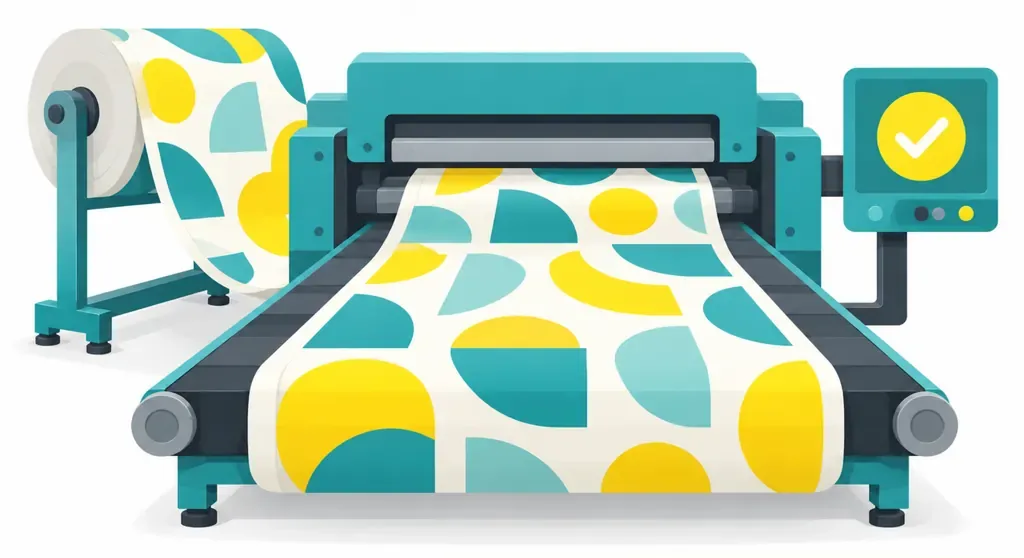
Where can AI save time in textile printing?
AI's clearest use right now is speeding up early-stage creative exploration and proposal revisions. People still need to make the final selections and decide whether a design is suitable for printing. Corel's AI prompting tools, from a brand that makes graphic design software, can explore styles, colors, and compositions from text prompts, then turn the results into editable artwork. That gives designers a faster start than a blank page
For print providers, the value depends on whether revisions reach a review-ready version sooner, not on how eye-catching the generated image looks. Designers still need to check the pattern's size, repeat, and appearance on fabric. The print provider needs to confirm that the file fits the existing production process. AI can shorten the time spent finding a direction, but it cannot replace sampling and color approval on the actual product
Why connect design data and color approval first?
A digital workflow should connect design data and color approval first, so specifications confirmed upstream can reach production. A digital workflow links artwork and specifications as transferable data across development, color approval, and production. That lets later stages use information already confirmed earlier, instead of relying on verbal handoffs and guesswork
NedGraphics, textile pattern design software, and Optitex, apparel pattern development software, connect textile design and apparel pattern specifications in one workflow. Sharing information from the start of development can reduce sampling, shorten development cycles, and cut rework and waste. Color should be addressed early too. A calibrated RGB (Red, Green, Blue) profile can help the design team preview results and speed up approval. Track the benefits through sampling rounds and rework hours. Don't promise a fixed percentage before you have records from your own operation
Why does on-demand production also put supply chain data to the test?
For on-demand production to make business sense, order intake has to keep pace with demand for personalization, and sampling and rework can't eat into margins. FESPA's feature points to shorter purchasing cycles, expectations of near real-time response, and pressure on profits in textile printing. If every small order still requires specifications to be copied by hand, a shorter lead time doesn't mean lower production costs
The feature also discusses the Digital Product Passport, a digital record that presents product information across the supply chain, and the broader push for transparency. It doesn't specify an implementation standard, so printers don't need to design a complex system right away. They can start by organizing how order and product data are handed off. Danit Peleg writes that 3D-printed clothing is becoming a mature production model, supported by materials science and more accessible AI-assisted workflows. That's a signal from an adjacent manufacturing model, not a reason for every textile printer to buy 3D equipment
How should small and midsize printers get started?
Small and midsize printers can start with a small trial run in a product category with stable specifications, then compare costs and lead times on the same basis. MINDS, a mid- to high-end fully customized commercial printing brand, has the "Three Gates for On-Demand Production" framework. It breaks implementation into design data, color approval, and production and delivery, with clear handoff requirements for each gate
・Design data gate: Confirm how artwork, patterns, and product specifications are handed off, so production doesn't have to chase down details after receiving the files
・Color approval gate: Set up a calibrated RGB preview and a customer approval process, and spell out when a physical sample is still needed
・Production and delivery gate: Use small-batch orders to check job changes, scheduling, leftover materials, and shipping data. Record which steps still require manual copying or editing
Compare sampling rounds, rework hours, and the time from proof approval to shipment before and after the trial. That shows where the process improved, without assuming every printer will see the same gains. To turn the checkpoints into an implementation plan, talk with the Mai Strategy Knowledge Academy consulting team. SaaS teams can also start by organizing order fields, color approval records, and job handoffs so the data can be used throughout the workflow

Key takeaways
・To handle on-demand textile printing orders, carry design specifications all the way through production and shipping
・AI can speed up creative exploration. People still need to review design selections, print suitability, and color approval
・Calibrated RGB previews can speed up approval. Track sampling rounds and rework hours to see whether implementation is paying off
・Trial the workflow with one product category first, then decide whether to expand the process, software, or equipment
What to explore next
Printers can choose a textile product they handle often and whose specifications are easy to define. Map out which details from artwork to shipment are copied by hand or confirmed repeatedly, then use trial orders to track changes in sampling, rework, and lead times. When the design team handles file handoffs well and the print team spells out color approval requirements, SaaS teams can take on order fields and job routing. That makes it easier to see where production time is actually saved than starting with a large AI system
Further reading
FAQ
- Where should textile printers start when adopting AI?
- Use AI to explore styles, colors, and composition, then have a designer turn the results into editable artwork. The print provider still needs to check specifications, print suitability, and color approval requirements
- Do you have to buy new digital textile printing equipment to move to on-demand production?
- Not necessarily. Review design data, color approval, and job handoffs first, then trial the process with one product category to see whether equipment capacity is really the bottleneck
- How can a calibrated RGB profile help a print shop?
- A calibrated RGB preview can help the design team preview results and speed up approval. It doesn't replace physical sampling and color approval when those are needed
- How can small and midsize printers tell whether workflow integration is working?
- Compare sampling rounds, rework hours, and the time from proof approval to shipment for the same product category before and after the trial. Then decide whether to expand implementation
Related articles


The Print × AI weekly
The print and AI know-how designers, brands and enterprises can use before they commit — one email, every week
MINDS Free Tools
AI background removal, brand stamping, and a LINE sticker maker — free design tools, right in your browser, no upload.
MINDS Group
Need actual printing or gifting services?
From premium printing to online ordering and festive gifts — the MINDS Group sister brands take it from here.