
Overview
When a multi-SKU brand wants to unify sustainable packaging, it should not rush to turn every product into a version that simply "looks green." Instead, it should use MINDS' three-gate print submission review to build a packaging specification system. First define ① shared paper stocks, ② shared box structures, ③ size modules, ④ layout rules, ⑤ label hierarchy, and ⑥ finishing limits, so that every time the brand adds 1 SKU, it does not have to reopen the paper selection, die-line, proofing, quoting, and ESG narrative all over again
Why Does Packaging Slow Down Multi-SKU Brands?
I have seen many brands where, as the product line grows from 5 SKUs to 30 SKUs, packaging issues do not explode all at once. They gradually turn into the kind of mess that procurement, design, and print vendors all avoid touching
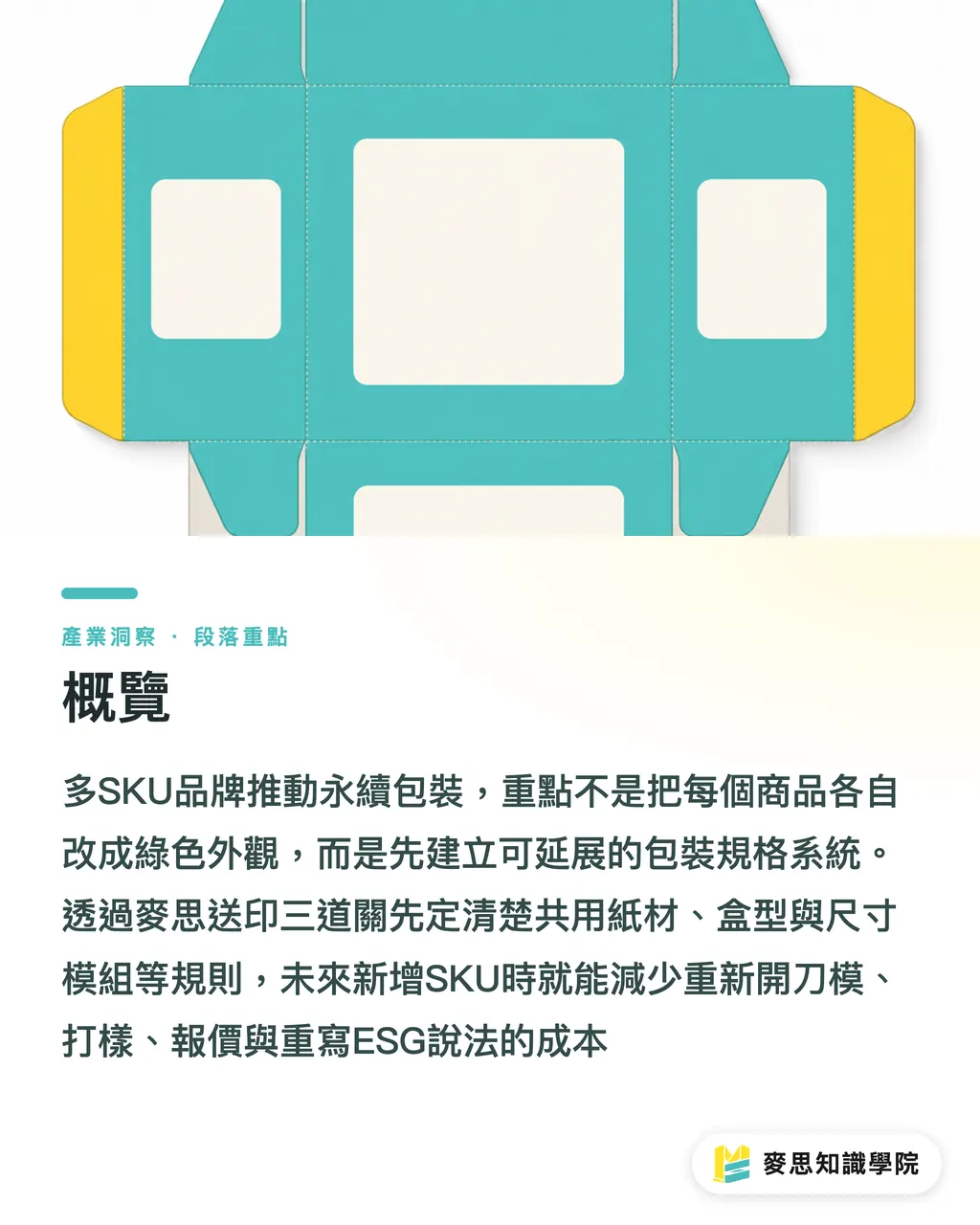
A common situation for multi-SKU brands is that every product has its own box structure, its own paper stock, and its own label position. Even capacity differences within the same series get new layouts. In the end, the packaging may look highly designed, but every ingredient change, barcode update, or country-of-origin revision requires checking a long chain of files
Sustainable packaging amplifies the problem here, because the brand has to ask not only whether the paper is recyclable, but also manage paper certifications, plastic film ratio, foil stamping area, coating method, label material, and recycling communication. MINDS' three-gate print submission review first asks three questions: Can this material be sourced consistently? Can this structure be shared? Can this information be revised without damaging the layout?
Let's clarify the core term first: a sustainable packaging specification system is a reusable specification table that organizes a brand's paper stocks, box structures, dimensions, printing, labels, finishing, and recycling instructions, so multi-SKU product expansion, print quoting, inventory management, and ESG communication all follow the same basis
What Is a Sustainable Packaging Specification System?
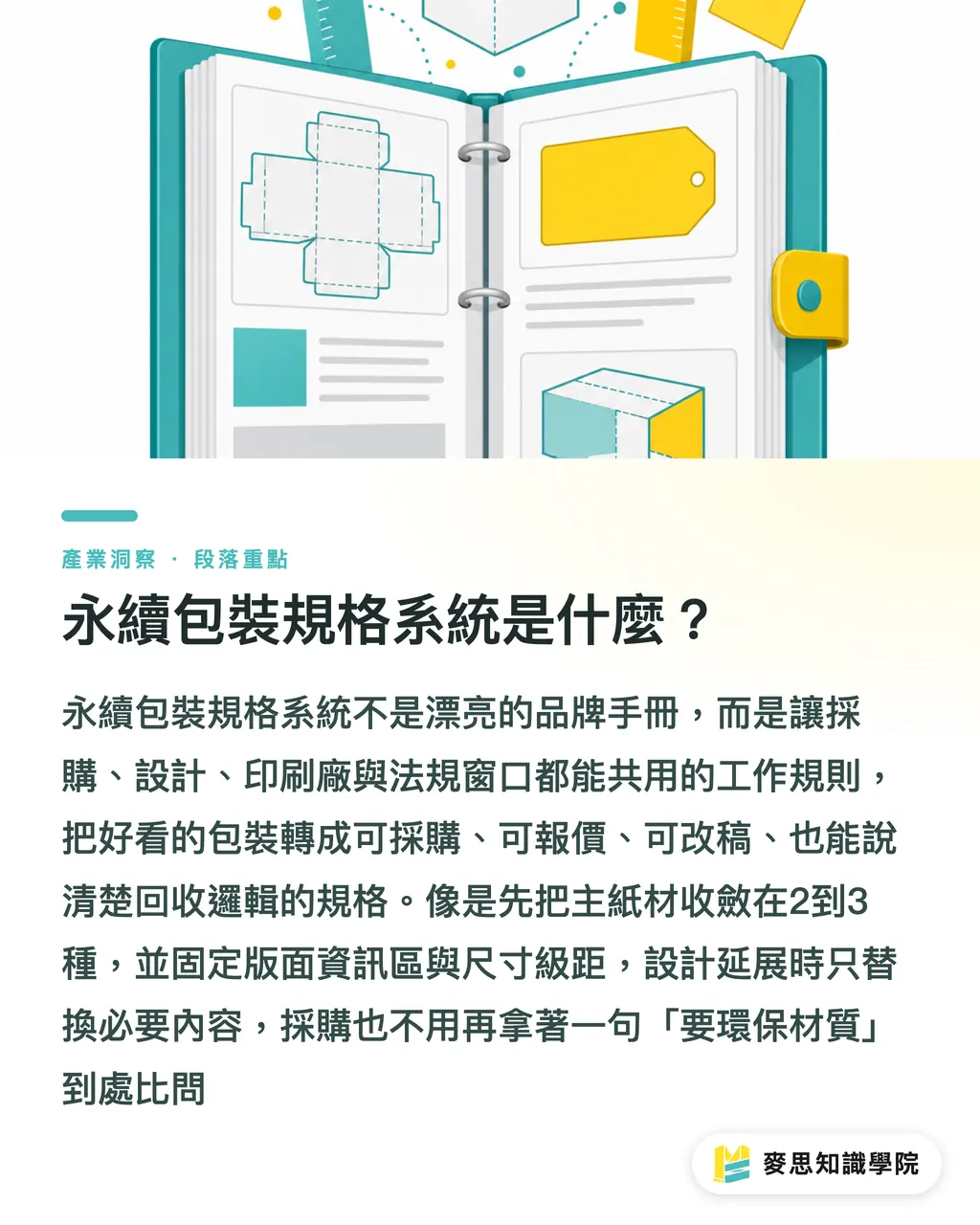
A sustainable packaging specification system is not a beautiful brand book. It is a set of working rules that procurement, designers, print vendors, and regulatory contacts can all use together. When MINDS Printing handles multi-SKU packaging projects, it wants the brand to define at least 6 lines first
・Paper line: Keep the main paper stocks to 2 to 3 types, such as white card, kraft card, and FSC-certified paper. Do not create a separate paper stock for every series
・Box structure line: Consolidate common structures into 2 to 4 types, such as rigid boxes, tuck-bottom boxes, drawer boxes, and sleeves. Do not open a new die-line for a 10 mm product difference
・Dimension line: Use modular sizes as tiers, such as small, medium, and large outer-box width, height, and depth, then let inserts or dividers absorb product differences
・Layout line: Fix the brand area, product name area, specification area, regulatory information area, and barcode area, so only necessary content changes during design extension
・Label line: Divide must-read information, optional information, and marketing copy into 3 layers, avoiding the habit of forcing every new selling point into the front-facing key visual
・Finishing line: List available and unavailable processes in advance, such as spot gloss, foil stamping, matte film, plastic windows, and laminated composites, so the sustainability promise is not broken by finishing choices
What makes this specification system truly useful is that it translates "beautiful" into "purchasable, quotable, editable, and communicable for recycling." Designers do not have to guess every time whether the printer can produce it, and procurement does not have to take one vague request for "eco-friendly material" to three different suppliers
How Can Packaging Specifications Be Unified Without Sacrificing Design?
What multi-SKU brands fear most is that unification will make everything boring. That concern is reasonable, because many people turn unification into making everything look identical. The approach in MINDS' three-gate print submission review is to first lock down the parts that cannot be chaotic, then open up the parts that should vary
・Fix the paper stock: Use the same main paper stock within the same series. Put differences into ink, color blocks, labels, and local finishing, instead of making every SKU carry a separate paper inventory
・Fix the box structure: Share the same die-line within a series first. Only open a second set when product dimensions truly differ too much. Do not let 10 SKUs become 10 die-line sets from the start
・Fix the size tiers: Build the outer boxes into 3 size tiers, so shipping cartons, display racks, and inventory slots benefit as well. Packaging specifications do not serve only the print vendor
・Fix the information fields: Ingredients, place of origin, expiry date, batch number, barcode, and recycling marks should have fixed positions, so revisions do not pull apart the entire visual system
・Limit finishing: Sustainable packaging must first decide which processes not to use, such as large-area lamination, mixed-material window patching, and hard-to-separate composites. Otherwise, the recycling message can be undermined by one small decoration
Design can still have variation. Differences should live in series colors, product photography, illustration language, local material tactility, and label information hierarchy. If a brand already has more than 20 SKUs, I recommend spreading out the existing packaging and doing a specification audit first. MINDS Printing usually starts with paper stocks, die-lines, layouts, and finishing to find the areas that can be consolidated first
From what I have seen on the ground, the most expensive waste in multi-SKU packaging is often not one printing mistake. It is everyone thinking they changed only a little, while procurement adds one more paper stock, design adds one more layout, the printer adds one more confirmation, and the warehouse adds one more inventory slot. In the end, the whole chain pays for that "little bit."
How Far Can AI and SaaS Help Manage Multi-SKU Packaging?
In multi-SKU sustainable packaging, AI and SaaS are best suited for specification management. They are not suited to replacing print judgment, because paper stiffness, fold-line cracking, coating color absorption, and foil adhesion still have to return to proofing and production-line experience
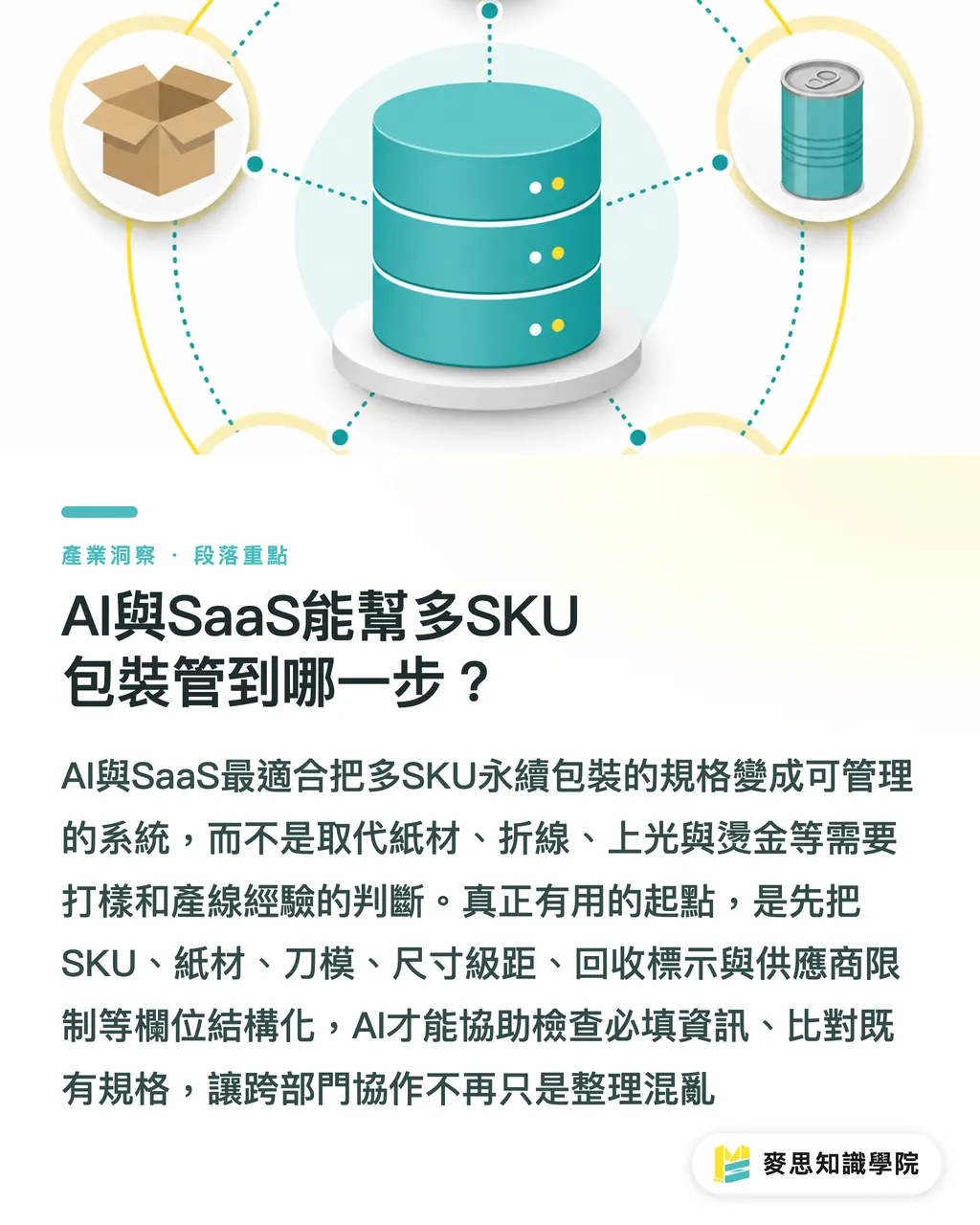
A usable packaging SaaS should structure at least 12 fields: SKU, series, paper stock, basis weight, box structure, die-line number, size tier, number of print colors, surface treatment, labeling rules, recycling marks, and supplier restrictions. These fields are more useful than uploading 100 PDFs
AI applications can handle 3 practical tasks
・Help the design side check whether the layout is missing required information, such as the barcode area, batch number area, and recycling mark area
・Help the procurement side compare whether a new SKU can use existing paper stocks, die-lines, and size tiers
・Help ESG or brand teams organize the material descriptions for each packaging series, so the same paper stock is not written under 3 different names across different documents
For AI and SaaS to connect well, the premise is that the brand already has a packaging specification system. Without specifications, the system will only preserve chaos in a neater form. When the consulting team at Mai Strategy Knowledge Academy helps brands organize packaging workflows, it usually first turns existing SKUs into a specification list, then discusses automated checks and cross-department collaboration
Key Takeaways
・For multi-SKU sustainable packaging, unify the specifications before discussing single-product beautification. Otherwise, every new product will consume procurement, design, and printing costs all over again
・Only when the 6 lines of paper stock, box structure, dimensions, layout, labels, and finishing are clearly defined can a brand maintain sustainable packaging over the long term
・Design extension does not mean redesigning every SKU. It means preserving differences in series colors, imagery, labels, and tactile details within fixed specifications
・AI and SaaS can help brands manage fields, check omissions, and compare specifications, but proofing and print limitations still need to be calibrated by production-line experience
Further Thinking
On the print manufacturing side, multi-SKU packaging quotes can move from "single-item estimating" to "specification-system estimating." On the design side, layout rules can become extension templates. On the AI application side, teams can begin with specification checks across 12 fields. SaaS teams should turn die-lines, paper stocks, and finishing restrictions into queryable data structures. If a brand is preparing to launch sustainable packaging, the next step is not to hold a meeting about green visuals. It is to lay out every SKU and audit materials, structures, and information using MINDS' three-gate print submission review
FAQ
- What should multi-SKU brands change first when working on sustainable packaging?
- Start with the specification system. First audit paper stocks, box structures, size tiers, layout fields, label hierarchy, and finishing limits. MINDS' three-gate print submission review handles these 6 items first to prevent every SKU from being developed in isolation
- Will unified sustainable packaging make products look too similar?
- Not necessarily. Packaging can fix the paper stock, box structure, and information positions, while leaving variation to series colors, product imagery, local tactile details, and label content. Design differences should be placed in controllable areas
- How does sharing box structures help print quoting?
- Shared box structures reduce die-line, proofing, confirmation, and inventory complexity. When quoting, the print vendor can use the same structure to estimate multiple SKUs, and the brand can more easily compare pricing across suppliers
- Can AI directly decide sustainable packaging materials for a brand?
- AI can help organize SKU data, check fields, and compare specifications, but whether a material can be printed, whether fold lines will crack, and whether finishing will affect recycling still require judgment from proofing and print manufacturing experience
Related articles

The Print × AI weekly
The print and AI know-how designers, brands and enterprises can use before they commit — one email, every week
MINDS Free Tools
AI background removal, a LINE sticker maker, spine & imposition calculators — all free, right in your browser, no upload.
MINDS Group
Need actual printing or gifting services?
From premium printing to online ordering and festive gifts — the MINDS Group sister brands take it from here.