
What Material Should You Choose for an Eco-Friendly Coffee Cup?
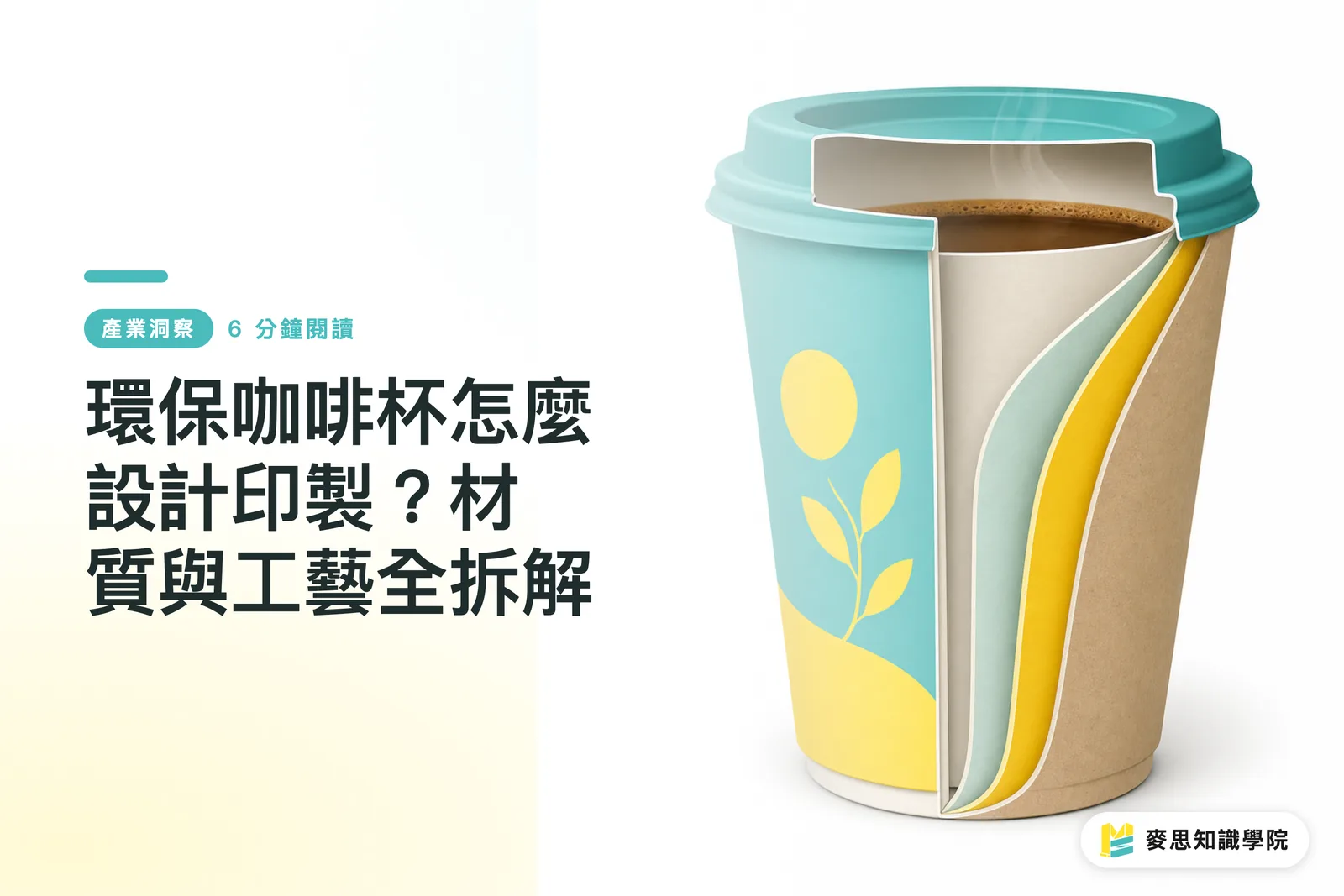
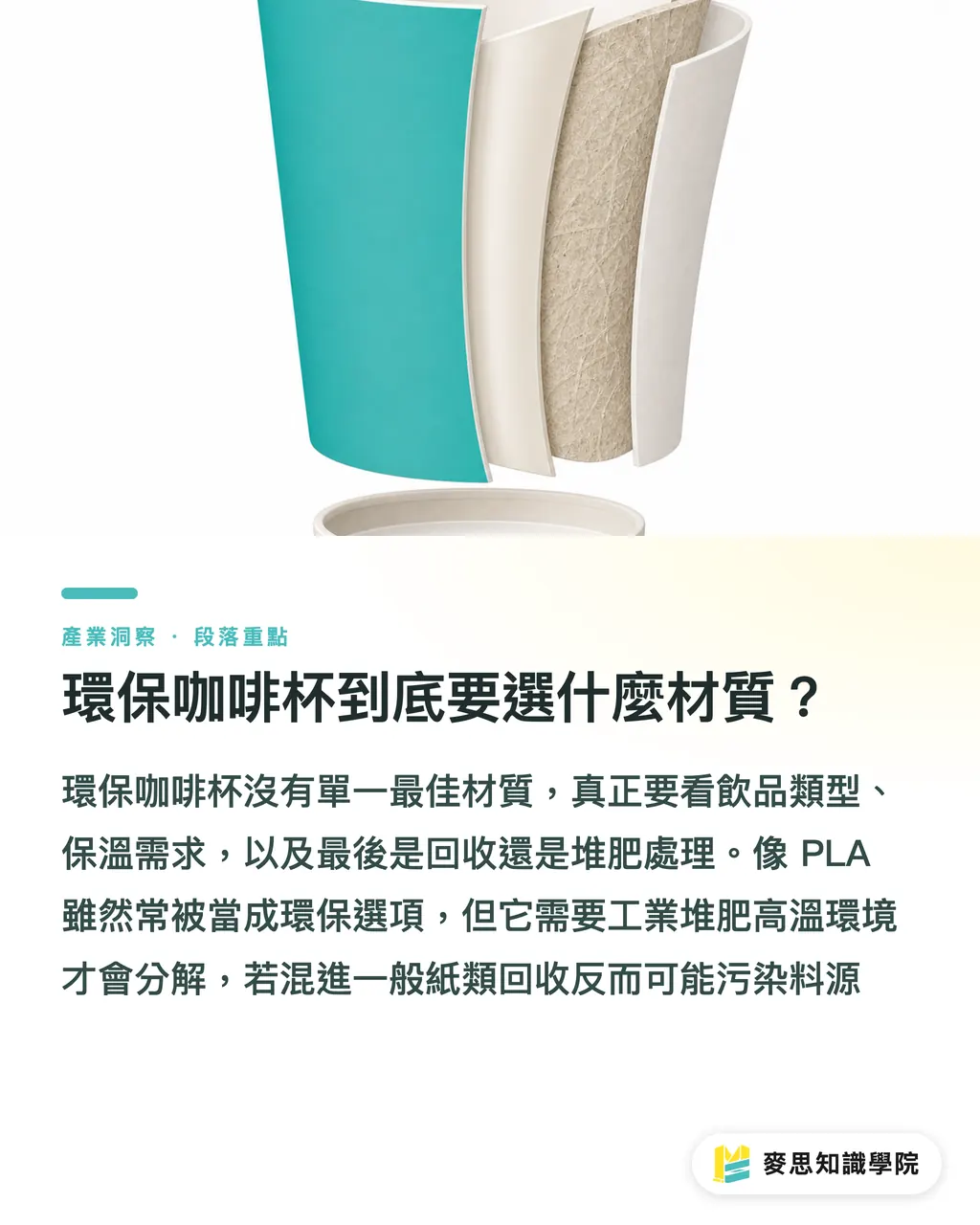
Here is the most direct answer: there is no single best material for eco-friendly coffee cups. The right choice depends on three things together: what drink it will hold, whether it needs heat insulation, and whether the intended end-of-life route is recycling or composting. It is not enough to simply pick a certification label and call it sustainable
In practice, the mainstream materials you will encounter are roughly these:
・PE-coated paper cups: the most common and lowest-cost option, but the inner polyethylene plastic film bonds the paper and plastic together. Most recycling systems in Taiwan struggle to separate them, making this the classic example of something that looks eco-friendly but causes the most headaches at the recycling end
・PLA-coated paper cups: these replace PE with polylactic acid made from corn starch and can be marketed as biodegradable. However, PLA only truly breaks down in an industrial composting environment at around 60°C. If thrown into general waste or a household food-waste bin, it will barely degrade
・Aqueous-coated paper cups: these use water-based coating instead of plastic lamination. Their water resistance is weaker than PE, so they are better suited to cold drinks or fast-consumption scenarios. The benefit is that the fiber is easier to repulp at recycling facilities
・Molded fiber cups, such as bagasse or sugarcane pulp: these are molded directly from sugarcane residue or bamboo fiber. They are naturally heat-resistant, water-resistant, and compostable, but the cup wall is thicker and the print surface is less smooth than a paper cup
One common on-site misconception is that many business owners think "PLA = recyclable." In reality, if PLA enters regular paper recycling, it can contaminate the material stream. This is one of the first things designers should explain clearly to clients
Why Can a Cup with an Eco Label Still Be Seen as Not Eco-Friendly Enough?
The key is that "compostable" and "recyclable" are two completely different routes. Which route a certification refers to determines whether the cup will eventually be repulped and recycled or sent to an industrial composting facility
Compostability certifications, such as BPI and OK Compost internationally, test whether a material breaks down under specific composting conditions. That does not mean it will disappear if you throw it into a curbside recycling bin. Over the past year or two, I have clearly felt clients becoming more anxious about this, especially takeaway coffee brands. Consumers often hold the cup and ask, "Which bin does this go in?" If the brand cannot answer, the situation gets awkward
To make an eco-friendly cup live up to its name, design and procurement teams need to evaluate these factors together:
・The coating and paper base must share the same processing route: if the paper base is recyclable but the coating can only be composted, the whole cup gets stuck in the middle and neither side wants it
・Ink counts too: use water-based ink or soy ink wherever possible. Residual solvent-based ink can affect composting certification and the quality of recycled paper
・Avoid over-processing: hot foil stamping, spot UV, and plastic labels may look attractive, but they can directly undermine composting or repulping
Put simply, the core rule for designing an eco-friendly cup is this: all materials in the entire cup must be able to follow the same end-of-life processing route. That matters far more than collecting a stack of certifications
How Can Eco-Friendly Coffee Cups Be Printed Without Smudging or Fading?
The biggest risk with hot drink cups is that the graphic smudges or the coating bubbles once someone grips the cup and steam hits it. That means the printing method must be chosen according to both the material surface and the drink temperature
The three mainstream printing methods each fit different use cases:
・Flexo printing: the main process in the paper cup industry. The flat sheet is printed first and then formed into a cup. It is suitable for high-volume designs with relatively simple color registration, with low unit cost but high minimum order quantities
・Offset printing: precise color registration and refined gradients make it suitable for premium coffee brands that need high-quality visual presentation, but the cost and minimum order threshold are higher than flexo
・Direct print or direct-to-object printing: used on formed cups or molded fiber cups. It eliminates the outer printed sleeve or wrap, turning the container itself into the advertising surface. This is also the most important process shift behind the rise of circular cups and reusable cups
A few practical points must be confirmed before sending files to print:
・Keep printing away from seams and rolled rims: rim areas crack easily once printed, so a safety zone needs to be built into the design from the start
・Dark, full-coverage artwork is the most accident-prone: paper cups absorb ink unevenly, and full-coverage coffee brown or dark green is especially likely to show banding. If the design can work with linework or white space, avoid forcing a full flood of color
・Proofing must be done on the actual cup material: a good-looking flat proof does not mean the cup will look good. A formed paper cup is curved, and molded fiber cups have fiber texture on the surface, so color will definitely shift
My long-term observation from production lines and client work is that eight out of ten eco-cup failures are not material problems. They happen because the design file was not built around the real cup shape. Flat-design thinking applied to a curved container is where problems start
Can Eco-Friendly Cups Balance Looks and Cost?
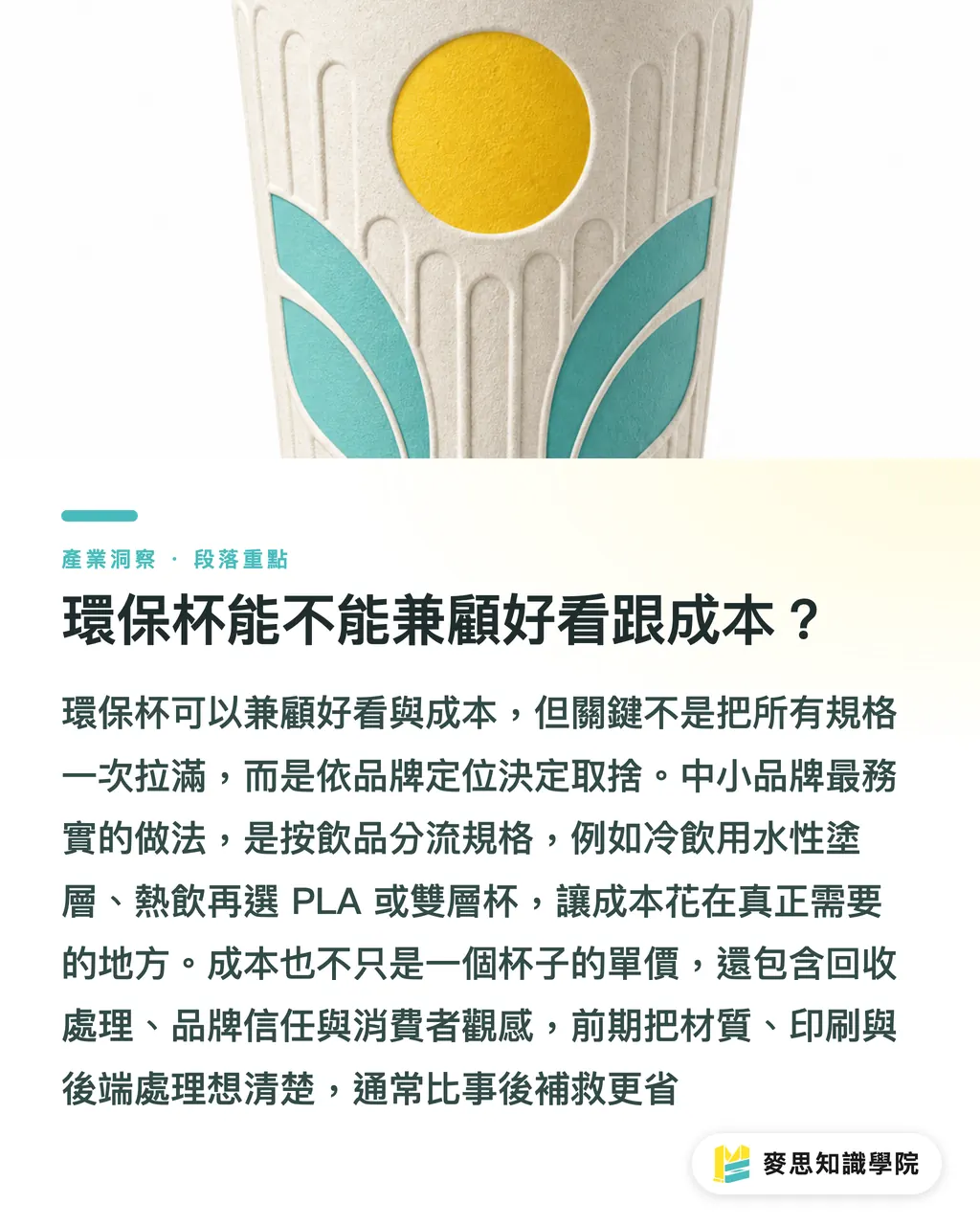
Yes, but you first need to let go of the idea that you can have everything. Sustainability, water resistance, refined printing, and low cost are difficult to maximize at the same time. Priorities need to follow the brand positioning
For small and mid-sized brands, the pragmatic approach is to adjust these levers:
・Use aqueous coating for cold drinks, and reserve PLA or double-wall cups for hot drinks: do not use the same specification across the entire product line. Segmenting by drink type is the most cost-efficient route
・Use double-wall cups instead of sleeves when insulation is needed: double-wall paper cups can eliminate the cost and inventory of separate cup sleeves, and they are often more economical when calculated as a whole
・Trade printing complexity for lower minimum quantities: the more colors and finishing processes involved, the higher the minimum order threshold. Smaller brands are often better off simplifying the design in exchange for small-batch printability
・Create texture through structure and embossing rather than extra finishing: the natural fiber texture of molded fiber cups and the lines of the cup shape often age better and are more sustainable than forcing on hot foil stamping
One judgment I often share with clients is this: the cost of an eco-friendly cup is not just "how much one cup costs." You also need to factor in recycling treatment, brand trust, and consumer perception. The price of using the wrong label and getting called out by consumers is far higher than the small amount saved on coating cost
This is also why it is valuable to discuss material choice, printing method, post-processing, and end-of-life treatment together. Thinking through the full chain from specification to printing saves far more effort than trying to fix problems afterward
Key Takeaways
・There is no universal solution for eco-friendly cups. Material choice should be based on what the cup holds, whether it needs insulation, and whether the end-of-life route is recycling or composting
・Compostable does not mean recyclable. PLA cups can contaminate the material stream if placed in regular recycling, so the route behind the certification must be explained clearly upfront
・The paper base, coating, and ink of the entire cup need to follow the same end-of-life processing route. This matters more than collecting certifications
・Most eco-cup printing failures are not material issues. They happen because flat design files were not created for the real curved cup shape
・Separating specifications for hot and cold drinks, using double-wall cups instead of sleeves, and replacing decorative finishing with structural texture are three cost levers for small and mid-sized brands
Further Reflection
The real barrier in eco-friendly coffee cups is not material procurement, but shifting prepress thinking from flat graphics to containers. For designers, the next step is to build a habit of proofing on the actual cup material, with curves, fiber texture, and rim safety zones all included in the file. For print shops, direct printing and molded fiber cup forming are processes worth preparing for early, because once circular cups remove the outer printed sleeve, orders will concentrate around suppliers that can print directly on containers. For brands, instead of chasing the trendiest eco label, it is better to first clarify the end-of-life route of the whole cup. Materials, coatings, inks, and finishing should all align along one chain, or the cup may be rejected by recycling facilities or public opinion. Discussing specifications, design, printing, and post-processing on the same blueprint is the key to reducing mistakes and making these orders easier to replicate
FAQ
- Can eco-friendly coffee cups be thrown directly into the recycling bin?
- It depends on the material. PE-coated paper cups are difficult for most recycling systems to process because the plastic film is hard to separate. PLA cups require industrial composting to break down, and putting them in regular recycling can contaminate the material stream. Aqueous-coated paper cups have fibers that are easier to recycle and repulp, but you should confirm the disposal instructions printed on the cup before purchasing
- How are PLA cups different from regular paper cups?
- PLA cups use a bioplastic made from corn starch as the inner layer instead of PE petrochemical plastic. They can be marketed as biodegradable, but they only truly break down in an industrial composting environment at around 60°C. If placed in household food waste or general trash, they will barely decompose
- Will printing on hot drink eco-cups fade or rub off?
- Not if the process and material are properly matched. The key is to use water-based or soy ink, avoid printing on rolled rims and seams, replace dark full-coverage designs with layouts that use white space, and always proof on the actual cup material. Colors from a flat proof will definitely shift once applied to a curved cup body
- Are minimum order quantities high for custom eco-friendly coffee cups from small brands?
- It depends on the printing method and design complexity. Flexo printing has low unit costs at scale but a higher minimum order threshold. More colors and more finishing processes also raise the threshold. Small brands should use simpler designs to enable smaller print runs and control total cost by separating specifications for hot and cold drinks
- Are molded fiber cups or paper cups more eco-friendly?
- Molded fiber cups are made from sugarcane residue or bamboo fiber, and they are naturally heat-resistant, water-resistant, and compostable, making end-of-life treatment simpler. Paper cups have the advantage of a smoother print surface and more refined visuals, but PE-coated versions get stuck in recycling challenges. The better choice depends on whether you prioritize end-of-life treatment or print quality
Related articles
The Print × AI weekly
The print and AI know-how designers, brands and enterprises can use before they commit — one email, every week
MINDS Free Tools
AI background removal, a LINE sticker maker, spine & imposition calculators — all free, right in your browser, no upload.
MINDS Group
Need actual printing or gifting services?
From premium printing to online ordering and festive gifts — the MINDS Group sister brands take it from here.