
T-Shirts: Screen Printing or DTG? Start with Artwork and Quantity
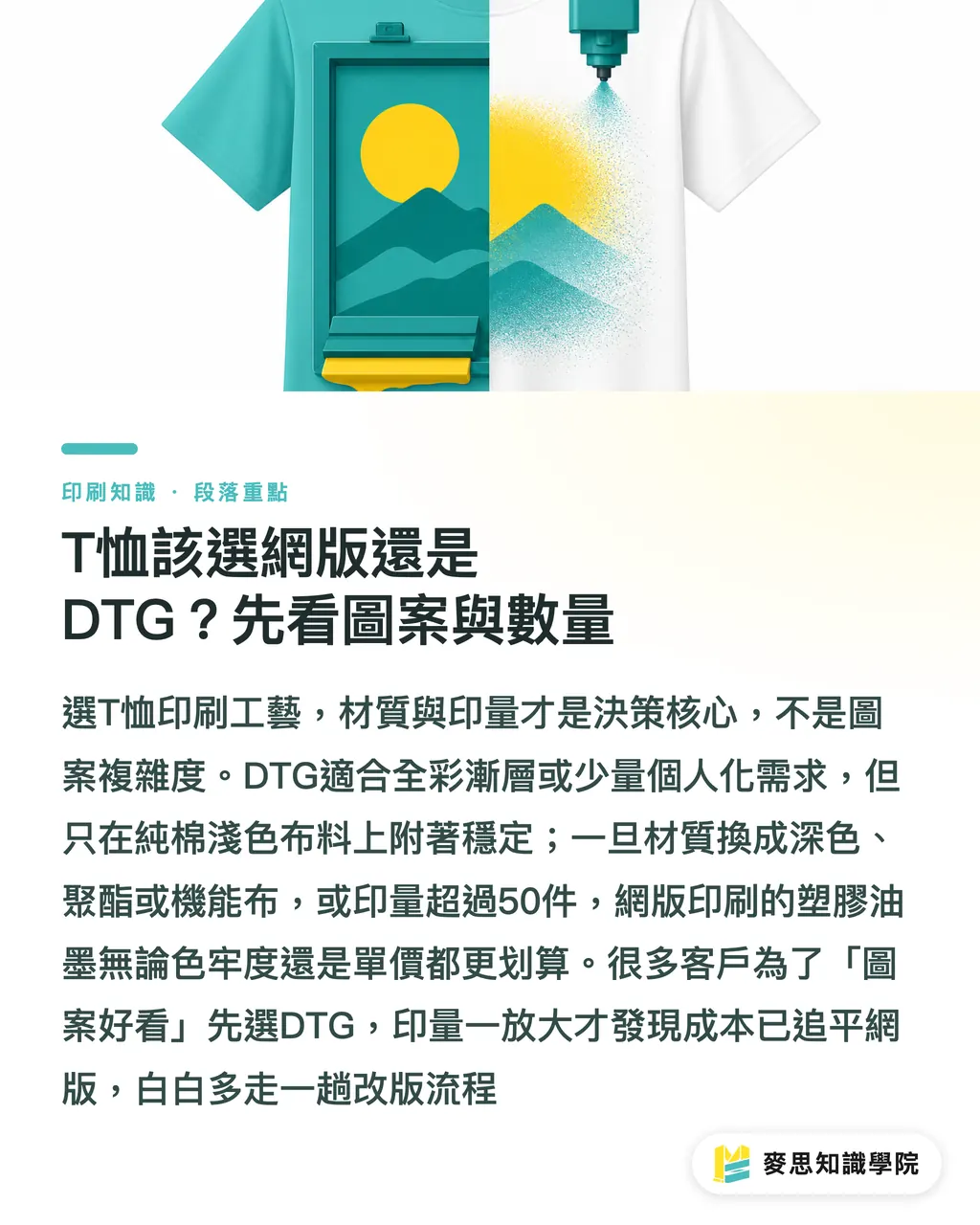
T-shirts are the most common piece of brand merchandise, and the question I hear most from clients is: 'My design is this complex, can't one DTG machine just handle it all?'
It's not that simple. The core limitation of DTG (Direct to Garment) is ink absorption. Plain cotton tees in light colors with a decent weight are DTG's home turf. Polyester, dark fabrics, waterproof coatings, and moisture-wicking performance fabrics? The water-based inks DTG sprays on these tend to bond poorly and fade. Screen printing's plastisol ink, on the other hand, forms a film on the fiber surface, a physical mechanism that actually holds better than DTG on these materials
In practice, the call is straightforward:
・Artwork is 1–3 colors, clean color blocks, 50+ pieces for an event or staff: screen printing is almost always the only answer, low per-unit cost, high color fastness, durable through washing
・Full-color gradients, photorealistic images, unique names or numbers on each piece, starting quantity of 1–20: DTG is the only way to handle it, you skip the screen-making fee for every color
・Material is light-colored 100% cotton: both DTG and screen printing work, depending on quantity
・Material is dark, polyester, or performance fabric: go straight to screen printing. DTG can lay down a white ink base first, but it's not worth it at low quantities, and at high quantities the color fastness still can't match plastisol
Quantity is the deciding factor here. I've watched too many clients on the production floor choose DTG for 'better-looking artwork,' only to find that once they reorder past 50 pieces, the per-unit cost matches or beats screen printing, at which point they switch to screen, and have to proof all over again
Tote Bags: Screen Printing Spot Colors Are the Workhorse
Tote bags are another classic case. Cotton canvas has coarse fibers, a flat surface, and moderate-to-strong ink absorption, material properties that have made screen printing the standard from the 1980s right up to now
Three reasons tote bags default to screen printing:
・Spot color accuracy: one screen per color, sharp color block edges. For something like a corporate logo that needs clean outlines, screen printing beats DTG every time
・Thick ink layer, abrasion-resistant: tote bags see daily use, friction, and washing. A thicker ink layer is what actually holds up over time
・Per-unit cost drops sharply at volume: eco-friendly cotton bags in Taiwan are largely produced by specialty bag factories in the central and southern regions. Starting from 100 pieces, blank bags run NT$80–150/piece; with printing, NT$150–250/piece is typical
When should you skip screen printing? Full-color photos, gradients, or unique numbering and names on every bag, that's where DTG or heat transfer comes in. Another common mistake: sending a polyester non-woven bag to a screen printer as if it were canvas. Ink adhesion will be poor and peeling is likely
Mugs Are Not Screen Printing Territory: UV Direct and Dye Sublimation Own This Space
A lot of clients hear 'print on mugs' and immediately think screen printing. But a mug is a cylindrical hard surface, traditional screen printing requires a specialized rotary screen press, and color registration on a round object is a headache. The process is complicated, and small runs don't pencil out
The two mainstream methods for mugs in Taiwan right now:
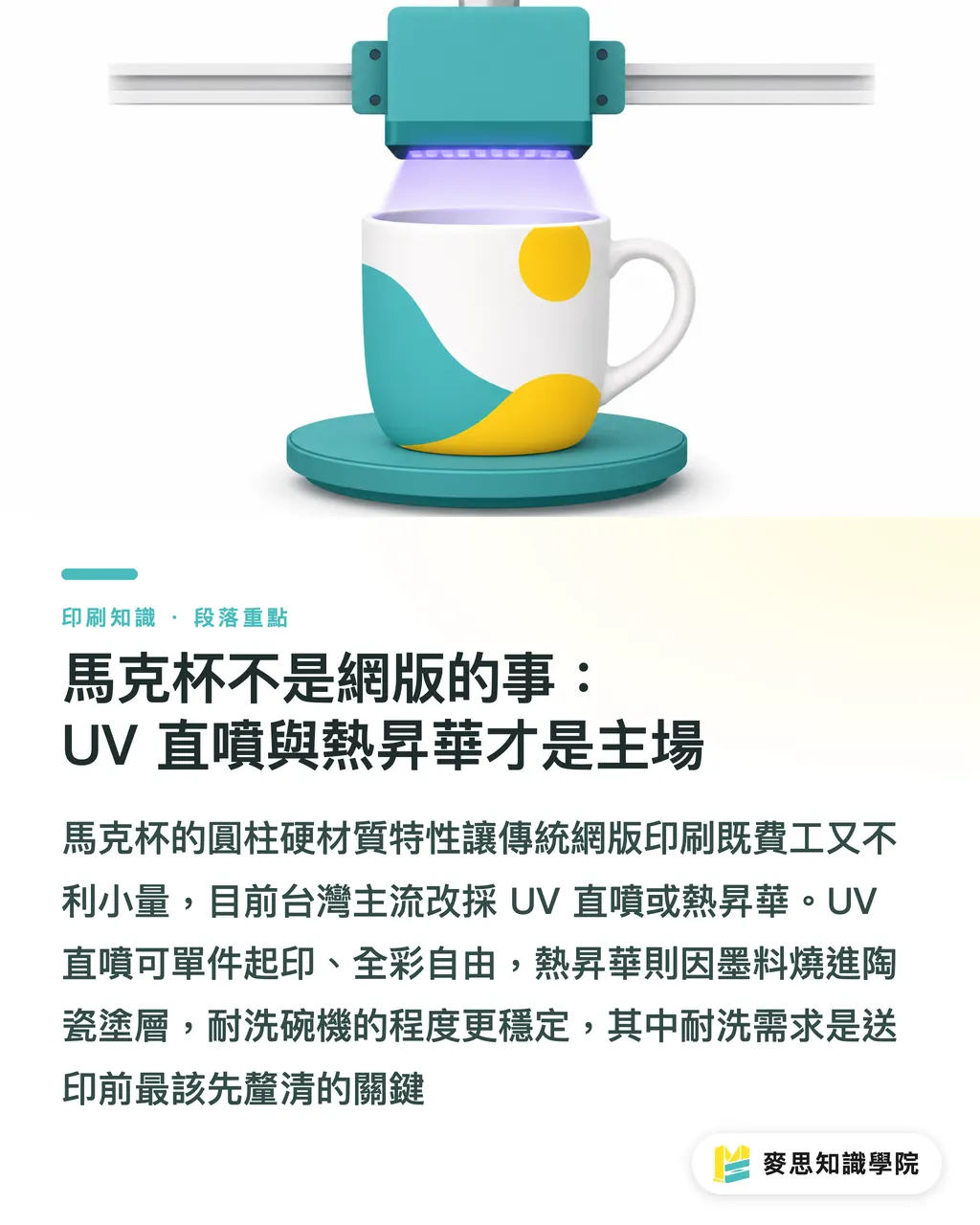
・UV direct: the print head sprays UV ink directly onto the mug surface and a UV lamp cures it on the spot. Works on ceramic, metal, glass, and other hard surfaces, full-color artwork, single-piece runs included
・Dye sublimation: sublimation ink is printed onto transfer paper, then high heat and pressure fire the ink into the ceramic coating. Colors are vivid, the surface feels smooth, and the industry widely agrees it holds up in a dishwasher better than UV direct
If your mug artwork is a single-color logo, you're ordering a lot, and budget is razor-thin, rotary screen printing still has a place. But for most brand merchandise situations, UV direct and dye sublimation are the modern choice. Before sending to print, get clarity on washability: UV direct's surface ink layer handles everyday hand washing fine, but the high-temperature steam in a dishwasher tends to cause peeling. Dye sublimation, because the ink is fired into the coating, holds up significantly better
Four Questions to Answer Before You Send to Print
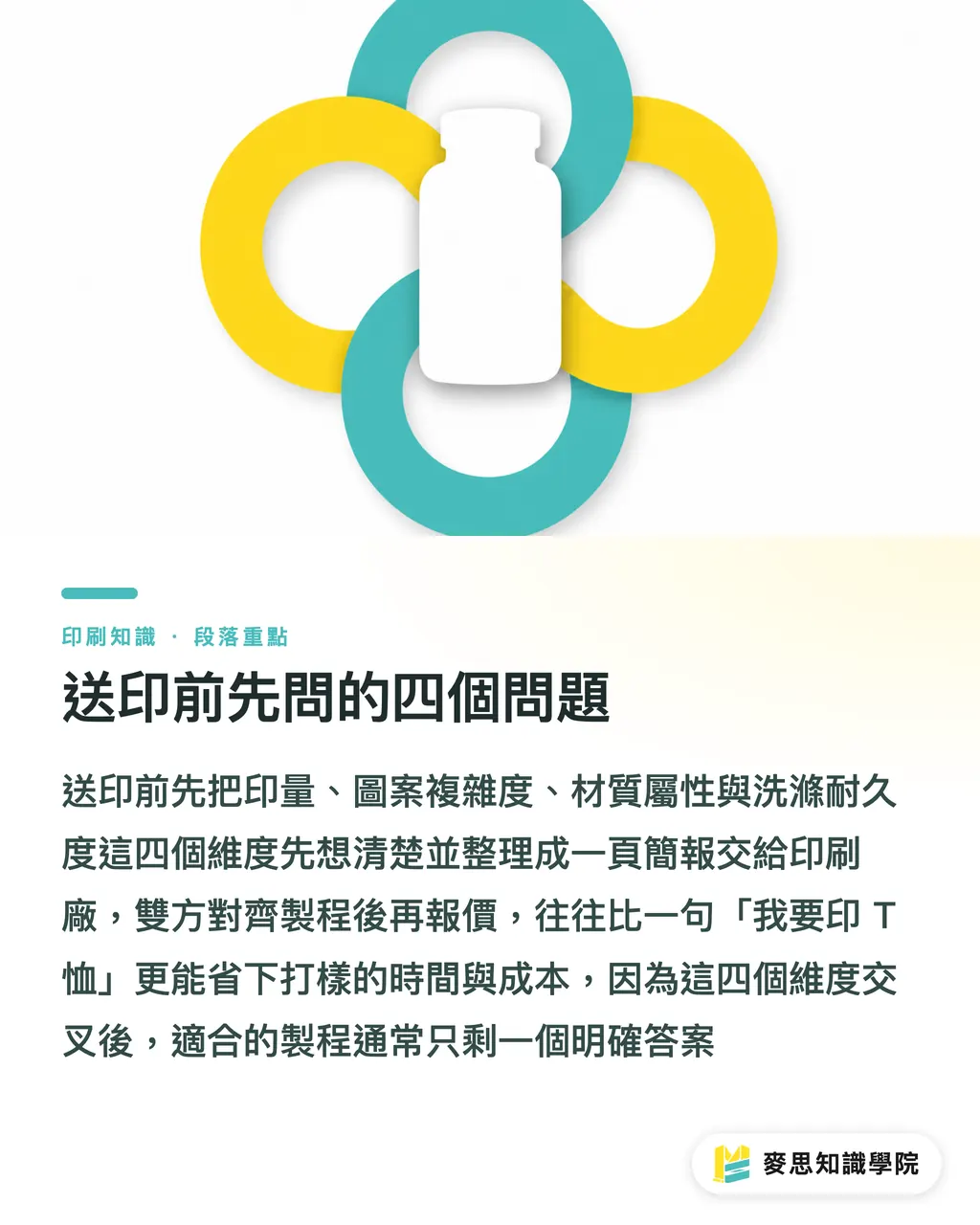
Pull the logic from those three product types and distill it into four questions procurement should ask before briefing a printer. Getting these right saves at least one round of proofing
・Quantity range: where does your total fall? 1–20 pieces, 20–100 pieces, or 100+? The economical process is completely different across these three brackets
・Artwork complexity: number of color blocks, gradients, photorealistic images, or unique codes per piece, these four tiers each point to a different process
・Material properties: cotton, polyester, canvas, ceramic, metal, every material has processes that work with it and processes that work against it
・Washability: hand wash only, machine washable, or dishwasher/industrial wash, three levels, each pointing to a different ink and process
Cross those four dimensions and you're usually left with one answer. This is the decision framework we've built at MINDS (MS, mid-to-high-end fully custom commercial printing) from working through merchandise jobs, the 'four-dimension method,' running quantity, artwork, material, and washability in sequence. Most jobs land on the right process in the first pass
In practice, I'd tell corporate procurement to write those four answers onto a single slide and hand it to the printer before the first brief. Align on process, then get the quote, beats saying 'I want T-shirts printed' every time. To understand how material properties determine process, see the article 'Why Screen Printing Works on Special Materials' at Mai Strategy Knowledge Academy and how it unpacks the handling logic for dark and transparent substrates
If your job is mid-to-high-end fully custom commercial printing with complex materials and quantities, go straight to MINDS (MS) at MINDS Official Website to get a quote. If you need standard merchandise at a lower price point with online ordering, MINDS Print (MYS) at MINDS Print Official Website is the faster path
Key Takeaways
・Quantity determines process: 50+ pieces with multi-color blocks, screen printing gets the unit cost down. Small runs or full color, DTG has the flexibility
・Material determines process: absorbent 100% cotton works with either method; polyester and dark fabrics need screen printing plastisol
・Mugs belong to UV direct and dye sublimation. Traditional screen printing only has a cost advantage there when volume is high and the design is simple
・Write down the four answers, quantity, artwork, material, washability, before briefing a printer, and you'll likely save a round of proofing
・Screen printing wins on ink layer thickness; digital direct wins on color range and flexibility. They don't replace each other, they split the work
Further Thinking
The takeaway for procurement and designers: turn 'I want merchandise printed' — a vague brief, into four concrete variables: material, artwork, quantity, and washability. Each variable narrows the possible process options to one or two, instead of going round-robin on every process type when you don't know what you need. That's the most time-wasting way to start a brief. For SaaS and the printing industry, the implication is the value of turning decision logic into a form: converting the judgment calls in a consultant's head into structured fields a client can fill out themselves. That's the foundation for future AI quoting and process recommendation systems
Further Reading
・Printing knowledge article: 'Screen Printing vs. Digital Direct-to-Garment for Merchandise: How to Choose for T-Shirts, Tote Bags, and Mugs' (original source outline)
FAQ
- Is screen printing more cost-effective for T-shirts above a certain quantity?
- Generally, for 50 or more pieces with a multi-color block design, screen printing can bring the per-unit cost down to half of DTG or lower. Under 50 pieces or for full-color gradients, DTG is the one that makes sense
- Can you use digital direct printing on canvas tote bags?
- You can, but the coarse-fiber surface of cotton canvas makes DTG colors look washed out and edges come out soft. For designs like corporate logos that need clean, sharp contours, screen printing spot colors are still the standard
- Why isn't screen printing used for mugs?
- Mugs are cylindrical hard surfaces. Traditional screen printing needs a specialized rotary press and color registration on a round form, making the process complicated. UV direct and dye sublimation are now the standard, both handle full-color artwork and single-piece runs
- How well do screen-printed T-shirts hold up in the wash?
- Plastisol screen-printed tees are widely recognized in the industry as more wash-resistant than DTG water-based inks. They can handle machine washing at 40–60°C for dozens of cycles, and once properly cured, can even go in the dryer
- How do you communicate with a printer to avoid choosing the wrong process?
- Before sending to print, write down the four answers, total quantity, number of colors in the artwork, material spec, and washability requirement, on one page and hand it to the printer along with your design file. It's far more efficient than describing everything verbally
Related articles
The Print × AI weekly
The print and AI know-how designers, brands and enterprises can use before they commit — one email, every week
MINDS Free Tools
Spine width and imposition calculators — skip the manual math, free in your browser.
MINDS Group
Need actual printing or gifting services?
From premium printing to online ordering and festive gifts — the MINDS Group sister brands take it from here.