
How should you design a sample kit so it is easy to mail?
To make a sample kit easy to mail, first use MINDS Printing (MS)'s three print-prep checkpoints to clarify "what question it needs to answer, which printed pieces it should include, and how replenishment will work." Then decide the outer bag or box size. Do not pick a beautiful package first and try to force the contents into it afterward
When I review B2B sample kits, the thing I worry about most is seeing three things mixed together: swatches placed randomly, catalogs that are too large, and cards with no clear order. After customers receive the kit, they struggle to find information, and when sales needs to send replacements, they have to rebuild the whole pack. This kind of sample kit can be mailed, but it is hard to use
Definition of a sample kit: a sample kit is a physical set that a company sends to potential customers. It usually includes color swatches, material samples, catalogs, cards, and quotation guidance, helping the recipient quickly judge texture, specifications, and the possibility of working together
In practice, I first ask sales teams three questions. These three questions determine cost earlier than the packaging appearance does
・Do customers most often ask about materials, sizes, or finishing effects?
・Does the sales team most often replenish swatches, samples, or single-sheet catalogs?
・After customers receive it, is the next step a quotation, a proof, or a meeting?
After these three questions are mapped out, the sample kit usually separates into three layers of content
・Layer 1: make it instantly clear what the company can do, such as one overview card or one slim catalog
・Layer 2: let customers feel the differences, such as color swatches, paper samples, finishing samples, or spot UV samples
・Layer 3: show customers the next step, such as a QR code quotation card, specification form card, or sales representative's business card
When the consulting team at Mai Strategy Knowledge Academy helps companies organize sample sets, we usually start with this "three-question checklist," because a sample kit is not a gift box. A sample kit is a tool for sales development
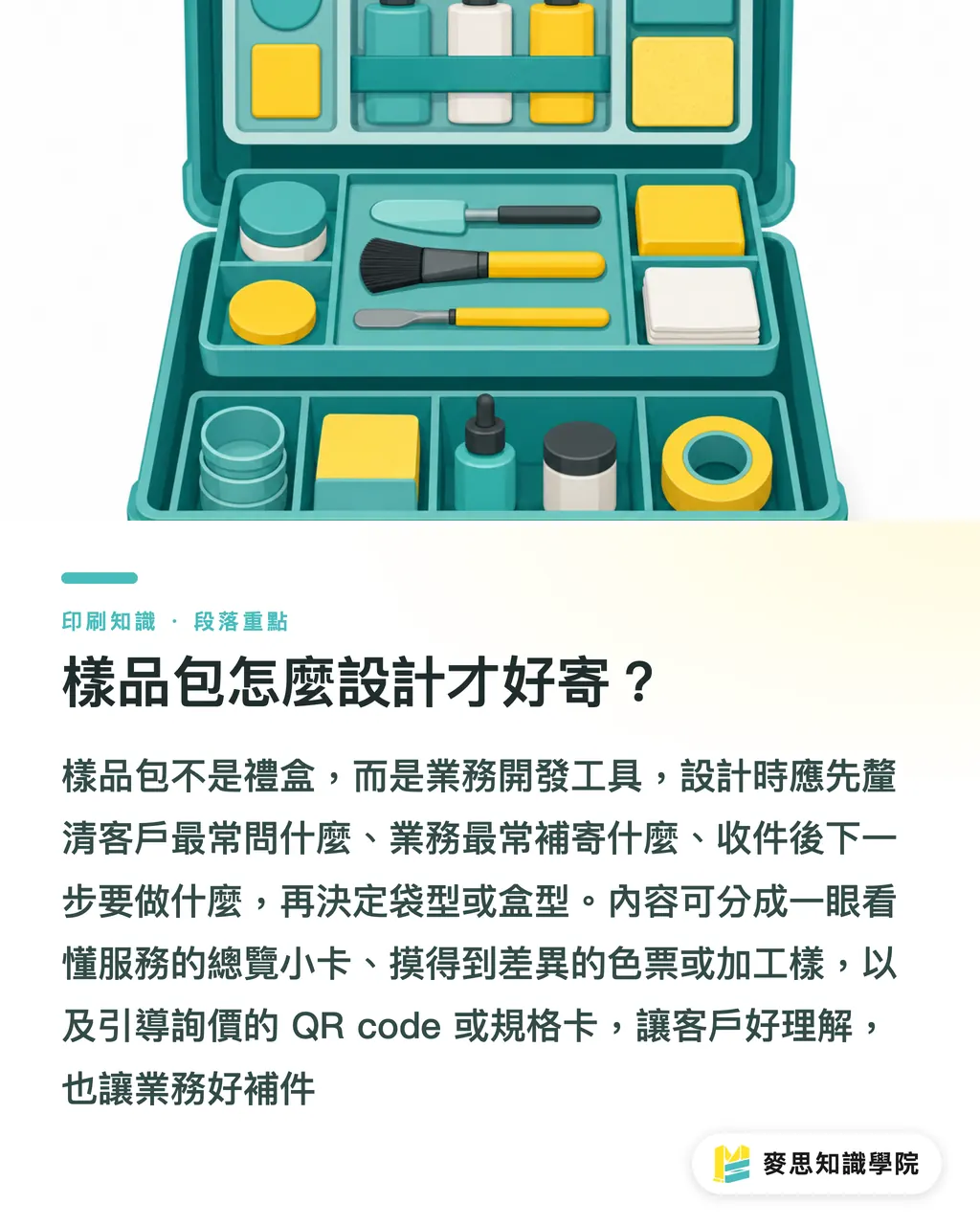
How should you determine the outer bag or box size?
For sample kit size, first look at the largest printed item, then check thickness and mailing method. If the largest item is an A4 catalog, the outer bag must at least fit content measuring 210 × 297 mm, with extra room for easy removal. If you switch to an A5 or DL compact catalog, mailing cost and deformation risk are usually much easier to control
My own judgment is direct: if an A5 format can explain the sales sample clearly, do not force it into A4. A4 looks complete, but once you add swatches, samples, and a protective board, both thickness and weight increase, and the corners are more likely to be crushed during shipping
Common outer packaging can be selected this way
・Folder: easier to control cost, suitable for holding 5 to 10 single-page sheets, and easy to replenish. The downside is that thick samples can bulge, and the corners need reinforcement for mailing
・Envelope: best for lightweight mailing, suitable for cards, slim catalogs, and swatch cards. The downside is limited perceived quality, and the content order can shift during transport
・Drawer box: offers the best unboxing experience, suitable for premium materials, boutique printing, and special finishing samples. The downside is higher cost and volume, and even replacing one swatch may require opening the whole box
・Belly band packaging: best for sample sets that need repeated replenishment, suitable for mixing swatches, paper samples, and booklets. The downside is insufficient outer protection, so it usually needs to be paired with an outer bag or paper box
A simple sizing method is to stack the contents to the actual thickness that will be mailed, then add 3 to 5 mm of working space. A box that fits too tightly may look good in the office, but on the logistics route, the opening and corners are tested first
How should the contents be sequenced so customers can understand them?
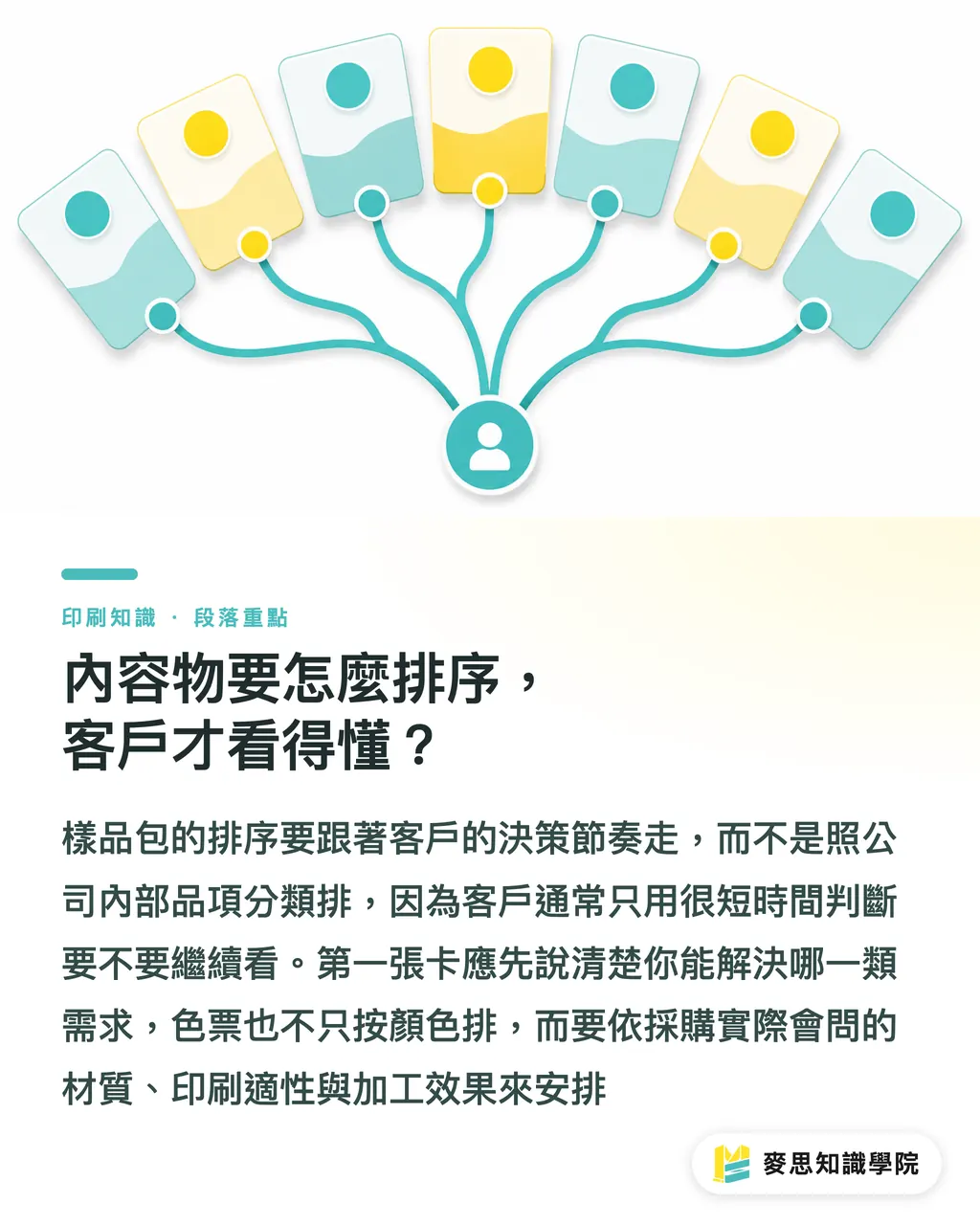
The content sequence of a sample kit should follow the customer's decision-making order, not the company's internal product categories. After receiving it, customers are usually only willing to spend 30 seconds deciding whether to keep looking, so the first card must answer: "What kind of need can you solve for me?"
I organize the contents into four actions
・Look first: a cover card or overview card that clearly explains 3 to 5 main services or material directions
・Touch next: color swatches, paper samples, and finishing samples that let customers compare weight, texture, matte finish, and gloss by hand
・Choose next: a catalog or case card that helps customers match their needs to similar products
・Contact next: a quotation card, specification sheet, business card, or QR code so the sales team can follow up smoothly
There is a small detail that industry insiders often overlook: color swatches should not be arranged only by color. They should also be arranged according to "how procurement will ask questions." For example, packaging box customers often ask about white card, coated duplex board, kraft paper, and gray-back white board. Designers often ask about printability, foil stamping effects, and whether fold lines will crack. These two sequencing methods turn the same set of swatches into different tools
If the sample kit is for cold outreach, I put the most reliable core samples at the front. If it is for a high-value proposal, I put the sample that best shows craftsmanship differences at the front. This is not an aesthetics issue. It is a sales pacing issue
What should you watch for in mailing protection and weight control?
A mailed sample kit needs to protect four positions: corners, edges, openings, and sample surfaces. If even one of these areas is not handled, and the customer sees bent corners, scratches, or scattered contents on arrival, even the most beautiful design loses points
I usually use five checkpoints to assess shipping risk
・Can the outer layer resist pressure? If thick swatches are placed in a thin envelope, the corners can easily leave crease marks
・Will the contents slide around? When catalogs, cards, and swatches differ greatly in size, use a belly band, divider, or inner bag to secure them
・Will surfaces scratch each other? When spot gloss, matte lamination, and foil-stamped samples are mixed together, it is best to add tissue paper or divider cards between them
・Will the opening loosen? Drawer boxes, tuck-end boxes, and envelopes should all be shake-tested to see whether they open
・Does the weight fit the mailing budget? If the same sample kit changes from one catalog to one catalog plus six thick cards, postage and packaging materials will both increase
Weight control does not mean putting in fewer and fewer things. It means keeping the items that customers absolutely need to touch. Take swatches as an example: putting in all 10 cards looks abundant, but if sales is most often asked about 3 paper materials and 2 finishing methods, then 5 key samples plus 1 complete swatch request card may be easier to mail and easier to replenish
When MINDS Printing (MS) handles mid- to high-end fully customized commercial printing, I advise customers to separate the mailing version from the proposal version. The mailing version controls weight and impact resistance, while the proposal version presents the full range of craftsmanship. Do not force both purposes into the same box
How should a sample kit be designed so it is easy to replenish?
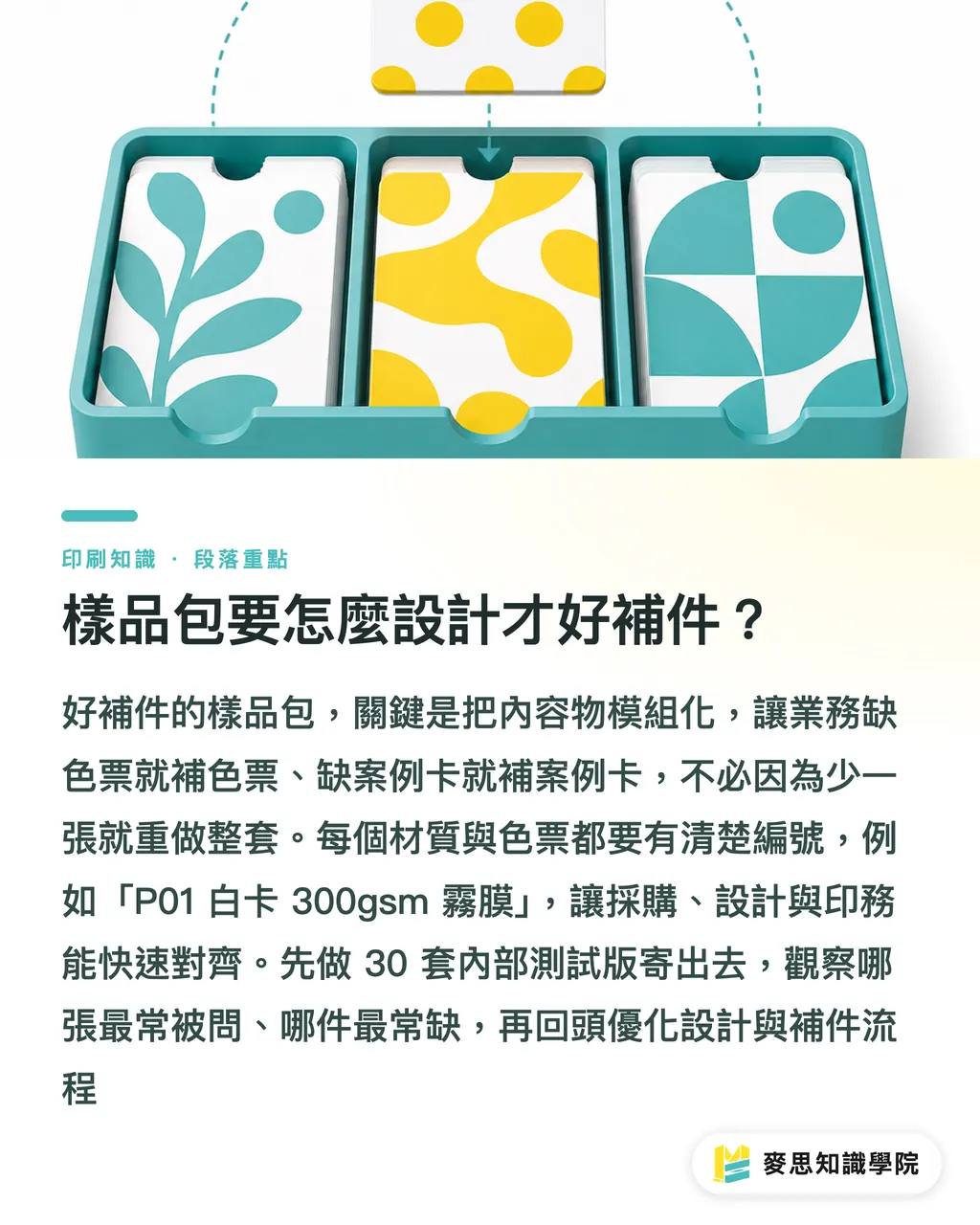
A sample kit that is easy to replenish needs modular contents. If sales is missing swatches, replenish swatches. If they are missing case cards, replenish case cards. Do not remake the entire package every time only one card is missing
For sample sets that can be mass-produced, I split them into four modules
・Fixed module: company introduction card, service overview, and standard contact card, identical in every batch
・Product module: different catalogs based on industry, such as food packaging, skincare paper boxes, and commercial printing
・Material module: paper samples, color swatches, films, and specialty papers, each with a clear number
・Action module: quotation card, specification form card, and QR code, preferably with consistent card sizes
Numbering is important. If a swatch only says "matte white card," sales can easily pick the wrong item when replenishing it. If it is labeled in a format such as "P01 White Card 300gsm Matte Lamination," procurement, design, and print production will need far fewer back-and-forth confirmations. The numbering can be very plain, but it cannot be missing
If a company already has a CRM, SaaS quotation system, or internal sample management sheet, the QR code on the sample kit can point to the corresponding form. AI applications can also start here. There is no need to build a large system at the beginning. If sales can take a photo or enter a number and quickly find specifications, inventory, and replenishment records, that is already very practical
My advice to small and midsize companies is to first make 30 internal test sets. Have 3 salespeople each mail 10 sets, then record which card gets the most questions, which item runs out most often, and which outer bag wrinkles most easily. Improving print design is often not about holding one more meeting. It is about actually mailing the samples
Key Takeaways
・A sample kit should first answer the 3 types of information that sales is most often asked about, then address the outer bag, box structure, and unboxing experience
・An A4 catalog feels complete, but an A5 or compact kit is often easier to mail, easier to replenish, and less prone to damage
・Swatch sequencing should follow the customer's decision process, not only the company's internal categories
・A good sample kit can always be broken into modules. If one card is missing, replace that one card without remaking the full set
・The mailing version and proposal version are best kept separate. The former handles weight and protection, while the latter handles texture and craftsmanship presentation
Further Thoughts
Sample kit design involves print manufacturing, graphic design, sales development, and SaaS management. The most practical next step is to organize content numbers, sizes, weights, and replenishment rules into one table. Designers use this table for layout, printers use it to estimate paper and finishing, and sales teams use it to track customer responses. If AI or a sample management system is introduced later, it can start from these clean fields instead of becoming a pile of beautiful samples with specifications that no one can look up
FAQ
- Does a B2B sample kit always need to be a box?
- Not necessarily. If the contents are mainly catalogs, cards, and thin swatches, a folder or envelope is usually easier to mail. If you need to showcase premium materials or special finishing, a drawer box becomes more necessary
- How many types of printed pieces should go into a sample kit?
- Start with 3 categories: an overview card, touchable materials or swatches, and a next-step quotation card. If you include too many catalogs and samples at the beginning, customers may struggle to see the priorities, and replenishment will become more troublesome for sales
- Which should go first, swatches or the catalog?
- For cold outreach, usually place the overview card first, followed by swatches and the catalog. For high-value proposals, you can place the most representative craftsmanship sample first. The order should match the customer's decision-making sequence, not the company's product categories
- How can a sample kit avoid bent corners during mailing?
- The outer layer needs to protect corners, edges, openings, and surfaces, and thick cards should not be loosely mixed with thin paper. If the contents vary greatly in size, add a belly band, inner bag, divider, or protective board to secure them
- How many sample kits should a small or midsize company print the first time?
- Start with 30 test sets and have the sales team actually mail them out and record responses. Once you confirm which cards are asked about most often and which items need replenishment most frequently, moving into formal mass production will be more stable
Related articles

The Print × AI weekly
The print and AI know-how designers, brands and enterprises can use before they commit — one email, every week
MINDS Free Tools
AI background removal, a LINE sticker maker, spine & imposition calculators — all free, right in your browser, no upload.
MINDS Group
Need actual printing or gifting services?
From premium printing to online ordering and festive gifts — the MINDS Group sister brands take it from here.