

Introduction: A Piece of Equipment Put in the Wrong Spotlight
Screen printing on corrugated board has long been filed under postpress in the trade, a process running from stencil preparation, emulsion coating, exposure, developing, printing, drying, through to finishing. In most introductory Chinese- and English-language write-ups, the term "washout booth" is treated as effectively synonymous with developing, and is assumed to be essential infrastructure on any screen printing line. That assumption does not necessarily hold up against the realities of working with corrugated board
Taiwan's design-and-print industry is dominated by small and mid-sized printers. Under the Ministry of Economic Affairs' industrial product classification, most operators sit with paid-in capital in the tens of millions to roughly one hundred million New Taiwan dollars, and marginal equipment decisions routinely shape line configuration [1]. The question that drives this study comes out of that context: when a printer steps into corrugated screen printing and lifts the washout booth layout from flat substrates such as posters, fabric, or stickers and drops it in unchanged, does that actually misallocate capital and add redundant steps? Working from shop-floor records and process physics, this article analyzes how that fallacy takes shape and lays out a judgment logic that re-derives the equipment list from the process
The article contributes four things: (1) a systematic comparison of corrugated versus flat substrates at the developing/washout step, clarifying what the washout booth actually does on different lines; (2) a structural unpacking of why the "washout booth equals process core" myth persists; (3) a framework that starts from process steps rather than equipment categories; (4) concrete recommendations for equipment investment and process design aimed at small and mid-sized Taiwanese printers
Literature and Current Practice: Structure and Gaps in the Existing Conversation
The washout booth as standard kit in screen printing discourse
The developing step in screen printing relies on water to wash away unhardened emulsion so that image areas of the mesh open up. To house that step, plenty of training material and vendor manuals list the washout booth, an enclosed work area with supply and drain lines, spray or high-pressure wash, as standard kit. That line of thinking comes mainly from apparel printing, wide-format graphics, and fine-art practice, where the substrates are paper, textiles, and plastic film, and where water volume, developing time, and drying behavior are comparatively settled. The booth, in those settings, tends to be presented as a standardized module
The extension of that discourse, treating the washout booth as a universal standard, has not been systematically tested when the substrate switches to corrugated board. This article treats that untested extension as the main gap in existing discussion, and as the entry point for the argument
Process characteristics of screen printing on corrugated board
Discussion of corrugated screen printing tends to zero in on ink-film thickness, color reproduction, and ink-trapping. Corrugated board is built up of a liner, a flute, and an inner liner (or multiples of these layers), and under pressure and ink it behaves very differently from a single ply of paper; its surface is less flat, and its ink absorption is shaped by the flute geometry. To get saturation and a tactile ink film, screen printing on corrugated usually needs a heavier ink deposit, which pushes makers toward lower mesh counts and high-solids inks, and that in turn drives up emulsion coating thickness and the developing load
Developing on corrugated board therefore has several characteristics that diverge from flat substrates: water volume rises with screen size and emulsion thickness; drying time is affected by the absorbency and breathability of the fluted structure; and wastewater handling has to plan more carefully for solids-liquid separation because of ink and emulsion residue. These points are mostly scattered across the literature, and an integrated set of process-design guidelines has not yet been put together. This article treats that as a further gap
Existing work on equipment investment frameworks
Work on equipment investment in small and mid-sized manufacturing tends to stress payback period, capacity fit, and flexible production. In the Taiwanese print industry context, operators regularly face trade-offs between multi-purpose and single-purpose machines, and between in-housing a process and outsourcing it. The specific decision around the washout booth, however, gets surprisingly little airtime; most treatments presume it is "required" rather than "optional," which clashes with hands-on experience on corrugated board. This article identifies that structural presumption, and the room to revise it, as the practical contribution of the study
Core Analysis 1: What the Washout Booth Actually Does
The washout booth's role in a screen printing workflow breaks down into three layers:
・First, a physical space for developing, housing the wash equipment, supply and drain lines, and wastewater holding
・Second, a visualization aid, letting the operator see developing progress directly and adjust water pressure and angle on the fly
・Third, a contamination buffer within the line, keeping developing wastewater away from ink and the print area. Of those three, the first is a process requirement, and the latter two are auxiliary
This article argues that the fallacy of treating the washout booth as the process backbone comes from mistaking auxiliary functions for core ones. In corrugated screen printing, the developing step itself can be carried out in any work area with basic supply and drain; the water volume, pressure, and wastewater handling it needs are tied to process design first, and only loosely to the equipment category. Put differently, the washout booth is one way of realizing the developing step, not a precondition for it
That view sits in contrast with how most teaching material frames it. The article pins the difference on approach: the teaching materials usually start from equipment ("you need a washout booth to do screen printing"), whereas the process-led approach starts from the step itself ("you need to complete developing; the washout booth is one way to do it")
Core Analysis 2: Process Specifics of Developing and Drainage on Corrugated
The process specifics of screen developing on corrugated board can be unpacked along three axes
First, emulsion thickness and developing load. To support heavier ink films, corrugated screen work tends to use thicker emulsion coatings, which increases the volume of unhardened emulsion that has to be washed out. That increase is not linear: past a certain thickness, unhardened emulsion sticks more stubbornly, and the water pressure and time needed to clear it climb with it. This article argues that this non-linearity makes pressure stability more important on corrugated than on typical flat substrates, and that a booth's standardized pressure setting may not be enough on its own
Second, drying and drainage are coupled. The fluted medium in corrugated board is highly breathable and absorbent, which changes how the screen dries after developing. On one hand, breathability helps water evaporate; on the other, absorbency pulls water into the flutes, lengthening the time to full dryness and raising the risk of distortion while the screen dries. That coupling means drying planning after developing has to integrate drainage design from the developing step, rather than treating the two as separate
Third, wastewater and environmental compliance. Spent emulsion solution falls under industrial wastewater management in Taiwan, and discharge and treatment are governed by the relevant environmental rules. The volume and concentration of wastewater from corrugated developing are set directly by how the step is designed; get that wrong and treatment cost quietly turns into an operating burden. This article argues that compliance cost should be priced into the equipment investment decision from the start, not bolted on afterwards
Core Analysis 3: Re-deriving the Equipment List from the Process
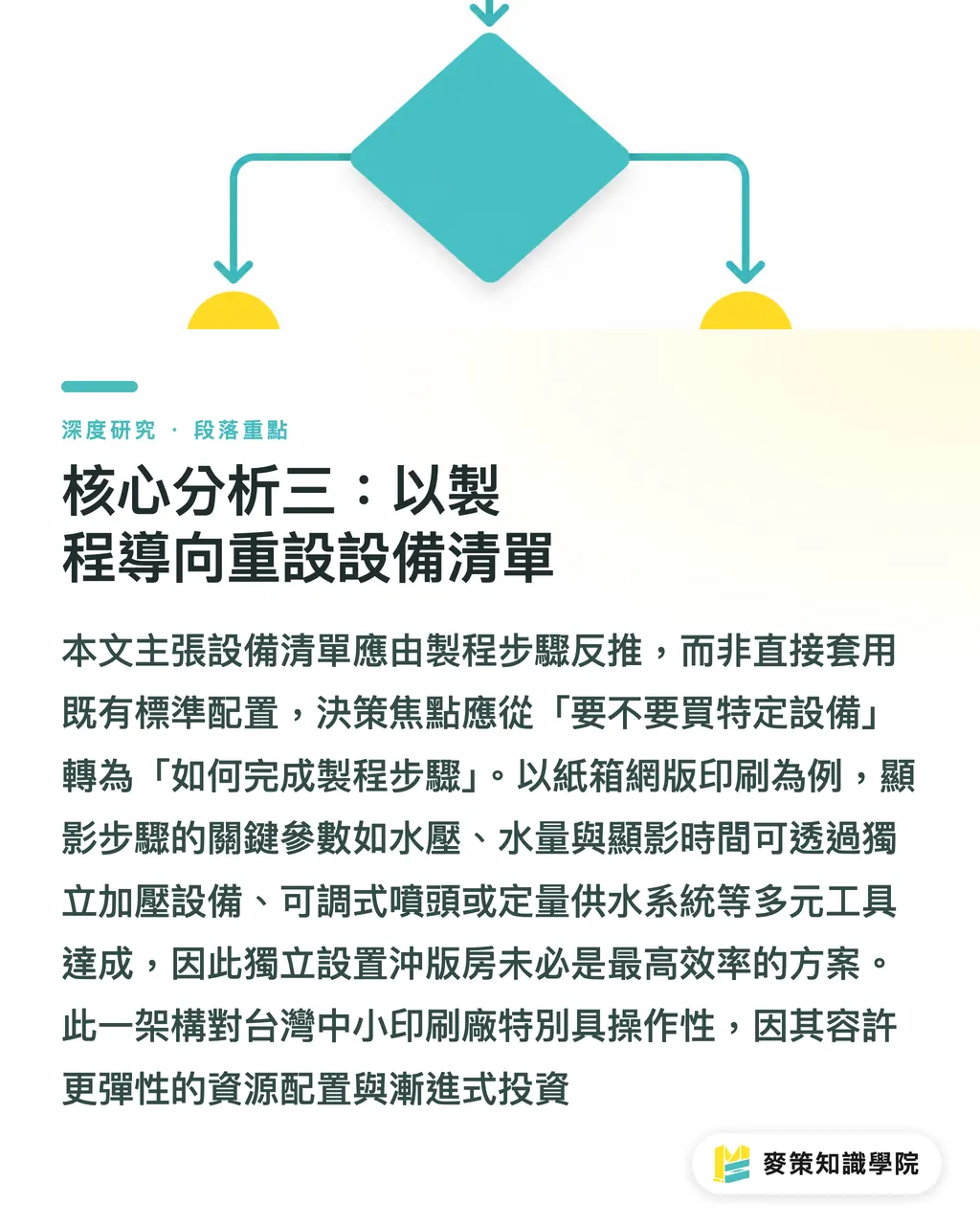
Based on the analysis above, this article proposes a process-led equipment list framework. Its core idea: the equipment list should be reverse-engineered from the process steps, not lifted from a standard equipment template. The framework has three layers
Layer one is process-step mapping: lay out every required process step explicitly, and for each one note its inputs (materials, energy, information), outputs (product, waste), and key control parameters (temperature, pressure, time, concentration, and so on). In the corrugated screen printing case, the key parameters at the developing step include water pressure, water volume, water temperature, developing time, and emulsion clearance rate
Layer two is functional requirement definition: for each key parameter, define an acceptable range and the control tools needed to hold it. Water-pressure stability, for instance, can be achieved with an independent booster, an adjustable nozzle, or a metered supply system. Working at this layer pulls equipment selection back to functional need, away from equipment category
Layer three is equipment selection and integration: only once functional requirements are defined does equipment selection have a fair basis for comparison. At this layer, whether the washout booth is worth it comes down to whether it satisfies functional requirements more efficiently than alternatives. This article argues that, at typical corrugated screen printing scale, a dedicated booth is often not the most efficient option; a work area with basic supply and drain, paired with adjustable wash tools, will usually cover the process need
The practical meaning of the framework: it shifts the decision from "should I buy a washout booth" to "how do I get the developing step done." The first is equipment-led; the second is process-led. This article argues that the second framing is more workable for small and mid-sized Taiwanese printers, because it allows more flexible resource allocation and incremental investment
Implications for Taiwan's Design and Print Industry
For small and mid-sized printers, the implication is a structural shift in how equipment investment is decided. At the evaluation stage, the recommendation is to start from the process steps, draw the flow, mark each key parameter, derive functional requirements from those, and only then move to equipment selection. Reordering the sequence like this avoids the misallocation that comes from assuming a standardized equipment template, and helps put capital where it actually pays off
For designers and brand teams, the implication is a deeper grasp of corrugated screen processes. Design should take on board the downstream realities of developing, drying, and wastewater handling during artwork prep, and align with the print side on those points. Heavy ink-film looks great on screen, but it drives up developing load and drying time, which then hit schedule and cost. Pulling that causal chain into the design decision cuts down on last-minute process adjustments and re-work on press
For brand procurement and project management, understanding that the washout booth and similar kit are not strictly necessary makes it easier to read a quote accurately. When a quote carries a fixed-cost share for the washout booth, procurement can push back on its functional role and alternatives, and negotiate a package that fits actual need
Conclusion and Limitations
This study takes the developing/washout step in corrugated screen printing as its entry point and argues that the washout booth should sit in an auxiliary role rather than a core one, and proposes a decision framework that re-derives the equipment list from the process. The main conclusion: whether to install a washout booth should be decided by going back to the functional needs of the developing step, not by copying a standard layout from a different substrate
The limitations of this study are as follows:
・First, the primary hands-on source is a single video record; there is no systematic cross-plant, cross-scale empirical data behind it, so the inference boundary on some conclusions is limited to the setting and conditions that video reveals
・Second, the wastewater cost analysis stays at a conceptual level and does not cite specific regulatory clauses or quantify cost; for real quotes and compliance review, separate verification is needed
・Third, the process-led framework is logically coherent, but its fit across different scales and product mixes still needs to be validated through further practice
Future directions: (1) run an empirical survey of developing/washout practice across a sample of small and mid-sized Taiwanese printers, and build a database linking process parameters to equipment configuration; (2) extend the process-led framework to other postpress steps and test how generalizable it is, and what it needs to adjust; (3) bring in life cycle assessment to quantify the environmental and cost externalities of different equipment configurations, as a basis for sustainability-led equipment investment decisions

Key Takeaways
The washout booth is one way of realizing the developing step, not a precondition for it
Corrugated board has three process specifics at the developing/washout step: thicker emulsion, coupled drying and drainage, and stricter wastewater compliance
Equipment investment decisions should reverse-engineer the equipment list from process steps, not copy a standardized equipment template
Wastewater compliance cost belongs inside the equipment investment evaluation, not as an afterthought
Aligning design and print on process realities cuts down on last-minute adjustments and re-work at developing and drying
Further Thoughts
For print manufacturers, the study points to a shift from equipment-led to process-led equipment investment as a way to reduce misallocation and improve capital efficiency. For designers, understanding downstream realities like developing and drainage lets artwork decisions line up with process limits, cutting re-work and schedule risk. On the AI side, the structured exercise of mapping process parameters and defining functional requirements is exactly where AI-assisted decision systems can add value, for example taking process steps as input and producing an equipment shortlist or a payback simulation. On the SaaS side, the process-led equipment list framework is modular by nature and has potential to grow into a process design and equipment evaluation tool for small and mid-sized printers. Open questions include: how to calibrate the framework's parameter thresholds across different scales and product mixes, and how to bring regulatory compliance cost systematically into the economic evaluation of equipment investment
References
[2] Netz E. (1998). Washboarding and print quality of corrugated board. Packaging Technology and Science. DOI: 10.1002/(SICI)1099-1522(199807/08)11:4<145::AID-PTS426>3.3.CO;2-Y
[3] Partridge S. (1987). The Role of the Stencil in High Definition Screen Printing. Circuit World. DOI: 10.1108/eb043860
FAQ
- Is a washout booth essential for corrugated screen printing?
- No. The washout booth is one way of realizing the developing step, not a precondition. A work area with basic supply and drain, paired with adjustable wash tools, usually covers the process need
- How does corrugated screen developing differ from developing on flat substrates?
- The main differences are heavier emulsion demand, drying and drainage coupled by the fluted structure, and stricter wastewater compliance. These three make a standardized booth layout hard to drop in unchanged
- Why not just copy the standard washout booth setup from other substrates?
- That standard comes out of apparel printing, wide-format graphics, and similar work on single-ply paper or textiles, where water volume, drying time, and wastewater behavior are different from corrugated board. Copying it straight across tends to misallocate capital and add redundant steps
- Where should a small or mid-sized printer start when evaluating corrugated screen equipment?
- Start by mapping the process steps: list every required step and its key parameters, then define functional requirements from those, and only then move to equipment selection. That sequence keeps the decision from being driven by equipment category
- What can the design side do about developing and drainage?
- Design should pick up the downstream realities of developing, drying, and wastewater handling at the artwork stage, and align with the print side on process. For instance, a heavy ink-film design has to be weighed against its impact on developing load and drying time
Related articles

The Print × AI weekly
The print and AI know-how designers, brands and enterprises can use before they commit — one email, every week
MINDS Free Tools
Spine width and imposition calculators — skip the manual math, free in your browser.
MINDS Group
Need actual printing or gifting services?
From premium printing to online ordering and festive gifts — the MINDS Group sister brands take it from here.