

Introduction
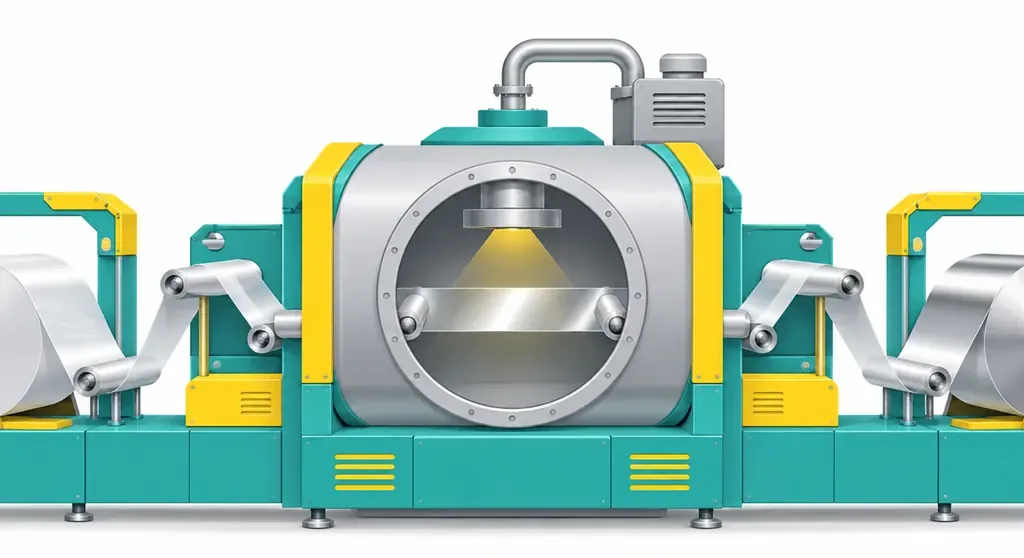
Automation in vacuum metallizing is shifting from a question of choosing individual machines to a starting point for reconfiguring the entire flexible packaging line. Vacuum metallizing is a process that deposits an extremely thin layer of aluminum onto PET, PP, or increasingly, PE-based films in a vacuum. This tiny amount of metal can greatly improve a film's barrier properties against oxygen, moisture, and light without adding the weight and thickness of aluminum foil [1]. Products such as snacks, confectionery, coffee, and powdered foods rely on vacuum metallizing to extend shelf life, maintain quality, and reduce food waste [1]
The technology matters because it sits at a key point in the flexible packaging value chain. The barrier performance of metallized film directly determines the specifications available for subsequent printing, lamination, bag making, and filling. Any change to the metallizing process therefore carries upstream to substrate selection and downstream to converting conditions
There is a specific gap in existing discussions. Equipment makers tend to focus on how automation can reduce reliance on skilled operators and improve quality consistency on individual machines [1]. Cross-industry research on automation adoption, meanwhile, examines the costs, skills, and inclusion barriers that shape technology diffusion [2]. Both strands give limited attention to one question: when the metallizing process itself becomes automated, how should the packaging line's integration logic change, and what does that mean for an industry made up largely of small and medium-sized enterprises?
This article makes three contributions, each addressed in a section of the main text:
・First, it reframes the drivers of metallizing automation as a problem of "codifying process knowledge" and explains how that relates to labor shortages (see "Analysis 1")
・Second, it shows how mono-material regulations and heat-sensitive substrates make metallizing a point where upstream and downstream specifications meet, rather than an isolated process (see "Analysis 2")
・Third, it proposes a "three-layer model for metallizing integration" covering equipment, process knowledge, and production line systems. The model provides a framework for evaluating automation investments and is applied to the practical implications for Taiwan's small and medium-sized printing firms, designers, and brand owners (see "Analysis 3" and "Implications for Taiwan's Design and Printing Industries")
This topic matters to Taiwan because its flexible packaging supply chain consists largely of small and medium-sized converters serving domestic food brands and export customers. Sustainability regulations faced by export customers pass through material specifications to Taiwan's metallizing and finishing operations. This article argues that this shift will happen faster than most companies can update their equipment
Definitions and Scope
This section defines the key terms and then explains the scope of the study. "Vacuum metallizing automation" refers to the use of sensors, controls, and software to perform or assist with parameter setting, evaporation monitoring, coating quality assessment, and process adjustment. Skilled operators have traditionally handled these four tasks [1], so this article uses them as its measures of automation
"Production line integration" refers to the coordination of specifications, data exchange, and quality responsibilities between metallizing and upstream substrate supply, downstream printing, lamination, and bag making. This definition deliberately excludes general-purpose factory management system adoption, keeping the focus on integration issues arising from the metallizing process
The study focuses on flexible packaging. It does not cover paper metallizing, metallized transfer paper, or decorative hot foil stamping. Although these applications also involve metallized surface treatments, their barrier requirements and production line structures differ, so any conclusions drawn from them should be treated with caution
Literature and Industry Review
This section groups existing material into four topics: process technology, labor and knowledge, regulations and materials, and cross-industry automation adoption. Each group ends by explaining its connection to, or difference from, this article's analysis
Process technology: Metallizing as an enabling technology for barrier performance. This body of commentary presents vacuum metallizing as a core enabling technology for high-performance flexible packaging for decades. Its value lies in achieving barrier performance close to that of aluminum foil with very little metal [1]. The commentary also notes that substrates are expanding beyond PET and PP to include PE-based films [1]. This literature establishes metallizing's technical importance, but it generally treats the individual process as the unit of analysis. This article widens the frame to include the interfaces between metallizing and upstream and downstream operations
Labor and knowledge: Shortages of skilled operators and loss of expertise. Bobst reports that 95% of companies across the broader packaging industry have difficulty recruiting skilled operators and technicians [1]. It also stresses that experienced metallizing operators take years to train, and that when they retire or leave, companies lose decades of accumulated technical knowledge [1]. This article separates the labor problem into recruitment and knowledge retention, and argues that retained knowledge should be organized into transferable process specifications
Regulations and materials: The shift to recyclable, mono-material packaging. The same source says the packaging industry is moving toward more recyclable, mono-material flexible packaging, against the backdrop of the European Union's packaging and packaging waste regulations [1]. It also notes that newer sustainable substrates are more heat-sensitive while barrier requirements are rising [1]. This article goes a step further: regulation not only drives metallizing automation, it also reshapes how specification responsibilities are divided between upstream and downstream operations
Cross-industry automation adoption: Inclusion and barriers to diffusion. A Food and Agriculture Organization of the United Nations report examines how automation can spread inclusively in agriculture, with a focus on the barriers small-scale operators face when adopting new technology [2]. Agriculture is a different field from packaging, so this article borrows only the report's perspective on "uneven technology diffusion" and does not directly apply its conclusions to printing and packaging. The connection is that Taiwan's flexible packaging industry, with its many small and medium-sized firms, may face a similar risk of automation benefits accruing mainly to larger players
What existing discussions leave unresolved. Taken together, these four groups of material point to broad agreement on why automation is needed: labor shortages, regulation, and material complexity [1]. But there is still little systematic analysis of how production lines should be reintegrated after automation, or how smaller companies can take part. The following sections examine how production line integration could work and how smaller companies might participate

Analysis 1: From Operator Craft to Codified Process Knowledge
The heart of metallizing automation is turning judgments that once lived in an operator's experience into specifications that machines can follow and organizations can preserve. Traditional metallizing relies on skilled operators to set film and process parameters, visually monitor aluminum evaporation, assess coating quality, and keep adjusting the process [1]. At least three of these four tasks involve assessment and adjustment, rather than simple machine operation
This article argues that the nature of these tasks explains why labor shortages are particularly severe in metallizing. If operators mainly pressed buttons and moved materials, companies could fill a labor gap quickly by training newcomers. But a metallizing operator's value lies in making real-time assessments, a skill that takes years to build [1] and cannot be replaced with short-term training
Some 95% of packaging companies report difficulty recruiting skilled workers [1]. The figure shows that skilled labor shortages are a widespread problem in the packaging industry. Simply raising wages or recruiting more aggressively may not close the gap. Companies also need to redesign their workflows. One caveat: the figure covers the packaging industry as a whole, not metallizing operators specifically, so this article does not interpret it as a precise shortage rate for metallizing
Codifying process knowledge has three layers. The first is the parameter layer, which turns experienced operators' settings for different substrates into recipe data. The second is the assessment layer, which replaces visual inspection with sensors and turns "does the coating look uniform?" into measurable indicators. In industry practice, optical density (OD) is often used as an in-line proxy for the coating. This is a general practice, not a universal rule. The third is the adjustment layer, where the control system automatically corrects the process based on measurement results
This article argues that how well these three layers are implemented determines the actual value of automation. Companies that complete only the parameter layer still need experienced staff to handle exceptions. Those that complete the assessment and adjustment layers can move process knowledge out of individuals and into the system. When evaluating investment in metallizing automation, companies should ask how much of an operator's judgment has been turned into transferable specifications, not just how many operators the system can replace
Analysis 2: Sustainability Materials and Regulations Make Metallizing a Coupling Point Between Upstream and Downstream Operations
Mono-material regulations and heat-sensitive substrates mean that changes in metallizing affect both upstream materials and downstream processing. The shift toward recyclable, mono-material flexible packaging [1] means structures that once relied on laminating dissimilar materials for barrier performance need to achieve it using a single-material system. In this transition, metallizing takes on more of the barrier responsibility
Bobst says metallizing substrates are increasingly shifting to PE-based films, and that newer sustainable substrates are more heat-sensitive [1]. PE-based films are more sensitive to heat, while barrier requirements are higher. This narrows the operating window for metallizing and reduces the margin for manual adjustment. Based on this, this article argues that automation is not just about improving efficiency. It also affects whether the process can run reliably
The effects of a narrower operating window carry downstream. Small variations in coating quality may not show up until printing, lamination, or bag making, where they can appear as poor adhesion, reduced barrier performance, or visual defects. If the metallizing stage lacks traceable measurement data, downstream teams will have trouble identifying responsibility when an issue surfaces and finding a fast way to correct it
For this reason, this article argues that metallizing can no longer be treated as a standalone black box. When barrier performance shifts from a multilayer structure to relying mainly on the metallized coating, measurement data from the metallizing stage becomes a shared basis for quality assurance across the production line. That shift calls for upstream and downstream teams to coordinate specifications using data rather than experience
There are limits to this analysis. The source used here does not provide specific process parameters or barrier values for different substrates [1]. The claim that the operating window is narrowing is therefore a mechanistic inference. Its scale needs to be verified using measurements from individual plants
Analysis 3: Updating the Integration Mindset with a Three-Layer Model for Metallizing Integration
An evaluation of metallizing automation should cover the equipment layer, the process knowledge layer, and the production line systems layer. This article calls this framework the "three-layer model for metallizing integration." It is designed to keep companies from judging an investment only by machine output and labor savings while overlooking the main value of integration
The equipment layer covers the degree of automation on an individual machine, including parameter setting, evaporation control, and in-line measurement. Bobst presents automation as a necessary way to manage manufacturing complexity while maintaining capacity, quality, and profitability [1]. The equipment layer is the foundation for integration. If investment stops at automating an individual machine, a company can make the machine more consistent but still cannot connect the whole production line
The process knowledge layer covers how experience is turned into recipes, measurement standards, and rules for handling exceptions. Its output is a set of specification documents and data records that new employees can use and customers can audit. In this model, this layer addresses the source's emphasis on "preserving critical process knowledge" [1]
The production line systems layer covers how metallizing data connects with upstream substrate specifications and downstream printing and lamination conditions. This article argues that this is what updating the integration mindset means in practice: measurement data from metallizing should travel downstream with each batch, and downstream problems should be traceable to the metallizing batch. Finishing equipment such as folder-gluers and folding carton machines has also been moving toward digital connectivity and automatic positioning in recent years. This shows that integration is not unique to metallizing. It is a broader direction for packaging manufacturing
The three layers depend on one another. Without measurements from the equipment layer, there is no data to codify at the process knowledge layer. Without standards at the process knowledge layer, the production line systems layer can pass along only numbers that no one can interpret. Investment should therefore build from the bottom up, but planning should begin from the top down: first decide what data the production line needs, then determine what the equipment layer needs to measure
Cross-industry research cautions that automation benefits may accrue mainly to large operators with ample resources, while smaller operators face cost and skills barriers [2]. This observation comes from agriculture, so this article treats it only as a possible parallel risk. If the same risk applies in flexible packaging, integration at the production line systems layer may create a new barrier: companies that can provide complete batch data may find it easier to win brand orders that require sustainability compliance

Implications for Taiwan's Design and Printing Industries
This section covers the practical implications and possible actions for small and medium-sized printing firms, designers, and brand owners. These are recommendations based on this article's analysis. Specific costs and timelines will depend on each company's circumstances
Small and medium-sized printing firms should document process knowledge before investing in equipment. As a first step, over 1 to 3 months, they can record experienced operators' settings for key substrates, common problems, and ways to address them in recipes and checklists. This requires almost no equipment investment. Next, they should find out whether their current equipment can export measurement data. If it cannot, they should first consider adding in-line measurement rather than replacing the entire machine. Then they should agree on a batch data format with downstream lamination and bag-making partners so that problems can be traced
Smaller printing firms should also prepare for material changes early. If export customers begin requiring mono-material structures, trials of PE-based metallized films, barrier validation, and downstream processing tests should be scheduled across several months. Companies should not wait until an order is confirmed to start
Designers are working with a narrower set of material options. A shift to mono-material structures and metallized substrates may affect color reproduction, metallic sheen, and the finishing options available. Designers should ask about the material structure during the proposal stage, rather than discovering during proofing that the result looks different from the original design
Designers can also treat the metallized layer as a design resource. The metallic look of metallized film, combined with white ink coverage or selectively exposed areas in the print, may achieve effects that would otherwise require processes such as hot foil stamping, without adding dissimilar materials. These approaches need to be confirmed with actual proofs
Brand owners should turn barrier requirements into verifiable specifications. When asking for "recyclable packaging," they should also specify shelf life, barrier targets, and how those targets will be tested. This gives the supply chain a clear design goal. Vague sustainability requirements can force converters to respond with conservative, high-cost structures
Brand owners should also include suppliers' data capabilities in their evaluations. Suppliers able to provide metallizing batch measurements and traceability records have a real advantage in regulatory audits and customer complaint handling. This article argues that adding data requirements to procurement specifications would speed up integration at the production line systems layer across Taiwan's supply chain
Conclusion and Limitations
The research question addressed in this article is: as vacuum metallizing enters a new phase of automation, how should the packaging line's integration mindset change? The conclusion is that skilled labor shortages, mono-material regulations, and heat-sensitive substrates are driving metallizing automation [1]. These same forces make metallizing a coupling point for upstream and downstream specifications. The main value of automation therefore lies in codifying process knowledge and connecting production line data, rather than simply saving labor on an individual machine
The proposed "three-layer model for metallizing integration" evaluates investment across the equipment, process knowledge, and production line systems layers. It calls for planning from the top down and investing from the bottom up. For Taiwan's flexible packaging supply chain, which is dominated by small and medium-sized enterprises, this framework offers an upgrade path that does not require a large one-time investment
The study has the following limitations:
・Limited source coverage. The industry evidence in this article comes mainly from commentary by a single equipment maker [1], whose views may reflect the perspective of an equipment supplier. The full text available to this study also cuts off after the second trend, leaving the last two of the four trends in the original article out of the analysis
・Limits on data generalization. The figure of 95% reporting recruitment difficulties covers the packaging industry as a whole [1]. It cannot be directly interpreted as the labor shortage rate in metallizing or in the Taiwan market. The cross-industry research comes from agriculture [2], and this article borrows only its analytical perspective
・Time frame. The primary source used here was published in October 2026. Long-term results following adoption are not yet available, so the benefits of the three-layer model remain a mechanistic inference
Future research could take three specific steps:
・First, survey Taiwan's flexible packaging plants on the age profile of metallizing operators and how thoroughly process knowledge has been documented
・Second, compare barrier performance and yield differences for metallized PET, PP, and PE-based films on the same production line
・Third, track companies that adopt in-line measurement and batch traceability, and quantify changes in downstream complaints and the time needed to trace problems
Further reading: Bobst: How Automation Is Enabling a New Era of Vacuum Metallizing

Key Takeaways
The main value of vacuum metallizing automation is turning operator experience into transferable process specifications, not simply reducing headcount
Mono-material regulations and heat-sensitive PE-based substrates narrow the operating window for metallizing, making automation a way to keep the process viable as well as improve efficiency
Metallizing has become a point where upstream and downstream specifications meet in flexible packaging. Measurement data should follow each batch through printing, lamination, and bag making
The "three-layer model for metallizing integration" recommends evaluating investment at the equipment, process knowledge, and production line systems layers. Plan from the top down and invest from the bottom up
Taiwan's small and medium-sized printing firms can start at low cost by documenting recipes and checklists, then consider adding in-line measurement and batch traceability
Further Considerations
Automation in vacuum metallizing shows that the competitive unit in packaging manufacturing is shifting from a single machine to data continuity across the entire production line. The next step for printing manufacturers is to connect batch data from metallizing, printing, lamination, and bag making into a traceable quality chain. Designers need to understand the material structure from the early proposal stage and treat the coating's visual texture as a design resource, not a constraint. A sensible entry point for AI is the process knowledge layer, where historical parameters and measurement data can support fault assessment and help new operators make decisions. But that depends on having structured data in place, a condition most small and medium-sized plants have yet to meet. The opportunity for SaaS lies in providing cross-plant batch data formats and traceability platforms that lower the barriers for smaller companies to take part in production line systems integration. Questions remain: who defines the data formats, how do supply chain partners share the cost of measurement investments, and will smaller companies with limited data capabilities be pushed to the margins of sustainability-compliant orders?
References
FAQ
- What is vacuum metallizing, and why does flexible packaging need it?
- Vacuum metallizing deposits an extremely thin layer of aluminum onto PET, PP, or PE-based film in a vacuum. It greatly improves the film's barrier properties against oxygen, moisture, and light without adding the weight or thickness of aluminum foil. That is why it is widely used in packaging for snacks, coffee, and powdered foods
- Why does vacuum metallizing need automation?
- Traditional vacuum metallizing relies on skilled operators to set parameters, monitor evaporation by eye, and assess coating quality, while the packaging industry as a whole faces difficulty recruiting skilled workers. Mono-material regulations and heat-sensitive substrates also narrow the operating window. Automation has become necessary to maintain quality and preserve process knowledge
- How do mono-material regulations affect vacuum metallizing?
- The shift to mono-material flexible packaging makes barrier performance more dependent on the metallized coating and less on structures laminated from dissimilar materials. PE-based substrates are also more heat-sensitive. This makes metallizing a coupling point for upstream and downstream specifications, since variations in coating quality can directly affect subsequent printing, lamination, and bag making
- What is the three-layer model for metallizing integration?
- The three-layer model for metallizing integration is a framework for evaluating investment in vacuum metallizing automation. It covers the equipment layer (machine automation and measurement), the process knowledge layer (turning experience into recipes and standards), and the production line systems layer (connecting metallizing data with upstream and downstream operations). It recommends planning from production line needs downward and building investment from the equipment layer upward
- How can small and medium-sized printing firms in Taiwan start automating metallizing at low cost?
- They can start by documenting experienced operators' substrate settings, common problems, and solutions in recipes and checklists. This requires almost no equipment investment. They can then consider adding in-line measurement and agree on a batch data format with downstream partners to build traceability
Related articles



The Print × AI weekly
The print and AI know-how designers, brands and enterprises can use before they commit — one email, every week
MINDS Free Tools
Spine width and imposition calculators — skip the manual math, free in your browser.
MINDS Group
Need actual printing or gifting services?
From premium printing to online ordering and festive gifts — the MINDS Group sister brands take it from here.