

Introduction
The criteria for evaluating industrial inkjet equipment are changing. The focus is shifting from "how well it prints" to "how smoothly it fits into an existing production line." On October 30, 2026, Fujifilm Integrated Inkjet Solutions announced the HX1024 Printbar System, a four-color inkjet unit that prints at 400 dpi in a single pass, reaches speeds of up to 152.4 m/min, and is designed to integrate into existing production lines. Its initial applications target building materials such as waterproof breathable membranes, sandpaper, gypsum board, and decorative panels [1]
Research on print quality has long focused on the relationship between process parameters and output quality. Flexographic printing, in particular, has accumulated a substantial body of work on this subject [4][5]. These studies treat a single printing process as the unit of analysis. They less often assess an imaging unit as one module within a complete manufacturing line
Most existing studies evaluate standalone presses. They have yet to establish a framework for assessing imaging stations embedded in building-material or converting lines. This article makes three contributions:
・It proposes a "four-axis process simplification" framework covering synchronization, changeovers, data, and maintenance to break down the value of an embedded printbar. See "Core Analysis One" through "Core Analysis Three."
・It uses published specifications to estimate the scale of print frequency and pixel throughput, showing why the data side can become a practical bottleneck to process simplification. See "Core Analysis Three."
・It turns the framework into practical evaluation steps for small and medium-sized print shops, designers, and brand owners in Taiwan. See "Implications for Taiwan's Design and Printing Industry."

Definitions and Scope
This section defines the terms used throughout the article
・Single-pass: The substrate passes through the printing unit only once, completing imaging in a single pass [1]. By contrast, in scanning, multi-pass imaging, the printhead moves back and forth
・Printbar: A fixed imaging module with printheads arranged across the width of the substrate. This article uses the term for equipment such as the HX1024
・Inkjet printing: A non-contact digital printing process in which printheads jet ink droplets directly onto a substrate
・Digital Front End (DFE): The hardware and software system responsible for file processing, color management, production scheduling, and raster image processing. Its Raster Image Processor (RIP) converts vector or image data into print-ready raster data [1]
・LED UV curing: A drying method that uses an LED light source to polymerize and cure UV ink [1]
This study is limited to embedded printbars for industrial decoration and marking. It does not compare complete graphic arts presses
Literature and Industry Review
Existing sources can be grouped into four areas. Each looks at a different level and leaves different questions unanswered
Group One: Engineering for printbar uniformity. Mizes and Viassolo describe a scanner-based technique for measuring and adjusting the uniformity of LED printbars. It addresses inconsistent output across the width of the printbar [2]. Their study concerns LED printbars in electrophotographic systems, not inkjet. Still, it points to a shared challenge across technologies: the wider the imaging module, the more systematic the calibration needs to be across its width. This article uses that challenge as engineering context for printbar width selection. The focus here is how calibration demands affect line-change costs, not the calibration algorithm itself
Group Two: How quality depends on parameters in analog printing. Research on flexographic printing quality shows that output quality depends on several interacting parameters, including dot gain, impression pressure, anilox rollers, ink, and substrate [4][5]. A doctoral thesis from Karlstad University systematically examines the relationship between flexographic printing quality and process parameters [5]. This body of work provides an analytical tradition that treats quality as the result of interacting parameters. Digital printbars remove variables such as plates and impression pressure. Quality variables shift to data processing and printhead maintenance, and the focus of evaluation shifts with them
Group Three: Standards for materials and testing. ASTM International maintains a range of standards and test methods for paper and packaging materials [3]. These standards define measurable substrate properties and can guide the evaluation of materials and printing processes. This article treats them as a necessary reference when bringing inkjet printing to building materials and other industrial substrates. Existing standards focus on material properties, though, and do not directly address integration questions such as how embedded imaging interacts with a material's temperature sensitivity
Group Four: Industry information in equipment announcements. The HX1024 announcement emphasizes integration: top, side, or bottom mounting; two widths, 30 and 40 inches; workflows ranging from direct TIFF printing to a full DFE; liquid-cooled electronics; and built-in system checks [1]. Such primary sources provide concrete specifications but lack a framework for comparing them. This article uses the announcement as a starting point and reorganizes the specifications around process simplification
None of these four areas provides a shared framework for evaluating imaging quality, changeover costs, data flow, and maintenance together
Core Analysis One: Single-Pass Printing Turns a Speed Problem into a Synchronization Problem
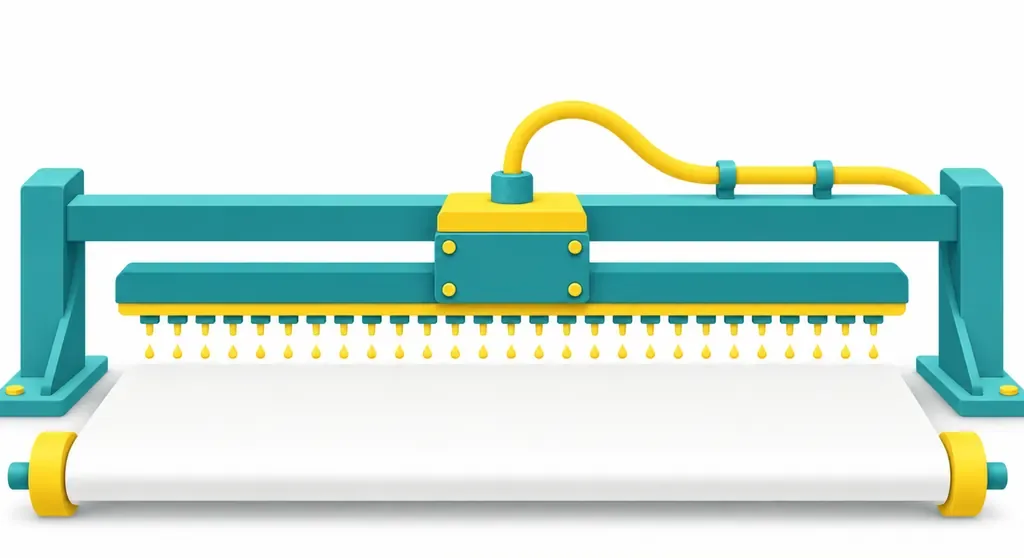
The central point of single-pass printing is that the imaging unit has to keep up with the production line. The line should not have to adapt to the press. Fujifilm describes single-pass printing as a prerequisite for matching the speed of a continuous production line [1]
The HX1024 is rated for a top speed of 500 ft/min, or about 152.4 m/min [1]. Based on that figure, 500 ft/min equals 6,000 inches per minute. If imaging in the feed direction also runs at 400 dpi, each nozzle row would need to print about 40,000 lines per second, or roughly 40 kHz. This is a theoretical estimate. It does not account for actual droplet frequency or grayscale strategies, but it makes one point clear: at this speed, any fluctuation in line speed must feed back into print timing in real time. Otherwise, the image will stretch or compress in the machine direction
For an embedded printbar, synchronization matters more to real-world performance than top speed. A conventional press sets its own printing speed. A printbar has to match upstream building-material forming, calendering, or coating stations. This analysis suggests that production-line encoder signal quality and printbar timing control will determine actual yield more than the top speed listed in the specifications
The 400 dpi figure also needs context. The equipment is promoted as combining high resolution with single-pass printing [1]. Its initial applications, though, include building materials such as gypsum board, sandpaper, and decorative panels [1]. Their viewing distances and image requirements differ from those of printed materials meant to be read up close. In this context, 400 dpi is best understood as "enough resolution for industrial decoration and marking." Its strategic value lies in achieving production-line speed at that resolution, not in leading the field on resolution
Core Analysis Two: Two Printbar Widths and Mounting Options Shift Changeover Costs
The HX1024 offers two fixed widths, avoiding repeated repositioning of narrower printbars and directly addressing changeover time. According to the announcement, the system comes in 30- and 40-inch print widths. The manufacturer says this removes the need to reposition smaller printbars when the printed area changes, a setup step that can cost production time when formats vary [1]
Using the published widths, we can estimate theoretical area throughput. A 40-inch width is about 1.016 m. At 152.4 m/min, that works out to about 154.8 m² per minute. A 30-inch width is about 0.762 m, or about 116.1 m² per minute at the same speed. These are upper bounds for full coverage with no stoppages. Actual throughput will be affected by roll changes, splicing, and maintenance. The figures show why changeovers matter: once theoretical throughput reaches more than a hundred square meters per minute, every additional minute of downtime costs hundreds of square meters in production. That makes simpler changeovers more valuable
Printbar width also affects uniformity calibration. Mizes and Viassolo's study shows that uniformity across a printbar's width must be maintained through measurement and adjustment [2]. This analysis suggests that a fixed-width setup concentrates calibration work at the factory and during scheduled maintenance, instead of requiring the array to be repositioned and recalibrated at every changeover. That is another form of process simplification that may not show up in a specifications table
Mounting options address space constraints. The equipment can be installed above, beside, or below the material path, making integration possible where space is limited [1]. For an existing line, this means adding imaging capability may not require a full redesign of the production layout. Capital spending could shrink from "adding a new printing line" to "installing a module at an existing station." This is an inference from the article's analysis. The actual scope of any retrofit will depend on the mechanical setup of each line
Core Analysis Three: Data Flow and Maintenance Become Practical Bottlenecks to Process Simplification
Once the mechanical integration issues are addressed, the bottlenecks to process simplification shift to data and maintenance. The HX1024's data setup ranges from simple direct TIFF printing to a full DFE with support for multiple file formats, production workflow management, color management, and a built-in RIP. It can also handle variable data, such as serial numbers for traceability, and print layouts generated by order or localized for language and regulatory requirements [1]
The specifications also let us estimate the scale of data involved. At 40 inches wide and 400 dpi, each line contains about 16,000 pixels. At roughly 40 kHz, that comes to about 640 million pixels per second for one color channel, or about 2.56 billion pixels per second across four colors. This estimate excludes grayscale bit depth and compression. A static pattern can be rasterized in advance and printed repeatedly. Variable data may change from one frame to the next. If the RIP and data transfer cannot keep up with the line, the printbar will have to slow down and wait
That is the difference between the direct TIFF and full DFE paths. In this analysis, a building-materials plant printing only fixed patterns may meet most of its needs with the TIFF path. Manufacturers that need serial-number traceability or multilingual, regulatory labeling are the ones that truly need the DFE's variable-data capabilities. The difference in implementation cost and staffing needs may be greater than the difference in hardware specifications
The maintenance design also supports process simplification. The printbar's electronics use liquid cooling. The manufacturer says it is more efficient than air cooling and reduces the risk of contaminants in ambient air entering the system. All components are accessible for service, and built-in system checks return error codes to help narrow down faults [1]. LED UV curing is described as generating less heat and using less energy than traditional mercury lamps, which matters especially for temperature-sensitive substrates [1]. This analysis suggests that building-materials line operators often lack a printing background. Error codes and a lower-heat design can reduce how much the imaging station depends on print specialists
Together, the three analyses form a "four-axis process simplification" framework for evaluating embedded printbars:
・Synchronization: Can the printbar reliably follow changes in upstream line speed, rather than just reach a high top speed?
・Changeovers: Do the width, mounting options, and calibration setup let the format change without stopping the line for adjustments?
・Data: Can the RIP and DFE handle variable data at production-line speed?
・Maintenance: Do cooling, curing, and fault diagnosis lower the need for specialist staff?

Implications for Taiwan's Design and Printing Industry
This section turns the four-axis framework into practical steps for different roles. The recommendations are based on this article's analysis
Small and medium-sized print shops should first work out whether they are operating as "a print shop" or "one station on a production line." If most of their business is marking and decorating building materials, paper products, or industrial substrates for converters, they should shift their evaluation from buying a complete digital press to asking whether an imaging module can be added to a customer's line or their own converting line. Practical steps:
・Measure the actual speed range and fluctuations of the existing line. Check whether its encoder signal can support printbar synchronization
・Track the number of changeovers and downtime per changeover over the past quarter. Use the figures to estimate how much labor time a fixed-width setup could save
・Confirm the substrate's temperature tolerance. Use test methods defined by material standards such as ASTM as a common language when talking with material suppliers [3]
Designers are no longer handing over a single print file. They are handing over a set of rules. Variable-data printing means the design must define which fields stay fixed and which change by order, language, or regulation [1]. When delivering artwork, designers should include field specifications, such as the maximum length of variable text, serial-number formats, and layout tolerances for multilingual versions. They should proof the actual 400 dpi output at the expected viewing distance, rather than zooming in on screen details
Brand owners should first clarify whether they want inkjet for personalization, traceability, or shorter lead times. The manufacturer cites building-materials companies facing pressure both to offer personalization and to shorten delivery times [1]. If a brand owner needs serial-number traceability, they should ask their converter early in the project to explain the DFE path and data connection method. Put the data format, exchange frequency, and error handling into the project specifications. Otherwise, the hardware may be ready before anyone discovers the data side cannot support it
Conclusion and Limitations
The HX1024 case suggests that competition in industrial inkjet equipment now extends to process simplification. The value of 400 dpi single-pass imaging lies in integrating resolution that meets industrial needs into a production line [1]. Equipment value can be assessed across four axes: synchronization, changeovers, data, and maintenance. When variable data is involved, the data axis is the most likely practical bottleneck
The study has several specific limitations:
・Single case and single source: All core specifications come from one industry report [1]. The report cuts off in its section on service and supply, so pricing, printhead model details, ink certifications, and real-world installation examples were unavailable
・Limits of the estimates: The 40 kHz line frequency, 154.8 m² per minute area throughput, and 2.56 billion pixels per second data rate assume 400 dpi in the feed direction, full coverage, and no downtime. They exclude grayscale, compression, and maintenance stops, so they should be treated as order-of-magnitude estimates
・Scope of extrapolation: The case concerns building-material applications [1]. Extending the conclusions to flexible packaging, labels, or graphic arts printing requires separate validation because substrates, ink migration, food safety, and other conditions differ
・A mismatch in the literature: The uniformity study concerns electrophotographic LED printbars [2], whose physical mechanisms differ from those of inkjet printbars. This article uses it only to identify an engineering challenge. It does not claim that its calibration methods can be transferred directly
Future research could take three directions. First, measure image distortion in embedded printbars as production-line speed fluctuates. Second, compare implementation costs and yield for direct TIFF printing and full DFE setups at different shares of variable data. Third, survey changeover frequency and downtime at building-material and paper-product converters in Taiwan to test the economic value of the changeover axis

Key Takeaways
・The HX1024 combines four-color single-pass imaging, 400 dpi, and a top speed of 152.4 m/min. It is designed to fit into an existing production line, not operate as a standalone press [1]
・For industrial building-material applications, 400 dpi is valuable because it is "enough and fast enough for the line," not because it leads in resolution
・Embedded printbars are better assessed across four axes, synchronization, changeovers, data, and maintenance, than by speed and resolution alone. This is closer to how they affect actual yield
・Based on the specifications, a 40-inch printbar running at full speed handles about 2.56 billion pixels per second across four colors. With variable data, the DFE and RIP are the most likely bottlenecks
・Before adopting this equipment, manufacturers in Taiwan should measure line-speed fluctuations, track changeover downtime, and confirm the data connection path
Further Considerations
Printing manufacturers can assess imaging capability as a production-line module and measure its value through line-wide yield and downtime. Designers need to deliver field rules and layout tolerances, not just a single file, so design tools must support structured definitions for variable data. AI is more likely to find a useful entry point in maintenance and data: training fault-prediction models on error codes and printed images, and automatically checking whether variable-data fields exceed layout tolerances. SaaS providers may be able to offer a data layer between the production line and DFE to route orders, serial numbers, and regulatory text in real time. Open questions remain: how should image accuracy be approved when line speed fluctuates, who is responsible when variable data is wrong, and how can small and medium-sized plants obtain synchronization signals and data interfaces without rebuilding their production lines?
References
[2] Mizes H., Viassolo D. (2003). Scanner-based Technique to Adjust LED Printbar Uniformity. NIP & Digital Fabrication Conference. DOI: 10.2352/issn.2169-4451.2003.19.1.art00020_2
[3] ASTM International: ASTM Standards for Paper and Packaging. ASTM International
[4] Journal of Graphic Engineering and Design: JGED Paper on Flexographic Printing Quality. Journal of Graphic Engineering and Design
[5] DiVA Portal / Karlstad University: Doctoral Thesis on Flexographic Printing Quality and Process Parameters (PDF). DiVA Portal / Karlstad University
FAQ
- What is single-pass printing?
- Single-pass printing means the substrate passes through the printing unit only once, completing imaging in a single pass. It is what allows an inkjet printbar to keep up with the speed of a continuous production line
- What are the main specifications of the Fujifilm HX1024 Printbar System?
- The HX1024 is a four-color inkjet printbar that prints at 400 dpi in a single pass, reaches speeds of about 152.4 m/min, and comes in 30- and 40-inch widths. It uses LED UV curing ink and can be installed above, beside, or below an existing production line. Its initial applications target building materials such as gypsum board, sandpaper, decorative panels, and architectural waterproof breathable membranes
- Is 400 dpi considered high resolution for industrial printing?
- That depends on the application. For industrial decoration and marking on materials such as building products, viewed from farther away, 400 dpi is enough to meet the need. Its value lies in reaching production-line speed at that resolution, not in leading on resolution
- Where are embedded inkjet printbars most likely to run into problems?
- The most common bottlenecks are data and synchronization. Variable data requires the RIP and DFE to keep processing at production-line speed. The printbar also has to follow fluctuations in upstream line speed reliably. Otherwise, the line may slow down or the image may stretch or compress
- What should small and medium-sized print shops in Taiwan do first when evaluating single-pass equipment?
- They should measure the actual speed range and fluctuations of their existing line, track the number of changeovers and downtime, and confirm the substrate's temperature tolerance and the data connection method. These figures predict real-world benefits better than the top speed on the equipment specification sheet
Related articles





The Print × AI weekly
The print and AI know-how designers, brands and enterprises can use before they commit — one email, every week
MINDS Free Tools
Spine width and imposition calculators — skip the manual math, free in your browser.
MINDS Group
Need actual printing or gifting services?
From premium printing to online ordering and festive gifts — the MINDS Group sister brands take it from here.