

Introduction: Why Packaging Becomes More Difficult as Devices Shrink
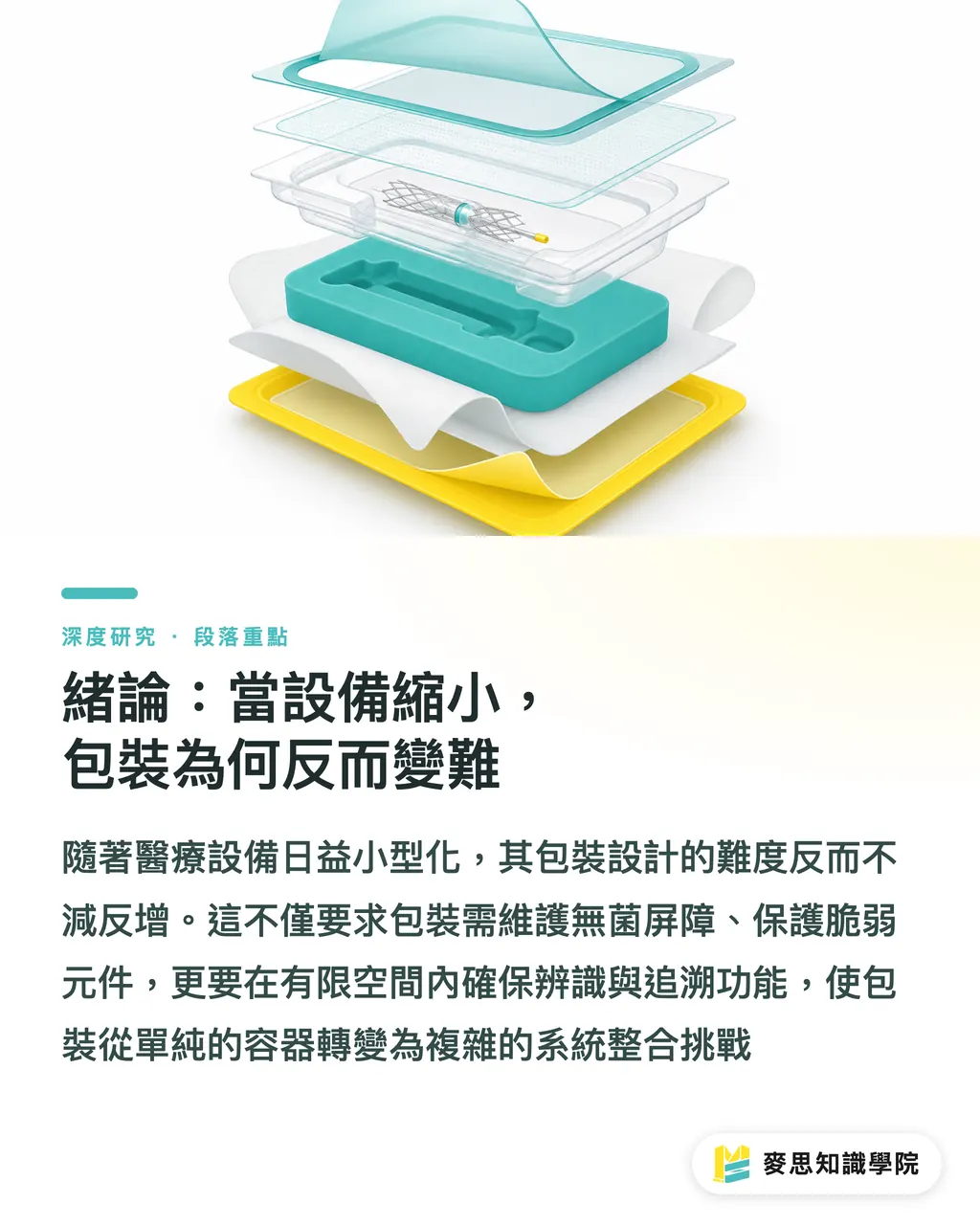
Medical device miniaturization is one of the most important trends in contemporary medical technology. Devices are evolving towards smaller, more precise, and less invasive forms, and are increasingly equipped with real-time data and therapeutic functions [1]. The proliferation of implantable sensors, wearable diagnostic devices, and minimally invasive instruments has reshaped the landscape of clinical deployment. However, a counterintuitive phenomenon has emerged: device miniaturization does not mean packaging miniaturization; in fact, the design difficulty of packaging has increased [1]
The problem statement lies in the fact that the functions packaging performs in a clinical setting far exceed 'containment.' It must maintain a sterile barrier, protect fragile micro-components, ensure clinical personnel can safely identify and access them, and maintain complete labeling and traceability information within reduced physical space [1][3]. As device size decreases, the tension between these functions is amplified, transforming packaging design from a 'material container' issue into a 'system integration' issue
The research questions this article seeks to answer are Three:
・First, what structural impacts does medical device miniaturization specifically impose on packaging?
・Second, how are these impacts translated into capability requirements for prepress and printing processes?
・Third, within an industry structure dominated by small and medium-sized printing companies in Taiwan, does this type of precision small-batch demand constitute an actionable opportunity for differentiated transformation? This article's contribution lies in synthesizing scattered industry intelligence and medical packaging literature into an analytical framework available for reference by Taiwan's industrial decision-makers
This issue holds special significance for Taiwan's industry. The printing industry in Taiwan has long faced price competition and profit compression in bulk consumer packaging, whereas medical packaging is characterized by high profit margins and strong customer stickiness [1]. Clarifying its entry barriers and capability gaps is a necessary prerequisite for contemplating paths to industrial upgrading
Literature and Current Status Review: Evolution from Material Specifications to System Design
This section first reviews the grouping of existing medical packaging research topics, followed by positioning the gap this article intends to address. Synthesizing existing literature shows that discussions on medical packaging have evolved along three main axes, with unintegrated tensions existing between them
The first axis is material and biocompatibility specifications. Early medical packaging manuals already treated packaging as an independent engineering discipline, systematically handling material selection, sterile maintenance, and testing methods [5][6]. Building on this, subsequent specifications further focused on biocompatibility assessment of packaging materials, explicitly requiring that the materials themselves must not cause contamination or adverse reactions for medical use [4]. The core position of this thread is: packaging is part of the medical device safety chain, not an accessory
The second axis is functional integration of pharmaceutical and device packaging. Literature views medical device packaging as a composite system that balances protection, sterilization, labeling, and ease of use [3]. This perspective already implies an awareness that 'packaging functions are multiple and mutually constraining,' but its discussions mostly use conventional-sized devices as context, rarely dealing with the space compression issues brought about by miniaturization
The third axis, a relatively emerging direction, is miniaturization technology at the electronic packaging level. Research into advanced electronic packaging options for complex medical devices has explored how to maintain component reliability while shrinking volume [2]. In reality, this literature thread deals with packaging miniaturization 'inside the device,' not sales and sterilization packaging 'outside the device.'
Thus, a structural gap is visible. Existing literature digs separately into material specifications, functional integration, and internal electronic packaging, but lacks a systematic integrated analysis of the specific mechanism of 'how external miniaturization inversely pushes up the difficulty of outer packaging design.' The latest industry intelligence fills this gap in the current situation: small devices often require larger rather than smaller packaging to ensure safe handling and sterile maintenance. They also need buffer space during transport to protect micro-components from shock and compression, and require color-contrast design to assist clinical personnel in identification, grasping, and deployment [1]. This article uses this reality as an anchor point, interfaces it with existing normative literature, analyzes its translation into prepress capabilities, and focuses on the local implications for the Taiwanese industry, which is something not yet fully addressed by existing discussions
Core Analysis I: Five Packaging Impacts and Mechanism Deconstruction of Miniaturization
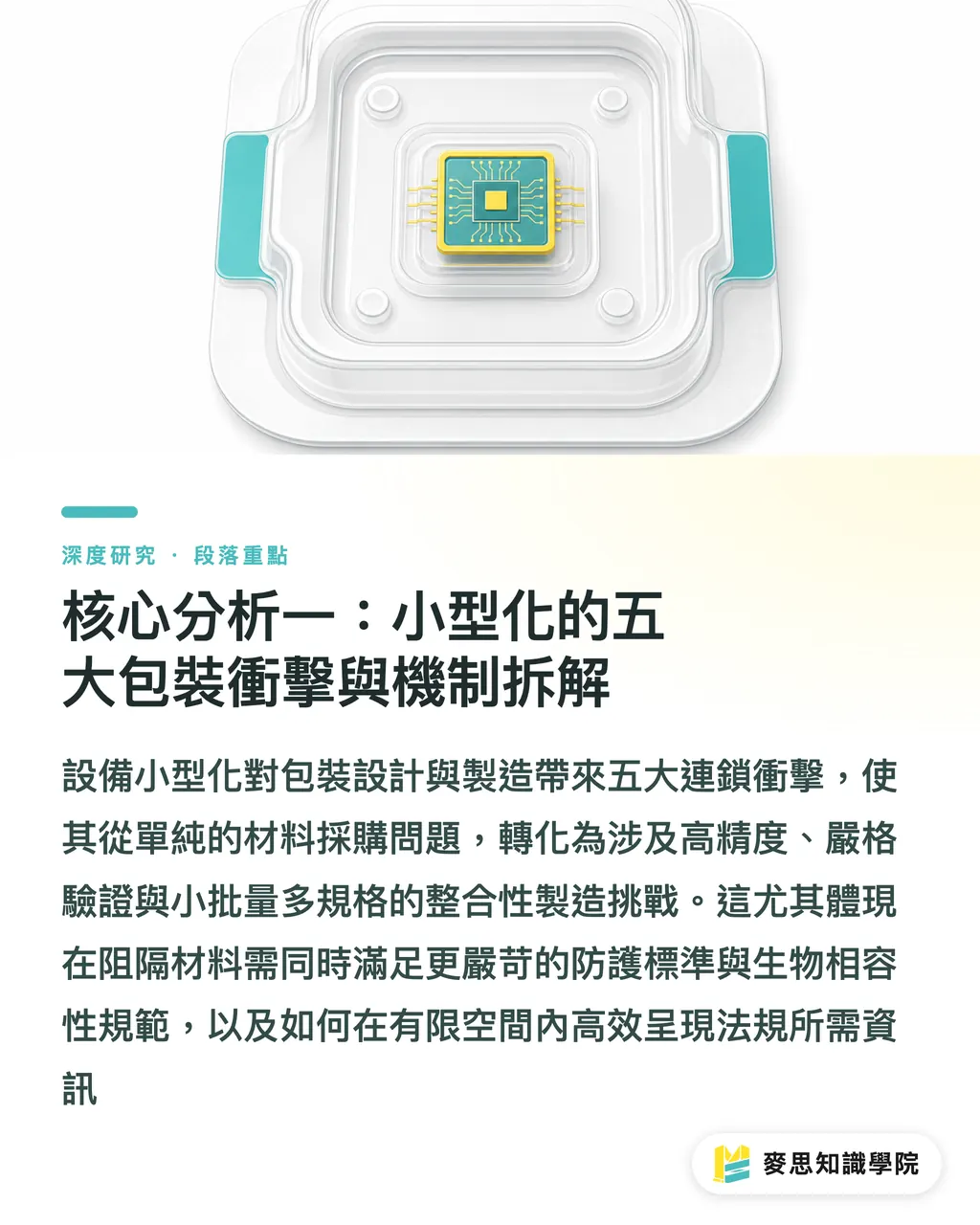
This section deconstructs the five structural impacts triggered by device miniaturization one by one and explains the underlying mechanisms. These five impacts are not parallel relations but a chain that reinforces each other
Stricter barrier material specifications are the first impact. Miniaturized devices often integrate more sensitive electronic and sensor components and have lower tolerance for moisture, oxygen, and contamination; therefore, requirements for packaging barrier properties are higher than for traditional instruments [1][3]. Biocompatibility specifications simultaneously require that the barrier material itself must not become a source of contamination [4], which means the window for material selection is narrowed from both sides: requiring both higher barrier properties and stricter compatibility
Complexity of sterilization compatibility is the second impact. Packaging must be compatible with diversified sterilization processes while maintaining a sterile barrier [3][5]. When devices integrate electronics and sensors, some high-temperature or radiation sterilization methods may impair component functionality, further limiting the combination of packaging materials and sterilization methods. This article argues that this increases the degree of coupling between material engineering and process validation, making it impossible to separate packaging decisions from sterilization decisions
Reduction of anti-counterfeiting and labeling space is the third impact, and the one most directly related to prepress. The surface area of the device and its immediate packaging shrinks, but the amount of labeling, warnings, and brand information required by regulations does not decrease proportionally, creating a sharp contradiction between available space and information density [1]. This article analyzes that this is the fundamental reason why color-contrast design is emphasized: when space is insufficient to accommodate redundant information, visual identification efficiency must be achieved through design rather than surface area [1]
Increased precision requirements for micro-barcodes and QR traceability are the fourth impact. Serialization and unit traceability on a shrunken surface area require barcodes and 2D codes that are smaller but still reliably machine-readable. This imposes direct pressure on printing registration precision, dot reproduction, and material flatness [1]. Traceability information must not lose machine readability due to size reduction; this is a non-negotiable functional bottom line
Increase in small-batch and multi-specification demand is the fifth impact. Miniaturized devices often correspond to more segmented clinical uses and more frequent model iterations, causing single-specification production batches to decrease and specification types to increase [1]. This requires the printing end to possess flexible switching capabilities of digital printing in order to economically accept short-run orders without sacrificing precision
In summary, these five impacts point to one conclusion: miniaturization pushes packaging from a 'scale-based material procurement problem' to a 'highly precise, highly validated, low-batch integrated manufacturing problem'
Core Analysis II: Translation of Impacts into Prepress Capabilities
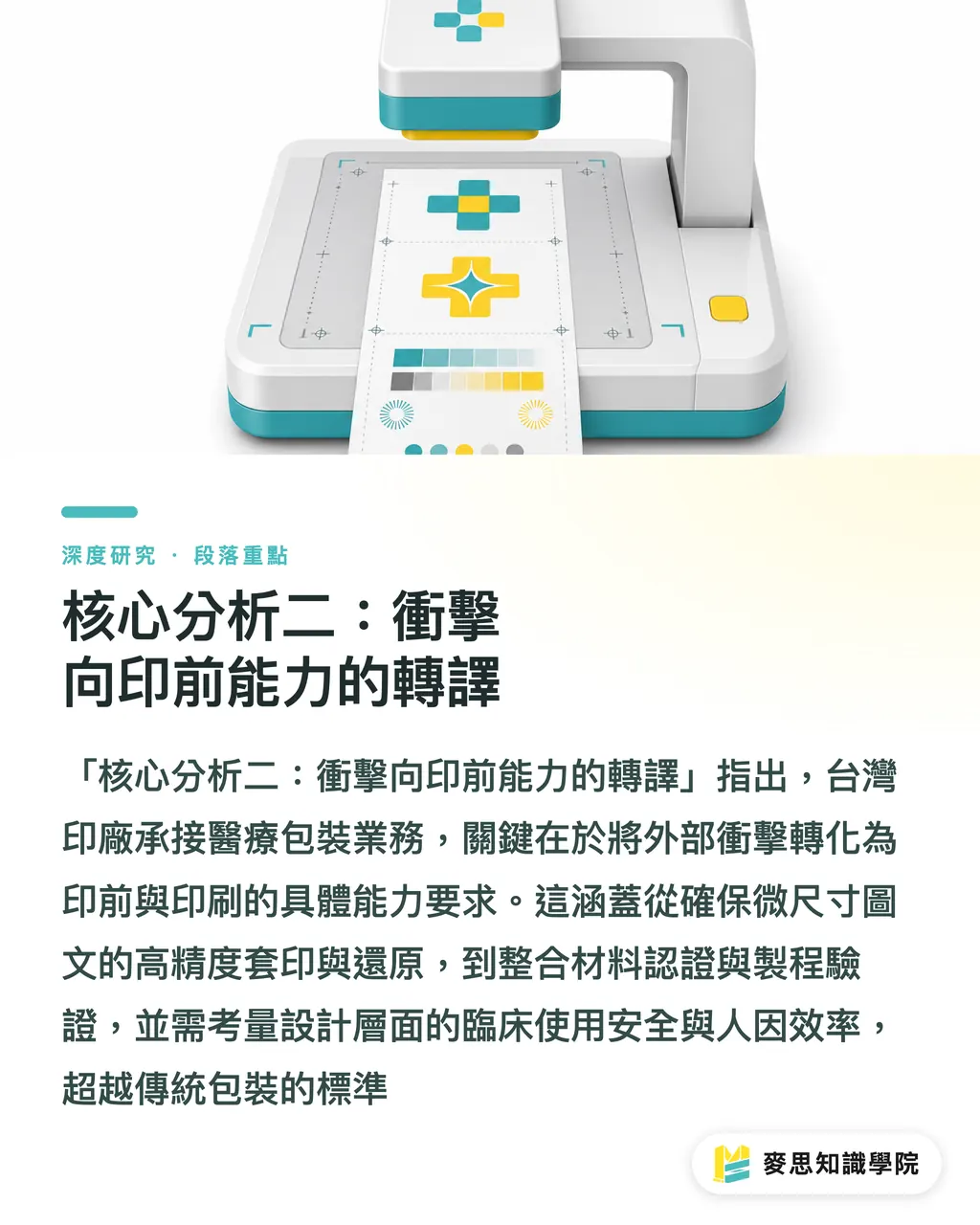
This section translates the aforementioned impacts into specific capability requirements for prepress and printing processes, which is the key link in judging whether Taiwanese printing factories can take on this work
The first capability is high-precision registration and micro-sized graphic reproduction. The fact that micro-barcodes and QR codes must maintain machine readability on a shrunken surface means that prepress dot processing, registration alignment, and printing reproducibility must achieve stricter tolerances than general consumer packaging [1]. This article analyzes that the bottleneck here is often not the printing press itself, but whether prepress color management and proofing processes can stably predict the final readability of micro-sized components
The second capability is the integration of material certification and process validation. Since barrier properties and biocompatibility are constrained by regulations [3][4], prepress is no longer just graphic processing but needs to be considered in conjunction with material specifications and sterilization methods. This article analyzes that whether material certification and validation processes can be incorporated into the quotation and proofing stages will be the watershed between medical packaging business and general packaging business
The third capability is flexible switching and short-run economics of digital printing. The situation of small batches and multiple specifications requires processes to be able to quickly change plates between different models, maintain consistent quality, and maintain cost feasibility at low volumes [1]. This directly echoes the parallel development trends of digital printing and automated quality control (integrating quality audits at the prepress stage) in the industry, allowing both precision and stability to be achieved for short-run orders
The fourth capability is visibility and human factors integration at the design level. Color-contrast design assists clinical personnel in identification and access [1], meaning that prepress and design must incorporate 'identification efficiency in clinical usage scenarios' into layout decisions, rather than just pursuing brand aesthetics. This article analyzes that this expands the design assessment criteria for medical packaging from 'aesthetics and compliance' to 'usage safety,' raising the professional threshold for the design side
Implications for Taiwan's Design and Printing Industry
This section explains the operational significance of the preceding analysis for Taiwan's small and medium-sized printing factories, designers, and brand owners by layer. Taiwan's industrial structure is dominated by small and medium-sized printing factories, and the high profit margins and high stickiness characteristics of medical packaging make it a potential blue ocean for differentiated transformation [1]. However, opportunities and thresholds coexist and need to be understood in layers
For small and medium-sized printing factories, the core of the entry path is 'capability certification' rather than 'equipment stacking.' In terms of concrete actions, it is recommended to prioritize investment in prepress color management and micro-size readability proofing processes, and to establish documented validation capabilities for material certification and sterilization compatibility, as this is the true barrier that differentiates medical orders from general orders [3][4]. In terms of processes, introduce digital printing capable of economical short-run switching and automated prepress quality control to accept small-batch, multi-specification demands [1]. Regarding time and costs, medical orders have long pre-validation periods and small batch sizes; manufacturers need to pre-account for validation and proofing costs in their quotation models to avoid evaluating medical business with the cost logic of consumer packaging
For designers, the implication lies in the expansion of design goals. With limited layout space, design needs to use color contrast and information hierarchy design to compensate for the lack of area, and incorporate human factor requirements for clinical identification and access into the assessment [1]. This requires designers to understand the limitations of sterilization, labeling regulations, and machine-readable barcodes, and to collaborate with prepress and material engineering rather than just delivering visual proofs one-way
For brand owners (medical device manufacturers), the implication lies in the re-evaluation of supply chain strategy. Small-batch, multi-specification, and high-validation demands increase the value of 'localized supply partners with integrated validation capabilities.' This article analyzes that printing partners who can accept short-run orders locally and provide material and process validation support can shorten iteration cycles, which has particular strategic value for miniaturized devices with frequent revisions
It must be emphasized that the aforementioned opportunities have threshold qualities. Material certification, sterilization validation, and precision requirements constitute substantial entry barriers, and not all small and medium-sized factories can cross them in the short term. This article analyzes that a pragmatic path is to use a single niche segment (such as label printing compatible with specific sterilization methods) as an entry point to accumulate certification credentials, rather than diving into it fully
Conclusion and Limitations
This article responds to the three research questions raised in the introduction:
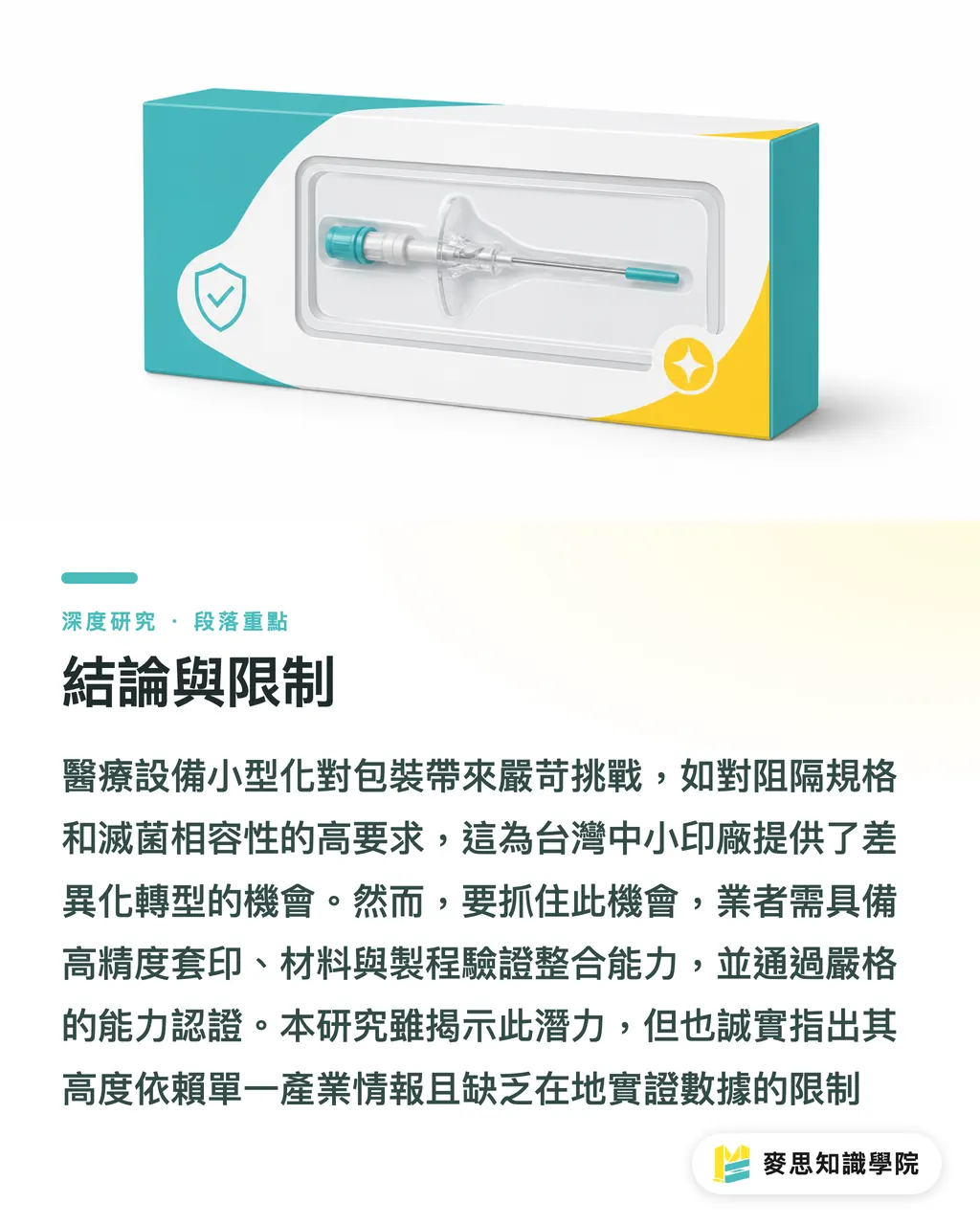
・First, medical device miniaturization imposes five mutually reinforcing packaging impacts: stricter barrier specifications, complicated sterilization compatibility, reduced labeling space, higher traceability precision, and small-batch multi-specification demand [1]
・Second, these impacts translate into capability requirements for high-precision registration, integration of material and process validation, digital short-run economics, and human-factors design at the prepress stage
・Third, under the structure dominated by Taiwan's small and medium-sized printing factories, such precision small-batch demands indeed constitute an opportunity for differentiated transformation, but capability certification is the substantive threshold, and a pragmatic path of niche entry is advisable [1]
This study has several limitations that should be honestly disclosed:
・First, the current situation analysis highly relies on a single source of latest industry intelligence [1]. Its generalization of the five major impacts has not been cross-verified by independent quantitative research, and the mechanism deconstruction based on this is analytical inference
・Second, existing literature is mostly review-based data on material specifications and packaging technology [2][3][4][5][6] and lacks direct empirical evidence aimed at 'outer packaging design difficulty rising with miniaturization.' Therefore, the translation and Taiwanese implication analysis of this article have inferential qualities
・Third, this article has not obtained local empirical data on the costs, certification cycles, and yield rates of Taiwanese printing factories accepting medical packaging; related actionable suggestions still await verification by field data
There are three directions for subsequent research: establishing benchmarks for certification costs and timelines for Taiwan's small and medium-sized printing factories to enter medical packaging; empirically quantifying the readability tolerance of micro-sized barcodes under different materials and printing processes; and comparing the trade-offs in iteration speed and total costs of localized short-run supply versus cross-border bulk supply. These directions will move the framework proposed in this article from an analytical proposition to a verifiable basis for industrial decision-making
Key Takeaways
・Medical device miniaturization will not shrink packaging but will instead push up the five difficulties of barrier, sterilization, labeling, traceability, and small-batch [1]
・Reduced layout space makes color contrast and information hierarchy design, rather than surface area, the key to clinical identification efficiency [1]
・The true entry barrier for medical packaging is the capability for material and sterilization validation, not the printing equipment itself [3][4]
・Small-batch, multi-specification demand requires parallel capabilities of digital printing short-run economics and automated prepress quality control [1]
・Taiwanese small and medium-sized printing factories should enter through a single niche certification field, gradually accumulating credentials rather than fully committing
Extended Thinking
For printing manufacturing, the opportunity for medical miniaturization packaging does not lie in production capacity but in 'verifiable precision and certification.' Manufacturers should view prepress color management, micro-sized readability proofing, and material/sterilization validation documentation as core assets rather than costs. For design, layout decisions need to expand from aesthetics and compliance to clinical usage safety, collaborating with prepress and material engineering. The introduction of AI and automated quality control at the prepress stage precisely matches the pain point of 'precision must not be compromised while batch is not economical' under short-run, multi-specification conditions and can become a technical lever for differentiation. For SaaS, integrating material certification, sterilization compatibility comparison, and barcode readability prediction into quotation and proofing workflows is a tool-driven direction worth exploring. The pending questions are: what are the true certification costs and cycles for local Taiwanese acceptance of short-run medical orders, and where is the critical point in total costs for localized supply relative to cross-border bulk supply
References
[2] Bagen S., Subrahmanyan R., Perrone R. et al. (2015). Advanced Electronic Packaging Options for Miniaturization of Complex Medical Devices. Additional Conferences (Device Packaging, HiTEC, HiTEN, and CICMT). DOI: 10.4071/2015dpc-tha23
[3] Medical Device Packaging. Pharmaceutical Packaging Handbook. DOI: 10.3109/9781420012736-8
[4] F02 Committee (None). Guide for Biocompatibility Evaluation of Medical Device Packaging Materials. DOI: 10.1520/f2475-11
[5] Medical Device Packaging Handbook, Second Edition, Revised and Expanded. DOI: 10.1201/b16281
[6] Medical Device Packaging Handbook, Revised and Expanded. DOI: 10.1201/9780429074691
FAQ
- Why is it more difficult to pack smaller medical devices?
- Because packaging must maintain a sterile barrier, protect fragile micro-components, and ensure clinical identification and complete labeling traceability. These functions conflict with each other in a shrunken space, and devices often require larger rather than smaller packaging to be handled safely [1]
- What are the five major packaging impacts brought about by medical device miniaturization?
- Stricter barrier material specifications, complicated sterilization compatibility, reduced space for anti-counterfeiting labeling, increased precision requirements for micro-barcodes and QR traceability, and increased demand for small-batch, multi-specification production [1]
- Is it suitable for small and medium-sized printing factories in Taiwan to enter the medical packaging field?
- Medical packaging has high profit margins and strong customer stickiness, making it a differentiated blue ocean. However, material certification and sterilization validation constitute substantial barriers to entry. It is recommended to enter through a single niche certification field to accumulate credentials, rather than fully committing [1]
- What are the specific requirements for prepress in medical packaging?
- Requirements include high-precision registration and micro-sized barcode readability, integration of material and sterilization process validation, economical switching for digital printing short-run orders, and color-contrast design that incorporates clinical identification and human factors [1][3]
- Why is color-contrast design so important in small medical packaging?
- When layout space is insufficient to accommodate redundant information, clinical personnel's identification and access efficiency must be achieved through visual design rather than surface area. Color contrast therefore becomes the key to safe deployment [1]
References
- 醫療設備越做越小,包裝難度反而越高:五大衝擊與台灣印廠的精密小批量商機 · packagingdigest.com
- Advanced Electronic Packaging Options for Miniaturization of Complex Medical Devices · doi.org
- Medical Device Packaging · doi.org
- Guide for Biocompatibility Evaluation of Medical Device Packaging Materials · doi.org
- Medical Device Packaging Handbook, Second Edition, Revised and Expanded · doi.org
- Medical Device Packaging Handbook, Revised and Expanded · doi.org
Related articles



The Print × AI weekly
The print and AI know-how designers, brands and enterprises can use before they commit — one email, every week
MINDS Free Tools
AI background removal, a LINE sticker maker, spine & imposition calculators — all free, right in your browser, no upload.
MINDS Group
Need actual printing or gifting services?
From premium printing to online ordering and festive gifts — the MINDS Group sister brands take it from here.