

Overview
Last week, a client messaged me again: "Our budget is limited, and social media and Google Ads are burning cash, so can we save money by skipping the catalog?" This is a good question, but it's aimed in the wrong direction. A catalog is not a competitor to your ad budget; it is a different kind of touchpoint. Comparing it in the same KPI spreadsheet against cost-per-click will naturally make it look expensive and slow. The real question should be: what are the things that screens cannot do, but a piece of paper can?

Forgotten on a Screen, Remembered on Paper: Why?
・First, let's talk about an experience we all share: an ad you swiped past three seconds ago is forgotten. But that gold-foiled business card in your drawer or that catalog with a tactile feel? You keep those
・The difference is "tactility." Physical objects occupy physical space. Being held, flipped through, or placed on a desk creates repeated brand exposure. Digital content is rented attention, if the algorithm doesn't give you space, you vanish. Physical objects are a buy-out; they stay in the client's office without incurring further costs
・Also, physical objects have no "next post." The design logic of social media is to keep you scrolling, with every brand fighting for a fraction of a second against infinite content. An open catalog doesn't have an algorithm to pull you away; the reader sets the rhythm. For products requiring serious consideration, B2B proposals, high-ticket services, or design-focused goods, this "distraction-free reading time" is something screens cannot provide. This is my judgment, not a statistic: the scarcity of attention is paradoxically turning "cannot be swiped away" into a distinct advantage
Why is the phrase "Packaging is Media" only now true?
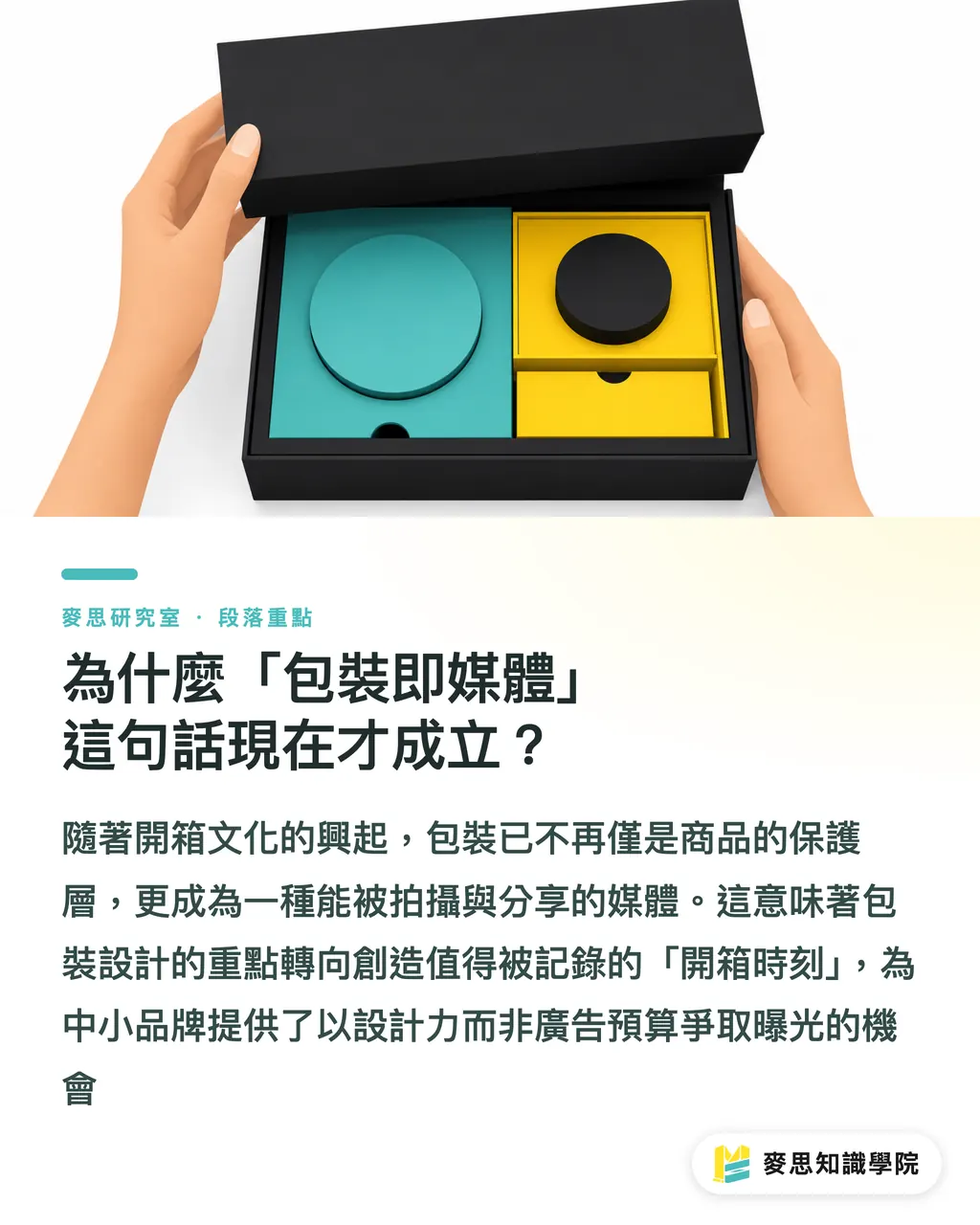
・We used to say packaging protected products; now we must update our stance: packaging is media that gets photographed and shared
・The key driver is unboxing culture. Unboxing videos have grown from a niche interest into a mature creator ecosystem on YouTube, supported by clear viewing motivations and social structures[1]. Academic research has even specifically deconstructed "why children watch people unbox items over and over," pointing out that unboxing satisfies the psychology of anticipation and surrogate ownership[2]. What does this mean? It means your packaging is no longer seen just by the buyer; it has the opportunity to be unboxed, recorded, posted to social feeds, and turned into free reach
・Therefore, the metrics for packaging design have changed. Previously, we asked, "Is it sturdy enough, and what is the cost?" Now, we also ask, "Is the moment of opening worth being filmed?" The fold of an insert, a message printed inside the box lid, or the paper quality of an instruction card are all setting the stage for that potential unboxing video. For small and medium-sized brands, this is one of the few battlegrounds where you can fight for visibility with design power rather than ad budgets
・A word of caution: this logic only works for product categories with "unboxing motivation." Forcing dramatic packaging on daily-use refill packs is just spending money where no one will film. Judge whether your customers want to share before deciding to invest in that moment
Print and Digital: Rivals or Teammates?
・Setting physical and digital against each other is the biggest misunderstanding in this entire issue. They each fill the other's blind spots
・The most direct bridge is the QR code. A flyer, a package, or a business card is originally a one-way street; print a QR code on it, and it becomes an O2O (Online-to-Offline) portal. Scanning leads to your LINE, exclusive offers, or product videos. The physical item is responsible for "being remembered and trusted," while digital is responsible for "being trackable and convertible." You can even use different links on different print materials to trace which touchpoint actually brought the customer, finally putting to rest the old complaint that "print performance cannot be measured."
・This also influences choices on the manufacturing end. If you are doing highly personalized, small-batch printing with variable QR codes or names, the flexibility of digital printing far outweighs offset printing. If quantities are under 500 copies and you don't need a unique spot color, digital is almost certainly more cost-effective. In other words, "print + digital integration" is not just marketing jargon, it also rewrites which printing method you should choose
・My advice is to stop drafting two separate budgets. Put physical and digital on the same customer journey map: use social media to spread awareness in the stranger phase, send a catalog to build trust in the consideration phase, and use the unboxing experience after the sale to drive word-of-mouth and repurchasing. Pick the medium that excels at each stage
What Should SMEs with Limited Budgets Print First?
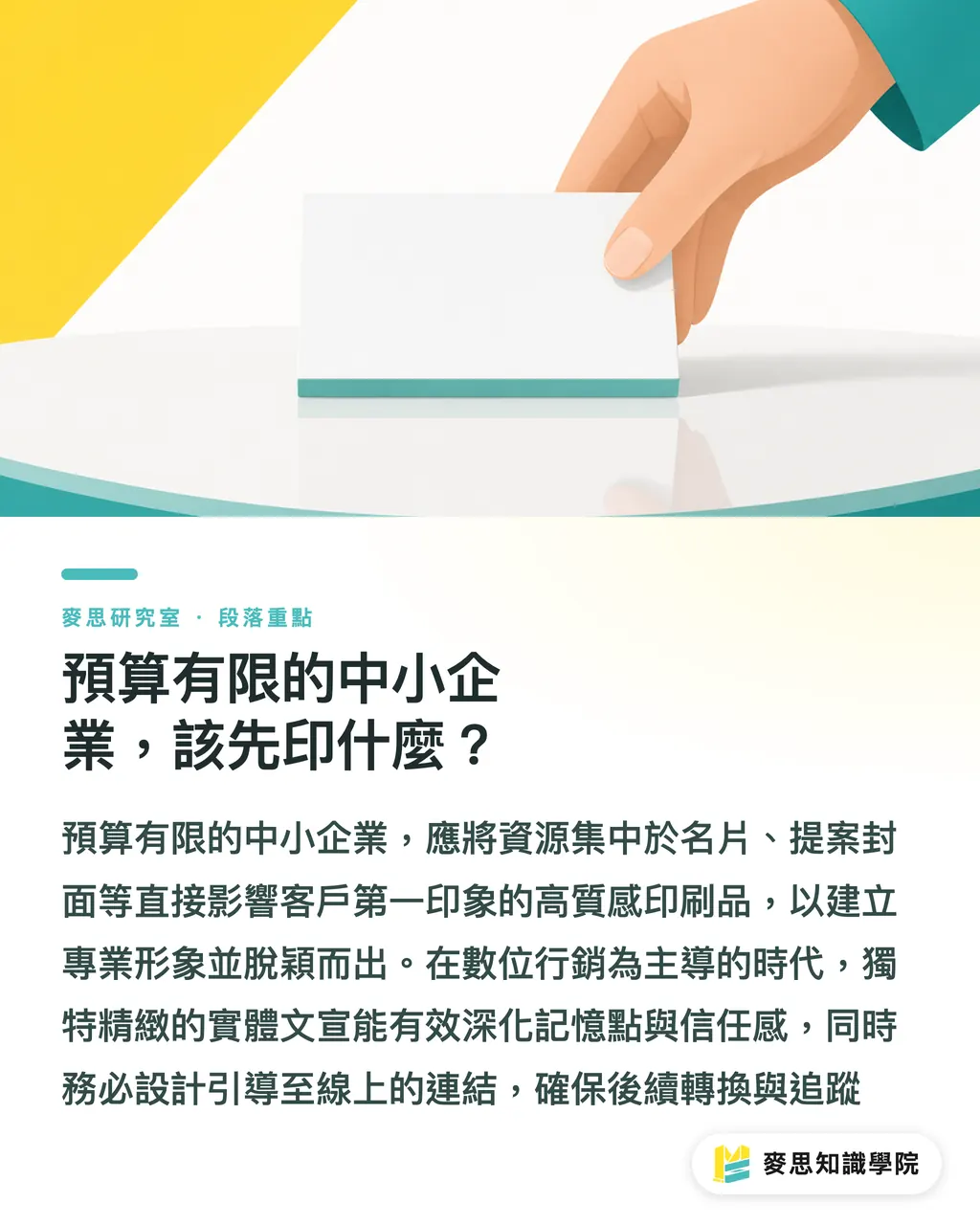
・If resources only allow for one or two things, don't split them evenly. Concentrate on the touchpoints "closest to the deal" that best showcase quality
・My prioritization is: First, scenarios involving direct human interaction, the paper quality and binding of business cards, proposal covers, and quotes. These directly determine the first impression of "professionalism," and first impressions are almost impossible to redo. Second is packaging, provided your product category has potential for unboxing or sharing[1]. Third is high-volume distributed flyers and catalogs; their role is coverage and reminder, with lower individual value, suitable for scaling only after the first two are established
・The key to differentiation isn't printing more, but printing "differently." When competitors move all their budget to online ads and simplify physical touchpoints, a piece of print with weight, design, and texture becomes a rarity. Rarity is a memory hook. This is one of the few areas where SMEs can use craftsmanship, rather than burning money, to win
・A final pragmatic reminder: every physical item should be designed to "connect back online." Print without QR codes or trackable links is effectively abandoning the conversion and measurement of the second half of the funnel. Physical is responsible for making people remember and trust you, but don't let that trust break because there is no next step
Key Takeaways
・The core strengths of physical objects are tactile memory, trust, and "cannot be swiped away by algorithms," filling gaps that screens cannot
・Packaging has evolved from protective functionality to media that gets unboxed and shared, though it only works for categories with sharing motivation[1][2]
・QR codes are the lowest-cost O2O bridge, enabling print to possess both "being remembered" and "being trackable" capabilities
・For quantities under 500 copies or when personalized variable content is needed, the flexibility and cost of digital printing usually beat offset
・With limited budgets, invest centrally in touchpoints closest to the deal (business cards, proposals, packaging) rather than diluting resources
Extended Thinking
The implications for the industry are clear: the value narrative of physical printing is shifting from "printing cheaply" to "connecting to digital and supporting experiences." For the printing and manufacturing side, this means demand for digital printing and Variable Data Printing (VDP) will continue to grow; orders that are small-batch, personalized, and include dynamic QR codes become the main field. For the design side, the standard for measuring packaging must add a new axis: "photographability of the unboxing moment." For businesses introducing AI and SaaS, the real opportunity lies in reconnecting data from physical touchpoints, QR scans, unboxing video reach, and offline-to-online conversion attribution are currently mostly broken. Whoever can create an integrated tool that allows an SME to "measure the effect of printing a single sheet of paper" will redefine print from a cost item into an optimizable marketing asset. The question to be solved is how to land this attribution without overly collecting personal data
References
[1] Walczer J.(None). Un-boxing toy unboxing: Analysing YouTube's toy unboxing creator culture. DOI: 10.5204/thesis.eprints.210189
[2] Treviño T.(2021). Unboxing the trend: Understanding why children watch unboxing videos on YouTube. Journal of Digital & Social Media Marketing. DOI: 10.69554/beeu8763
[3] Unboxing Japanese Videogames. Unboxing Japanese Videogames. DOI: 10.7551/mitpress/15321.003.0008
[4] Bommas M.(2024). Unboxing in Memphis. Tutankhamun. DOI: 10.4324/9781003496472-10
[5] Alemanno A.(2024). Unboxing the EU Body for Ethical Standards. DOI: 10.59704/8012be53661c21e3
FAQ
- Is it still necessary to produce physical print materials in the digital age?
- Yes, but the role has changed. The value of physical print is not to replace digital advertising, but to provide tactile memory, trust, and a reading experience undisturbed by algorithms, things screens cannot do. Treat it as a touchpoint in the customer journey, not a competitor to your ad budget
- What is "packaging as media"?
- It means packaging is no longer just for product protection, but a content carrier that will be unboxed, photographed, and shared on social media by consumers. Since the maturation of unboxing culture, a "shareworthy" unboxing experience can generate free reach for a brand[1][2]
- How can print materials be integrated with digital marketing?
- The simplest way is to print QR codes on flyers, packaging, or business cards, connecting to LINE, offer pages, or product videos to create an O2O portal. Physical is responsible for being remembered and trusted, digital is responsible for tracking and conversion, and different links can be used to backtrack the performance of each touchpoint
- Which types of print materials should SMEs with limited budgets prioritize?
- Focus on the touchpoints closest to the deal that best showcase quality, usually business cards and proposal documents, followed by packaging with sharing potential, and lastly high-volume flyers and catalogs. Do not spread limited budgets too thinly
- How should one choose between digital and offset printing?
- When quantities are under 500 copies, personalized or variable content is needed (e.g., unique QR codes, names), and no specialized spot colors are required, the flexibility and cost of digital printing are usually more advantageous. For large volumes and precise spot color requirements, offset is more cost-effective
References
Related articles





The Print × AI weekly
The print and AI know-how designers, brands and enterprises can use before they commit — one email, every week
MINDS Free Tools
AI background removal, a LINE sticker maker, spine & imposition calculators — all free, right in your browser, no upload.
MINDS Group
Need actual printing or gifting services?
From premium printing to online ordering and festive gifts — the MINDS Group sister brands take it from here.