
Overview
Picture a scenario you might already be living through. An e-commerce fulfillment client has warehouse corners permanently stacked with six or seven standard box sizes. Big boxes hold small items, small items are stuffed with bubble wrap, dimensional freight fees keep piling up, and return rates stay high. They call you up not for a quote, but to ask: "I heard there are machines that measure and build boxes one by one on demand. Does that mean I can stop ordering truckloads of inventory from you?"
That is a question every corrugated box manufacturer needs to answer seriously
What Does the CVP Everest Actually Do, and Why Is Everyone Talking About It?
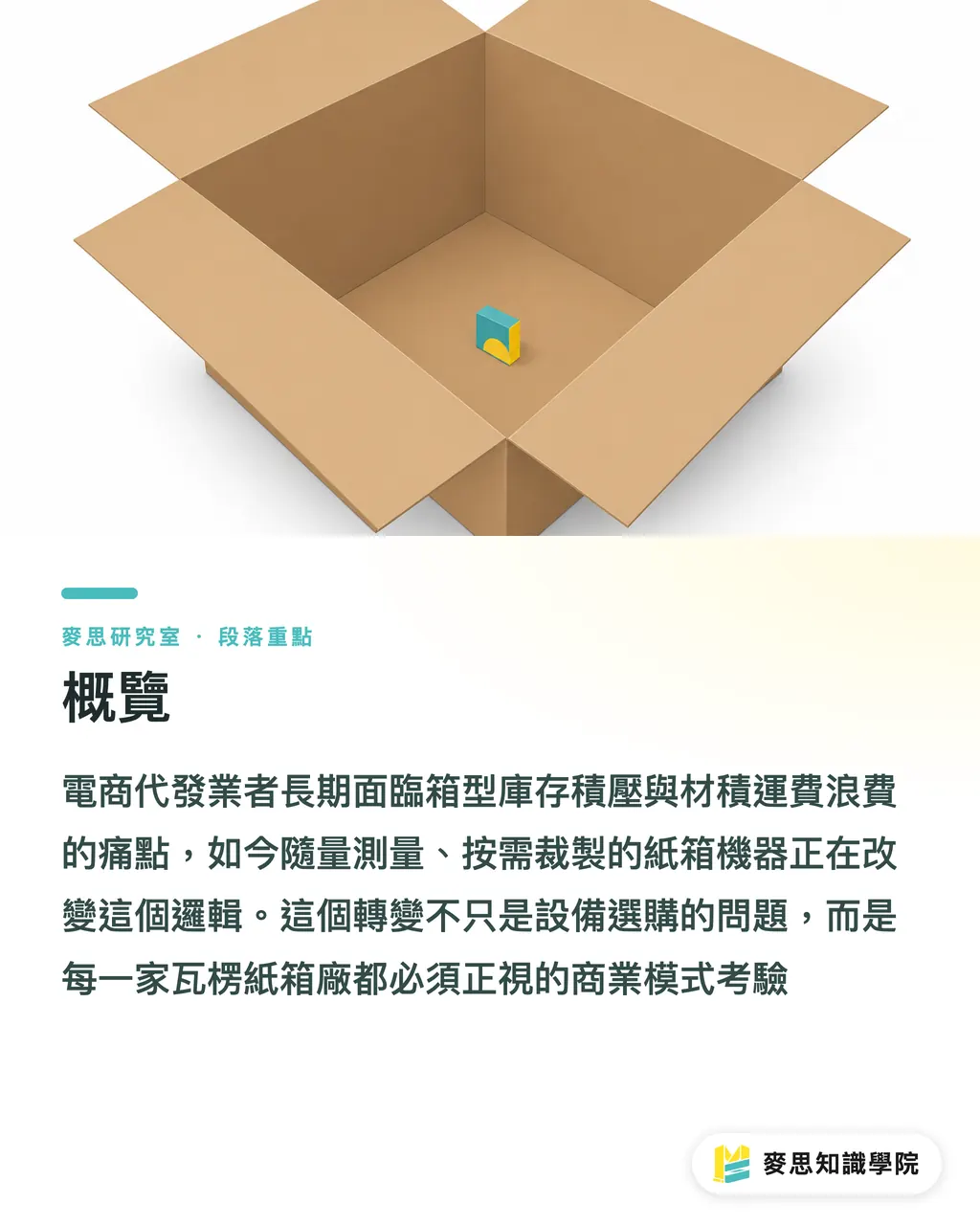
Put simply, it compresses cutting, creasing, erecting, and taping, steps that were once separate and required manual handoffs, into a single machine. Instead of relying on stocked sizes, it runs on live measurement and on-site production [1]. As an item moves along the conveyor, a vision system scans its length, width, and height. The software calculates the most material-efficient box design on the fly, cuts the flat pattern, folds it, packs the product, and seals it in seconds. It claims to process hundreds of boxes an hour with virtually zero human touch [1]
Speed is not the real story here. Speed is just the surface. The real shift is that it breaks a premise the industry has operated on for decades: packaging sizes must be stocked in advance
In the past, you stocked a dozen box types because you never knew what your client would ship on any given day. Clients accepted minimum order quantities because plate-making, printing, and die-cutting for just a few boxes could not amortize the setup costs. The logic of the CVP Everest is different: since every order has different items, make a custom-fit box for every single order, doing away with standard sizes altogether [1]
For downstream clients, the incentive is concrete. Source reports state it can cut packaging material waste and dimensional freight surcharges by 30-50% [1]. Dimensional weight is a hidden cost sink in e-commerce. A box half-filled with air means paying to ship empty space on every single run. Squeezing that out translates to real money for warehouses shipping millions of packages a year
Which Part of the Business Does It Actually Threaten?
Let us stay level-headed and avoid unnecessary panic. The CVP Everest does not disrupt the entire corrugated industry. It hits one specific slice of value: the inventory supply of standard-size boxes. That is my assessment, and the reasoning is straightforward
Think about how a box business breaks down: raw paper and board, printing and branding, die-cutting and converting, warehousing and delivery, and on-site packing. The CVP Everest mainly eats into the parts of those last three steps that rely on fixed sizes, volume runs, and inventory holding [1]. For a vendor that simply produces a few sizes of plain brown boxes and sells them in bulk, clients who bring packing in-house will undoubtedly order less
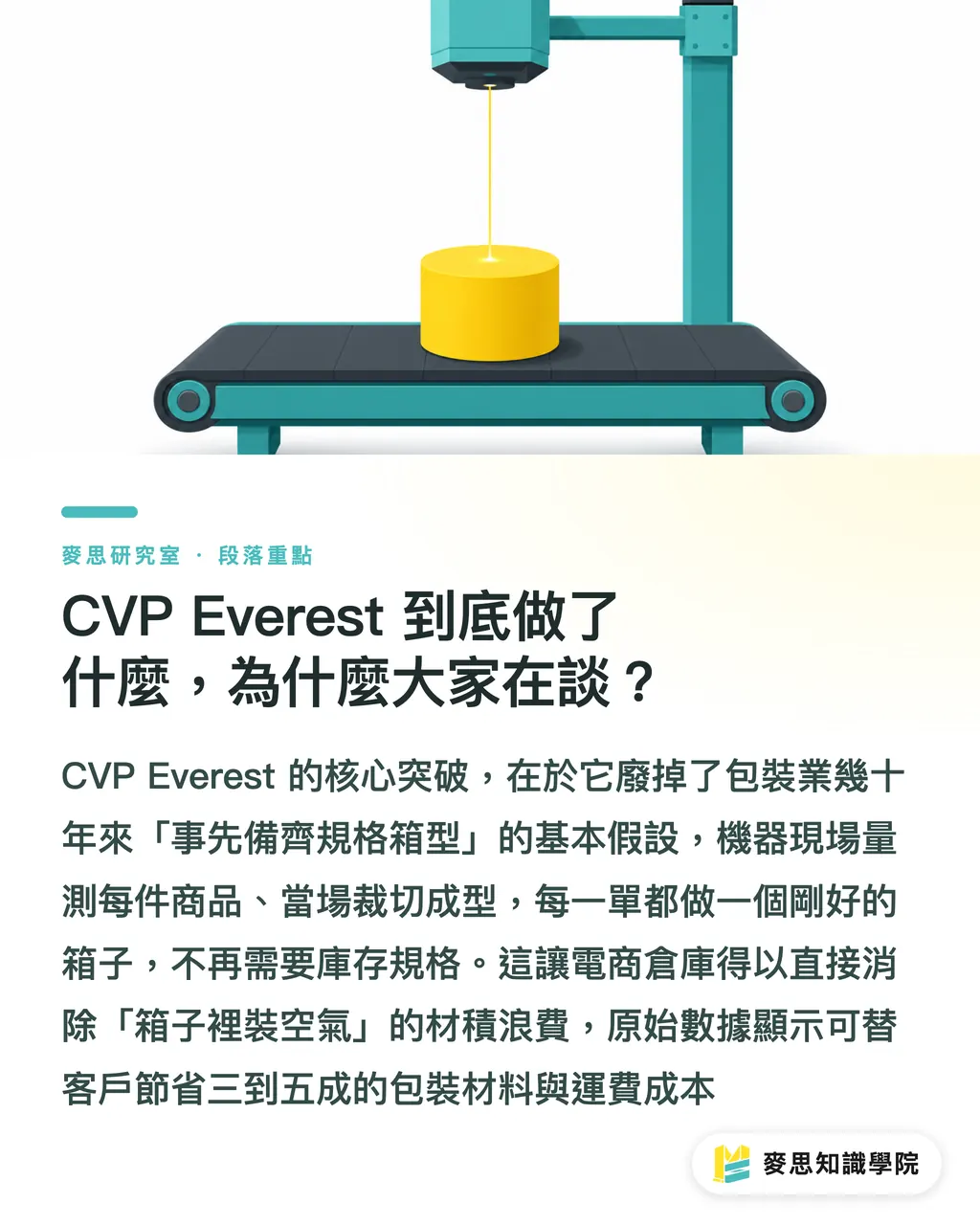
Yet what it leaves untouched is equally clear. The machine runs on a steady feed of fanfold corrugated board. It does not conjure cardboard out of thin air, consuming continuous corrugated raw material at high volume [1]. The demand has not vanished. It has shifted from selling finished boxes to supplying raw board and equipment services
This is the shift Taiwanese plants need to recognize. If your business model rests entirely on having the most complete ready-to-ship stock box sizes in your warehouse, your risk is high. If you pivot upstream toward stable, compliant, traceable corrugated board supply, or toward service lines like equipment integration, consumables contracts, and maintenance, you ride the wave instead. When a client brings packaging in-house, how many tons of raw corrugated board do they burn through each month? Who supplies that paper? That is where the new orders are
Should Traditional Taiwanese Corrugated Plants Panic, or Copy This Playbook?
My take: most small and mid-sized plants should adopt selective elements rather than forcing a full rollout. There are three distinct reasons for this
First, the scale threshold. Fully automated systems like the CVP Everest justify their payback period only when daily shipping volume is large and diverse enough to absorb the capital expense [1]. Massive e-commerce hubs and 3PL fulfillment centers are the sweet spot. If a traditional plant with ordinary monthly volume buys one for internal use, low operating volume turns it into an idle asset
Second, role mismatch. The value of this equipment belongs to those packaging large volumes of their own shipments, meaning brand owners and logistics providers, not box sellers [1]. If a traditional plant buys one intending to offer contract packaging services, run the numbers first. Are you selling manufacturing capacity, or are you competing directly against your biggest clients for operations they want to bring in-house?
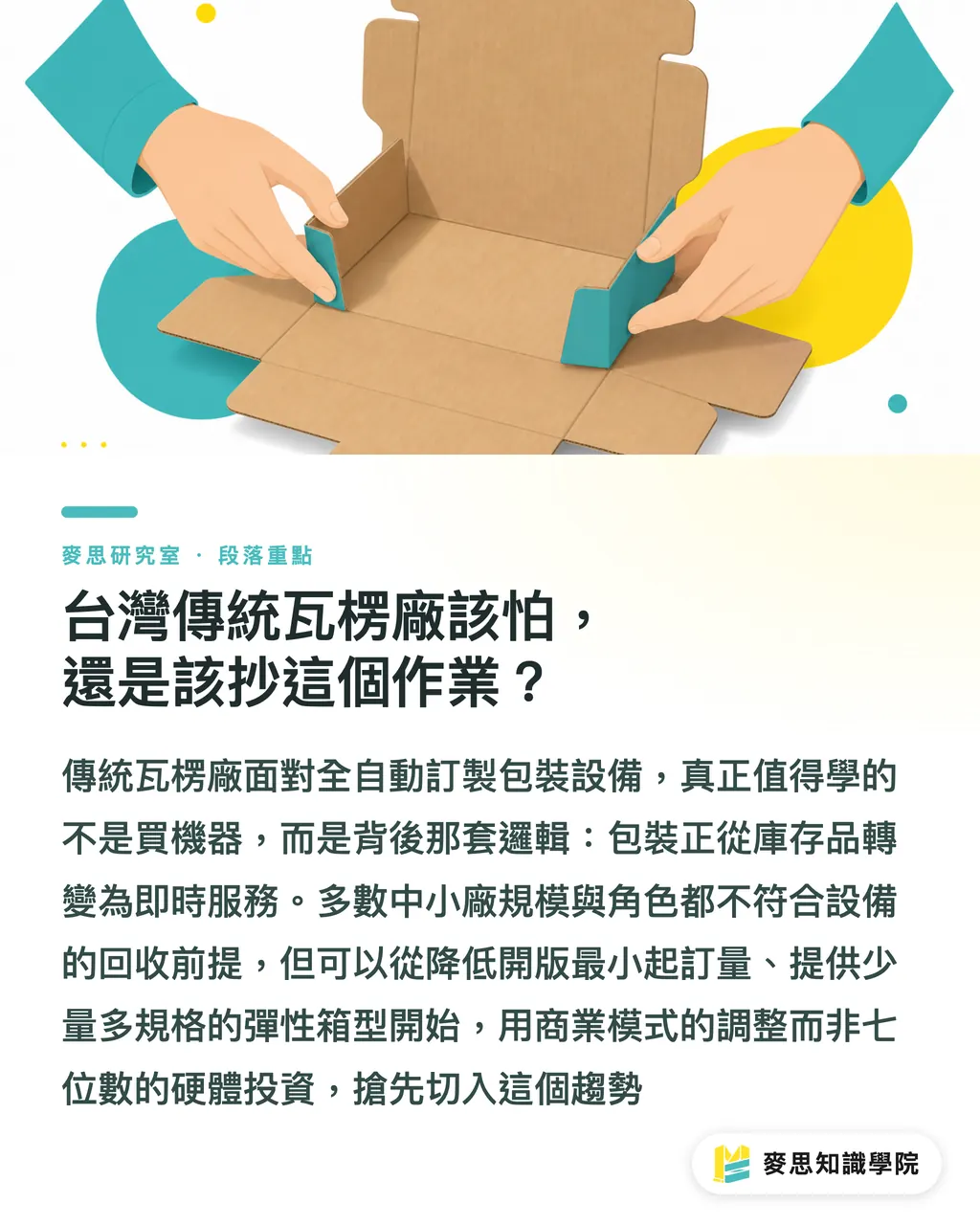
Third, what is worth copying is the mindset, not the machinery. The CVP Everest shows that packaging is shifting from an inventory commodity into a real-time service. You do not need to buy that machine to ask better questions: Can you offer short-run, multi-spec, fast-turnaround box options? Can you lower the minimum order barriers for tooling and die-cutting so clients do not have to order five thousand units just to get two hundred? Can you package finished boxes alongside board contracts and box-sizing optimization advice as a single solution? None of that requires seven-figure equipment. It takes a repricing of your business model
Beyond Selling Boxes, What Can Machines Never Take Away?
Machines are great at making right-sized boxes, but they fail at two things: brand experience and human judgment. These are the two fronts traditional plants must defend and double down on
Start with branding. A plain corrugated box cut on the fly offers maximum efficiency, but at the end of the day, it is just a brown box. For brand clients who care about the unboxing experience, print quality, and specialized structural designs like gift boxes, book-style boxes, or engineered internal cushioning, an on-demand plain box solves nothing. This high-margin segment, heavy on design and postpress finishing, remains out of reach for such machines and will only gain value as standard boxes become automated
Then look at judgment and compliance. As noted earlier, these machines continuously consume corrugated material [1]. In export markets, the origin, grade, and recyclability of that board are no longer afterthoughts. Brands in Europe and North America face stricter rules every year around packaging recyclability, extended producer responsibility, and material certifications. An on-demand box maker cannot tell a client whether a batch of board meets target market regulations, but a knowledgeable supplier can. Positioning yourself as a compliance and material consultant gives you an anchor that no machine can replace
The concluding takeaway is straightforward. The CVP Everest is not here to wipe out corrugated plants. It is here to phase out the business model of selling only standard inventory boxes and nothing else [1]. Your next step is not rushing to price out a machine, but auditing your revenue structure. What percentage of your sales relies purely on standard stock boxes? That is the portion you need to transform before your clients look elsewhere. Shift your resources toward flexible supply, upstream board, brand postpress finishing, and compliance consulting. You will not only survive this on-demand packaging shift, you might be the one capturing the new demand it creates

Key Takeaways
・ The CVP Everest eliminates the old premise that packaging sizes must be stocked in inventory, rather than threatening the corrugated industry as a whole [1]
・ It disrupts standard stock box inventory supply while consuming high volumes of corrugated board, shifting demand rather than erasing it [1]
・ The strongest incentive for downstream clients is cutting packaging material waste and excess freight fees by 30-50%, with dimensional shipping costs as the main battleground [1]
・ Most small and mid-sized traditional plants should adopt the packaging-as-a-service mindset rather than purchasing high-end automation they cannot keep fully operating
・ Machines cannot replace brand experience (design, postpress) or expertise (material compliance consulting), areas where plants should invest rather than clinging to plain box sales
Further Considerations
For print manufacturing, this serves as a wake-up call. When standard commodities can be produced automatically on demand, margins concentrate at the extremes of custom design and compliance, squeezing commodity inventory holders in the middle. For designers, the opportunity lies in turning box optimization and dimensional minimization into measurable engineering services rather than just visual work. The entry point for AI adoption is clear: optical measurement, nested cutting algorithms, and shipping data forecasting, capabilities demonstrated by the CVP Everest, can be integrated as modular tools to upgrade existing lines without buying complete machines. On the SaaS front, platforms managing box libraries, paper consumption, and compliance certificates could allow smaller plants to join this transition through service subscriptions rather than heavy capital outlays. The open question remains: as on-demand packaging scales up, whether raw board supply chains, traceability, and recycling systems can keep pace will determine if this efficiency promise is truly sustainable
References

FAQ
- What is the Packsize CVP Everest?
- It is a fully automated on-demand box packaging system that scans actual product dimensions on a conveyor, then cuts, folds, and seals custom-fit boxes in seconds without relying on pre-stocked box sizes. It is built for e-commerce fulfillment centers and logistics hubs [1]
- Does on-demand box making actually save costs, and where do the savings come from?
- The savings come primarily from materials and shipping. Source reports indicate it can reduce packaging material waste and excess freight surcharges by 30-50% by custom-fitting every box to the product and eliminating empty shipping space [1]
- Will traditional Taiwanese corrugated box plants be replaced by this equipment?
- The business model of selling only standard inventory boxes is what gets replaced, not the entire industry. The machines still consume large quantities of continuous corrugated board, shifting demand from finished boxes to raw material supply and support services [1]
- Should a traditional plant purchase a CVP Everest?
- Most small and mid-sized plants should avoid rushing into a purchase. The return on investment for automated machinery requires high, diverse daily shipping volumes. Without sufficient volume, it becomes an idle asset. The equipment delivers value to brands and 3PLs packing their own high-volume shipments [1]
- What value can machines never take away?
- Unboxing brand experiences, structural box design, postpress finishing, and expert guidance on material recyclability and export compliance. These are differentiated capabilities that on-demand box machines cannot provide and where traditional plants should focus their investments
References
Related articles


The Print × AI weekly
The print and AI know-how designers, brands and enterprises can use before they commit — one email, every week
MINDS Free Tools
AI background removal, brand stamping, and a LINE sticker maker — free design tools, right in your browser, no upload.
MINDS Group
Need actual printing or gifting services?
From premium printing to online ordering and festive gifts — the MINDS Group sister brands take it from here.