

What Is a Proof Actually Confirming?
Many clients hear 'do you want a proof?' for the first time and instinctively ask: haven't we already reviewed the PDF, why spend the money?
In all my years in printing, nearly every disaster I've helped clients avoid happened on jobs that skipped the proof
A proof is a sample sheet produced before the press run, designed to catch the three things most likely to go wrong before thousands of sheets roll off the machine
・Color shift: the blue on your screen prints as a completely different blue, this happens all the time
・Registration: whether the four color plates are aligned and whether text edges show ghosting from misregistration
・Content: typos, missing text, insufficient bleed, low-resolution images, these are things you only catch when you hold the physical piece
The critical point is that printing is a one-shot, high-volume, irreversible business
Digital printing lets you reprint a single bad sheet, but offset lithography starts at thousands of copies per run
I've seen a brand's hero red drift off-color and send an entire run of five thousand posters straight to the recycling bin, a loss that dwarfed the proofing fee they were trying to avoid
A proof isn't extra spending; it's insurance, and it's the cheapest policy you can buy anywhere on this production line

What's the Difference Between a Digital Proof and a Contract Proof?
These two terms get confused most often because they look similar, both are a sheet of paper that comes out of a machine, but their roles are completely different
Here's the plain-English dividing line: whether or not it can serve as an acceptance benchmark is the biggest difference between the two
Digital proof
・Output from a standard inkjet or laser printer to simulate the look of the finished print
・The upside is speed and low cost, you can often have it in hand the same day
・The limitation is that color accuracy depends entirely on the machine; without rigorous color calibration, reds can lean orange and grays can pick up green
・Best suited for 'getting a general sense': checking layout, catching typos, and verifying registration, it's perfectly adequate for all of those
Contract proof
・Also digitally output, but produced on a dedicated, calibrated proofing device paired with an ICC profile to simulate the target printing conditions
・An ICC profile, in plain terms, is a 'color translation table' — it tells the machine how a given color on your screen should actually appear on a specific press with a specific paper stock
・Because its color accuracy can withstand scrutiny, it can serve as a contractually binding acceptance standard between both parties, that's exactly what 'contract' in the name refers to
・If the final press sheets don't match the contract proof, liability is clearly established
One line to remember the difference
・Digital proof: check content and layout; color is for reference only
・Contract proof: color can be used as a standard; it's the sheet that gets used for 'settling accounts'
A common mistake among small and mid-sized businesses is taking an uncalibrated digital proof to the print shop and demanding they 'match this color'
That argument goes nowhere on the shop floor, because the proof itself isn't color-accurate, there's no shared standard to reference

Why Is a Press Proof the Most Accurate, and the Most Expensive?
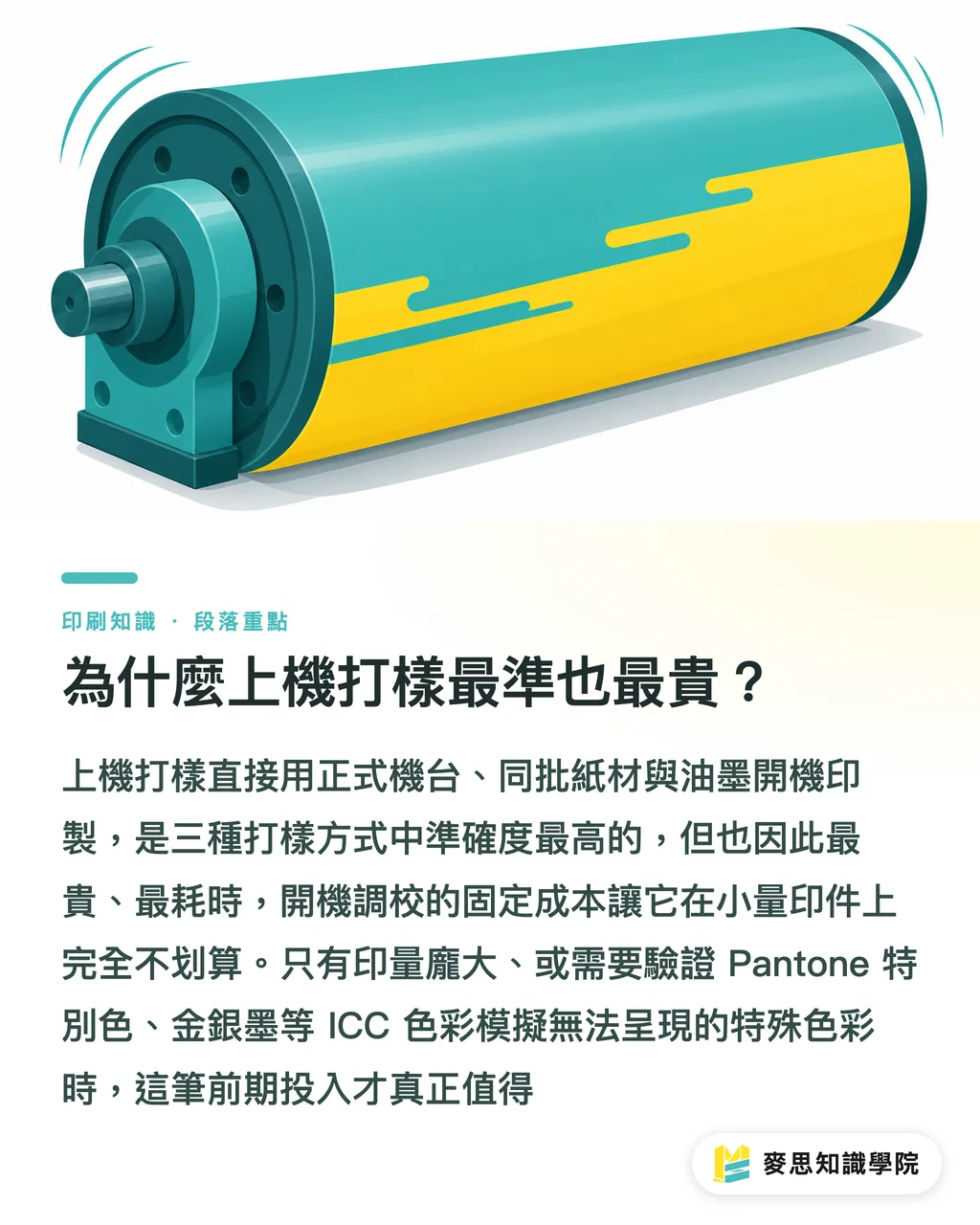
A press proof means actually running the exact press, the exact paper stock, and the exact ink set that will be used for the final job to produce one copy
The principle is straightforward: instead of simulating anything, you show the client the output under true production conditions
That makes it the most accurate of the three, by a wide margin
Paper absorbency, ink film thickness, dot gain, all of these variables are real, and what you see is what you get
The price you pay is equally direct
・Most expensive: setting up an offset press means mounting plates, mixing ink, and running makeready sheets, just getting the machine to a stable state burns through a significant amount of paper
・Slowest: it requires scheduling press time and waiting for the pressman to dial in the machine; rush jobs rarely get a slot
・The scenario where it doesn't make sense is obvious: if you're printing a few hundred standard flyers and you set up a full press run just for the proof, the cost is completely out of proportion
So when is it worth it?
・Very large print runs, where the upfront proofing cost becomes negligible once spread across tens of thousands of copies
・Special colors such as specified Pantone spot colors, metallic inks, or fluorescent colors that ICC profiles simply cannot simulate, only the real press can tell you
・Specialty substrates or special processes where ink absorption varies significantly and must be verified on the actual equipment
There's also one type of proofing that often gets overlooked: the soft proof
・It doesn't print anything, it's a simulated preview on a calibrated monitor
・The benefit is zero cost and zero wait time; you can check it the moment you finish a revision
・But the requirement is strict: the monitor must be color-calibrated and ambient lighting must be controlled, using a standard laptop screen for a soft proof is like measuring something with a ruler you know isn't accurate
・It's appropriate for quickly confirming direction during the design phase, not for final color acceptance
Color Accuracy vs. Budget: Which Proof Should You Actually Choose?
You don't need to memorize a list of specs, just answer two questions and you'll have your answer
First question: will it be a problem if the color is wrong on this job?
Second question: how large is the print run, and what's the budget?
Apply your answers to the following logic
・General collateral (business cards, flyers, internal documents, event DMs): a digital proof is sufficient, for simple content with a trusted print partner, even a soft proof or PDF sign-off works fine; the priority is catching typos and confirming layout
・Strict brand color requirements (corporate logo standards, annual reports, brand identity visuals, packaging): a contract proof is non-negotiable, because a brand color shift undermines the consistency of the entire brand identity, this is not a place to cut corners
・Large print runs or jobs with special colors: seriously consider a press proof; once the volume is large enough the cost amortizes, and special colors require the real press
A rule of thumb I often give clients
・Worried about color accuracy and can't afford to get it wrong: go with a contract proof or above
・Only worried about typos and can accept minor color variation: a digital proof will do
・Print run large enough that color drift becomes a disaster at scale: press proof
One final reminder about the step that gets skipped most often: a proof is a two-way confirmation, not a one-way handoff
When the proof arrives, don't just ask 'does it look nice?' — go through your original requirements item by item
・Do the primary colors and brand color values match?
・Are bleed, die-cut, and fold line positions correct?
・Will small text and reversed-out type hold without filling in?
The moment you sign off, you're taking ownership of the entire run
This is exactly why at MINDS we always discuss proofing as part of the complete production process: design, file check, proofing, printing, and finishing are a single chain, when the same color logic runs from start to finish, there's no finger-pointing at handoff points

Key Takeaways
A proof isn't extra spending, it's the cheapest insurance policy on this production line
Digital proofs are for content; contract proofs are for color, the difference is whether they can serve as an acceptance benchmark
Contract proofs use an ICC profile to translate screen color into press color, which is why they can bear the weight of acceptance responsibility
Press proofs are the most accurate and the most expensive; they only make financial sense for large runs or jobs with special colors
When choosing a proof type, first ask 'will a color error cause a real problem?' then ask 'what's the print run and budget?'
Further Thinking
The essence of proofing is 'aligning on a standard' — and this actually becomes more important as AI enters the design workflow
Today many people generate imagery with AI and produce visuals that look stunning on screen, but the rasterization, color gamut, and resolution may not translate to print
Looking good on a screen is not the same as printing accurately, and that gap is precisely why proofing exists, and why AI can't bridge it yet
The next step for design and print procurement teams is concrete: institutionalize color standards
Brand owners should have at minimum one clear color specification document, Pantone numbers or CMYK values, so every proof has something to compare against
For those building SaaS or digital tools, there's an opportunity here too: moving ICC profiles, soft proofing, and online color-matching comparison to the cloud so clients can see a credible simulation before placing an order is one area of print digitization that hasn't been fully captured yet
Back to the most practical point: don't treat proofing as an optional step in the process, it's your one and only chance to call a stop before spending the big money
FAQ
- How many types of print proofing are there?
- There are four mainstream types: digital proof (inkjet or laser simulation, fast and inexpensive but limited color accuracy), contract proof (calibrated proofing device with an ICC profile, high color accuracy that can serve as an acceptance benchmark), press proof (actually run on the production press, most accurate but most expensive and slowest), and soft proof (on-screen preview on a calibrated monitor, zero cost but requires strict environmental control)
- What's the difference between a digital proof and a contract proof?
- Both produce a printed sheet, but the biggest difference is whether the output can serve as an acceptance benchmark, a digital proof's color is for reference only and is best for checking layout and catching typos, while a contract proof is color-calibrated via an ICC profile and can be used as a binding contractual standard for acceptance between both parties
- When is a press proof absolutely necessary?
- A press proof is worth the time and cost in three situations: very large print runs where the upfront cost amortizes across the volume, jobs specifying Pantone spot colors or metallic and fluorescent inks that ICC profiles cannot accurately simulate, and specialty substrates or processes where ink absorption varies significantly enough to require verification on the actual equipment
- Do standard flyers and business cards need a proof?
- A digital proof is sufficient for general collateral, the focus should be on catching typos and verifying layout and bleed; for simple content with a trusted print partner, a soft proof or PDF sign-off works as well; a contract proof is not necessary in most cases
- Can a soft proof serve as the final color acceptance standard?
- This is not recommended, a soft proof is an on-screen preview that requires a calibrated monitor and controlled ambient lighting; a standard laptop display lacks the color accuracy needed, making it suitable only for quickly confirming direction during the design phase; final color acceptance should always be based on a contract proof
Related articles




The Print × AI weekly
The print and AI know-how designers, brands and enterprises can use before they commit — one email, every week
MINDS Free Tools
Spine width and imposition calculators — skip the manual math, free in your browser.
MINDS Group
Need actual printing or gifting services?
From premium printing to online ordering and festive gifts — the MINDS Group sister brands take it from here.