

Overview
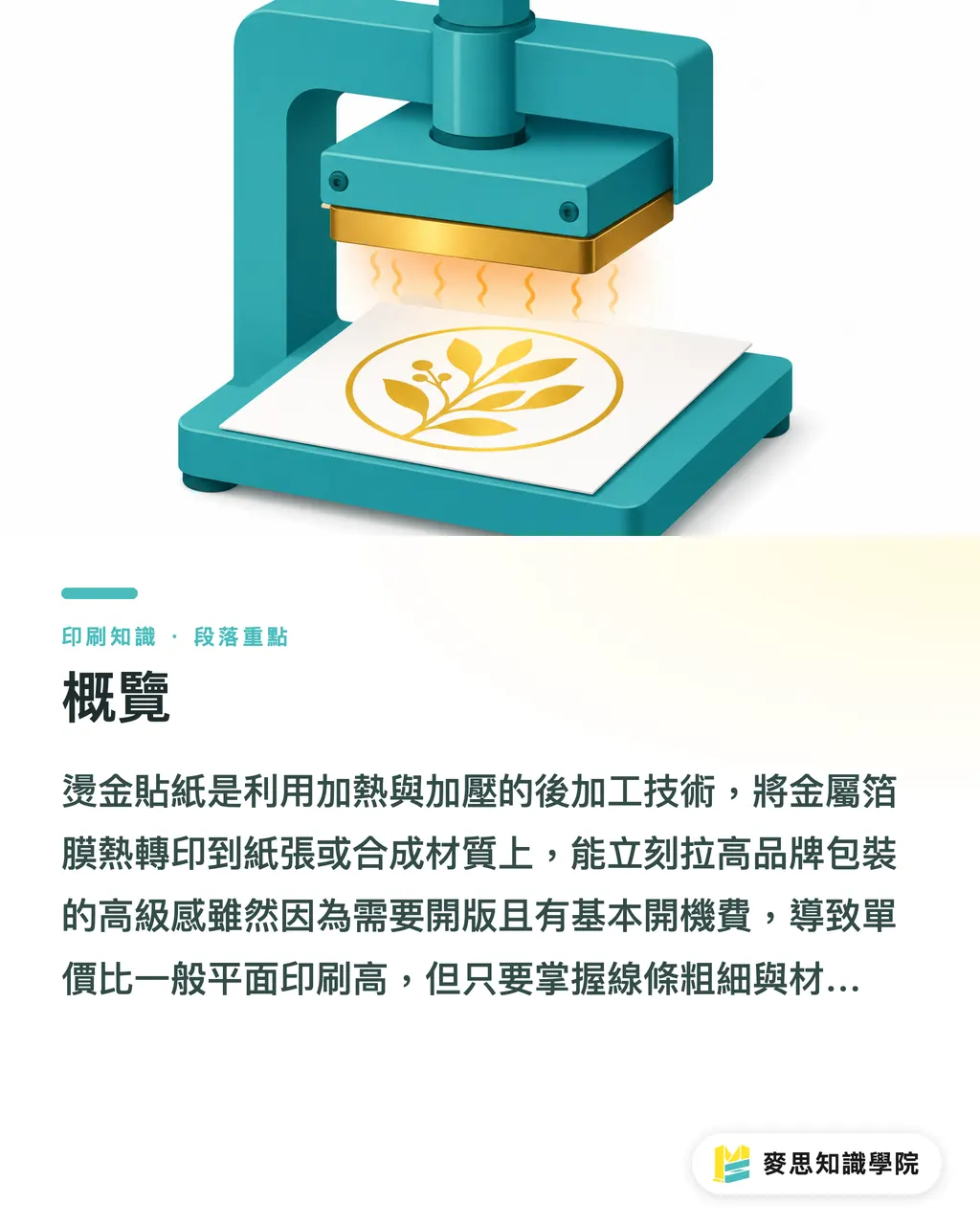
Hot foil stamping stickers use heat and pressure as a finishing technique to thermally transfer metallic foil film onto paper or synthetic substrates, immediately boosting the premium perception of brand packaging
Although unit costs are higher than standard flat printing due to die-making fees and a base setup charge, mastering the rules around line weights and material properties lets you avoid the disaster of smearing and reprinting — making every cent of the budget well spent
How Are Foil Stamping Stickers Made — and How Do They Differ from Regular Printing?
Clients who receive a proof often ask: 'The printing looks great, but something feels missing.' The answer usually has nothing to do with four-color printing — what's missing is a reflective finishing process
Standard printing layers four-color (CMYK) inks on paper; no matter how precisely you mix the colors, you can never achieve true metallic luster
Foil stamping is an entirely different physical process — no ink is involved at all. It relies entirely on heat and pressure
On the production line, we first fabricate a metal die (typically zinc or copper) based on your artwork
The machine is then heated to approximately 110°C–130°C, with a foil film placed between the sticker substrate and the metal die
When the machine presses down, the high temperature melts the adhesive backing on the foil film, bonding the metallic layer firmly to the sticker surface
The result is a visually striking metallic reflection, and because pressure is applied, the surface carries a subtle debossed texture you can feel with your fingertips — something flat ink can never replicate
Why Does Foil Stamping Always Cost More Than Regular Stickers — and Where Does the Budget Go?
Many clients new to print procurement are shocked when they see a quote for foil stamping stickers. The cost structure is fundamentally different from standard gang-run printing
Foil stamping costs are built from three components layered on top of one another: die fees, stamping labor, and material costs
・Die fees: Every individual foil stamping design requires its own dedicated metal die, which typically ranges from a few hundred to over a thousand dollars depending on the area size
・Setup and stamping labor: The operator spends considerable time registering the metal die to extremely tight tolerances and running tests on pressure and temperature — this upfront setup charge is fixed regardless of quantity
・Material costs: Beyond the common bright gold and bright silver foils, choosing laser film, rose gold, or specialty-colored foil stocks adds to the material cost
From years of tracking production costs on the floor, if you only print 100 sheets, the amortized die and setup fees result in a terrifying per-unit cost
I typically advise clients to bring the quantity up to 1,000 sheets or more before the per-unit price reaches a sensible sweet spot — which is also why foil stamping stickers tend to suit mature product packaging where the artwork has already been confirmed
How Should I Set Up My Files to Avoid Smearing or Broken Lines?
This is the most common minefield I encounter when reviewing client files every day. Foil stamping isn't as simple as filling a shape with yellow — it has strict physical constraints
When the metal die is heated and pressed, thermal energy spreads slightly outward in a phenomenon called thermal expansion
If you shrink text very small or draw lines very thin on your monitor, what actually stamps out is often a smeared blob of metal — or the foil simply won't adhere at all
To ensure crisp, clean foil stamping, please follow these field-tested file standards without exception
・Line weight: The minimum line weight for positive stamping (foil on background) must be no thinner than:
・0.2 mm (approximately
・0.5 pt). For reverse foil stamping (foil as background with knocked-out type or details), lines must be thickened to
・at least 0.3 mm, or thermal expansion will fill them in
・Font selection: Minimum recommended type size is 8 pt or above. Avoid typefaces with extreme stroke-width contrast such as Mincho or Song typefaces; switching to a sans-serif will be far safer
・Vector artwork: The foil stamping die can only read pure black (K100) vector paths. Always supply AI or PDF format files, and confirm that all text has been converted to outlines
・Registration tolerance: Foil stamping is a secondary finishing process and will always carry a physical registration variance of 1–2 mm. Never design the foil stamping outline to align perfectly with the edge of a printed color block — this almost guarantees an awkward white gap
Does Material Choice Affect the Adhesion and Brightness of Foil Stamping?
Absolutely — the same roll of foil stamped onto different sticker substrates produces completely different results and levels of difficulty
The most common coated paper sticker has a smooth, coated surface that offers excellent foil adhesion; the stamped edges come out the sharpest and the reflection is uniformly bright
Tear-resistant, waterproof pearl stickers or clear stickers made of plastic substrates are a different story. Because they are non-absorbent and have different surface tensions, the operator must adjust temperature and pressure, and may even need to switch to a specific foil grade to achieve a secure bond
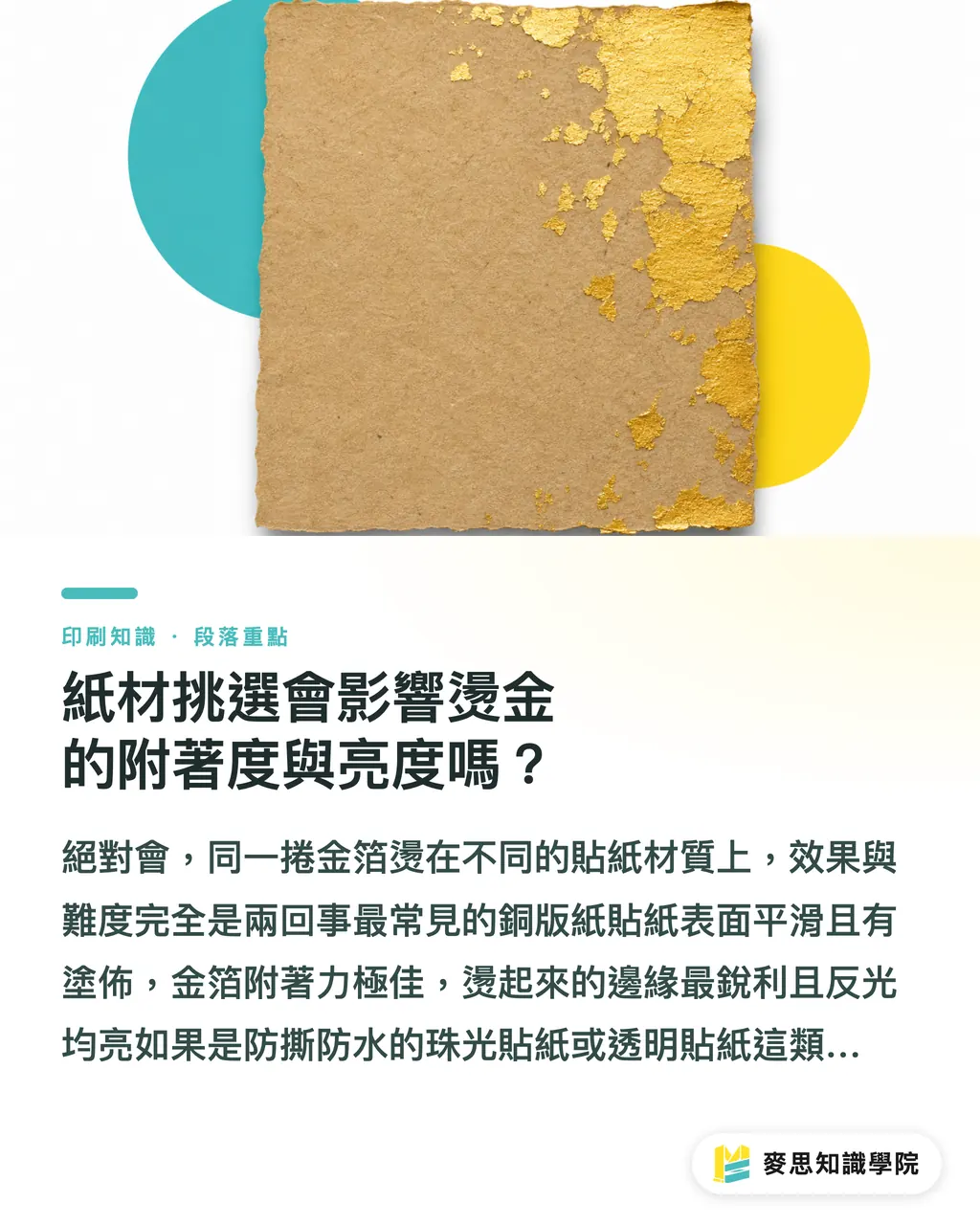
The most failure-prone materials are art paper stickers with coarse textures, such as uncoated stock or natural kraft
The pores and fibers in the paper surface absorb the pressure, causing ragged edges on the foil stamping, or tiny pinholes across large stamped areas — commonly known as 'sandhole defects'
If you absolutely must stamp on a deeply textured substrate, I generally advise clients to keep the artwork as simple as possible, avoiding intricate fine details, and to let the craftsmanship work with the material's natural character
Key Takeaways
・Foil stamping uses high heat and pressure to transfer metallic foil film, creating the reflective sheen and subtle debossed texture that ink cannot replicate
・Costs include fixed die fees and setup charges; printing 1,000 or more sheets is recommended to amortize the per-unit price effectively
・File line weights must be no thinner than 0.2 mm, type size must be 8 pt or larger, and artwork must be supplied as pure black vector outlines
・Smooth coated paper stickers yield the sharpest foil results; art paper substrates are prone to ragged edges or sandhole defects due to surface porosity
Further Considerations
Upgrading a brand doesn't always require a costly overhaul of packaging structure — sometimes a single high-quality foil stamping sticker is all it takes to completely refresh the overall visual impression
When preparing your files, build in the 1–2 mm registration tolerance and the 0.2 mm minimum line-weight constraint from the start, and you'll save countless rounds of back-and-forth communication with the print shop — and avoid reprints
If you have complex finishing requirements, working with a team like Minds that has integrated one-stop experience means potential conflicts between materials and finishing processes can be identified at the pre-press stage, ensuring the final product meets your expectations
FAQ
- Can I order foil stamping stickers in a quantity of just fifty or one hundred?
- Technically yes, but because foil stamping requires a dedicated metal die and a fixed machine setup fee, amortizing those fixed costs across such a small quantity results in a very high per-unit price. We recommend evaluating your budget carefully before committing
- My logo has a gradient — can it be done in foil stamping?
- No. Traditional foil stamping uses a physical metallic foil film that can only render a single, fully saturated solid color. Gradients or semi-transparent effects are not achievable with this process
- What is the difference between hot foil stamping and cold foil stamping?
- Hot foil stamping produces a noticeable debossed feel and exceptional metallic brilliance. Cold foil uses a different technology to adhere metallic foil to a flat surface; while it lacks the tactile relief and the brightness is slightly lower, it is well-suited for large coverage areas or for overprinting with four-color inks
- Why does my designer say reverse foil stamping lines need to be thicker than positive foil stamping lines?
- Because the metal die expands slightly when heated, causing the stamped foil area to spread outward a little. If the knocked-out lines in a reverse design are too thin, the surrounding foil that spreads inward during stamping will easily fill them in and merge into a smeared mass