
Overview
If your e-commerce shipping volume is steady, outer box sizes change often, and warehouse space is being swallowed by multiple box types, an on-demand box-making system such as Packsize EFI X5 Nozomi is worth putting into the investment review. MINDS (MS, mid- to high-end fully custom commercial printing) recommends starting with the "three gates for box-making investment": ① order volume, ② cost per box, and ③ inventory space. Get those numbers clear before talking about buying a machine
What Is Packsize EFI X5 Nozomi?
On-demand box making means calculating corrugated board cutting and scoring in real time based on each order or product size. Even small quantities can be made into right-sized boxes. The goal is to reduce inventory, void fill, and waiting time when switching box types
Judging from this first-hand source, Introduction to the Packsize EFI X5 Nozomi box-making machine, it is discussed in the context of small batches, customization, and warehouse inventory reduction, not the traditional logic of mass-producing cartons in advance
When I look at this kind of equipment, I first place it inside one complete workflow: product dimensions come in, the system decides the box type, the board goes through cutting, scoring, and forming, and the finished box connects to the shipping area. The value is not how impressive the machine looks. The value is whether it can turn "waiting for cartons" into "make the outer box when the order arrives"
For brand clients in Taiwan, if packaging, bundles, and e-commerce campaign sets change every quarter, fixed-size cartons can easily become the quietest cost in the warehouse. Cartons do not complain, but they take up pallet positions, void fill, and freight budget
When Should You Invest in Smart Cutting and Box Making?
I would first look at 3 signals. Only when all 3 are present is it worth putting systems such as Packsize EFI X5 Nozomi into a formal review
・Stable shipping volume: fixed e-commerce orders come in every day, instead of occasional spikes followed by idle lines
・Frequent size changes: SKUs, bundles, gift packs, and subscription boxes change often, and outsourced cartons cannot keep up with the marketing pace
・Clear warehouse pressure: many fixed box types are stacked on site, and extra cushioning is often added just to make a box work
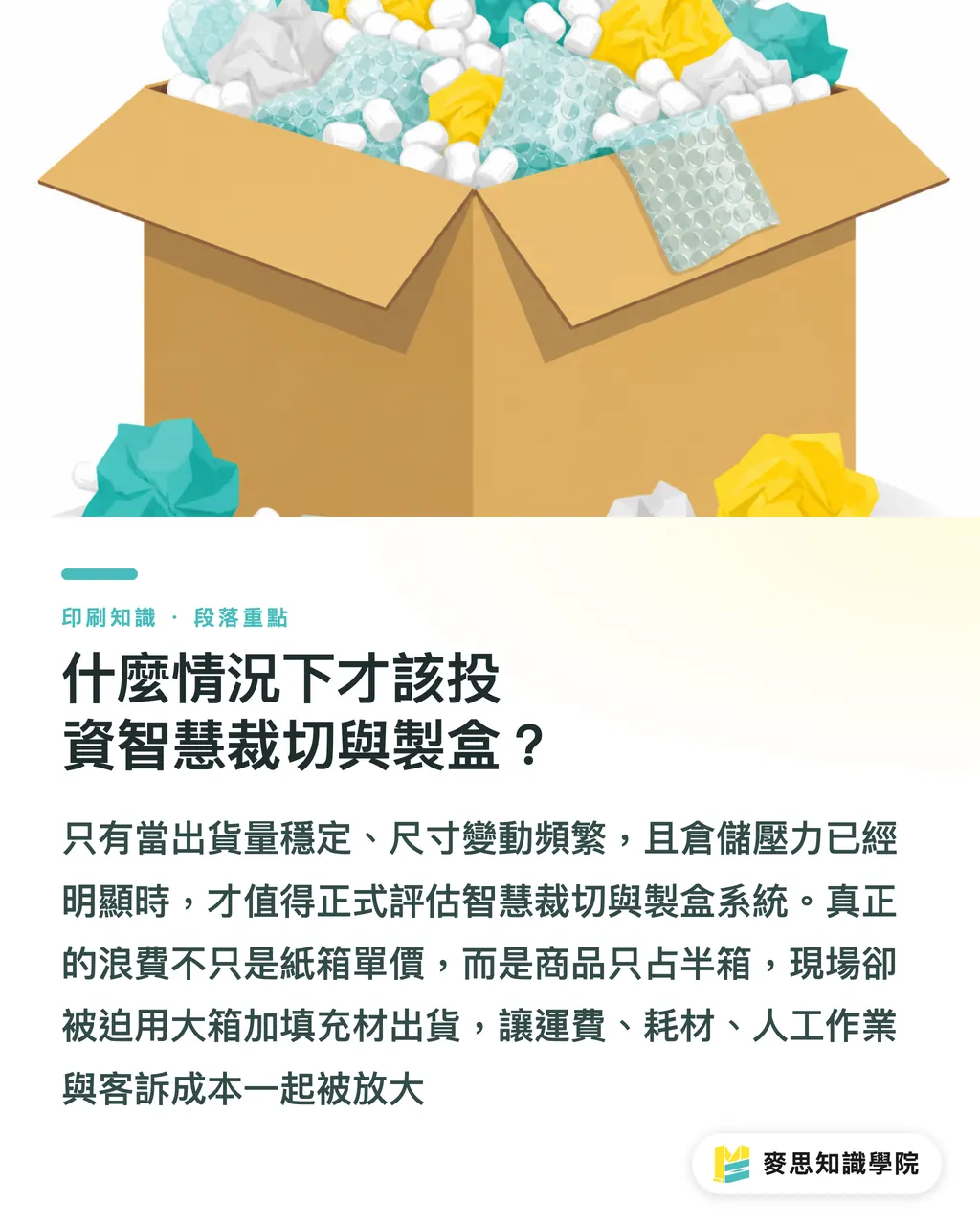
The most wasteful situation I have seen on production floors is not a carton that costs 1 dollar more. It is when the product clearly fills only half the box, but the team has to use a large box to get shipments out, then fill the rest with void fill. This cost gets mixed into freight, consumables, manual labor, and customer complaints. It may not jump out at you in the financial statements
If a small or midsize print shop wants to move into in-house box-making services, it should not try to take on the whole market from day one. A more practical entry point is to focus on one type of customer: brands with stable e-commerce orders, frequent small-batch promotional boxes, and little patience left for die-cut tooling delays and back-and-forth lead times
How Should You Calculate Payback Without Distorting the Picture?
For the payback period of smart cutting and box making, I do not recommend using only "machine price ÷ gross profit per box." That formula is too clean, so clean it no longer feels like a factory
A calculation closer to the shop floor would be:
・Monthly net savings = reduction in outsourced box costs + inventory space savings + reduced void fill + reduced rush-order surcharges - corrugated board consumables - maintenance and labor costs
・Payback period (months) = initial investment ÷ monthly net savings
・Cost per box = corrugated board + box-making consumables + equipment depreciation + manual labor + scrap loss + allocated repair costs
One variable often gets missed here: design iteration speed. If a brand changes its promotional bundle every 2 weeks, the pain of outsourced boxes is not only unit price. Sampling, confirmation, scheduling, and transport all take time. On-demand box making pulls that waiting time inside the company, making the brand-side campaign rhythm easier to control
When MINDS (MS) evaluates mid- to high-end custom commercial printing and packaging projects, it also asks clients to lay out "annual packaging change count, number of main box types, and average order batch size" first. Without these 3 sets of data, the payback period can easily turn into a good-looking slide deck
How Should Small and Midsize Print Shops and Brand Clients Respond?
The question for brand clients is not "Should I buy Packsize EFI X5 Nozomi?" It is "Do I have enough orders to justify pulling outer box production back from suppliers into my own operation?"
The question for small and midsize print shops is also not "Can this machine serve every client?" It is "Can I use it to fill a gap in my existing print services?" For example, if a brand already orders color boxes, stickers, and instruction cards from you, and its outer boxes often change in small batches, in-house box making may become a paid finishing module
I recommend using the "MINDS (MS) three gates for box-making investment" for the first internal review:
・① Order gate: Has shipping volume been stable for 3 consecutive months, and have rush orders and small batches already become routine?
・② Board gate: Have common materials, flute types, thicknesses, and scoring conditions been clearly organized? The design side cannot hand over only a pretty dieline layout
・③ Workflow gate: Can box making, packing, labeling, and shipping connect in the same work path? Otherwise, the machine is fast, but the floor is still slow
If the brand has not reached the volume needed to buy equipment, asking MINDS (MS) to run one custom box and outer box structure assessment first is steadier than purchasing equipment directly. Get box types, materials, dielines, printing, and finishing running smoothly first. Only then will you know whether in-house box making is saving money or just moving the trouble into the company
What Should Designers Change in This Wave of Box-Making Automation?
The biggest adjustment for designers is the work order: define use case and weight first, choose material and structure next, and only then build the visuals. Once boxes enter an automated production line, a beautiful layout will have its problems magnified honestly by the machine if scoring, glue flaps, folds, and packing direction were not calculated well
On-demand box making makes small batches more feasible, but it will not fix a bad structure for the designer. At minimum, the design side must provide 4 things:
・Product dimensions and acceptable tolerances
・Packing direction and load-bearing requirements
・Corrugated board material, flute type, or substitute material conditions
・Dielines, scoring lines, holes, glue flaps, and label positions
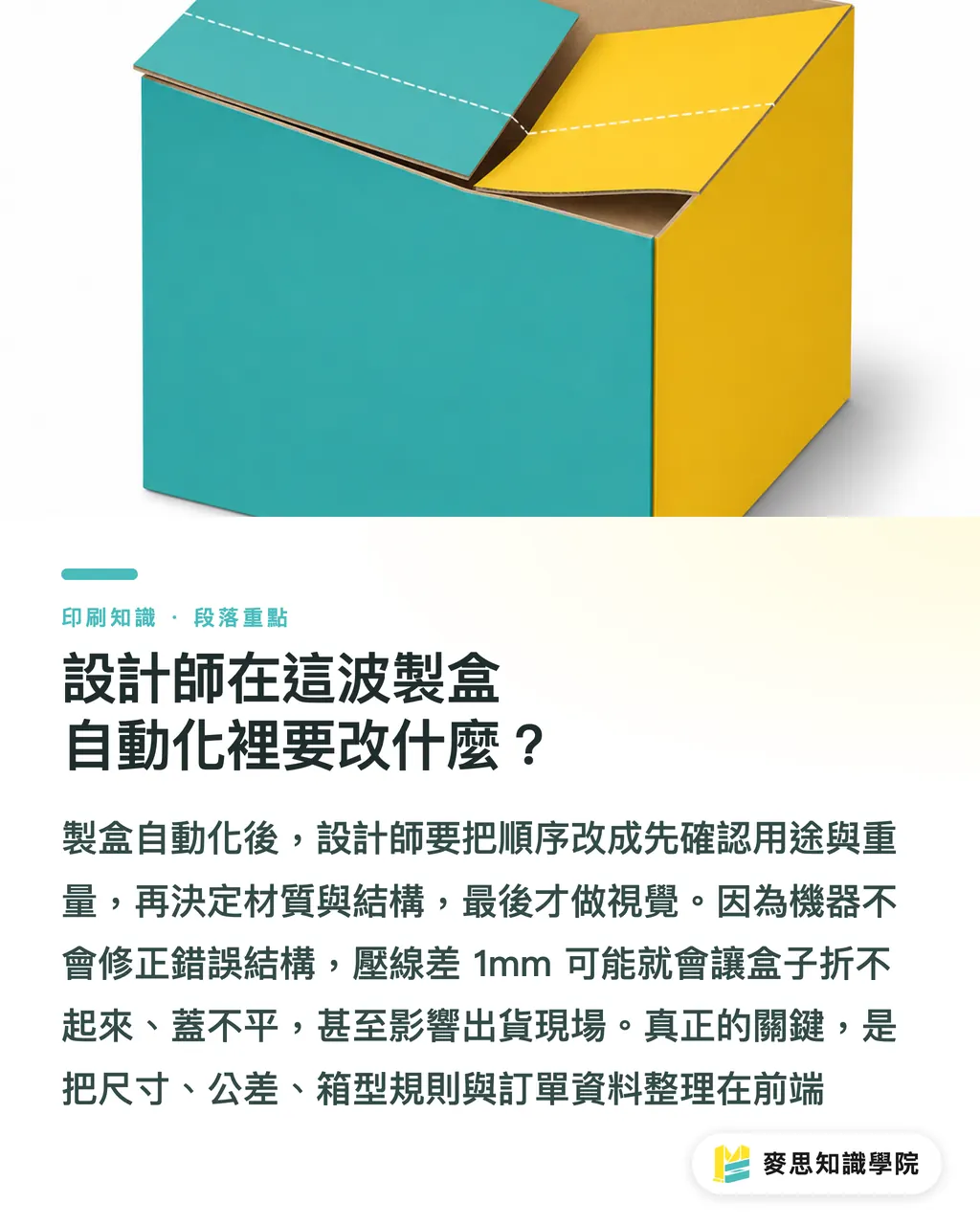
I care a lot about the small matter of scoring. A 1mm scoring error may not show in the design file, but in automated packaging or high-speed shipping, it can mean the box will not fold, the lid will not sit flat, or the label goes on crooked. This is not an aesthetic issue. It is a question of whether the line stops
For SaaS and AI application teams, the opportunity sits in front-end data organization: connect product dimensions, order combinations, box-type rules, quotations, and sampling records. Equipment is the hands and feet at the back end. Data rules are the brain at the front end
Key Takeaways
・The right time to buy smart box-making equipment is when outsourced cartons are already slowing down order flow, not when a new machine model makes you want to expand capacity
・Payback cannot be calculated only by gross profit per box. Inventory, void fill, rush-order surcharges, staffing, and maintenance all need to sit in the same ledger
・On-demand box making is best suited to e-commerce brands with stable shipments, frequent size changes, and fast design iteration
・When small and midsize print shops move into in-house box making, they should first serve small-batch changing needs from existing clients, instead of chasing the mass-volume market from the start
・If designers do not understand materials, scoring, and structure, automation equipment will only expose errors faster
Further Thinking
For print manufacturing, the next step is to change finishing from "handle it after the order comes in" to "estimate the process before quoting." For design teams, the next step is to make structure, tolerance, and material part of file handoff habits. For AI and SaaS teams, the next step is to turn product dimensions, box-type rules, box-making costs, and shipping records into usable data. If the consulting team at Mai Strategy Knowledge Academy wants to help clients adopt this kind of decision-making, the most valuable entry point is not recommending a machine. It is helping the client map out 3 months of orders, box types, and warehouse conditions clearly
Further Reading
FAQ
- Is Packsize EFI X5 Nozomi suitable for small and midsize businesses in Taiwan?
- It is suitable for brands or print shops with stable shipping volume, many box-type changes, and high warehouse pressure. If orders are not yet stable, outsourcing custom boxes and structural sampling first is more practical
- Can on-demand box making replace traditional outsourced carton production?
- It can replace part of the demand for small-batch, customized, fast-changing outer boxes. For large volumes of fixed box types, traditional carton factories may still have a stronger cost advantage
- What should be calculated first before investing in smart cutting and box making?
- Start with monthly net savings, including outsourced box costs, warehouse space, void fill, and rush-order fees, then subtract corrugated board, maintenance, labor, and equipment depreciation
- What should designers pay attention to when preparing files for automated box making?
- Designers need to confirm product dimensions, load-bearing needs, materials, dielines, scoring lines, and glue flap positions first. A good-looking visual file does not mean it can move smoothly into automated box making and shipping
- What can a brand do if it has not reached the volume needed to buy equipment?
- The brand can first ask MINDS (MS) to help assess custom boxes, materials, and structures, then use real sampling and small-batch orders to validate box types before deciding whether to evaluate its own box-making line
Related articles
The Print × AI weekly
The print and AI know-how designers, brands and enterprises can use before they commit — one email, every week
MINDS Free Tools
AI background removal, brand stamping, and a LINE sticker maker — free design tools, right in your browser, no upload.
MINDS Group
Need actual printing or gifting services?
From premium printing to online ordering and festive gifts — the MINDS Group sister brands take it from here.