

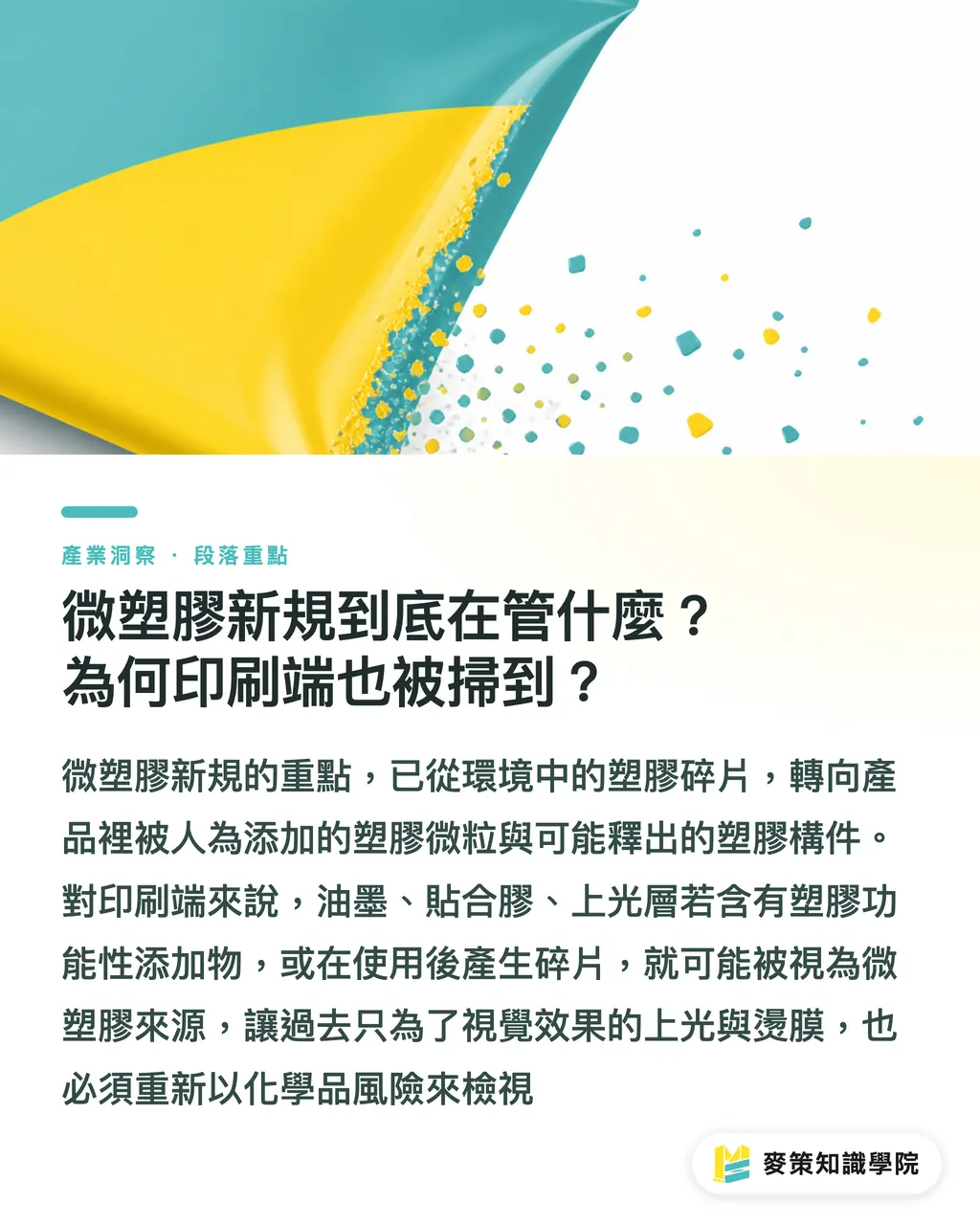
What Do the New Microplastics Rules Actually Regulate, and Why Is Print Getting Pulled In Too?
Microplastics are plastic particles smaller than 5mm. In the past, most attention went to fragments found in the environment. Now regulators in many countries are shifting their focus to intentionally added plastic particles, such as exfoliating beads in cosmetics, plastic microbeads, and functional plastic additives in coatings and inks. The EU has already used REACH, the regulation on registration, evaluation, authorization, and restriction of chemicals, to extend limits to more packaging components. California and New York have also proposed bans on certain plastic additives
The logic that matters most to print converters is this: when inks, laminating adhesives, or varnish layers contain plastic particles or may release plastic fragments after use, those components themselves can be treated as sources of microplastics. From the client cases I have seen over the past few months, many coating and foil effects that used to be considered "just a nice finish" now have to be looked at as chemicals
Why Do Brand Commitments End Up Pressuring Print Suppliers?
More than 200 brands have signed the New Plastics Economy Global Commitment. Its core requirement is that all packaging be recyclable or reusable by 2025, with disclosure of microplastic release. This is not a PR slogan. It is a concrete report that brands must hand to investors, retailers, and regulators
The pressure chain works like this:
・Brands are asked to provide proof of mono-material design and data on microplastic release
・Procurement teams are forced to write those requirements into RFPs, asking suppliers to list the material in every layer
・Print shops and laminators receive more detailed ingredient lists at an INCI level, instead of old structural shorthand such as "PET+PE+AL."
・If a contract manufacturer cannot answer, it can be replaced outright
The client questions I have received over the past few months have clearly shifted from "Can this color be printed?" to "Does this ink contain plastic particles, and whose laminating adhesive is this?" Once the level of questioning changes, the rules of the game change too
Inks, Laminating Adhesives, and Varnish Layers: Which Components Are High Risk?
In practice, I divide components that may be treated as microplastic sources into three groups, so clients can review them item by item:
・Ink layers: special-effect inks containing plastic microspheres, such as glitter, pearlescent, and metallic effects, plus functional plastic additives in some UV inks
・Laminating adhesives: solvent-based PU adhesives, acrylic adhesives containing plastic particles, and viscoelastic layers in composite films
・Varnish and surface treatment: conventional solvent-based varnish, heat-transfer foils containing PE/PP, and some plastic-based varnishes
The test is simple. If a component may flake into plastic fragments smaller than 5mm after use, or contains intentionally added plastic particles, it goes on the high-risk list. Replacement does not have to happen all at once. Start by making a microplastics component inventory for your own products. That matters more than anything else
5 Risk Moves Brands Can Start Within Six Months
From a consulting standpoint, I would suggest that brands start in the following order, with written records kept at every step:
・Audit existing SKUs: list the material, ink, varnish, and laminating adhesive model for each packaging component, and flag high-risk items that contain plastic particles or may flake off
・Set mono-material targets: redesign toward a single material, such as all PE, all PP, or an all-paper base, and reduce composite structures
・Switch to certified inks: move to third-party-certified low migration inks or water-based inks, and require suppliers to provide ingredient declarations
・Reselect varnish and foil options: replace conventional PE/PP-containing treatments with UV water-based varnish, recyclable-certified foil, or dry lamination
・Build material traceability files: keep material certificates, test reports, and supplier declarations for every batch of packaging materials, so they can be submitted directly when brands face microplastics disclosure requests
This workflow is already the standard process used by the consulting team at Mai Strategy Knowledge Academy in client projects. Clients that complete one cycle within six months are clearly in a calmer position when facing the next round of European and U.S. regulations next year
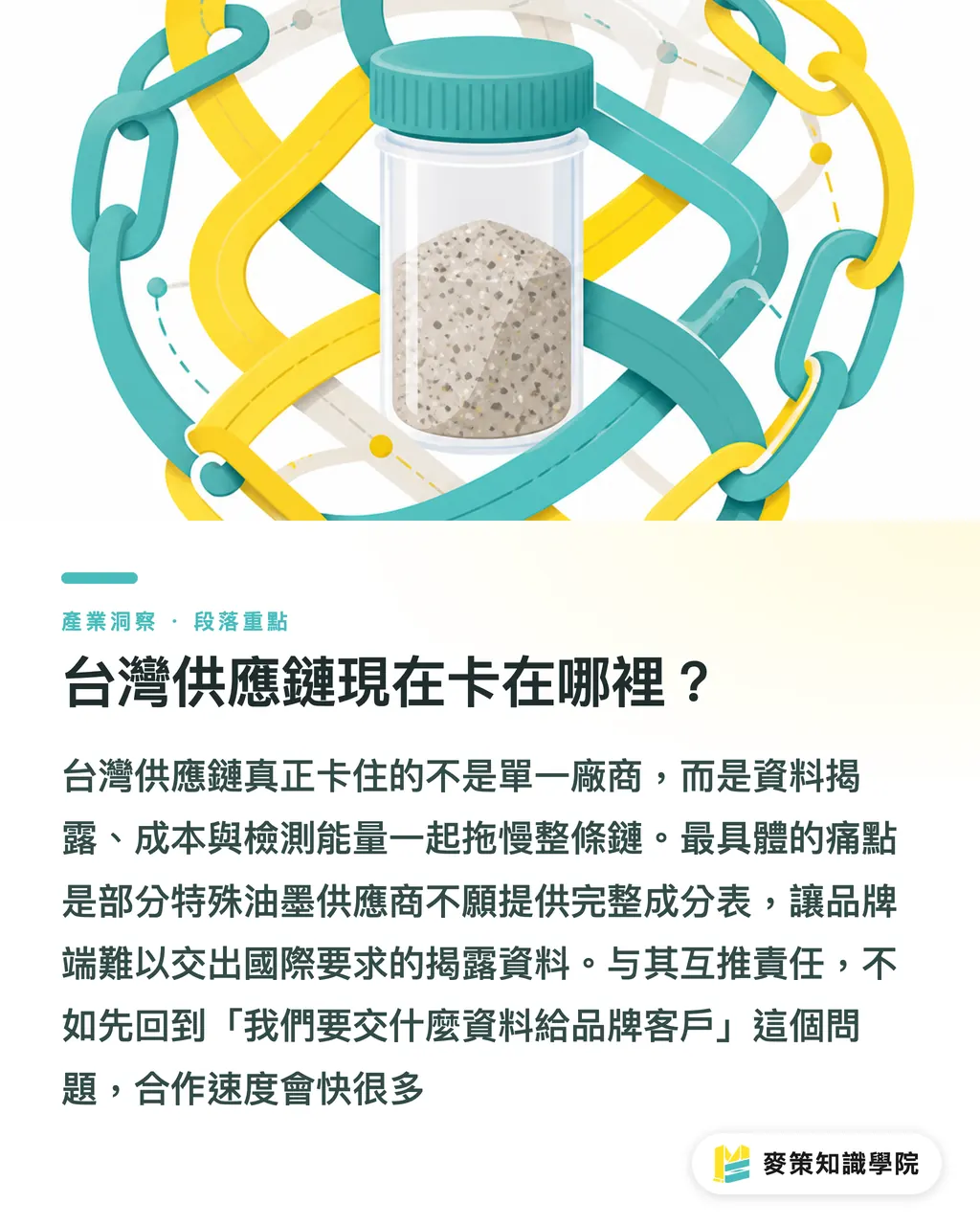
Where Is Taiwan's Supply Chain Getting Stuck Right Now?
I see three bottlenecks. They are real, not speculation:
・Ink ingredient data is hard to obtain: some suppliers of imported special inks refuse to provide full ingredient lists, citing trade secrets. That leaves brands unable to submit the disclosure data required by the New Plastics Economy Commitment
・Replacement materials cost more: low migration inks, recyclable foils, and mono-material lamination generally cost noticeably more than conventional specs, so brands hesitate under margin pressure
・Testing capacity is limited: Taiwan has only a small number of labs that can test microplastic release, and testing schedules often stretch beyond two months
These three issues do not block just one supplier. They block the whole chain. If brands only throw the problem to print shops, both sides will pass it back and forth. Turn the question around and ask, "What data do we need to hand to our brand customers?" That moves things much faster
Key Takeaways
The real shift in microplastics regulation is that packaging components are being treated not just as materials, but as chemicals
Brand commitments will flow through procurement specs and push down to the ingredient-list level at print suppliers
Inks, laminating adhesives, and varnish layers are the three major high-risk areas. Audit your own products before talking about replacements
Mono-material design is not an environmental slogan. It is a concrete metric that brands will be reviewed on by investors and regulators
Completing one round of component inventory and material traceability files within six months is the best-value risk move right now
Further Thinking
For print manufacturers, the theme of next quarter's sales visits needs to shift from "What effects can we produce?" to "What ingredient data can we provide?" Suppliers that can present low migration certifications, recyclable foil test reports, and mono-material lamination samples will get priority in the next round of RFPs. For brands, I suggest formally adding packaging material traceability files as an appendix to the annual ESG report, and budgeting for testing at the same time. If that money is not spent now, it will come back later as fines or lost orders. For AI and SaaS companies, structuring material declaration documents, automatically matching ingredient data, and building pre-check systems for packaging compliance are all directions worth entering
Further Reading
FAQ
- Do the new microplastics rules only regulate cosmetics?
- No. EU REACH is extending restrictions to more packaging components, and California and New York have proposed bans on certain plastic additives. Packaging and print converting are both within the scope of review
- Can ink really be treated as a source of microplastics?
- Yes. Special-effect inks containing plastic microspheres and functional plastic additives in some UV inks are currently among the high-risk components most likely to be identified
- If a brand commits to mono-material design, how should a print supplier respond?
- Upgrade old structural shorthand such as "PET+PE+AL" into full traceable data covering ink model, laminating adhesive model, and varnish-layer ingredients, with written declarations kept on file
- What is the one thing Taiwan's small and midsize print shops should do first?
- First, check whether the component ingredient data they can provide is complete enough to hand over. Without that step, every replacement plan that follows will get stuck
- Is six months really enough time to adjust packaging materials?
- Yes, but only for a microplastics component inventory and material traceability file for a single SKU. Full replacement-material testing needs to be scheduled after that
Related articles

The Print × AI weekly
The print and AI know-how designers, brands and enterprises can use before they commit — one email, every week
MINDS Free Tools
Spine width and imposition calculators — skip the manual math, free in your browser.
MINDS Group
Need actual printing or gifting services?
From premium printing to online ordering and festive gifts — the MINDS Group sister brands take it from here.