

Why will 55% rPET change prepress work?
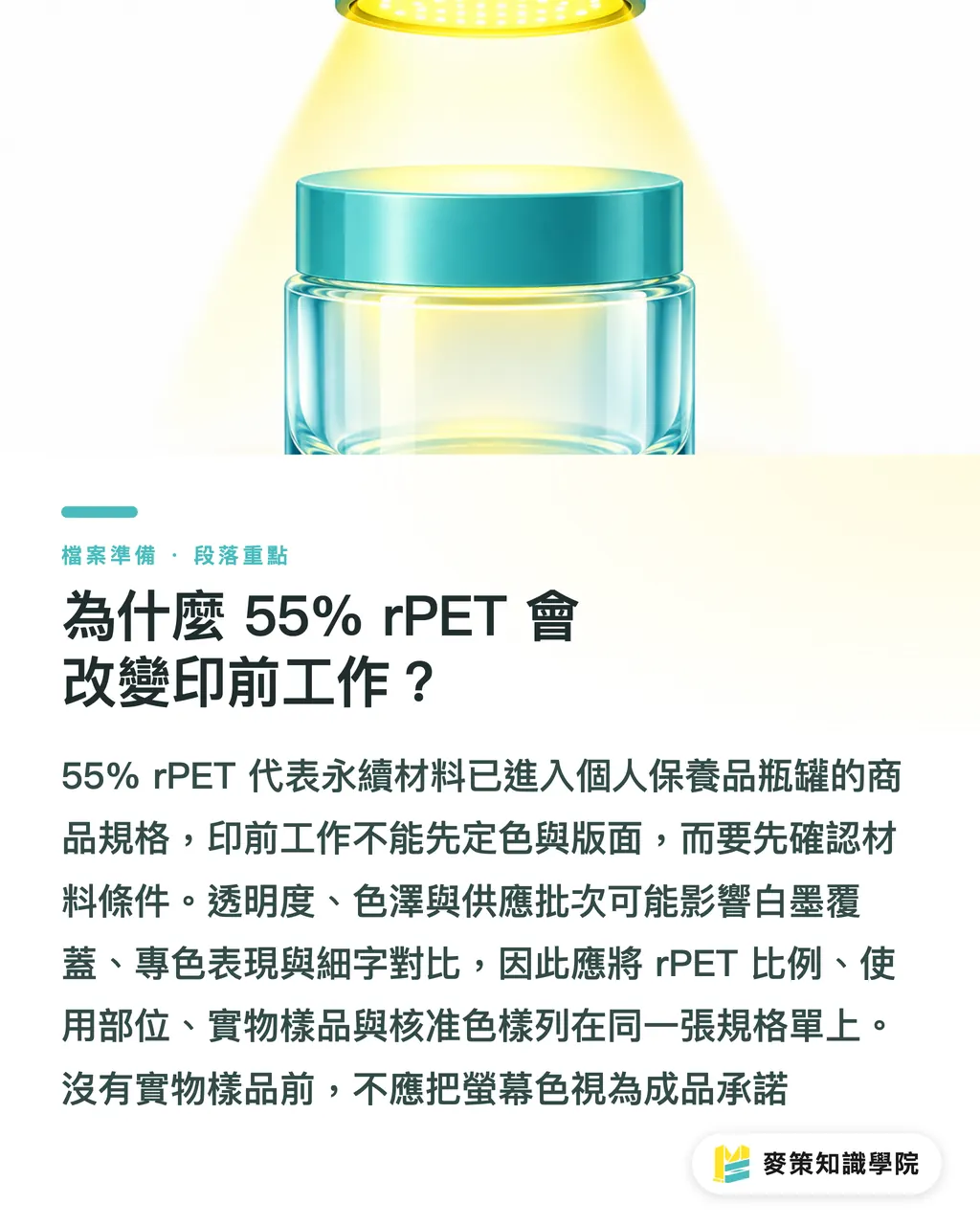
The signal from 55% rPET is that sustainable materials have already entered the product specifications for personal-care bottles and jars. Designers need to ask about material conditions first, then decide on color and layout
At London Packaging Week 2026, Spectra unveiled personal-care bottles and jars with an rPET content of 55%, exceeding the threshold for the UK market. The key point in Packaging Insights' exhibition report is that the material percentage is now tied to the product's appearance and supply conditions
rPET (recycled polyethylene terephthalate) is PET reprocessed into usable material. The design team needs to confirm transparency, color, and supply batch at the same time, not just look at the recycled content
When the same artwork is moved onto a bottle or label substrate containing recycled material, white-ink coverage, spot-color rendering, and small-type contrast may all differ from the original proof. I require designers to put the rPET percentage, where it is used, the physical sample, and the approved color proof on the same spec sheet
Don't rush to quote. Without a physical sample, don't treat screen color as a promise of the finished product
How do self-cooling cans affect packaging design?
The value of a self-cooling can is that it shifts part of the cooling requirement to the container, prompting brands to recheck instructions for use, transport conditions, and the recycling route
At the same event, DeltaH introduced a recyclable self-cooling can designed to reduce the need for cold-chain logistics. A cold chain is a temperature-controlled transport and storage process maintained to preserve product conditions. This structural change directly affects packaging information design
When designers receive a project like this, they should ask three questions before doing anything else
・1. Where should the activation and usage steps be printed? Is the reading direction clear on the can, outer box, or instruction card?
・2. Does the self-cooling structure change the label, shrink sleeve, dieline, or outer dimensions? Confirm it with a physical sample during proofing. A flat mockup is not enough
・3. Do the recycling mark and material description match the supplier's specifications? Don't finalize the front-end copy first and try to patch it in the mass-production documents later
Sabert Europe expanded its product catalog at the same event. With more options to choose from, procurement teams need to spell out the materials, structure, print surfaces, and recycling method even more clearly. A catalog tells you what is available. Only a physical sample tells you what to choose
What should AI quality control manage first?
The first thing AI quality control should handle is repeatable print defects and deviations from specifications. It cannot replace confirming paper, ink, and mass-production conditions
AI (artificial intelligence) quality control uses camera images and preset decision rules to automatically find color differences, registration issues, scratches, or missing print, so every batch is checked against the same yardstick
The problem I often see on jobs is not that the camera cannot see. It is that the approved artwork was never locked, or nobody defined what counts as acceptable. If the reference image changes, even a faster inspection is just comparing against the wrong answer
・1. Fix one approved artwork first, and mark the version, spot colors, white ink, dieline, and text that must be checked
・2. Write acceptance criteria as inspection items. Let AI handle repetitive work first, then send anomalous images back to prepress and quality control for judgment
・3. Recheck with first-article inspection, changeover checks, and spot checks during mass production. Do not look only at one pretty sample
AI sees it fast. People decide what counts as a defect

Which specifications must designers not miss before handoff?
Before handing off files, designers need to put at least the material, structure, printing, and inspection requirements into one spec sheet. Otherwise, 55% rPET or a self-cooling function remains just a nice idea in a presentation
I use MINDS' three-gate print handoff check
・1. First confirm whether rPET is used in the bottle or jar itself, the label, or another component, and request actual color and surface samples
・2. If the project uses the self-cooling can introduced by DeltaH, confirm the outer dimensions, labeling area, operating information, and location of recycling instructions first
・3. Lock the dieline, bleed, white ink, spot colors, text converted to outlines, barcode, and version number in the file. Before exporting the PDF, check overprint and transparency again
・4. Quality control needs the approved file, color proof, and mandatory inspection areas, so AI and manual checks both follow the same benchmark
When a brand wants to extend its packaging visual system to catalogs, display cards, and commercial print materials, MINDS can confirm the paper stock, color, and handoff conditions together before proofing, so procurement gets a quote it can actually compare
How can small and mid-sized print shops turn the three highlights into capabilities?
The most practical approach for small and mid-sized print shops is to break material verification, structural communication, and AI inspection into work items that can be quoted, proofed, and traced
Conditions such as 55% rPET, and structural requirements such as DeltaH's self-cooling can, both require suppliers, designers, and printers to share one set of specifications. With Sabert Europe's expanded product catalog, this kind of cross-team communication will only happen more often
You do not need to chase a full equipment setup from day one
Lock the specifications first
Put the client's artwork, physical samples, color samples, dieline, and photos of defects into one job record. Do not guess the version from a chat window
If a SaaS (software as a service) team wants to enter the packaging workflow, it should start with version locking, specification fields, and inspection records, so designers, printers, and brand procurement all work from the same data. Leave image recognition for later. Define responsibilities and data fields first, or you will only generate disputes faster
When quoting, print shops can list physical-sample confirmation, structural proofing, color verification, and mass-production inspection separately. Then clients know which risk each cost covers

Key takeaways
・55% rPET is a material specification first, and only then a visual design issue
・A self-cooling can changes the instructions for use, label layout, and recycling communication
・AI quality control starts with approved artwork and acceptance criteria. Without a benchmark, there is no reliable inspection
・Small and mid-sized print shops can organize physical samples, versions, and inspection records before expanding their equipment
Further thought
When the next packaging project comes in, have the designer put the rPET percentage, physical sample, dieline, color proof, and mandatory inspection areas on one page. Have the printer quote structural proofing and mass-production inspection separately. Have the AI or SaaS team handle version locking and anomaly trails first. These three steps can turn the trade-show signals from London Packaging Week 2026 into working specifications that Taiwanese small and mid-sized shops can use every day
Further reading
FAQ
- Does 55% rPET directly determine print colors
- The percentage alone does not, but rPET's transparency, color, and batch can affect white ink, spot colors, and small-type contrast. Designers should confirm them against an actual substrate sample and an approved color proof
- What is easiest to miss in the print design for a self-cooling can
- The easiest things to miss are the functional usage instructions, label-area limits, and the location of recycling information. DeltaH's recyclable self-cooling can cannot be checked with a standard beverage-can mockup alone
- What information should be prepared first for AI quality control
- At minimum, you need a locked approved artwork, color proof, dieline, and acceptance criteria. Only then can AI check color differences, registration, scratches, or missing print. Anomalies still need to be judged by prepress and quality control
- Should small and mid-sized print shops buy AI inspection equipment now
- First fix the material, version, physical-sample, and mass-production inspection workflow. Then assess equipment based on defect volume and job types. Without stable specifications, the equipment will only amplify errors faster
Related articles




The Print × AI weekly
The print and AI know-how designers, brands and enterprises can use before they commit — one email, every week
MINDS Free Tools
AI background removal, brand stamping, and a LINE sticker maker — free design tools, right in your browser, no upload.
MINDS Group
Need actual printing or gifting services?
From premium printing to online ordering and festive gifts — the MINDS Group sister brands take it from here.